How Does the Body Tell the Digestive System What Time It Is?
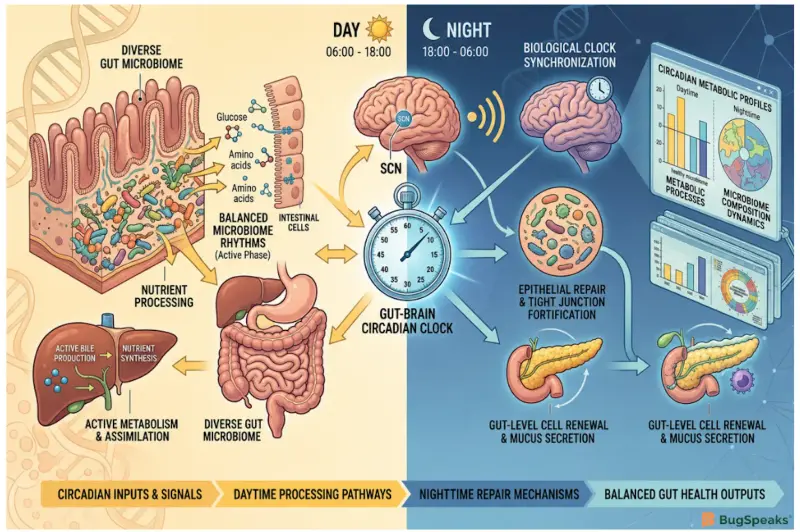
The body follows a built-in timing system that tells different organs when to work and when to rest. Every cell operates on a Circadian Rhythm, a twenty-four-hour biological cycle that synchronizes sleep, digestion, hormone release, and metabolism with the Earth's light-dark cycle. This timing system is controlled by the Suprachiasmatic Nucleus (SCN), a region in the brain that detects environmental light and coordinates daily biological activityde Oliveira Melo et al. (2024).
To communicate with organs like the liver and gut, the body uses clock genes such as Brain and Muscle Aryl Hydrocarbon Receptor Nuclear Translocator-Like Protein 1 (BMAL1) and Circadian Locomotor Output Cycles Kaput (CLOCK). These genes switch cellular functions on and off according to the time of dayZhang et al. (2025). The body also releases Melatonin in the evening to support repair and sleep, while Cortisol rises in the morning to increase alertness and energy availability (Tognini et al., 2018).
This timing coordination ensures that digestion happens when the body is metabolically prepared for it. During the day, digestive enzymes, nutrient transport systems, and insulin signaling work efficiently. At night, the body shifts toward repair, immune maintenance, and cellular recovery.
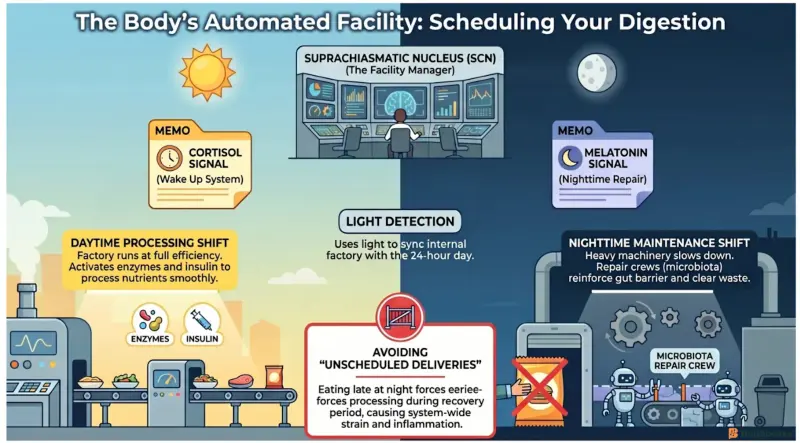
In our simulation, the digestive system functions like an automated processing plant. The Suprachiasmatic Nucleus (SCN) acts as the facility manager, scheduling operating hours based on light exposure. Melatonin and Cortisol function as shift-management signals that tell the plant when to activate or power down. During the daytime shift, machinery runs at full efficiency, conveyor systems move smoothly, and nutrients are processed with minimal strain.
At night, the facility transitions into maintenance mode. Heavy machinery slows down, repair crews begin infrastructure work, and energy is redirected toward recovery. When this biological schedule is respected, the plant operates efficiently. When eating patterns ignore these timing signals, the entire system becomes unstableMaqsood et al. (2026).
Why Do Late-Night Meals Cause Digestive and Metabolic Problems?
Eating late forces the body to process food during its biological recovery period. While the brain's master clock mainly responds to light, the digestive system is strongly influenced by the Food-Entrainable Oscillator (FEO), a secondary timing system that prepares the gut for expected meal timesde Oliveira Melo et al. (2024).
When meals occur consistently during daytime hours, digestion runs efficiently. Enzymes break down food properly, insulin sensitivity remains stable, and nutrients are converted into usable energy. However, eating late at night creates Chrono-disruption, a mismatch between the body's internal clocks and actual behavior.
At night, metabolism naturally slows down. Fat and carbohydrate processing becomes less efficient, and insulin sensitivity decreasesBishehsari et al. (2020). Because of this, nutrients are more likely to remain in circulation or be stored as fat instead of being used immediately for energy. Over time, this contributes to elevated blood sugar, weight gain, and long-term Metabolic InefficiencyMaqsood et al. (2026).
In the automated processing plant, late-night meals resemble unscheduled overnight deliveries arriving after the facility has already powered down. Conveyor systems are running slowly, most workers have left, and only maintenance teams remain active. The plant struggles to process the unexpected shipment using limited nighttime resources.
As these disruptions continue, unprocessed materials begin accumulating across the factory floor. The machinery experiences strain, recovery work is interrupted, and maintenance schedules fall behind. Biologically, this translates into inflammation, metabolic stress, and reduced digestive efficiencyde Oliveira Melo et al. (2024).
How Does Irregular Eating Affect Our Gut Microbiota?
Irregular eating disrupts the daily rhythm of the Gut Microbiota, the trillions of microorganisms that live inside the digestive tract. These microbial populations follow their own timed activity cycles, becoming more or less active depending on meal timing and the time of dayZhang et al. (2025).
Under healthy eating schedules, beneficial bacteria help digest dietary fiber and produce Short-Chain Fatty Acids (SCFAs). These molecules strengthen the intestinal lining, reduce inflammation, and provide energy to intestinal cellsBishehsari et al. (2020). Two major bacterial groups, Firmicutes and Bacteroidetes, normally remain balanced during stable feeding patterns.
Late-night eating and irregular schedules disturb this balance. Beneficial microbial activity decreases while inflammatory species become more dominant, leading to dysbiosis (Sun et al. (2023). As protective microbial functions decline, the intestinal barrier becomes weaker and more vulnerable to inflammation.
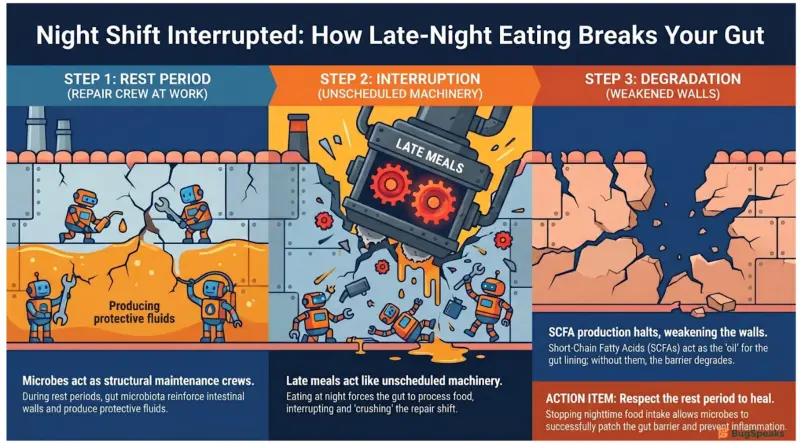
In the automated processing plant, the Gut Microbiota function as maintenance crews that repair the facility during the night shift. Once daytime processing ends, these crews reinforce structural barriers, clear waste, and produce the lubricating fluids represented by Short-Chain Fatty Acids (SCFAs).
When late-night eating repeatedly interrupts the night shift, the crews cannot complete their repair work. Conveyor systems wear down, facility walls weaken, and maintenance quality declines. Over time, the plant becomes less stable and more vulnerable to system-wide damagede Oliveira Melo et al. (2024).
What Happens to the Immune System When Digestion is Disrupted at Night?
When the intestinal barrier weakens, harmful bacterial compounds can leak into the bloodstream and activate the immune system. One important example is Lipopolysaccharides (LPS), toxic molecules found on the outer membrane of certain bacteriaSun et al. (2023).
Once these molecules enter circulation, immune sensors called Toll-Like Receptor 4 (TLR4) detect them and activate inflammatory pathways. This triggers Nuclear Factor Kappa-B (NF-κB), a major inflammatory regulator that stimulates the release of Pro-inflammatory CytokinesBishehsari et al. (2020).
Short-term inflammation is part of normal immune defense. However, when late-night eating and microbial disruption occur repeatedly, the immune system remains in a constant low-grade inflammatory state. Over time, this contributes to insulin resistance, metabolic syndrome, and chronic disease development.
In the automated processing plant, Lipopolysaccharides (LPS) represent hazardous waste leaking from damaged containment walls. The weakened barriers allow toxins to spread into sensitive areas of the facility. Toll-Like Receptor 4 (TLR4) acts like the plant's emergency detection system, identifying the leak and activating alarms throughout the building.
These alarms activate Nuclear Factor Kappa-B (NF-κB), triggering emergency response teams that attempt to contain the damage. But if the plant experiences nightly disruptions, the emergency system never fully shuts down. Instead of focusing on repair and efficient operation, the facility remains trapped in constant crisis managementSun et al. (2023).
How Does Time-Restricted Eating Repair the Gut Environment?
Time-Restricted Eating (TRE) restores alignment between eating behavior and the body's biological clocks. Instead of focusing only on calories, this approach limits food intake to a consistent daytime window, usually lasting eight to twelve hoursMaqsood et al. (2026).
When meals occur during biologically appropriate hours, digestion becomes more efficient and metabolic stress decreases. Insulin sensitivity improves, lipid metabolism stabilizes, and the body regains Metabolic Flexibility, the ability to switch smoothly between carbohydrates and fats for energy.
At the same time, Time-Restricted Eating (TRE) restores the Diurnal Rhythmic Oscillations of the Gut Microbiota. Beneficial bacteria recover their normal activity cycles, and production of Short-Chain Fatty Acids (SCFAs) increasesZhang et al. (2025). This strengthens the intestinal barrier and reduces inflammatory signaling.
In the automated processing plant, Time-Restricted Eating (TRE) creates a predictable operating schedule. Deliveries arrive only during active daytime hours, allowing machinery to function efficiently without overwhelming the system. At night, the facility fully powers down so maintenance crews can repair infrastructure without interruption.
With consistent schedules, the plant becomes more stable and resilient. The containment walls remain strong, emergency alarms activate less frequently, and recovery systems function properly. Biologically, this creates a healthier intestinal environment with lower inflammation and improved metabolic balanceMaqsood et al. (2026).
The science increasingly shows that meal timing matters. By respecting the operational schedule of the body's internal processing plant and the biological rhythms of the Gut Microbiota, the digestive system can maintain long-term stability and health.
Visualize the process- https://youtu.be/ugBdfKKbUiE
Reference
Zhang, M., Zhou, C., Li, X., Li, H., Han, Q., Chen, Z., Tang, W., & Yin, J. (2025). Interactions between Gut Microbiota, Host Circadian Rhythms, and Metabolic Diseases. Advances in nutrition (Bethesda, Md.), 16(6), 100416. https://doi.org/10.1016/j.advnut.2025.100416
Maqsood, S., Amjad, S., Ahmed, F., & Ahmad, M. F. (2026). Time-restricted eating and circadian rhythms: A new frontier in diabetes and obesity management. Primary care diabetes, 20(1), 1–12. https://doi.org/10.1016/j.pcd.2025.11.004
Bishehsari, F., Voigt, R. M., & Keshavarzian, A. (2020). Circadian rhythms and the gut microbiota: from the metabolic syndrome to cancer. Nature reviews. Endocrinology, 16(12), 731–739. https://doi.org/10.1038/s41574-020-00427-4
Sun, J., Fang, D., Wang, Z., & Liu, Y. (2023). Sleep Deprivation and Gut Microbiota Dysbiosis: Current Understandings and Implications. International Journal of Molecular Sciences, 24(11), 9603. https://doi.org/10.3390/ijms24119603
Tognini, P., Murakami, M., & Sassone-Corsi, P. (2018). Interplay between Microbes and the Circadian Clock. Cold Spring Harbor perspectives in biology, 10(9), a028365. https://doi.org/10.1101/cshperspect.a028365
de Oliveira Melo, N. C., Cuevas-Sierra, A., Souto, V. F., & Martínez, J. A. (2024). Biological Rhythms, Chrono-Nutrition, and Gut Microbiota: Epigenomics Insights for Precision Nutrition and Metabolic Health. Biomolecules, 14(5), 559. https://doi.org/10.3390/biom14050559