Your gut functions exactly like a Great Library because trillions of microscopic workers constantly organize the vast biological information of your daily health. Imagine an enormous and bustling building located right inside your stomach. This beautiful building holds all the essential knowledge needed to keep you highly energetic and completely free from illness. The Librarians are the tiny microscopic bacteria living continuously inside this dark space. Approximately one hundred trillion microbes manage this massive internal building every single day. These tiny workers encode one hundred and fifty times more genetic material than your own human genome. They work tirelessly around the clock to digest your food and keep your body running perfectly. When you consume healthy traditional foods like Chickpeas or Curd they immediately begin breaking down the complex parts. They transform these raw foods into special energy packages for your entire human body. The Librarians constantly communicate with your brain and direct your immune system to fight off bad germs. An organized library produces vibrant health while a disorganized library leads directly to total biological chaos.
Daily signs that your Librarians are doing a great job:
You feel highly energetic after drinking your morning Buttermilk.
Your digestion is perfectly smooth without any loud noises or pain.
You rarely get sick because the security team is incredibly strong.
Your mind feels clear and focused throughout the entire day.
You sleep soundly because the building is perfectly organized.
What is the High-Speed Intercom connecting the Library to City Hall?
The High-Speed Intercom is the vagus nerve that acts as a massive bi-directional fiber optic cable connecting your gut directly to your brain. The Great Library is not an island because it is connected to City Hall in your brain via this massive biological cable. Think of this as the master intercom for the library. Interestingly eighty to ninety percent of the traffic on this line is actually The Librarians reporting up to The Mayor. They send vital status updates using chemical signals like serotonin of which nearly ninety five percent is produced right inside the library stacks. When the line is clear The Mayor feels calm and The Librarians work efficiently. However when The Noisy Guest leans on the panic button the intercom is flooded with high decibel static. This metabolic noise distracts the crew causing them to drop their Book Carts and neglect wall repairs. Maintaining intercom hygiene through relaxation ensures The Mayor stays informed and The Librarians stay focused on their mission.
Steps to maintain perfect Intercom Hygiene:
Practice daily deep breathing to keep the vagus nerve perfectly calm and clear.
Eat traditional foods like Curd to provide excellent materials for serotonin production.
Avoid checking stressful messages right before eating your meals.
Take short walks after lunch to keep the biological communication lines completely open.
Ensure you lock the doors at Closing Time to let the entire intercom system reset.
Why is 'Closing Time' (Sleep) the most important rule for my Librarians?
Closing Time allows your microscopic workers to properly repair the library walls and produce vital health protecting chemicals without daytime interruptions. Every hardworking team needs a long break to clean up the mess from the day. Sleep acts as this mandatory break for your human body. Without proper sleep The Librarians become utterly exhausted and completely confused. A fascinating human clinical trial detailed inLeone et al. 2026: Sleep Restriction in Humans proves this exact point beautifully. Researchers tested nine healthy human adults inside a strictly controlled scientific laboratory. The scientists first measured the participants during a normal Closing Time of eight and a half hours of sleep. The scientists later restricted their Closing Time to only four and a half hours of sleep. The researchers kept all human meals and calories perfectly identical across both testing phases. Blood was drawn from the human participants every two hours over full twenty four hour periods.
The laboratory results were incredibly clear and somewhat scary. The Librarians produce helpful chemicals called microbial metabolites which travel through your blood. Short term sleep restriction completely destroyed the daily rhythms of these vital chemicals. Butyric acid normally protects the library walls and heavily reduces systemic inflammation in your body. This highly protective chemical entirely lost its natural twenty four hour rhythm when sleep was restricted. Indole-3-propionic acid is a powerful antioxidant created by The Librarians that also completely lost its protective daily rhythm. A dangerous chemical called kynurenine simultaneously gained an abnormal new rhythm. Kynurenine is strongly linked to human inflammation and severe neurological problems. The Librarians absolutely need a full Closing Time to turn Chickpeas into medicine instead of poison.
Human sleep habits for a healthy library:
Maintain a strict schedule of eight and a half hours in bed nightly.
Keep your bedtime completely consistent to help The Librarians predict Closing Time.
Eat your meals at identical times every single day to support digestion.
Avoid erratic shift work because irregular sleep hours confuse your internal workers.
Use dim lighting before sleep to naturally prepare your body for deep rest.

How does 'The Noisy Guest' (Stress) ruin the Library?
The Noisy Guest triggers emergency biological alarms that destroy the structural walls of the library and chase away your most helpful workers. Psychosocial stress acts exactly like a violent intruder screaming inside your peaceful body. We call this destructive intruder The Noisy Guest. Research outlined inMarwaha et al. 2025: Psychosocial Stress and the Human Gut explains exactly how this biological destruction occurs. Your brain senses a threat and immediately activates your sympathetic nervous system. This emergency alarm forces your adrenal glands to release heavy stress hormones like cortisol and catecholamines. These dangerous hormones violently flood your human bloodstream and run straight toward The Great Library.
The Noisy Guest screams through the halls and immediately slows down your physical digestion. Slower human digestion fundamentally changes the beautiful diversity of The Librarians. Highly friendly workers belonging to the Bacteroides family drop heavily in numbers. Friendly Lactobacillus and Bifidobacterium populations also decrease severely under chronic stress. The Noisy Guest then physically attacks the actual architecture of The Great Library. Sustained stress hormones break apart the microscopic tight junctions holding your human intestinal cells together. This catastrophic structural failure creates dangerous physical gaps in the library walls. Scientists call this dangerous condition increased intestinal permeability. Harmful bacteria easily escape the library and enter your human bloodstream. Your immune system panics and launches a massive defensive attack called dysbiosis. Dysbiosis floods your body with aggressive inflammatory chemicals like interleukin six and tumor necrosis factor alpha.
Ways The Noisy Guest attacks your body:
Floods your blood with dangerous cortisol and catecholamines.
Slows down your natural digestion and causes stomach discomfort.
Breaks apart the tight junctions that keep your gut perfectly sealed.
Allows toxic waste to leak directly into your sensitive bloodstream.
Triggers heavy systemic inflammation that makes you feel terrible.
Can a 'Book Cart' (Exercise) improve the Library's performance?
Pushing The Book Cart actively grows your strongest microbial workers and completely reshapes the internal crew for much better performance. Physical movement is not just for building big human muscles. Movement acts as a highly powerful biological signal that tells your microbes to upgrade their operation. A massive human clinical study published inStraub et al. 2026: Resistance Training in Humans investigated this exact physiological process. The scientists recruited one hundred and fifty sedentary but healthy human adults. These adult participants completed an intense eight week supervised resistance training program. The researchers carefully tracked their physical strength gains using advanced digital machines. They also tested their gut microbes regularly using complex genetic sequencing tools.
Pushing The Book Cart created profound physical shifts inside the human gut. Participants who gained the most physical strength experienced massive upgrades in their microbial crew. The strongest humans successfully grew massive populations of Faecalibacterium. They also cultivated incredibly high numbers of Roseburia hominis. These specific microbes are considered the absolute elite Librarians. They are famous for producing powerful anti-inflammatory chemicals that expertly repair broken walls. Many helpful microbes from the Lachnospiraceae family also increased dramatically by week eight. The best part of this scientific discovery is that these incredible library upgrades happened completely independently of any human dietary changes. The adult participants did not eat more Chickpeas or Curd than usual. The simple act of intense physical resistance training forced The Librarians to become much stronger. Movement actively circulates high quality fuel from Chickpeas and Buttermilk directly to these elite workers ensuring everyone gets fed.
Benefits of pushing The Book Cart regularly:
Builds serious physical strength in your human muscles and bones.
Upgrades your gut microbiome without changing your normal daily diet.
Increases the exact bacteria that fight off dangerous body inflammation.
Helps circulate the fuel from Chickpeas directly to your lower intestine.
Forces your internal workers to become highly efficient at harvesting energy.
What is the 'Library Clock' (Circadian Rhythm) and why does it matter?
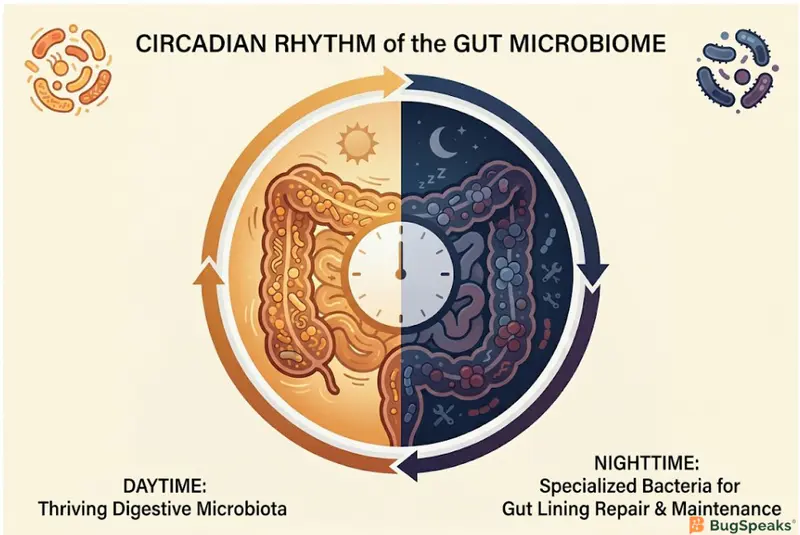
The Library Clock is a strict biological master schedule that synchronizes every single task your microbes perform with the rotation of the Earth. Every massive organization requires a perfect schedule to avoid total disaster. The Library Clock acts as this master schedule for your human metabolism and your immune system. Research detailed inZhao et al. 2026: Human Microbiota Circadian Rhythms explains this beautiful daily dialogue. Your gut microbes synchronize their daily activities directly with the natural twenty four hour cycle of light and darkness. Human studies absolutely prove that approximately ten percent of bacterial groups follow this exact daily schedule. These specific Librarians show characteristic biological peaks and troughs in their physical activity. They actively change their physical location and their chemical production based entirely on the specific time of day.
The Librarians know exactly when to expect your morning Curd and when to rest. They align their metabolic tasks flawlessly with your natural human sleep and wake cycles. Modern human lifestyles frequently destroy this extremely delicate clock. Erratic eating patterns severely break The Library Clock and confuse your workers. Shift work completely ruins the schedule and causes absolute chaos inside the building. A clinical study of human shift workers revealed a severe biological drop in healthy Bacteroidetes bacteria. These human night workers also showed a dangerous abnormal increase in Dorea species. When The Library Clock breaks the human immune system makes terrible biological mistakes. The total loss of these natural microbial rhythms leads directly to chronic inflammation and severe metabolic problems.
Library Rules to protect the ecosystem:
Never eat heavy meals late at night when the workers are sleeping.
Get plenty of natural sunlight in the morning to set the clock.
Go to bed at the exact same time every single night.
Eat traditional foods like Curd at regular predictable hours.
Keep The Noisy Guest out by practicing daily relaxation techniques.
Visualize the process- https://youtu.be/QzztRxdhlds
Reference
Leone, V. A., Frazier, K., Kaur, M., Chrisler, E. A., Sidebottom, A. M., Tai, E., Tran, V., Li, S., Chang, E. B., Jones, D. P., Van Cauter, E., & Hanlon, E. C. (2026). Short-term sleep restriction in humans alters diurnal circulating metabolite profiles, including those of microbial origin. The Journal of clinical investigation, 136(6), e189363. https://doi.org/10.1172/JCI189363
KomalMarwaha, RyanCain, KatherineAsmis, KatyaCzaplinski, NathanHolland, Darly C. GhislaineMayer, and JessicaChacon
Journal of Applied Physiology 2025 138:2, 518-535
Straub, D., Englert, T., Beller, A., Stadelmaier, J., Stahl, M., Kilian, J., Borzym, J., Rotermund, C., Akbuğa-Schön, T., Krakau, S., Czemmel, S., Weiler, S., Pettenkofer, M., Pettenkofer, J., Maser, U., Dammeier, S., Nieß, A. M., Enderle, M. D., & Nahnsen, S. (2026). Resistance Training Reshapes the Gut Microbiome in a Longitudinal 8-Week Intervention in Sedentary Adults. Sports medicine - open, 12(1), 21. https://doi.org/10.1186/s40798-026-00990-6
Zhao, Z., Wu, S., Wang, T., & Zhao, Y. (2026). Gut microbiota circadian rhythms: a key regulator of immunometabolic homeostasis. Acta biochimica et biophysica Sinica, 58(1), 106–119. https://doi.org/10.3724/abbs.2025220