The Ultimate Guide to Gut Health for Travelers
Why does the 'Orchestra' lose its rhythm during an international tour?
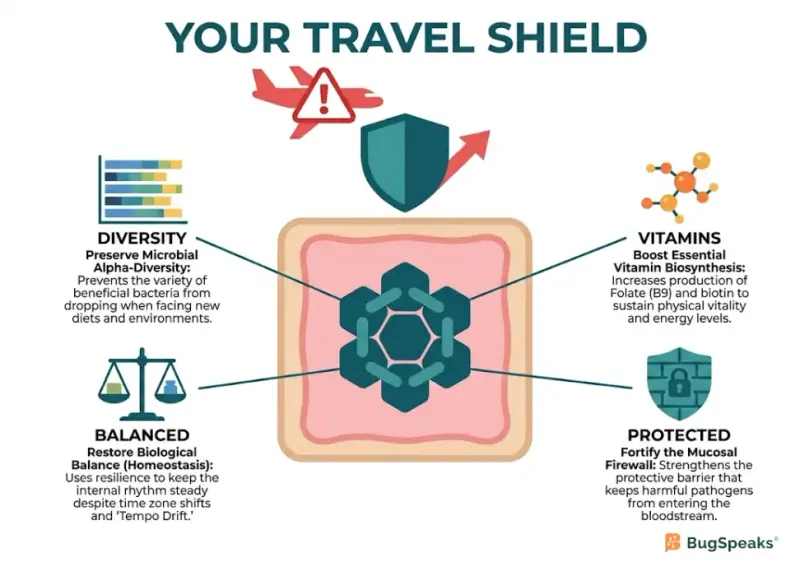
The orchestra loses its rhythm during an international tour because the sudden stress of traveling including changes in diet and water sources causes the microbial musicians in your intestines to fall out of tune Henares et al. (2024). In simple terms, your internal concert hall is a sensitive environment that thrives on a steady routine, and international travel acts as a loud, unannounced interruption to that peace. This environmental pressure often leads to a state of Transient Dysbiosis, where the microbial ensemble stops playing in harmony and begins to produce "biological noise" instead of music. Ultimately, these geographical shifts test the resilience of your internal symphony, making it difficult to maintain the steady rhythm that keeps your digestion and energy levels stable.
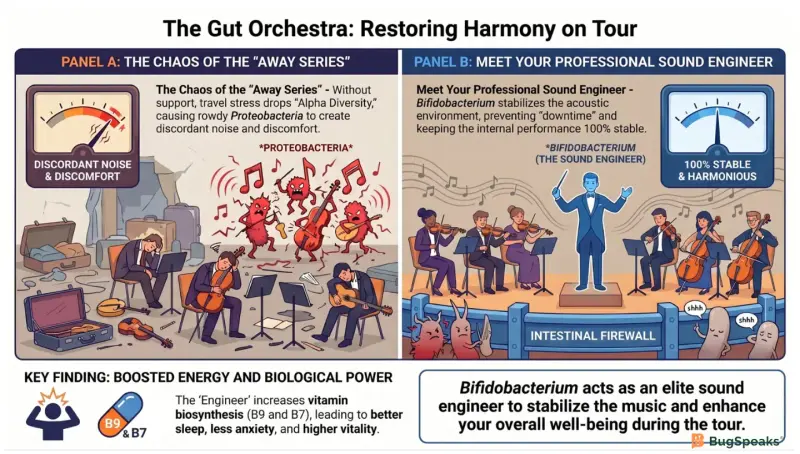
The orchestra loses its rhythm due to chaotic fluctuations in the variety of performers, a stability metric that scientists refer to as Alpha-diversity. In a perfectly tuned concert hall, a wide richness and evenness of bacterial species play together to create a full, rich sound. However, international travel can cause this Alpha-diversity to drop significantly or shift erratically as the system struggles to adapt to new "musical inputs" Henares et al. (2024). Some travelers exhibit a very low richness pattern, meaning entire sections of the orchestra simply stop playing, leaving the acoustic profile thin and unbalanced. When the variety of musicians plummets, the remaining performers struggle to cover all the necessary metabolic notes, leading to visible performance failures like bloating or discomfort. This is often accompanied by a surge in Proteobacteria, the rowdy musicians who thrive on the chaos of travel.

How do 'Noise Interference' scripts enter the performance?
'Noise interference' scripts enter the performance when travelers visit regions with different microbial environments, exposing their intestines to "bad musical codes" known as Antimicrobial Resistance Genes (ARGs) Swiss Expatriate Study (2023). These disruptive scripts act like corrupted sheet music that instructs the microbial musicians on how to ignore and survive medicines that are supposed to keep the system clean. When individuals perform an "away series" in high-risk areas, they interact with local environments that contain these resistant microbes. This exposure allows the intestinal concert hall to passively acquire these dangerous codes, fundamentally altering the Resistome of the gut. Even a perfectly healthy traveler can return home carrying hidden, unwanted noise interference in their biological ensemble.
'Noise interference' scripts enter the performance because regional pressures in the destination country force the musicians to adapt by sharing specific resistance traits. For example, researchers using advanced metagenomic tools have observed that travelers returning from specific regions carry a higher prevalence of tet genes, which allow the orchestra to ignore certain medicines. These specific ARGs are picked up by the visiting orchestra as a survival mechanism, permanently altering how the musicians respond to future chemical signals Swiss Expatriate Study (2023). It is this deep, regional exposure to localized pressures that dictates which type of "bad musical code" is added to the traveler's repertoire, making it harder for the host to maintain a clean and responsive concert hall in the future.
What are the 'Mobile Equipment Vans' that spread bad audio code?
The 'mobile equipment vans' that spread bad audio code are highly transferable genetic vehicles known as Plasmids, which allow corrupted music to be shared quickly between different musicians Swiss Expatriate Study (2023). These microscopic delivery trucks are a major category of Mobile Genetic Elements (MGEs) and exist separately from the main bacterial genetic material. Because Plasmids can drive freely between different species of bacteria in the intestines, they serve as the primary logistical network for spreading dangerous ARGs throughout the concert hall. The mobility of these MGEs makes the spread of resistance a profound global threat, as they can quickly upgrade a background musician into a multidrug-resistant "rogue."
The 'mobile equipment vans' include specific high-performance vehicles that traffic resistance scripts exclusively among the Gram-negative Bacteria sections of the orchestra. Through high-speed metagenomic sequencing, researchers have observed these Plasmids carrying multiple severe resistance genes at once. When one of these vehicles arrives, it essentially unloads an entire library of bad audio code, instantly transforming a standard, peaceful musician into a highly resistant performer. This logistical network is extremely efficient; even if you only pick up a few "rogue" microbes during your tour, the Plasmids can distribute the bad sheet music to your entire resident orchestra, potentially changing the acoustic profile of your gut for months after you return home Swiss Expatriate Study (2023).
Can 'Professional Sound Engineers' prevent a performance failure?
'Professional sound engineers' can prevent a performance failure by stepping in early to stabilize the acoustic environment of the gut before travel stress causes true chaos Wang et al. (2026). These biological sound engineers, such as Bifidobacterium, are living microbes that act as a buffer against the acute stressors associated with international travel. By adjusting your internal biological equalizers, these engineers preserve the overall Alpha-diversity of the intestines, preventing the sudden drops in richness that accompany dietary and water source disruptions. In controlled trials, travelers utilizing these engineers avoided the Transient Dysbiosis that plagued those who traveled without professional support.
'Professional sound engineers' also systematically upregulate the concert hall’s internal energy by boosting the natural microbial Biosynthesis of essential vitamins. Under the guidance of Bifidobacterium, the orchestra increases its production of crucial assets like Folate (Vitamin B9) and Biotin (Vitamin B7), which are essential for cellular energy and mucosal repair. This enhanced vitamin supply acts as a high-quality power source, keeping the musicians energized and the stage maintained even during long flights or strange meal times Wang et al. (2026). By guaranteeing a steady stream of these nutrients, the sound engineers sustain the physical vitality and well-being required for a flawless performance, ensuring that the host returns from their world tour feeling energized rather than exhausted.
Does the 'Concert Hall' maintain its core structure despite a chaotic tour?
The 'concert hall' maintains its core structure despite a chaotic tour because the most deeply established musical sections demonstrate remarkable Resilience Swiss Expatriate Study (2023). Extensive surveys of travelers returning from long-term stays abroad have shown that the overarching foundation of the gut remains surprisingly stable. Detailed statistical analyses using Beta-diversity metrics confirm that the core community structure does not significantly change for most travelers. This stability suggests that while a few "rogue" musicians might sneak onto the stage during your trip, they rarely succeed in permanently evicting the loyal, long-standing members of the ensemble.
The 'concert hall' maintains its core structure thanks to the presence of foundational bacterial groups that provide a harmonious baseline for the entire system. These essential musical sections serve as the resonant rhythm section of the gut, producing the anti-inflammatory Short-Chain Fatty Acids (SCFAs) needed to keep the environment calm. The steadfast loyalty and biological mass of these sections guarantee that life-sustaining melodies continue to play regardless of your location. This confirmed Resilience is your body's "home-field advantage," ensuring that once the travel stress is over, your original orchestra can quickly find its rhythm again and return the system to its factory-default HomeostasisSwiss Expatriate Study (2023).
How does 'Tempo Drift' disrupt the internal conductor?
International tours often suffer from "Tempo Drift" commonly known as jet lag which causes the internal conductor to lose the beat and leads to Circadian Desynchrony Wang et al. (2026). Your gut orchestra follows a strict 24-hour metronome governed by "peripheral clocks" within the microbial musicians themselves. When you cross time zones, your internal conductor (your central clock) and your microbial musicians are no longer playing in the same time signature. This tempo mismatch causes the musicians to play their "Daylight Energy" score during your "Nightly Repair" cycle.
When the orchestra performs the wrong setlist for the current time zone, the result is metabolic friction, sleep disruption, and systemic fatigue. This Circadian Desynchrony thins the physical stage of the intestines, making it harder for the musicians to stay on their marks. Maintaining a consistent "Show Time" for meals aligning your nutrient intake with the new local clock is the only way to help the conductor and the orchestra find a unified rhythm in a new city. By supporting your musicians with the right fuel at the right local time, you minimize the "Signal Noise" of jet lag and ensure your system continues to produce high-quality energy Wang et al. (2026).
Why is 'Soundproof Insulation' essential for intestinal integrity?
The success of an away series depends on the quality of your acoustic insulation the Mucosal Firewall, which ensures the "rowdy" music stays inside the hall and off the streets Wang et al. (2026). This insulation consists of a thick mucus layer and a specialized security detail that shields the intestinal stage. Travel stress, recycled cabin air, and dehydration act as "Biological Dehumidifiers" that thin this insulation, causing the hall to become porous and vulnerable to leaks.
When this Mucosal Firewall fails, the rowdy musicians (pathogens) can escape the concert hall and enter your bloodstream. This triggers systemic inflammation and "Noise Complaints" from distant organs, manifesting as fatigue or skin issues. Strengthening the insulation with proper hydration and fiber intake ensures the musicians remain off the streets, preserving the structural integrity of the venue regardless of the tour's intensity. This physical protection is what allows your orchestra to perform at 100% capacity without causing collateral damage to the rest of your body's infrastructure Wang et al. (2026).
What are the 'Metabolic Encores' that provide long-term stability?
A flawless performance is defined by its "Acoustic Echo" , the beneficial Postbiotics that linger in the intestines after the musicians have finished their set Swiss Expatriate Study (2023). While probiotics are the live performers, Postbiotics are the "Completed Recordings" stable chemicals that continue to provide therapeutic value long after the bacteria have finished their work. These echoes act as long-term systemic stabilizers, ensuring that the benefits of a healthy gut workforce are felt even between meals or during periods of stress.
Professional sound engineers prioritize these encores because they provide a metabolic buffer, ensuring that even if the live musicians take a brief break due to travel fatigue, the anti-inflammatory melodies continue to play. By utilizing these Postbiotics, your system maintains its Resilience and continues to block the "Signal Static" of inflammation. Ensuring your diet is rich in the raw materials needed for these encores is the best way to guarantee a successful tour with 100% system uptime and high Well-being Swiss Expatriate Study (2023).
-Varsha V
Visualize the process- https://youtu.be/4JI9X6AXkaU
Reference
Wang, L., Yu, Y., Shen, X., Li, X., Wang, D., Zhai, Y., Jiang, W., Zhao, W., Yu, Q., Liong, M. T., Chen, D., & Zhao, A. (2026). Bifidobacteriumsupplementation maintains gut microbiota stability and enhances well-being during short-term travel. Frontiers in nutrition, 13, 1724829. https://doi.org/10.3389/fnut.2026.1724829
Henares, D., Monsalvez, V., Brotons, P., Machado, M. L., Capilla, S., Gomila-Grange, A., Bierge, P., Cubero, M., Q Pich, O., Requena-Méndez, A., Muñoz-Almagro, C., & Gasch, O. (2024). Human gut microbiota composition associated with international travels. Travel medicine and infectious disease, 61, 102747. https://doi.org/10.1016/j.tmaid.2024.102747