Introduction
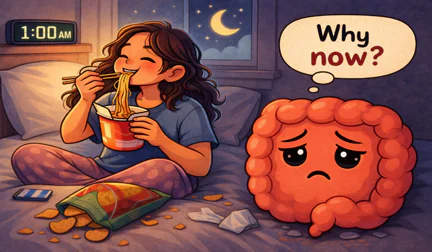
It’s late at night. You’re lying in bed, scrolling through your phone, and suddenly you feel it-that urge to eat something. Not just anything, but something specific. Maybe it’s chips, chocolate, or instant noodles. You’re not exactly hungry, but the craving feels real and hard to ignore.
We often blame this on habit or lack of self-control, but what if there’s more to it? What if your body, and more specifically your gut microbes, are influencing these midnight cravings? The truth is, these late-night cravings are not random, they are biologically driven. They are shaped by a complex interaction between your gut bacteria, your brain, and your internal biological clock.
Your Gut Is Constantly Talking to Your Brain
Inside your digestive system lives a vast ecosystem of microorganisms known as the gut microbiome. These microbes don’t just help digest food, they communicate with your brain through the gut-brain axis. This connection involves nerves, hormones, and chemical signals that constantly send information between your gut and your brain.
Different types of bacteria thrive on different types of food. Some prefer sugar, others prefer fibre, and some depend on fats. When certain microbes become more dominant, they can influence your food preferences by sending signals that make you crave the foods they need to survive. This means that your cravings may not always come from your conscious mind, they may be driven by your gut.
Why Cravings Get Stronger at Midnight
Your body operates on a circadian rhythm, an internal clock that regulates sleep, metabolism, and hunger. During the day, your body is prepared for eating and digestion. At night, it shifts into a state of rest and repair.
However, when you stay awake late, especially while using screens or dealing with stress, this rhythm becomes disrupted. Hormones like ghrelin and leptin are affected. Ghrelin, which increases hunger, rises when you are sleep-deprived, while leptin, which signals fullness, decreases. This imbalance makes you feel hungry even when your body does not actually need food.
At the same time, your brain becomes more sensitive to reward signals at night, making unhealthy foods harder to resist. This is why midnight cravings are often specific and intense rather than general hunger.
What Midnight Eating Does to Your Gut
Eating at midnight interferes with the natural rhythm of your gut microbial community. Normally, nighttime is when your gut enters a fasting state. During this time, beneficial bacteria focus on repairing the gut lining and producing important compounds like short-chain fatty acids, which help regulate metabolism and reduce inflammation.
When you eat late at night, this process is interrupted. Instead of repairing itself, your gut has to switch back into digestion mode. Over time, this repeated disruption can lead to an imbalance in your microbiome, a condition known as dysbiosis.
Additionally, most midnight snacks are processed and high in sugar or fat. These foods promote the growth of less beneficial bacteria while reducing the diversity of good microbes. This shift not only affects digestion but also increases the likelihood of future cravings.
The Hidden Craving Cycle
Midnight cravings often become a cycle that feeds itself. It usually starts with poor sleep or stress, which increases hunger hormones and triggers cravings. You eat late at night, which disrupts your gut microbiome and sleep quality. The next day, your body feels tired, and your hunger signals become even stronger.
Over time, your microbiome adapts to this pattern. Bacteria that thrive on sugary or processed foods become more dominant and continue to signal for those same foods. What began as an occasional craving turns into a repeated habit driven by both your biology and your behaviour.
Is Midnight Eating Always Bad?
Not every late-night snack is harmful. If you are genuinely hungry and choose something light and nutritious, such as fruits, yogurt, or nuts, the impact on your gut may be minimal. The issue arises when midnight eating becomes a regular habit, especially when it involves processed foods.
Consistency matters more than occasional behaviour. Regular disruption of your eating and sleeping patterns can gradually affect your microbiome, metabolism, and overall health.
Breaking the Pattern
Breaking the cycle of midnight cravings does not require extreme changes, but it does require consistency. Maintaining a regular sleep schedule helps regulate hunger hormones. Eating balanced meals during the day, especially those rich in fibre, supports beneficial bacteria and keeps you full for longer.
Reducing screen time before bed and avoiding heavy meals late at night allows your body and your microbiome to follow their natural rhythm. Over time, as your gut health improves, your cravings will also begin to change.
Conclusion
Midnight cravings are not simply a matter of willpower. They are influenced by your gut microbiome, your hormones, and your circadian rhythm. What feels like a harmless late-night snack can gradually disrupt your gut balance and create a cycle of cravings and poor sleep.
Understanding this connection allows you to make more mindful choices. By aligning your habits with your body’s natural rhythm, you can support your gut health, improve your sleep, and reduce unnecessary cravings. Your cravings are not just habits — they are signals from within.
- Sahana S
Also Read: Live Your 5-to-9 Right: Protect Your Gut from Your 9-to-5
References
Zarrinpar, A., Chaix, A., Yooseph, S., & Panda, S. (2014). Diet and feeding pattern affect the diurnal dynamics of the gut microbiome. Cell Metabolism, 20(6), 1006–1017.
Leone, V., Gibbons, S. M., Martinez, K., Hutchison, A. L., Huang, E. Y., Cham, C. M., Pierre, J. F., Heneghan, A. F., Nadimpalli, A., Hubert, N., Zale, E., Wang, Y., Huang, Y., Theriault, B., Dinner, A. R., Musch, M. W., Kudsk, K. A., Prendergast, B. J., Gilbert, J. A., & Chang, E. B. (2015). Effects of diurnal variation of gut microbes and high-fat feeding on host circadian clock function and metabolism. Cell Host & Microbe, 17(5), 681–689.
Cryan, J. F., & Dinan, T. G. (2012). Mind-altering microorganisms: The impact of the gut microbiota on brain and behaviour. Nature Reviews Neuroscience, 13(10), 701–712.
Fetissov, S. O. (2017). Role of the gut microbiota in host appetite control: From bacterial growth to feeding behaviour. Nature Reviews Endocrinology, 13(1), 11–25.
Spiegel, K., Tasali, E., Penev, P., & Van Cauter, E. (2004). Sleep curtailment in healthy young men is associated with decreased leptin levels and increased ghrelin levels. Annals of Internal Medicine, 141(11), 846–850.
Reutrakul, S., & Van Cauter, E. (2018). Sleep influences on obesity, insulin resistance, and risk of type 2 diabetes. Metabolism, 84, 56–66.
Voigt, R. M., Forsyth, C. B., & Keshavarzian, A. (2016). Circadian rhythms: A regulator of gastrointestinal health and dysfunction. Expert Review of Gastroenterology & Hepatology, 10(3), 411–424.