Get Your Hands Dirty: The Connection Between Gardening and Gut Health
How does playing in garden soil change the invisible bugs on and inside us?
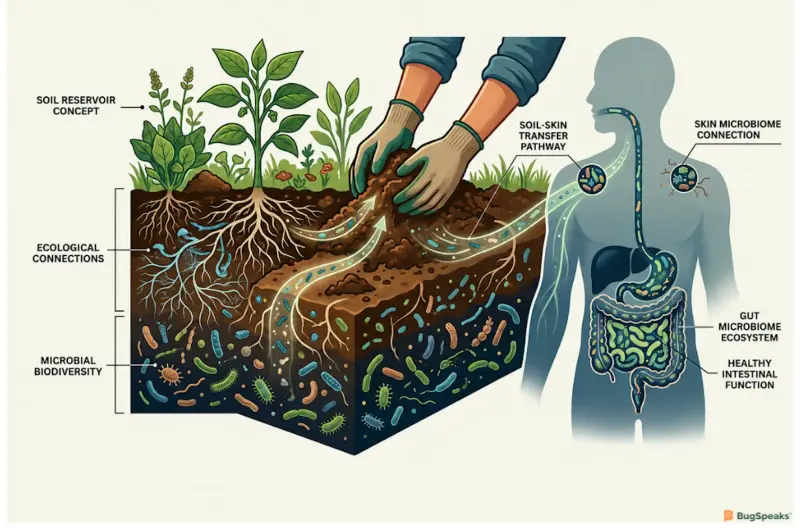
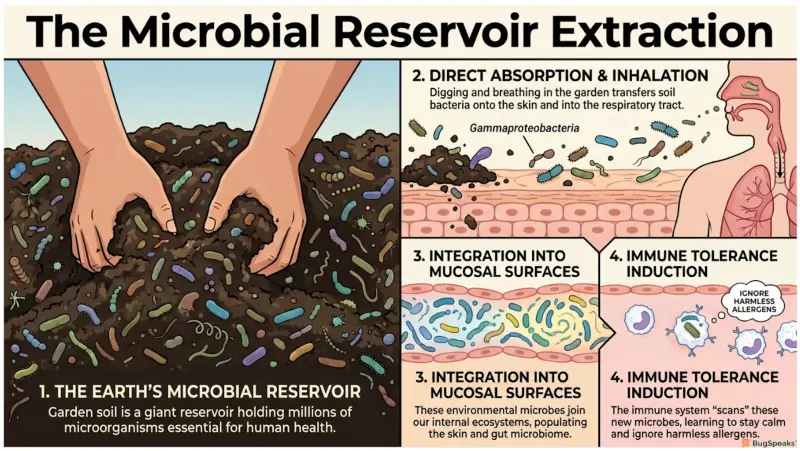
Direct contact with garden soil adds good, helpful microorganisms to our bodies, which increases the variety of microbes living on our skin and in our guts. You can think of the garden soil as a giant microbial reservoir, holding millions of tiny living things. When we act as participating ecosystem members by digging in the dirt, we pick up these tiny helpers. This fun biodiversity exposure activity transfers soil microbes straight onto our hands and eventually into our digestive system. Our skin and our guts act like connected receiving ecosystems, happily taking in these environmental microbial communities. These new microbes join our own personal microbiome, which is the collection of all the invisible bugs keeping us healthy [Vuong et al. (2025);Ma et al. (2025)].
The reason we need dirt is explained by the Biodiversity Hypothesis. This idea says that staying inside and avoiding nature's microbes makes our bodies forget how to stay healthy. In the past, scientists called this the Hygiene Hypothesis, meaning being too clean could make kids sick. Today, we know that skipping a biodiversity exposure activity starves us of the microbial reservoir. Studies show that when we garden, the variety of healthy bugs like Gammaproteobacteria on our skin goes way up. These environmental microbial communities act like tiny shields. They protect our connected receiving ecosystems from getting irritated or developing allergic reactions to everyday things [Vuong et al. (2025)].
Not all bugs just stay on our skin; many of them can happily live in both the soil and our tummies! Some types of bacteria are excellent travelers that move perfectly from the microbial reservoir into our bodies. When these environmental microbial communities enter our connected receiving ecosystems, they go straight to work. They help digest our food, make special vitamins, and block bad germs from making us sick. By acting as active participating ecosystem members in the garden, we make sure our bodies are not closed off from the world. We need this constant flow of microscopic life to keep our internal environments strong, diverse, and ready to protect us every single day [Ma et al. (2025)].
Why do soil microbes make our body's defense system so much stronger?
Microbes from the soil train our immune system to stay calm and ignore harmless things, which stops our bodies from accidentally attacking themselves. We can picture our immune system as a smart adaptive learning network. To work perfectly, this network needs lots of information to know what is dangerous and what is safe. The microbial reservoir in garden soil gives our bodies this exact training information. When participating ecosystem members dig in the garden, they breathe in and swallow environmental microbial communities. Instead of starting a fight, our adaptive learning network inside our connected receiving ecosystems scans these friendly microbes and learns to be peaceful. This helps our bodies tolerate normal things instead of overreacting [Szurek et al. (2026)].
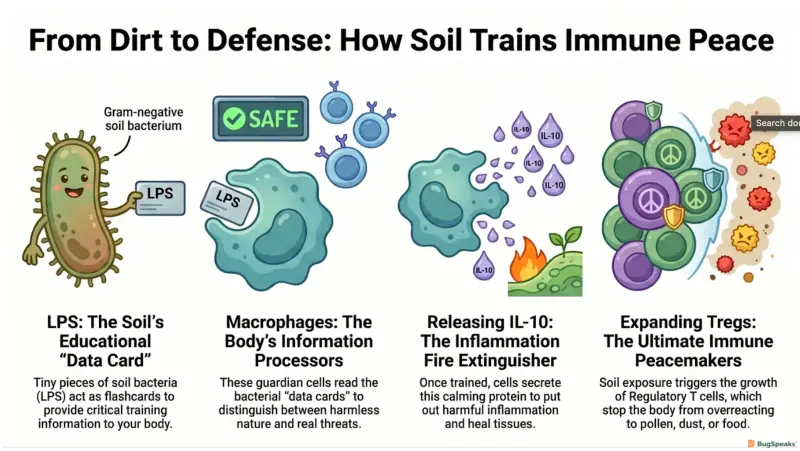
A big part of this immune training comes from Lipopolysaccharides (LPS), which are tiny pieces found on the outside of certain soil bacteria. When these pieces enter our connected receiving ecosystems, they meet special guardian cells called Macrophages. Instead of causing a fever or sickness, the environmental Lipopolysaccharides (LPS) act like flashcards for our adaptive learning network. The Macrophages read these flashcards and tell the body to create more Regulatory T cells (Tregs). These are the master peacemakers of our immune system. The environmental microbial communities help these Regulatory T cells (Tregs) multiply, which ensures our bodies do not freak out over harmless stuff like pollen, dust, or food [Szurek et al. (2026)].
Once they are activated, these Regulatory T cells (Tregs) and the smart Macrophages start making a special calming juice called Interleukin-10 (IL-10). This Interleukin-10 (IL-10) acts like a fire extinguisher inside our adaptive learning network, putting out harmful inflammation and helping heal any damaged tissues. Studies prove that when people do a biodiversity exposure activity like gardening, the calming juices in their blood go up. Without this regular training from the microbial reservoir, our immune system gets paranoid and attacks things it shouldn't. By spending time in the dirt, we give our connected receiving ecosystems the programming they need to stay relaxed, highly efficient, and healthy for a very long time [Szurek et al. (2026);Vuong et al. (2025)].
How do raw fruits and vegetables bring soil microbes into our bodies?
Raw fruits and vegetables act like biological delivery trucks, pulling healthy microbes out of the dirt and carrying them straight into our digestive system. In our garden, plants work like straws, sucking up specific microbes from the massive microbial reservoir. The plant’s roots invite environmental microbial communities inside their tissues, creating an inner world called the Endosphere. The plants also host microbes on their leaves and skin, which is called the Phyllosphere. When humans act as participating ecosystem members and eat a freshly picked, raw carrot or apple, they eat billions of these hidden microbes. This fun biodiversity exposure activity transports the microbes safely into our connected receiving ecosystems [Berg et al. (2025)].
The trip from the garden to our intestines is actually very dangerous for these tiny bugs. Our stomach is full of strong acid that acts like a security gate to destroy bad germs. However, many environmental microbial communities on plants are tough enough to survive. For example, Lactic Acid Bacteria (LAB) naturally live on fresh vegetables and have strong shields to protect them from stomach acid. Once they make it to the intestines, our main connected receiving ecosystem, they set up camp. There, they talk to our adaptive learning network and share new information from the microbial reservoir, which keeps our immune system strong, alert, and perfectly balanced [Berg et al. (2025)].
These tough plant microbes do much more than just train our immune system; they also help us digest our food. Humans cannot break down the tough fibers in vegetables by ourselves. Thankfully, the microbes from the microbial reservoir have special tools to chop up these plant fibers. As they digest the fibers inside our connected receiving ecosystems, they make Short-Chain Fatty Acids (SCFAs). These fatty acids are magic health molecules that give us energy and soothe our tummies. By eating raw plants from the garden, participating ecosystem members keep their bodies full of these amazing environmental microbial communities that factory-made foods just cannot provide [Berg et al. (2025);Ma et al. (2025)].
How does playing in the garden make our brains feel less stressed?
Gardening lowers our stress hormones and makes our brains feel calm because it combines light exercise with breathing in special plant smells and soil bacteria. When humans step outside as participating ecosystem members, moving around to dig or water plants acts as a gentle biodiversity exposure activity. This easy exercise helps our bodies lower cortisol, which is our main stress hormone, and releases happy chemicals in our brains. Because of this, our adaptive learning network doesn't get overwhelmed or frozen by worry. The physical connection with the microbial reservoir naturally resets our minds and keeps our nervous system running smoothly without getting too stressed out [Vuong et al. (2025)].
The invisible smells floating in the garden air also do an amazing job of calming us down. Plants release invisible chemicals called Volatile Organic Compounds (VOCs) into the air to protect themselves from bugs. When we breathe in these Volatile Organic Compounds (VOCs) from the microbial reservoir, they travel into our blood and relax our minds. Breathing in these plant smells actually increases the number of Natural Killer (NK) cells in our blood. These Natural Killer (NK) cells are super-fast defenders in our adaptive learning network that clear out sickness. The air in our garden acts like an invisible, stress-melting bath for our connected receiving ecosystems [Vuong et al. (2025)].
Touching the dirt itself also triggers a wonderful chemical reaction inside our heads. The microbial reservoir is packed with harmless bacteria that change how our brain works. When we breathe in or touch these environmental microbial communities during a biodiversity exposure activity, they send a signal to our brain to make more Serotonin. This is a powerful brain chemical that makes us feel happy, safe, and peaceful. Also, being in the sunshine helps our brains create Brain-Derived Neurotrophic Factor (BDNF), which is like miracle grow for our brain cells. By being participating ecosystem members, we naturally grow happier brains and stronger bodies just by playing in the dirt [Vuong et al. (2025)].
How does getting dirty help us live longer, healthier lives?
Regular contact with soil microbes helps us live longer by keeping our immune system calm, which prevents a slow, damaging type of full-body irritation as we get older. When humans age, their bodies naturally start to experience Inflammaging, which is a slow, quiet irritation that damages our cells over time. However, when we constantly act as participating ecosystem members, we give our connected receiving ecosystems fresh updates from the microbial reservoir. These environmental microbial communities constantly train our adaptive learning network to stay cool and quiet. This amazing biodiversity exposure activity puts the brakes on Inflammaging, keeping our tissues young, flexible, and free from the slow damage of getting older [Szurek et al. (2026)].
Getting dirty in the garden also protects our bodies from serious sugar and weight problems. The adaptive learning network inside people who regularly visit the microbial reservoir learns a neat trick called Oxidative Phosphorylation. This is a super-efficient way for cells to make energy without getting stressed out or causing irritation in our fat and liver cells. Also, the environmental microbial communities we pick up help grow special barrier-protecting bugs in our gut. These helpful bugs physically block the quiet inflammation that causes diseases like diabetes. By acting as participating ecosystem members, we easily keep our energy systems running perfectly and our connected receiving ecosystems super strong [Szurek et al. (2026)].
Finally, the dirt helps our bodies survive sudden, dangerous sicknesses like Sepsis. Sepsis happens when the immune system panics and fights an infection so hard that it damages our own organs. But our adaptive learning network is so well-trained by the microbial reservoir that it builds a massive shield of calming cells. When a sickness attacks, our connected receiving ecosystems use these calming cells to block the panic. To stop dangerous Pathobionts, which are normal bugs that suddenly turn bad, we must stay close to nature. This daily biodiversity exposure activity weaves a magical armor of health into our bodies, letting us live a long, happy, and super healthy life [Szurek et al. (2026);Ma et al. (2025)].
Reference
Ma, H., Cornadó, D., & Raaijmakers, J. M. (2025). The soil-plant-human gut microbiome axis into perspective. Nature communications, 16(1), 7748. https://doi.org/10.1038/s41467-025-62989-z
Szurek, E. A., Ngo, V. L., Abo, H., Cebula, A., Chassaing, B., Howard, R. A., … Kuczma, M. P. (2026). Soil-derived microbiota induces T regulatory cells and protect against mouse colitis, metabolic disease, and sepsis. Gut Microbes, 18(1). https://doi.org/10.1080/19490976.2026.2675089
Berg, G., Toledo, G. V., Schierstaedt, J., Hyöty, H., & Adi Wicaksono, W. (2025). Linking the edible plant microbiome and human gut microbiome. Gut microbes, 17(1), 2551113. https://doi.org/10.1080/19490976.2025.2551113
Vuong, Q. H., Sari, N. P. W. P., La, V. P., & Nguyen, M. H. (2025). Exploring the health benefits of home gardens: biological, psychological, and therapeutic perspectives. Discover Public Health, 22(1), 578.