The Complete Pet Effect Guide to a Stronger Microbiome
Is Your Home Actually a Living Research Outpost?
Your home functions as a living research outpost because the human body operates as a "holobiont," a unified ecological unit that constantly processes environmental information to maintain health.
In this scientific model, the gut acts as the central Outpost, a sophisticated research station where microbial partners analyze data from the outside world. Your dog serves as the Scout Vehicle, an explorer that ventures into the Wild to collect biological samples from parks, trails, and forests. When the Scout returns, it delivers a wealth of microbial data that prevents the human outpost from becoming isolated, stagnant, or oversensitive. This continuous influx of information is vital for the biological integrity of the home ecosystem.
The relationship between the Scout and the Outpost is built on a foundation of constant data exchange. Every time your dog enters the home after a walk, they bring back microscopic "files" attached to their paws, fur, and snout. These files contain information about the local flora, soil health, and even other animals. When a pet interacts with its owner through a lick, a nuzzle, or simply by sharing the same air it essentially uploads these new microbial files. These are then processed in the gut, which functions as a high-tech biological reactor.
This synchronized conversation between species ensures that the human immune system remains grounded in the realities of the local ecosystem. By preventing the Outpost from becoming a sterile "data vacuum," the Scout Vehicle ensures the Personnel remain trained, alert, and capable of identifying true threats. Without this input, the immune system can become restless, leading to a state of hyper-vigilance that is often the root cause of modern inflammatory conditions.
How Do Dogs Help Train the Outpost Personnel?
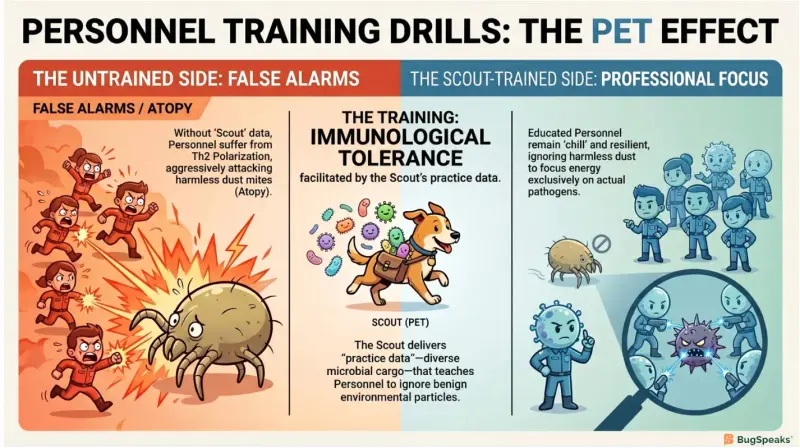
Dogs help train the immune system, or the Outpost Personnel, by providing a steady stream of low-level microbial data that prevents the personnel from overreacting to harmless environmental stimuli.
This education is most critical during the perinatal period, the time just before and after birth. Early exposure to diverse microbes helps infant personnel distinguish between actual threats (like harmful pathogens) and benign particles (like pollen or pet dander). When a Scout Vehicle is present in a home, it provides the "practice data" necessary for the personnel to develop superior Immunological Tolerance. This process reduces the likelihood of the system becoming bored and triggering Atopy, where the body mistakenly attacks harmless proteins, resulting in asthma, eczema, or food allergies.
Research into child health confirms that early interaction with pets promotes a balanced immune response, specifically favoring protective pathways over allergic ones. This shift away from Th2 Polarization ensures that the Personnel focus their energy on fighting actual pathogens rather than harmless dust. By interacting with the Scout, the Outpost develops a more resilient and "chill" defensive posture that lasts a lifetime. The presence of a dog effectively sets the baseline for a stable, well-informed, and highly competent immune staff.
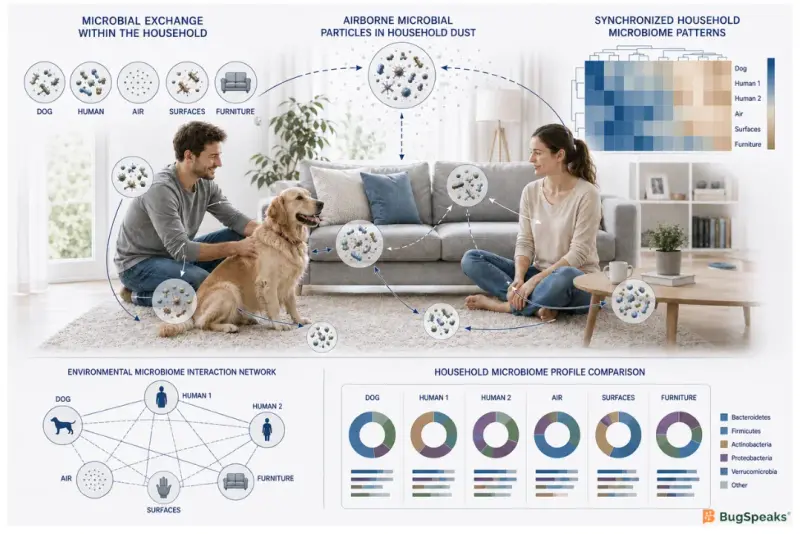
Furthermore, the "Bioaerosol Broadcast" mentioned in earlier research highlights how the Scout Vehicle does not require a physical docking station to transfer this information. As the Scout moves through the interior living space, it sheds a "microbial cloud" , a collection of bioaerosols that settles into the household dust. This environmental dust functions as a shared data drive, where the Outpost Personnel constantly samples and catalog the incoming files even without direct physical contact. By altering the home's airborne profile, the Scout ensures that the internal sensors are constantly recalibrating to the biological signatures of the local ecosystem. This continuous broadcast prevents the Outpost from becoming a "data vacuum," ensuring the personnel remain sharp.
What Kind of Biological Cargo Does the Scout Bring Back?
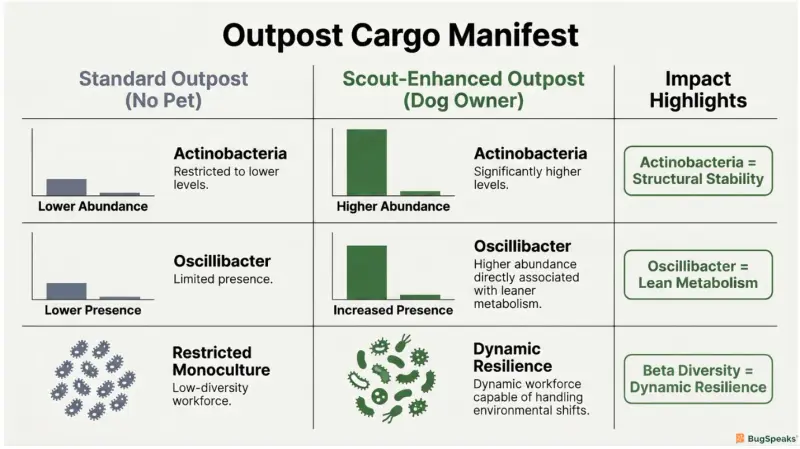
The Scout Vehicle brings back specific microbial cargo that significantly expands the diversity of the Outpost's internal workforce, specifically targeting "Old Friend" microbes from the soil. Scientific sequencing of the gut microbiome in pet owners reveals an increased abundance of beneficial groups such as Actinobacteria and the genus Oscillibacter. These "Geophilic Plugins" deep-earth samples from the soil are increasingly rare in modern, paved environments. They act as critical hardware updates for the Outpost, providing the ancient biological instructions necessary for high-level immune calibration. Because the Scout ventures into the untreated soil of the Wild, it brings back specialized microbes that have co-evolved with the human lineage for millennia.
These samples act as the "foundational code" for the Outpost, ensuring that the personnel understand the core rules of terrestrial life. By bridging the gap between the sterile interior and the geophilic Wild, the Scout ensures the Outpost maintains its original, high-performance biological settings. This Environmental Inoculation ensures that the Outpost does not become a low-diversity "monoculture," which is often a precursor to systemic vulnerability. Instead, the dog ensures that a variety of specialists are on duty, increasing the Beta Diversity of the system.
Table 1: Outpost Cargo Logs: Microbial Diversity Comparison
When the Outpost is populated by a diverse array of microbial workers, the system becomes much harder to disrupt. In a low-diversity system, the loss of one species can lead to a total collapse of function. However, the Scout's cargo ensures a "redundancy" effect. If one microbial team is busy or temporarily diminished, another can step in to fill the role. This diversity is measured by scientists as Beta Diversity, representing the richness of the biological "library" your body has access to.
How Does the Outpost Process This New Data into Energy and Calm?
The Outpost processes the microbial samples provided by the Scout to produce Short-Chain Fatty Acids (SCFAs), which serve as the primary fuel for the intestinal walls and as calming signals for the nervous system.
When the Scout Vehicle introduces fermentative specialists like the Ruminococcaceae family, these microbes break down complex fibers that the host cannot digest alone. This processing results in the production of Butyrate, which serves as a high-grade repair kit for the Colonocytes. This energy ensures the Outpost's barrier remains secure and prevents the leakage of unwanted debris into the systemic circulation, a condition commonly known as "leaky gut."
Furthermore, these SCFAs act as epigenetic messengers that engage in HDAC Inhibition, turning down the volume on inflammatory signals throughout the body. By encouraging the growth of SCFA-producing microbes, the Scout Vehicle helps install a natural anti-inflammatory system within the Outpost. This biochemical harmony keeps the Personnel calm and prevents the systemic stress that leads to long-term metabolic issues.
Physical interaction with the Scout such as cuddling further amplifies this stability through Neuroendocrine Co-Regulation. Interaction with a dog releases Oxytocin, which signals the nervous system to relax and reduces the activity of the HPA Axis (the body's stress response). This reduction in cortisol prevents the gut lining from becoming "leaky," ensuring that the personnel are not triggered into a state of panic by unwanted debris. A calm host provides a stable environment where beneficial microbes can thrive and perform their maintenance duties effectively. Shared activities like "Green Exercise" combine movement in nature with the microbial payload of the Scout, increasing the host’s Heart Rate Variability (HRV), a sign of health and stress resilience.
What is the "Familiome" and the Future of the Outpost?
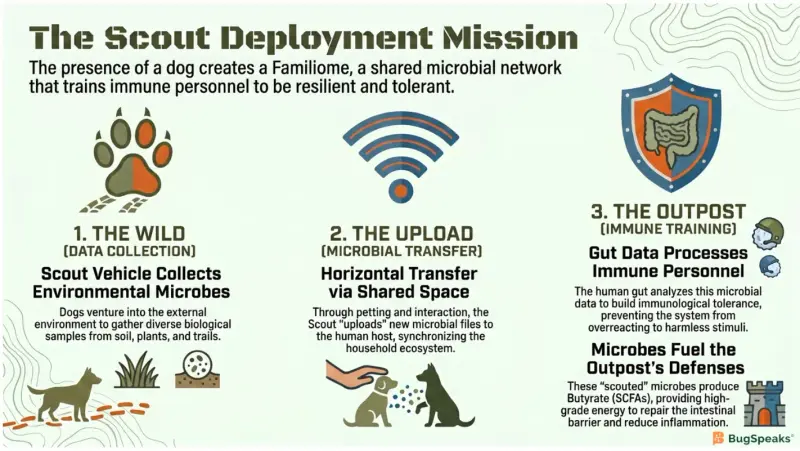
The Familiome is the shared microbial network that unifies the human host, the Scout Vehicle, and their shared living environment into a single, resilient ecosystem.
In a household with a pet, the boundaries between individual microbiomes begin to blur through Horizontal Microbial Transfer. This creates a synchronized ecological web where the entire family unit becomes more resilient to outside stressors. The shared environment acts as a reservoir of diverse biological data that supports the immune health of all inhabitants. This turns the home into a unified, healthy ecosystem where information is shared seamlessly between species.
However, management of this network requires vigilance. The Scout Vehicle can inadvertently track in Environmental Xenobiotics, such as pesticides or heavy metals, which can disrupt the Outpost’s Mucosal Homeostasis. Because dogs are closer to the ground, they often serve as early indicators of environmental toxicity, a "canary in the coal mine." Protecting the Scout from these hazards ensures that the "uploads" to the Outpost Personnel remain restorative rather than toxic. We also monitor the shared resistome collection of antibiotic-resistance genes—to ensure that our medical treatments remain effective for both humans and pets.
The future of Outpost management involves using Shotgun Metagenomics and Artificial Intelligence (AI) to map these exact microbial connections. Modern technology like Next-Generation Sequencing (NGS) allows us to visualize the entire Genomic Architecture of the familiome in real-time. This data-driven approach, known as the One Health framework, ensures that we can maintain perfect harmony between our pets and our personnel, ensuring the collective health of the entire Outpost crew for the entire lifecycle.
Table 3: One Health Framework: Future Outcomes for the Outpost
Reference
Skoufos, S., Stavropoulou, E., Tsigalou, C., & Voidarou, C. (2025). Microbial Interconnections in One Health: A Critical Nexus Between Companion Animals and Human Microbiomes. Microorganisms, 13(7), 1564. https://doi.org/10.3390/microorganisms13071564
Biagioli V, Matera M, Cavecchia I, Illiceto M, Pennazzi L, Luongo G, Lugli S and Striano P (2026) Beyond breastfeeding: a One Health Decalogue for nurturing the infant microbiota. Front. Nutr. 13:1784544. doi: 10.3389/fnut.2026.1784544
Banchi P, Mila H, Selma-Royo M, Tal S, Péron F and Gaillard V (2026) The perinatal microbiota in dogs and cats: a narrative review from human research to veterinary practice. Front. Vet. Sci. 13:1817504. doi: 10.3389/fvets.2026.1817504
Halling, K. B., Bowden, M., Pretty, J., & Ogeer, J. (2026). Bonded Green Exercise: A One Health Framework for Shared Nature-Based Physical Activity in the Human–Dog Dyad. Animals, 16(2), 291. https://doi.org/10.3390/ani16020291
https://mah.bioscientifica.com/view/journals/mah/3/1/MAH-25-0006.xml