Two kilos of soil. ₹68 lakh. And a wake-up call for biotech
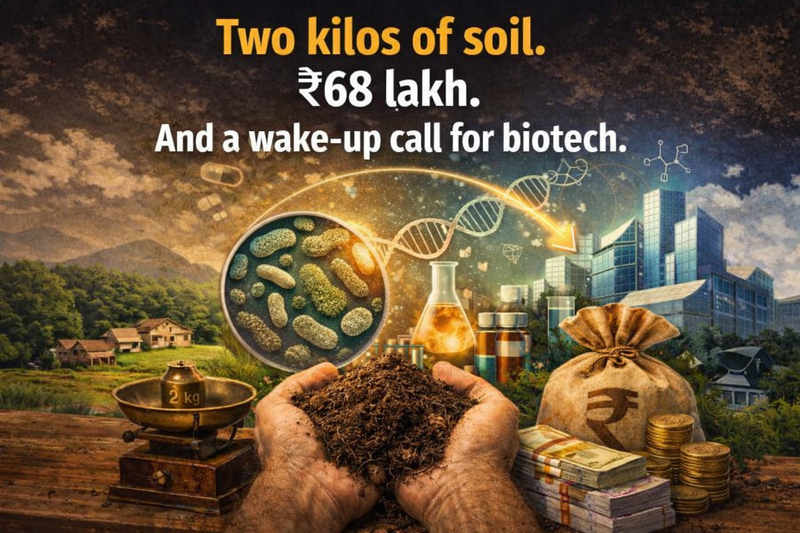
Somewhere in Maharashtra, a village just got paid ₹68 lakh.
Not for land. Not for crops.
For 2 kilograms of soil.
Let that sink in.
A company isolated a bacterium from that soil, built a probiotic application around it, and under India’s biodiversity regulations, shared the commercial benefits with the community.
This is not just a good story.
This is a signal.
We’ve been undervaluing biology
For decades, we’ve looked at soil as dirt.
At best, something to grow crops in.
But soil is not dirt.
It is one of the densest biological data layers on the planet.
Every gram contains:
Billions of microbes
Thousands of species
Millions of genes
Countless metabolic pathways
And we’re just scratching the surface.
If 2 kilos of soil can generate ₹68 lakh in downstream value, what is the value of:
a farm?
a forest?
a city?
a human gut?
We are sitting on biological gold mines and calling them ecosystems.
This is what the microbiome economy actually looks like
We often talk about microbiome in abstract terms:
Gut health
Probiotics
Research papers
But this story translates it into something tangible:
From Discovery to Product to Revenue and finally to Benefit Sharing
This is the pipeline.
And importantly, it introduces a concept that India is uniquely positioned to lead:
Biological assets as economic assets
Not just extracted.
Not just exploited.
But shared.
India has an unfair advantage here
If you think about it, India is probably one of the richest countries in the world when it comes to microbial diversity.
Different diets
Different climates
Different soils
Different lifestyles
And most importantly:
A massive, underexplored microbiome dataset across humans and environments
While the West has built strong capabilities in sequencing and analytics, India has something far more fundamental:
Raw biological diversity
The question is — are we going to study it, own it, and build on top of it?
Or will we let others come, sample, sequence, and commercialise it?
This changes how we should think about sampling
At Leucine Rich Bio, we think a lot about samples.
Gut samples.
Skin samples.
Environmental samples.
But this story reinforces something deeper:
Every sample is not just data.
It is potential IP.
That changes how you design:
Consent frameworks
Benefit-sharing models
Data ownership
Long-term storage
Because what looks like a “sample” today could be:
A probiotic tomorrow
A drug target next year
A billion-dollar pathway in a decade
The bigger opportunity
Imagine this at scale:
Mapping microbial diversity across India
Linking microbes to function (metabolites, pathways, health outcomes)
Building proprietary datasets
Discovering novel strains
Creating India-origin probiotics, enzymes, therapeutics
And crucially:
ensuring communities benefit when value is created
This is not just science.
This is nation-building through biology.
Final thought
We keep looking for the next big breakthrough in biotech.
Maybe it’s not in a billion-dollar lab.
Maybe it’s already under our feet.
In 2 kilos of soil.
The real shift is not technological.
It’s perspective.
Once you start seeing biology as data + IP + economic value, everything changes.
And we are only just getting started.
-Kumar Sankaran
Also Read: How Can Microbes Flush Out Toxins from Your Body?