Why does taking probiotics on an empty stomach reduce their survival rate?
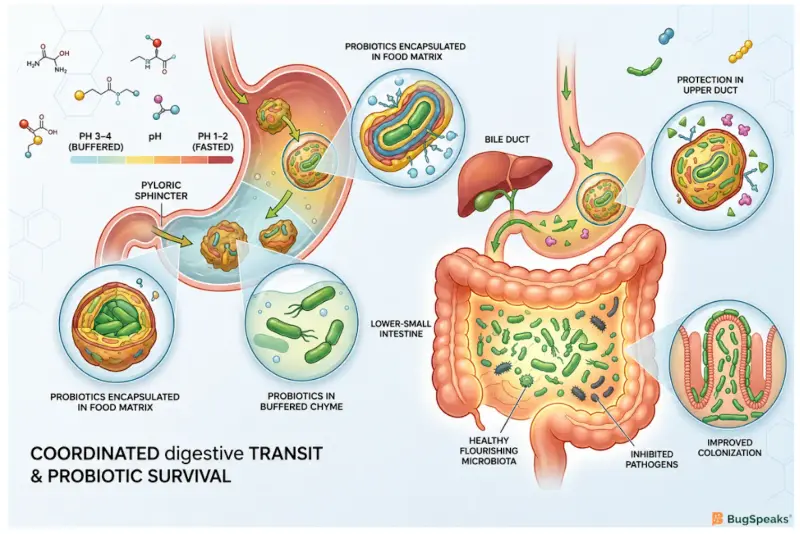
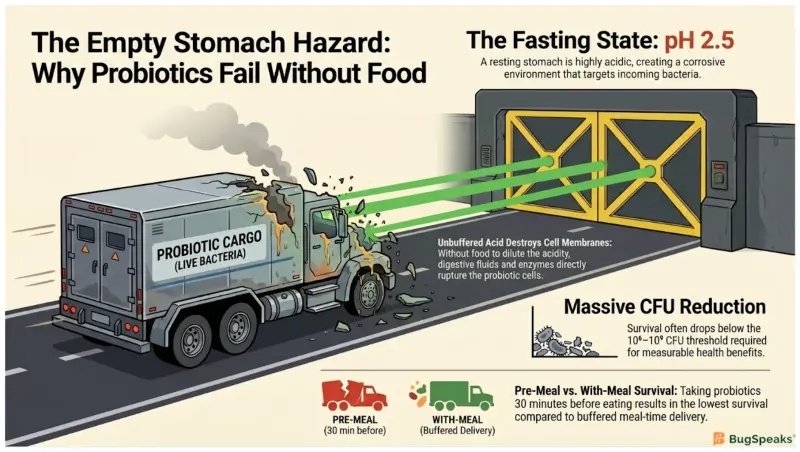
Taking probiotics on an empty stomach reduces their survival rate because the resting stomach is extremely acidic. Without food present, stomach acid directly attacks the live bacteria before they can safely reach the intestines. Probiotics must travel through the Gastrointestinal (GI) tract, where digestive acids and enzymes are designed to break down incoming material and eliminate potentially harmful microbes. In a fasting state, there is nothing available to dilute or buffer this acidity, leaving the probiotic cells fully exposed to damage. (Wang et al., 2025).
Within the Timed Delivery & Transit Coordination Network, probiotics function as live biological cargo moving through a tightly regulated transit system. The stomach acts as an acidic checkpoint. During fasting conditions, transit lanes are nearly empty, so the corrosive digestive fluids focus entirely on the incoming bacterial cargo. With no surrounding food traffic to absorb the acid load, large numbers of probiotic cells are destroyed before they can continue downstream. (Treven et al., 2024).
Scientific studies show how severe this loss can become. For probiotics to provide measurable health benefits, roughly 10⁶ to 10⁹ Colony-Forming Units (CFU) must survive digestion and arrive alive in the lower gutWang et al. (2025). Simulated digestion experiments demonstrate that taking probiotics with only water often causes a dramatic reduction in viable bacterial counts. In many cases, survival drops below the minimum threshold needed for biological effectivenessTreven et al. (2024).
The stomach also contains powerful digestive enzymes such as Pepsin, which begin dismantling proteins immediately after ingestion. When no meal is present, these enzymes interact directly with the probiotic membranes, weakening and rupturing the cells. This explains why probiotics taken in isolation struggle to survive the journey through the upper digestive tractWang et al. (2025).
How do meals act as protective buffers for probiotic transit?
Meals protect probiotics by temporarily reducing stomach acidity and creating a physical shield around the bacteria. When food enters the stomach, digestive chemistry changes rapidly. The stomach pH rises from an acidic fasting range near 2.5 toward a milder range of 4.0 to 6.0, reducing immediate acid stress on the incoming bacteriaWang et al. (2025). This process is known as Buffering capacity.
Inside the transit coordination system, meals function like dense traffic moving through the checkpoint. Instead of facing concentrated digestive acid alone, the probiotic cargo becomes mixed into a larger flow of proteins, fats, and carbohydrates. The digestive fluids must now process the entire meal, reducing direct exposure to the bacterial cells. This buffered environment significantly improves microbial survival during gastric transitWang et al. (2025).
Protection continues after the stomach. In the small intestine, probiotics encounter Bile salts and Pancreatin, both of which can damage bacterial membranes. Bile salts behave like biological detergents that dissolve fats but can also tear apart microbial cell wallsWang et al. (2025). When probiotics are consumed alongside food, however, the meal forms a dense matrix that physically traps many of the bacteria, limiting direct contact with these digestive compoundsTreven et al. (2024).
This buffering effect explains why dietary context matters so much. Fasting conditions expose probiotics directly to digestive acids and detergents, while meals create temporary protection that allows more bacteria to survive and reach the colon aliveWang et al. (2025).
Which types of foods provide the best protection for probiotics during digestion?
Solid, carbohydrate-rich foods provide the strongest protection for probiotics during digestion. Foods such as oatmeal, pasta, and porridge form dense physical structures that shield bacterial cells from stomach acid and intestinal detergents. Compared with liquids, solid foods digest more slowly and possess greater buffering capacity, allowing them to neutralize acidity for longer periodsWang et al. (2025).
As these foods digest, they create a gelatinized starch-protein network that physically surrounds the probiotic cells. Inside the transit system, this acts like protective cargo insulation. Instead of moving freely through corrosive digestive channels, the bacteria travel embedded within thick carbohydrate traffic, reducing direct contact with digestive acids and bileTreven et al. (2024).
Research involving Lactobacillus rhamnosus GG (LGG) highlights this difference clearly. Simulated digestion studies found that probiotics consumed with solid wheat pasta maintained far higher viable bacterial counts than probiotics taken with soy milk. Acidic beverages, such as fruit juice, performed even worse because they added extra acidity to the digestive environment. Orange juice caused roughly a 2.5 log₁₀ CFU reduction, while milk-based porridge reduced losses to only about 1.2 log₁₀ CFUTreven et al. (2024).
Interestingly, the relationship is mutually beneficial. As probiotics travel with complex carbohydrates, they can assist digestion by improving Starch hydrolysis and protein breakdownWang et al. (2025). The meal protects the bacteria, while the bacteria contribute to nutrient processing during digestion.
Does the exact timing of probiotic consumption before, during, or after a meal matter?
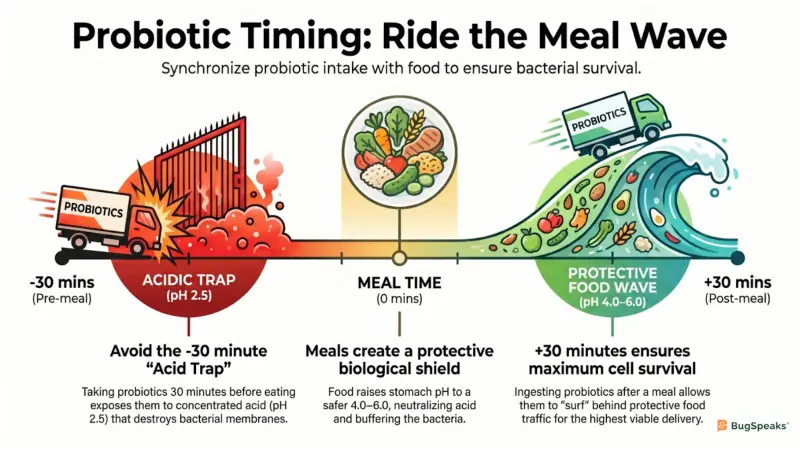
Yes. Timing significantly changes probiotic survival rates. Research shows that taking probiotics with a meal or shortly after eating results in much better bacterial survival than taking them beforehandWang et al. (2025).
When probiotics are consumed 30 minutes before a meal, they enter an empty stomach where acidity remains fully concentrated. By the time food arrives in the environment, many bacterial cells have already suffered irreversible membrane damage. In contrast, taking probiotics during or shortly after eating places the bacteria into an environment where stomach acid is already partially neutralized by active digestionWang et al. (2025).
Within the transit coordination network, timing determines whether the bacterial cargo arrives during a hazardous low-traffic window or during active meal processing. Coordinating delivery alongside food traffic allows the bacteria to pass through the checkpoint while digestive acids are occupied processing the meal. This improves transport efficiency and increases the number of surviving microbes reaching the intestinesLuo et al. (2026).
Studies in Chrono-nutrition support these findings. The digestive system follows daily biological rhythms that influence acid secretion, enzyme release, and microbial activity. Taking probiotics alongside scheduled meals appears to align bacterial delivery with periods when the gut environment is most prepared to support microbial survivalLuo et al. (2026).
This timing may also help stabilize the Gut microbiome, the complex microbial ecosystem living inside the digestive tract. Consistent meal-linked probiotic intake helps synchronize microbial activity with the body’s natural metabolic cycles, improving the chances that incoming bacteria successfully integrate into the intestinal communityLuo et al. (2026).
How do capsule technologies ensure probiotics reach the lower gut alive?
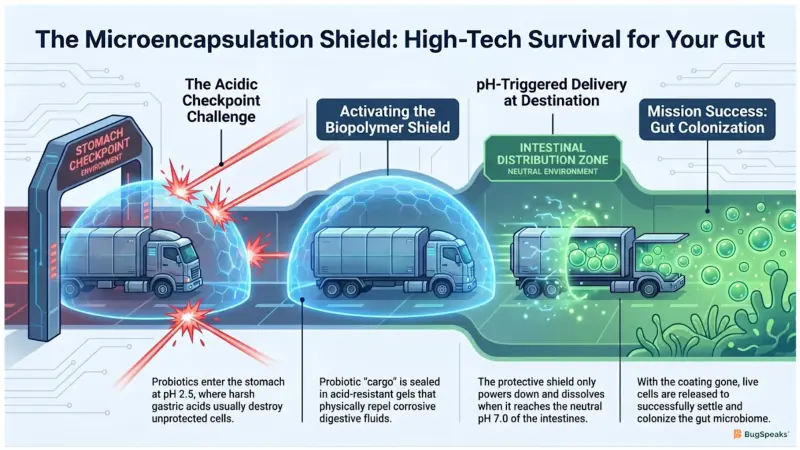
Modern capsule technologies improve probiotic survival by physically protecting bacteria from stomach acid until they reach the intestines. While meals provide natural buffering protection, engineered delivery systems can create an artificial shield around the microbes even when food is absent.
One major approach is Microencapsulation, where probiotic cells are coated inside acid-resistant gels made from materials such as sodium alginate or carrageenanUhegwu & Anumudu (2025). These protective coatings function like sealed transport containers within the transit system. The bacterial cargo remains locked inside the capsule while moving through acidic stomach conditions, then releases only after reaching the safer, higher-pH environment of the intestines.
Laboratory studies consistently show that encapsulated probiotics survive digestion far better than unprotected bacterial cells. Multi-layered biopolymer coatings help the bacteria resist both gastric acid and bile salt damage, dramatically improving the number of viable cells reaching the lower gutUhegwu & Anumudu (2025).
Some bacteria also possess natural protective systems. Certain strains produce Exopolysaccharides, sticky sugar-based coatings that form a defensive outer layer around the cell. These natural barriers help the bacteria tolerate digestive stress and improve their ability to attach to intestinal surfaces once they arriveUhegwu & Anumudu (2025).
Whether protection comes from food, engineered capsules, or the bacteria’s own biological defenses, the core principle remains the same: reducing direct exposure to stomach acid is essential for probiotic survival and successful delivery to the lower digestive tract.
Visualize the process- https://youtu.be/ecpIjE8Ov0g
Reference
Wang, J., Wu, P., Chen, X. D., Yu, A., & Dhital, S. (2025). Effect of Food Matrix and Administration Timing on the Survival of Lactobacillus rhamnosus GG During In Vitro Gastrointestinal Digestion. Foods, 14(17), 3076. https://doi.org/10.3390/foods14173076
Treven, P., Paveljšek, D., Bogovič Matijašić, B., & Mohar Lorbeg, P. (2024). The Effect of Food Matrix Taken with Probiotics on the Survival of Commercial Probiotics in Simulation of Gastrointestinal Digestion. Foods, 13(19), 3135. https://doi.org/10.3390/foods13193135
Luo L, Xue M, Sun L and Dai Z (2026) Gut microbiota in obesity management: from microbial clocks to precision microbial therapies. Front. Cell. Infect. Microbiol. 16:1705021. doi: 10.3389/fcimb.2026.1705021
Uhegwu, C. C., & Anumudu, C. K. (2025). Probiotic Potential of Traditional and Emerging Microbial Strains in Functional Foods: From Characterization to Applications and Health Benefits. Microorganisms, 13(11), 2521. https://doi.org/10.3390/microorganisms13112521
Dini, I. (2026). Probiotics and Fermented Foods in Human Nutrition. Molecules, 31(8), 1353. https://doi.org/10.3390/molecules31081353