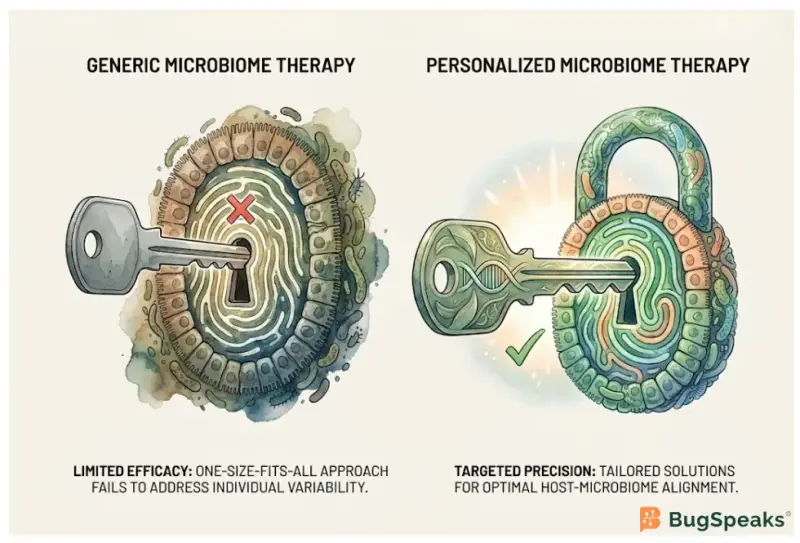
Why does the generic key fail while the biometric lock succeeds?
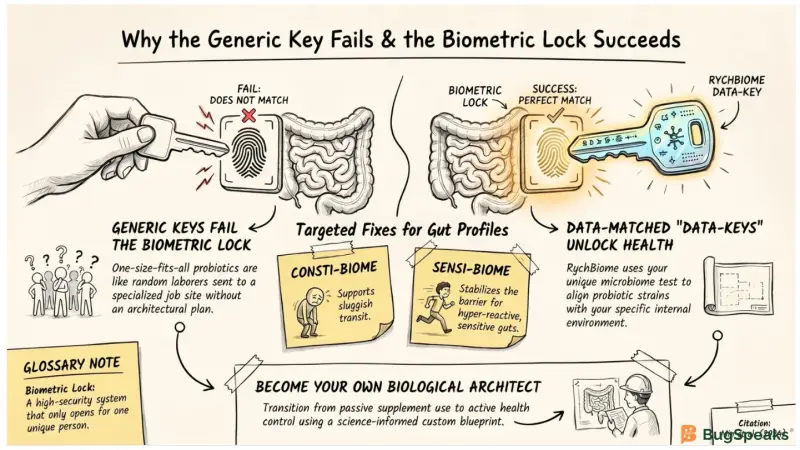
The generic key fails because the gut operates as a highly individualized biometric lock, requiring microbiome-informed and function-based probiotic formulations to improve alignment between the microbial crew and the unique host environment. For decades, the standard approach to addressing this massive, constantly evolving biological construction site relied on broad-spectrum, "one-size-fits-all" solutions. Generic probiotics were often deployed like unqualified day laborers sent to a specialized job site without a specific architectural plan, leading to inconsistent survival of the strains and variable symptom relief. Health optimization requires precision engineering because the intestines are not a uniform environment; they house a highly individualized biome governed by a combination of genetics, diet, and lifestyle. Administering a standard probiotic off the shelf is akin to forcing a generic key into a biometric lock—if the structural grooves do not align, the system remains stagnant.
While the concept of precision engineering is powerful, the biological construction site is not static. Unlike a mechanical system, the microbiome continuously evolves based on diet, stress, sleep, and environment. This means that even the most advanced Custom Blueprint is a dynamic plan—one that may require recalibration over time. BugSpeaks utilizes a methodology where the approach is built on data-informed personalization rather than fully predictive or deterministic modeling. Modern scientific literature demonstrates that addressing targeted functional disorders requires a strategy that acknowledges these complexities.Min et al. (2024) conducted a clinical trial investigating the precise microbial alterations required to address different architectural failures, such as constipation versus diarrhea. The clinical data revealed that patients presenting with an "Insensitive Gut" (constipation) possessed fundamentally different microbial deficits than those with a "Sensitive Gut" (diarrhea). Precision engineering, as applied through the Rychbiome (pronounced rich-biome) system, utilizes the findings ofMin et al. (2024) to create distinct, supportive formulations:
Consti-Biome Intervention: Designed for the sluggish profile, this targeted intervention promotes specific workers who support transit lines and motility. By modulating these specific populations, the formulation helps reduce abdominal discomfort and straining.
Sensi-Biome Intervention: Designed for the hyper-reactive profile, this formulation focuses on supporting the internal barrier and regulating inflammation. It increases the presence of soothing microbial "mortar" that supports structural stability and stool consistency.
How does the Microscopic GPS navigate the intestines?
The Microscopic GPS navigates the complex topography of the intestines by utilizing advanced microbiome analysis techniques such as metagenomics, and in some research contexts, metatranscriptomics, to map existing microbial inhabitants and suggest a specialized crew of microorganisms that have a high probability of supporting the local ecosystem. Without an accurate map, even highly skilled microbial workers can be lost in transit or fail to integrate into the existing workforce. The advanced methodology employed byBugSpeaks (2026) relies on a verified microbiome analysis to generate the Custom Blueprint. This process involves sequencing the DNA and reading the active functional patterns of the microorganisms currently living in the gut to understand the exact state of the biological construction site.
This evaluation relies heavily on "High-Definition Group Photos" (Metagenomics), which catalogs every microorganism present, and in advanced settings, a "Live Map" feed (Metatranscriptomics) that reveals what those microorganisms are doing in real-time. By analyzing features such as microbial diversity and active task patterns, the system pinpoints specific structural weaknesses. Once these deficits are mapped, a custom formula—a calculated blend of probiotic laborers and prebiotic fertilizers—is designed. It is important to note that current scientific models, including those used in microbiome-guided interventions, operate on probability rather than absolute certainty. The goal is not to create a "perfect" match, but to significantly improve the alignment between the supplement and the host. The specialized crew is delivered in a stabilized state to safely pass through the hazardous, acidic environment of the upper digestive tract. Once they reach the targeted zones of the intestines, the workers activate and begin supporting the existing ecosystem.
How are metabolic signals modulated to manage energy systems?
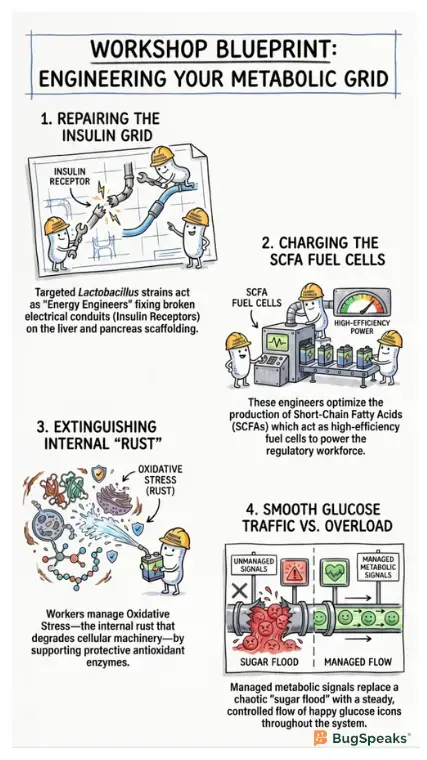
Metabolic signals may be influenced by deploying targeted Lactobacillus species as supportive energy engineers that help regulate glucose transport and optimize the production of Short-Chain Fatty Acids. Beyond mere structural maintenance, the specialized crew must assist in managing complex metabolic signaling across the construction site. It is important to note that these interventions do not function as standalone treatments for metabolic diseases like Type 2 Diabetes. Instead, they act as supportive engineers within a larger system that includes diet, physical activity, and medical care. Precision engineering relies on the fact that the effectiveness of strains such as Lactobacillus rhamnosus is highly strain-specific and dependent on the existing microbial environment.
Cheah et al. (2026) highlights the ability of targeted Lactobacillus to potentially influence glucose transporter activity. Instead of allowing sugar to flood the system unchecked, specific probiotic strains can help manage the transport of materials across the intestinal lining. Furthermore, these specialized engineers optimize the production of Short-Chain Fatty Acids (SCFAs), which act as fuel cells for the regulatory workforce. When these energy engineers are deployed according to a Custom Blueprint, they can increase SCFA production, subsequently triggering the release of hormones that support insulin sensitivity and help dampen inflammatory Cytokines. These targeted strains also assist in managing oxidative stress by supporting the production of antioxidant enzymes. These enzymes act as protective agents, preserving the cellular scaffolding of the liver and pancreas and helping to improve overall metabolic balance.
What protects the social network from dysbiosis?
A Custom Formula protects the delicate microbial social network from Dysbiosis by supporting beneficial, collaborative crew members and reducing the relative abundance of hostile rogue contractors. A construction site is only as efficient as its workers' ability to collaborate. In the microbiome, this collaboration is heavily dependent on microbial diversity. When this network breaks down, a state of Dysbiosis occurs—essentially a site where the balance is lost, and the structural integrity of the gut is compromised.
Implementing a precision-informed Rychbiome formula is a strategy used to support this balance. According to a clinical proof-of-concept study byPeerJ (2024), personalized, microbiota-driven nutritional interventions can influence systemic health outcomes. The trial demonstrated that the intervention resulted in measurable improvements in metabolic markers such as HbA1c and a marked decrease in systemic inflammatory indicators, suggesting that microbiome-targeted strategies can influence systemic health outcomes when applied with precision. This success was achieved by directly influencing the social network of the intestines. The intervention significantly increased Shannon Diversity, meaning a more balanced workforce was achieved. Specifically, the personalized blueprint helped drive down populations of rogue contractors linked to metabolic disruption while amplifying beneficial crew members such as Bifidobacterium. This shift also impacts the strength of the site's walls. A balanced microbial social network supports Mucin production, the thick, gel-like protective sealant that coats the inner walls of the gut. By maintaining a robust Mucin barrier, the specialized crew helps ensure that the structural perimeter remains secure against internal irritation.
How do supply chains and shift schedules manage advanced architecture?
Advanced architecture manages the internal environment by organizing microbial supply chains and shift schedules to ensure that nutrients are processed efficiently and structural repairs occur according to the body's internal clock. The 2026 blueprint extends beyond individual workers into a sophisticated Microbial Supply Chain. Precision engineering assembles a Functional Guild where primary workers break down complex fibers into raw materials for a specialized "Finishing Crew." This process, known as Metabolic Cross-Feeding, ensures that elite producers like Roseburia have the necessary precursors to manufacture a high-output "Post-biotic Payload" of protective Butyrate.
Furthermore, every high-stakes construction site requires a strict Shift Schedule. The microbial crew operates on Circadian Rhythms, oscillating their metabolic activity based on the body’s internal clock. Proactive engineering involves timing nutrient delivery to align with these shifts—daylight for energy harvesting and deep night for the structural repair of the Mucin barrier. Finally, the Biometric Handshake ensures host-microbe synergy. By analyzing unique genetic markers known as SNPs, the system verifies that the immune system's security protocols will recognize and accept the incoming crew. This prevents the body from accidentally deporting a helpful worker, solidifying a permanent, high-performance alliance between the biometric lock and the precision-engineered key.
What defines the proactive engineering of the 2026 landscape?
The proactive engineering of the 2026 landscape is defined by the integration of Predictive Modeling, Next-Generation Probiotics, and targeted Post-biotics to support the biological architecture. The field of microbiome science has advanced from merely reacting to existing damage to anticipating potential issues in the system. As established byScienceDirect (2025), the integration of probiotics into personalized therapeutics has catalyzed the development of "Live Biotherapeutic Products" (LBPs). Despite these advancements, it is important to recognize that predictive modeling is still in its early stages. While algorithms can identify patterns and probabilities, they cannot yet account for every environmental or biological variable.
Proactive engineering is therefore best understood as an evolving system. Using massive datasets and artificial intelligence, scientists can analyze a Custom Blueprint to identify microscopic weaknesses. Predictive Modeling allows the system to forecast how an individual's unique microbial network might respond to a specific strain. Furthermore, this landscape has introduced the concept of targeted Post-biotics. If probiotics are the living crew, and prebiotics are their raw materials, post-biotics are the completed components—the beneficial metabolites and inanimate microbial cells left behind after the work is done. Post-biotics have been shown to exhibit anti-inflammatory and metabolic regulatory effects in emerging research. Because they are non-living, they offer high safety profiles, particularly for those with sensitive immune systems. They provide the necessary support to reinforce the biological structure without the need to manage a live workforce. These tools are designed to support specific metabolic pathways, offering potential that goes beyond basic symptom management to help modify the long-term health of the host.
What does the final inspection reveal about human biological architecture?
The final inspection reveals that achieving systemic balance requires transitioning from a passive consumer of generic supplements to an active "Biological Architect" who utilizes a structured, science-informed Custom Blueprint. The intestines are no longer viewed as a "black box" where generalized solutions are applied with the mere hope of a positive outcome. Precision engineering in this field is an evolving, data-informed system that relies on rigorous analysis and targeted deployment. It is important to note that microbiome science is still evolving, and responses to personalized interventions can vary between individuals.
Whether supporting the body against metabolic dysfunction, strengthening the protective Mucin sealant, or addressing foundational issues like stool irregularities, personalized probiotics provide a structured pathway to improve systemic balance across functions such as digestion, metabolism, and skin health. By analyzing the precise deficits of the microbial construction site and deploying a specialized, GPS-guided crew of supportive strains, structural and metabolic balance can be improved. Through the Rychbiome approach, individuals are empowered to take data-driven control of their internal health. The generic key has been discarded; the biometric lock has been successfully engaged, ensuring the intestines operate at their highest potential for long-term health.
Visualize the process- https://youtu.be/rdj4q56fKvU
Reference
Min, U., Jin, Y. J., Jang, Y. J., Lim, J., & Kim, B. Y. (2024). Personalized probiotic strategy considering bowel habits: impacts on gut microbiota composition and alleviation of gastrointestinal symptoms via Consti-Biome and Sensi-Biome. Frontiers in nutrition, 11, 1302093. https://doi.org/10.3389/fnut.2024.1302093
Cheah, A. S., Tan, J. W., Jaafar, F., & Yeo, W. W. Y. (2026). Precision Microbiome Modulation: Exploring Lactobacillus spp. as A Targeted Strategy for Type 2 Diabetes Management. Current nutrition reports, 15(1), 19. https://doi.org/10.1007/s13668-026-00739-3
https://www.sciencedirect.com/science/article/pii/S2950194625002651
https://bugspeaks.com/product/rychbiome-personalized-probiotics/