The Microbyte Series-Bifidobacterium lactis BB-12:The Probiotic Champion for Gut Balance and Wellness
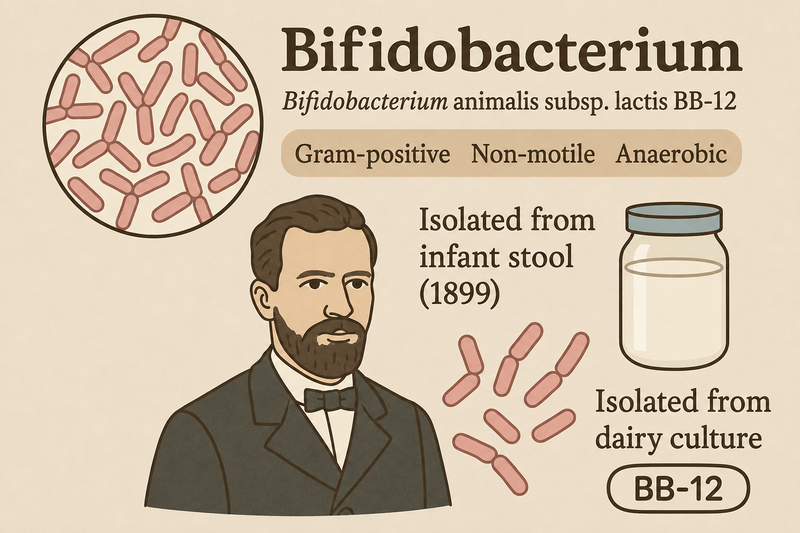
First identified in 1899, Bifidobacterium animalis subsp. lactis is a versatile Gram-positive bacterium capable of supporting a wide array of human health functions. Driven by an advanced arsenal of mucus adhesion properties and antimicrobial substances, it effortlessly survives upper gastrointestinal tract passage, spreading rapidly through fermented milk products and infant formulas. Benefits range from localized digestive distress like constipation to broad systemic enhancements, including immune system support and infant colic reduction. Accurate classification leverages classic laboratory profiles and modern tools like comparative subspecies reclassification. While optimization typically requires targeted probiotic therapy for strains like BB-12, robust industrial utilization relies heavily on high aerotolerance and operational stability protocols.
History
Bifidobacterium is a group of beneficial bacteria that are gram-positive, non-motile, and anaerobic, meaning they thrive without oxygen. They are known for producing lactic acid and are naturally found in the human gut, especially in infants. These helpful bacteria were first discovered in 1899, when scientists isolated them from the stool of breastfed babies. This early discovery showed how important they are to a healthy digestive system from the very beginning of life. One special strain, called Bifidobacterium lactis BB-12, was later isolated from a dairy culture in the Chr. Hansen collection, a well-known source of probiotic strains used in food and supplements. At first, scientists thought this strain belonged to a different species, Bifidobacterium bifidum. Later, it was reclassified under Bifidobacterium animalis, and then again as a new species called Bifidobacterium lactis BB-12. However, since it did not fully meet the scientific criteria for a new species, it was finally categorized as a subspecies, specifically Bifidobacterium animalis subsp. Lactis.
Health Benefits
One of the most important traits of a good probiotic is its ability to survive the harsh conditions of the upper digestive tract. Bifidobacterium lactis BB-12 can handle both stomach acid and bile, which means it makes it safely to your intestines, where it can do its job and support your health. For probiotics to be truly effective, they need to stick to the walls of your intestines. This helps them block harmful bacteria, settle in the gut, and support the natural barrier that protects your body. BB-12 has excellent mucus adhesion properties, which means it can stay where it is needed and promote better overall wellness. Our gut can sometimes be invaded by harmful microbes, known as pathogens, which cause infections and diseases. BB-12 helps fight these bad bugs by producing natural antimicrobial substances. This makes it harder for the harmful bacteria to grow and cause trouble in your digestive system.
Applications of Bifidobacterium lactis BB12
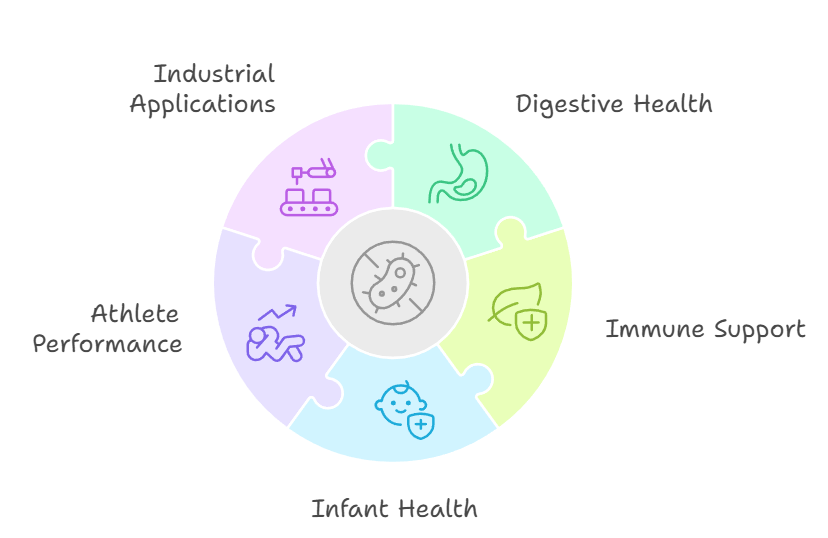
Bifidobacterium lactis BB-12 is a popular and well-researched probiotic known for its many health benefits. It is helpful for people struggling with constipation, as it can soften stools and reduce the time between bowel movements, making things more regular and comfortable. This is not just helpful for constipation; it has also been shown to reduce the duration and frequency of diarrhoea in children, helping them recover more quickly and feel better faster. One of the most important benefits of Bifidobacterium lactis BB-12 is its ability to support a strong immune system. Regular consumption of the probiotic can boost your body’s natural defenses, making it easier to fight off infections and stay healthy. In another study, infants who were given Bifidobacterium lactis BB-12 experienced a significant reduction in colic symptoms. Within just two weeks, their daily crying time decreased, sleep improved, and their stool became more consistent and regular. Even athletes can benefit from this probiotic; daily supplementation has been shown to reduce anxiety levels and improve performance under stress.
Bifidobacterium lactis BB12 is a technologically advanced strain that is ideal for fermentation. It offers excellent stability and high aerotolerance, making it perfect for large-scale industrial use. BB12 is widely used in the production of dietary supplements, infant formulas, and fermented milk products. One of its standout features is that it does not affect the taste, appearance, or texture of the final product. Plus, it can survive in food right up until consumption.
Safety of Bifidobacterium lactis BB12
Bifidobacterium lactis BB12 has been thoroughly studied in clinical trials involving people of all ages, from infants to the elderly. These studies have shown that it is safe to consume in doses of up to 100 billion CFU/day.
Taxonomy Classification
Microbial Profile
Gram nature- Gram positive
Shape- Rod Shaped
Spore formation- No spore formation
Oxygen requirement- Anaerobic
-Varsha V
Reference
Jungersen, M., Wind, A., Johansen, E., Christensen, J. E., Stuer-Lauridsen, B., & Eskesen, D. (2014). The Science behind the Probiotic Strain Bifidobacterium animalis subsp. lactis BB-12(®). Microorganisms, 2(2), 92–110.https://doi.org/10.3390/microorganisms2020092
Dong, W., Wang, Y., Liao, S., Tang, W., Peng, L., & Song, G. (2021). Bifidobacterium animalis subsp. lactis BB-12 Improves the State Anxiety and Sports Performance of Young Divers Under Stress Situations: A Single-Arm, Prospective Proof-of-Concept Study. Frontiers in psychology, 11, 570298.https://doi.org/10.3389/fpsyg.2020.570298
Nocerino, R., De Filippis, F., Cecere, G., Marino, A., Micillo, M., Di Scala, C., de Caro, C., Calignano, A., Bruno, C., Paparo, L., Iannicelli, A. M., Cosenza, L., Maddalena, Y., Della Gatta, G., Coppola, S., Carucci, L., Ercolini, D., & Berni Canani, R. (2020). The therapeutic efficacy of Bifidobacterium animalis subsp. lactis BB-12® in infant colic: A randomised, double blind, placebo-controlled trial. Alimentary pharmacology & therapeutics, 51(1), 110–120.https://doi.org/10.1111/apt.15561