The Microbyte Series: Bifidobacterium breve – A Tiny Bacterium with Mighty Benefits

History
The story of Bifidobacterium is closely tied to the origins of microbiology and probiotic science, beginning in 1899 when French pediatrician Henri Tissier at the Pasteur Institute identified a dominant Y- or V-shaped bacterium in the feces of breast-fed infants, which he named Bacillus bifidus communis. Notably, he observed that this bacterium was scarce in infants with diarrhea and proposed a groundbreaking idea that restoring gut health could be achieved by administering these beneficial microbes to displace harmful ones, laying the foundation of probiotic therapy. Over the years, the classification of this bacterium proved challenging, as it was variously grouped under names like Bacteroides bifidus and Lactobacillus bifidus before Danish microbiologist Orla-Jensen formally proposed the genus Bifidobacterium in 1924. Bifidobacterium breve was first formally described in 1971 by Reuter, who isolated it from human infant feces.
Health Benefits
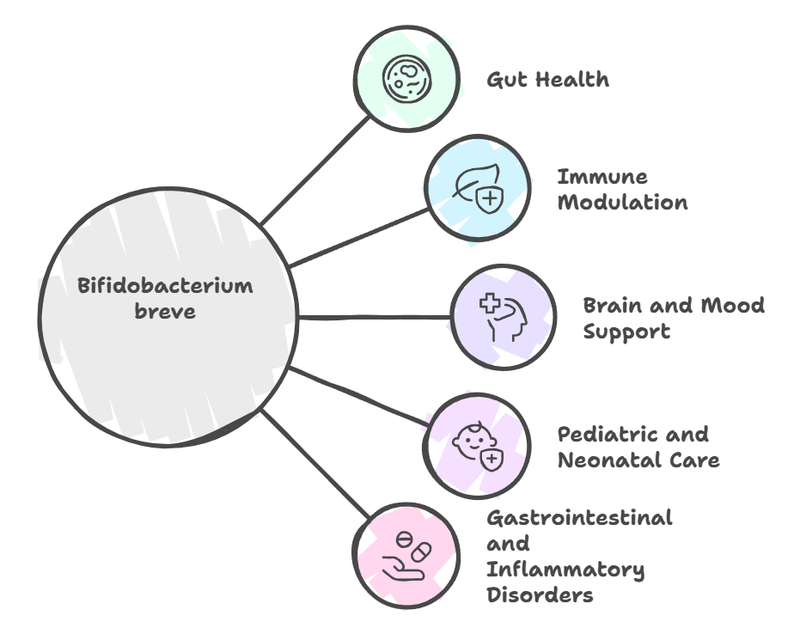
Bifidobacterium breve (B. breve) is a probiotic with remarkable clinical potential, offering benefits that range from gut health and immune modulation to brain and mood support. Originally isolated from healthy infant gut microbiota, B. breve is especially valued in pediatric and neonatal care. Certain strains, like B. breve M-16V, play a key protective role against Necrotizing Enterocolitis (NEC), a life-threatening inflammatory condition in premature infants, by supporting healthy microbial colonization and regulating immune responses. In addition, multiple B. breve strains help ease infantile colic, improve intestinal motility, and reduce infection risks in newborns, particularly when paired with Lactobacillus casei Shirota. Beyond infancy, B. breve demonstrates strong potential in managing gastrointestinal and inflammatory disorders. In Celiac disease, a synbiotic formulation containing B. breve BR03 and B632 helps lower TNF-α, a key inflammatory cytokine, enhancing gut health alongside a gluten-free diet. It is also included in therapeutic formulations for Inflammatory Bowel Disease (IBD), particularly Ulcerative Colitis, and shows promise in alleviating symptoms of Irritable Bowel Syndrome (IBS) such as bloating and abdominal pain, though results vary depending on the strain. Moreover, B. breve combined with galactooligosaccharides has been shown to enhance nutrient absorption and gut motility in Short Bowel Syndrome. Emerging research connects B. breve to the microbiota-gut-brain axis, revealing that certain strains may influence cognitive and emotional health. For instance, B. breve A1 has demonstrated neuroprotective effects in Alzheimer’s models by downregulating disease-related genes, while B. breve 1,205 shows antidepressant-like activity by reshaping gut microbial balance and metabolism.
Industrial Application
B. breve in probiotic yogurts, cheese, and fermented milk drinks and in infant formulas that support digestion and immunity. Two well-known strains, B. breve C50 and B. breve M-16V, are popular in baby products and dairy foods for helping build a healthy microbiome early in life. Many B. breve strains, like MCC1274 (also known as B-3), have even been given “GRAS” status (Generally Recognized As Safe) by the U.S. FDA. These probiotics are often paired with prebiotics such as inulin, FOS, or human milk oligosaccharides (HMOs). This combo, called a synbiotic, helps the good bacteria grow and thrive better in your gut.
The harsh conditions of food processing, storage, and the stomach can easily kill the probiotics. That’s why scientists have developed clever encapsulation techniques, basically wrapping the bacteria in protective layers made of alginate or other natural materials. This keeps B. breve alive and active all the way to your intestines. In the factory, they’re also preserved through gentle drying methods like spray-drying or freeze-drying, often mixed with protective ingredients like skim milk or trehalose to maintain their strength. Newer technologies are even working on special coatings that release these probiotics only once they reach the colon, where they’re most needed.
Taxonomic Classification
Domain: Bacteria
Kingdom: Bacillati
Phylum: Actinomycetota
Class: Actinomycetes
Order: Bifidobacteriales
Family: Bifidobacteriaceae
Genus: Bifidobacterium
Species: Bifidobacterium breve
Microbial Profile
Shape: Rod-shaped
Gram nature: Gram-positive
Spore formation: No spore formation
Motility: Non-motile
Oxygen requirement: Anaerobic
Optimal pH: pH 6.5-7.0
Optimal temperature: 36–38°C
-Varsha V
Reference
Arboleya, S., Watkins, C., Stanton, C., & Ross, R. P. (2016). Gut Bifidobacteria Populations in Human Health and Aging. Frontiers in microbiology, 7, 1204. https://doi.org/10.3389/fmicb.2016.01204
Chen, J., Chen, X., & Ho, C. L. (2021). Recent Development of Probiotic Bifidobacteria for Treating Human Diseases. Frontiers in bioengineering and biotechnology, 9, 770248. https://doi.org/10.3389/fbioe.2021.770248
Bozzi Cionci, N., Baffoni, L., Gaggìa, F., & Di Gioia, D. (2018). Therapeutic Microbiology: The Role of Bifidobacterium breve as Food Supplement for the Prevention/Treatment of Paediatric Diseases. Nutrients, 10(11), 1723. https://doi.org/10.3390/nu10111723
O'Callaghan, A., & van Sinderen, D. (2016). Bifidobacteria and Their Role as Members of the Human Gut Microbiota. Frontiers in microbiology, 7, 925. https://doi.org/10.3389/fmicb.2016.00925
Scardovi, V., Trovatelli, L. D., Zani, G., Crociani, F., & Matteuzzi, D. (1971). Deoxyribonucleic acid homology relationships among species of the genus Bifidobacterium. International Journal of Systematic and Evolutionary Microbiology, 21(4), 276-294.