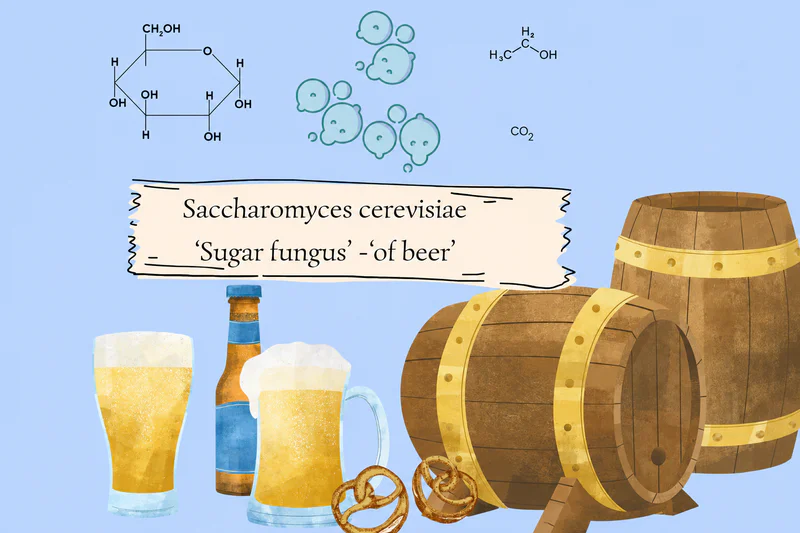
Saccharomyces cerevisiae is a versatile eukaryotic yeast capable of supporting a wide array of industrial and health functions. Driven by an advanced arsenal of fermentative enzymes and aromatic metabolites, it effortlessly executes anaerobic fermentation, spreading rapidly through domesticated brewing, baking, and wild forest niches. Applications range from everyday bread and wine production to serving as a vital biomedical model organism and protective oral probiotic. Accurate identification leverages classic laboratory microscopy and modern tools like whole-genome sequencing. While optimization typically requires targeted usage for strains like S. boulardii, robust safety relies heavily on screening immunocompromised individuals.
History and naming
The story of Saccharomyces, especially Saccharomyces cerevisiae, is entwined with the story of progress in biology. In attempting to understand what gave wine its alcohol, chemists turned to microbiologists, and yeast was first recognised as an organism. Through a combination of chemical equations, rigorous experimentation, and the development of microscopy, the alcohol fermentation equation was described and, at long last, attributed to a living organism, yeast. Somewhere along the way, Theodore Schwann conducted experiments to establish the role, characteristics, and requirements of yeasts in ethanol fermentation, and made a bold, ahead-of-its-time conclusion that yeasts used sugar and produced ethanol. While this was hotly debated and refuted in the following years, Schwann’s hypothesis was later adopted by Louis Pasteur, who further established it through experiments. As it turns out, in Schwann’s earlier research, he worked with F.J.F Meyen, who studied fungi. The latter proposed the naming of Schwann’s ‘Zuckerpilz’ or ‘sugar fungus’ as Saccharomyces, one of whose species was ‘cerevisiae ’, meaning ‘of beer’. The name has stuck and is now colloquially also known as ‘baker/ brewer’s/ beer yeast’.
Habitat
Saccharomyces cerevisiae is famously known as the first ‘domesticated’ yeast. However, wild strains do exist and have various characteristics. These strains are both found in the environment naturally or as domestic escapees. It has been isolated from various parts of forest systems like tree bark or rotting leaves, and even the soil. Interestingly, this yeast may prefer certain kinds of trees over others, and is rarely found in vineyards, even though the latter is the primary worksite for its domesticated relatives.
Applications
Saccharomyces cerevisiae is the driving force of two important industries with ancient roots: alcohol making and bread baking. In the area of alcohol production, S. cerevisiae, called ‘brewer’s yeast ’, converts sugar to ethanol through the process of anaerobic fermentation, and its other metabolites, which belong to other families of compounds like ketones, aldehydes, fatty acids, etc confer a desirable and characteristic taste to its fermentation products- it wouldn’t be wine without S. cerevisiae! Depending on its fermentation media, i.e., what it is grown in, different alcohols are produced: wine from grapes (famously), Chinese wine from rice, whiskey from grains, rum from sugarcane molasses, and other common liquors from a variety of similar substrates.
In the fermented bread industry, it receives the moniker ‘baker’s yeast’. It converts sugars in bread dough to carbon dioxide, which bubbles through the dough, giving it its characteristic pore-filled structure, and ethanol, which also vapourises and further develops the flavour and texture of the dough. Different strains produce different secondary metabolite profiles, and this profile leads to different breads, pastries, and pasta having different flavours.
An important use of Saccharomyces cerevisiae is in the development of the field of biology and medicine, where it plays an important role as a ‘model organism’. S. cerevisiae fills an important niche as a eukaryotic model system where important processes can be studied at a cellular and molecular level. They have several advantageous properties that enable them to play this role, such as fast growth time (in comparison to higher eukaryotes), can be grown easily in laboratories, their genomes can be readily modified, the genome is well established, and they can also carry other external DNA fragments (like plasmids, circular pieces of DNA which can be ‘read’ to produce some function or product). Several important advancements in biology have been made possible through the use of this organism in areas such as cell cycle regulation, transcription, telomerase function, and much more. Even today, hundreds of labs around the world use baker’s yeast to generate new knowledge and field advancement.
Saccharomyces cerevisiae has benefits to human health in the form of an oral probiotic, having several beneficial properties such as the ability to inhibit some kinds of pathogenic bacteria and modulate the immune system. Supplementation has been shown to have the potential to act against pathogenic microbes and help with bowel disturbances, and could even be a possible route to reduce the burden of vaginal infections. S. cerevisiae var. boulardii, or simply S. boulardii, is better known for its probiotic potential, but there is some debate as to whether it is its own species or falls under S. cerevisiae as it is currently categorised, due to its genetic and metabolic differences.
Risks
S. cerevisiae infections have occasionally been known to occur in very ill, hospitalised, or immunocompromised individuals, and are not preferred for probiotic therapy for these individuals. Strains of S. cerevisiae have different properties, and different populations of this microbe can have different potentials to cause disease. Fermented products made with this yeast are widely consumed, and it is a GRAS organism (Generally Regarded as Safe).
Fun fact
A landmark usage of yeast as a model organism came in 2015, when evolutionary biologists evolved multicellular forms called “snowflake yeast” due to their shape. Understanding how single-celled organisms can organise and operate as a unit could help reveal the circumstances and mechanisms by which complex life on Earth first came about. 
Microbe profile
Shape: Spherical or ovoid
Spore formation: Yes
Biofilm formation: Yes
Oxygen requirement: Both in the presence and absence of oxygen
Optimal temperature: 30-35 degrees Celsius
Optimal pH: 4-6
Nutrient usage: Hexoses like glucose, and disaccharides
Taxonomic Classification
Domain: Eukaryota
Kingdom: Fungi
Division: Ascomycota
Class: Saccharomycetes
Order: Saccharomycetales
Family: Saccharomycetaceae
Genus: Saccharomyces
Species: Saccharomyces cerevisiae
-Antara Arvind
Reference
Barnett J. A. (2000). A history of research on yeasts 2: Louis Pasteur and his contemporaries, 1850-1880. Yeast (Chichester, England), 16(8), 755–771. https://doi.org/10.1002/1097-0061(20000615)16:8<755::AID-YEA587>3.0.CO;2-4
Barnett J. A. (1998). A history of research on yeasts. 1: Work by chemists and biologists 1789-1850. Yeast (Chichester, England), 14(16), 1439–1451. https://doi.org/10.1002/(SICI)1097-0061(199812)14:16<1439::AID-YEA339>3.0.CO;2-Z
Bai, F. Y., Han, D. Y., Duan, S. F., & Wang, Q. M. (2022). The Ecology and Evolution of the Baker's Yeast Saccharomyces cerevisiae. Genes, 13(2), 230. https://doi.org/10.3390/genes13020230
The powerful function of Saccharomyces cerevisiae in food science and other fields: a critical review. (n.d.). Food Innovation and Advances.
Chambers, P. J., & Pretorius, I. S. (2010). Fermenting knowledge: the history of winemaking, science and yeast research. EMBO reports, 11(12), 914–920. https://doi.org/10.1038/embor.2010.179
Vanderwaeren, L., Dok, R., Voordeckers, K., Nuyts, S., & Verstrepen, K. J. (2022). Saccharomyces cerevisiae as a Model System for Eukaryotic Cell Biology, from Cell Cycle Control to DNA Damage Response. International journal of molecular sciences, 23(19), 11665. https://doi.org/10.3390/ijms231911665
Gaziano, R., Sabbatini, S., Roselletti, E., Perito, S., & Monari, C. (2020). Saccharomyces cerevisiae-Based Probiotics as Novel Antimicrobial Agents to Prevent and Treat Vaginal Infections. Frontiers in microbiology, 11, 718. https://doi.org/10.3389/fmicb.2020.00718
Staniszewski, A., & Kordowska-Wiater, M. (2021). Probiotic and Potentially Probiotic Yeasts-Characteristics and Food Application. Foods (Basel, Switzerland), 10(6), 1306. https://doi.org/10.3390/foods10061306
Herbrecht, R., & Nivoix, Y. (2005). Saccharomyces cerevisiae fungemia: an adverse effect of Saccharomyces boulardii probiotic administration. Clinical infectious diseases : an official publication of the Infectious Diseases Society of America, 40(11), 1635–1637. https://doi.org/10.1086/429926
Pérez-Torrado, R., & Querol, A. (2016). Opportunistic Strains of Saccharomyces cerevisiae: A Potential Risk Sold in Food Products. Frontiers in microbiology, 6, 1522. https://doi.org/10.3389/fmicb.2015.01522
Ratcliff, W. C., Fankhauser, J. D., Rogers, D. W., Greig, D., & Travisano, M. (2015). Origins of multicellular evolvability in snowflake yeast. Nature communications, 6, 6102. https://doi.org/10.1038/ncomms7102
Lagunas R. (1993). Sugar transport in Saccharomyces cerevisiae. FEMS microbiology reviews, 10(3-4), 229–242. https://doi.org/10.1016/0378-1097(93)90598-v