The Hidden Microbial World of Idli & Dosa Batter
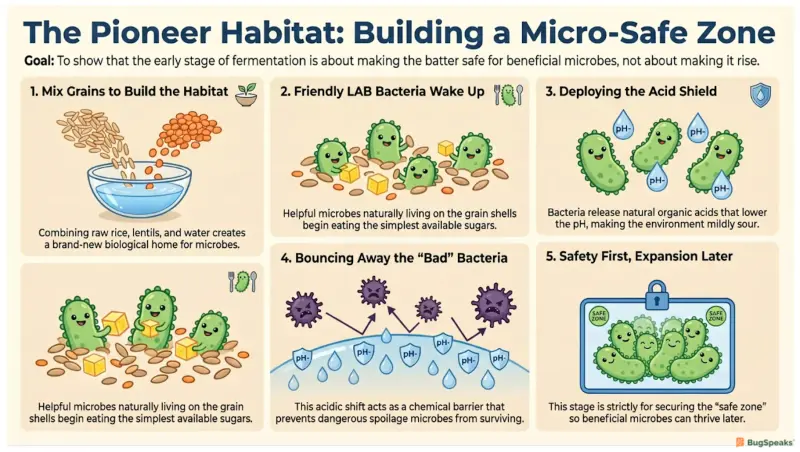
What happens to the batter during the early pioneer community phase of fermentation?
During the early pioneer community phase, the newly mixed batter acts as a fresh Microbial Habitat where initial bacteria safely secure the wet environment. The moment you blend raw rice and lentils with water, you create a brand-new biological home. This physical mixing marks the literal starting line of the microbial community growth timeline. Within this fresh environment, oxygen is still present, allowing a specific group of wild bacteria, primarily Lactic Acid Bacteria (LAB), to wake up. These friendly microbes naturally live on the outer shells of the grains. They quickly settle into their new liquid home and start eating the simplest free sugars available. This stage builds a safe, foundational community before rapid growth begins [Samantaray & Saha (2026)].
As these pioneer microbes multiply, they fundamentally change the chemical landscape of their new habitat to block dangerous invaders. The LAB continuously digest the easy sugars and release small amounts of natural organic acids. This steady biological activity slowly lowers the overall pH of the batter, making the environment mildly sour. This acidic shift is a critical Biological Activity Marker because it acts like an invisible chemical shield. Bad bacteria that cause food to spoil simply cannot survive inside this acidic liquid. The pioneer phase is not about causing the batter to expand rapidly. Instead, it is strictly focused on creating a specialized, safe acidic zone where only beneficial microbes can safely thrive later [Samantaray & Saha (2026)].
While the colonizing bacteria build their protective acid shields, wild yeasts operating within the pioneer community begin their own subtle metabolic work. These microscopic yeasts start generating tiny amounts of carbon dioxide gas alongside trace amounts of alcohol. When you look closely at the batter, you will see early Biological Activity Markers appearing as tiny, scattered bubbles forming near the surface. This very first gas production is essential for slowly adding air into the dense mixture. It creates tiny internal pockets of space inside the thick microbial habitat. Later on, these tiny pockets will expand, ultimately giving the final cooked food its famous soft, airy, and easily digestible texture that humans love [Samantaray & Saha (2026)].
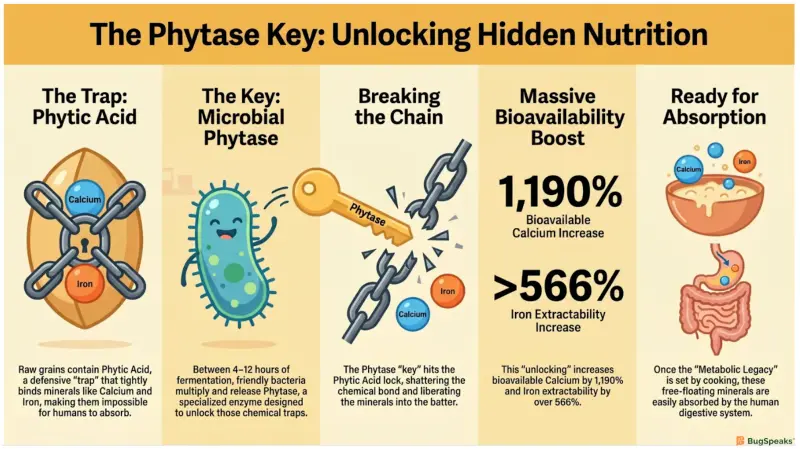
How does the mid-fermentation growth phase unlock hidden nutrients in the batter?
The mid-fermentation growth phase unlocks hidden nutrients because the multiplying microbial community produces specialized enzymes that actively dismantle protective chemical traps. Moving forward on the timeline, usually between the fourth and twelfth hours, the Microbial Habitat experiences an explosion of biological activity. The Lactic Acid Bacteria (LAB) multiply at their maximum speed. Because the environment is now comfortably acidic, these dominant microbes release a very specific enzyme called Phytase. Think of this enzyme as a precision biological key. It is uniquely designed to locate and destroy Phytic Acid, a natural defensive trap found inside raw grains that holds tightly onto essential minerals [Annapurna & Andallu (2022);Hariharamohan et al. (2026)].
In an unfermented habitat, Phytic Acid tightly locks away essential human dietary minerals like calcium, iron, and zinc. These bound minerals are completely trapped, meaning the human digestive system cannot absorb them. However, during the intense growth phase, the microbial Phytase enzymes systemically break apart these exact chemical traps. The enzyme forces the trap open, liberating the essential minerals directly into the surrounding wet batter. This massive internal transformation greatly increases the Bioavailability of the nutrients. This simply means that once the food is eventually eaten, the human body can instantly and easily absorb all of the floating calcium, iron, and zinc [Hariharamohan et al. (2026)].
The mathematical efficiency of this mineral liberation during the active growth phase is biologically remarkable. Scientific tests on fermented red rice and millet habitats show massive increases in available nutrition during this exact timeline window. For instance, the amount of bioavailable calcium can increase by an astonishing 1190%, while iron extractability multiplies by over 566% compared to raw grains [Hariharamohan et al. (2026)]. Even if you artificially add extra nutrients into the habitat, like electrolytic iron to fight public health issues, the strong microbial ecosystem easily accepts it without slowing down the ongoing biological timeline. This proves how powerful the natural microbial system truly is [Fortifying Idli Batter (2024)].
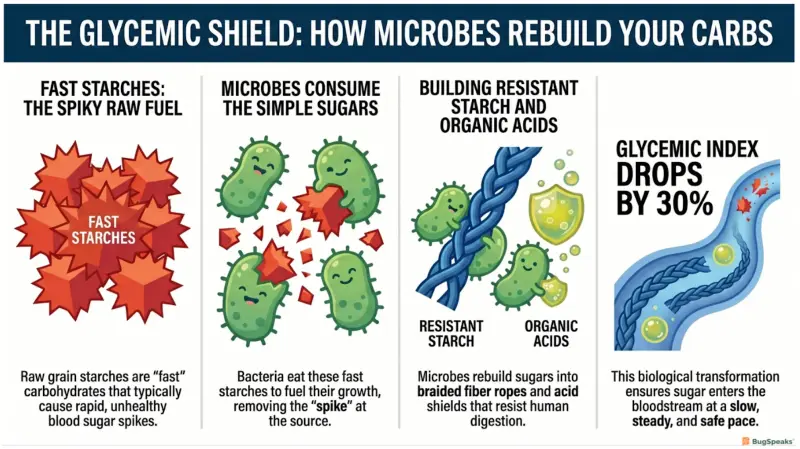
Why does the microbial ecosystem change how the batter affects human blood sugar?
The microbial ecosystem lowers the glycemic impact of the batter by consuming fast-acting starches and converting them into protective organic acids and resilient digestive fibers. As the microbial community growth timeline advances, the aggressive metabolic activity inside the Microbial Habitat fundamentally alters how the human body will process the food. In raw rice and lentils, starches digest extremely quickly, causing rapid, unhealthy spikes in human blood sugar. However, during the active growth phase, the rapidly multiplying bacteria use these exact fast starches as their main food source. They systematically eat the simple carbohydrates to fuel their own rapid cellular expansion [Samantaray & Saha (2026)].
The direct biological result of this massive starch consumption is the heavy production of organic acids, like lactic acid and acetic acid. When a human eventually eats these microbially produced acids, they act as an invisible shield inside the stomach. The acids physically slow down human digestion and actively block the human enzymes that normally break down starches. Consequently, this heavily lowers the Glycemic Index (GI) of the final food by up to thirty percent. This biological shift ensures that the remaining carbohydrates enter the human bloodstream at a remarkably slow, steady pace, naturally preventing dangerous blood sugar crashes [Samantaray & Saha (2026)].
At the same time, the microbial ecosystem forces the physical formation of highly resilient carbohydrate chains called Resistant Starch. As the microbes constantly reorganize the wet habitat, they change normal starches into tough fibers that human digestion cannot easily break. Instead of turning into sugar, this special fiber travels safely to the human colon. There, it feeds the human's own gut bacteria, which then produce highly beneficial Short-Chain Fatty Acids (SCFAs). The microscopic bacteria also produce sticky sugar molecules called Exopolysaccharides to protect themselves, which further improves the batter's physical structure while slowing down sugar absorption [Samantaray & Saha (2026)].
Table 1: Nutritional Unlocking During The Growth Phase
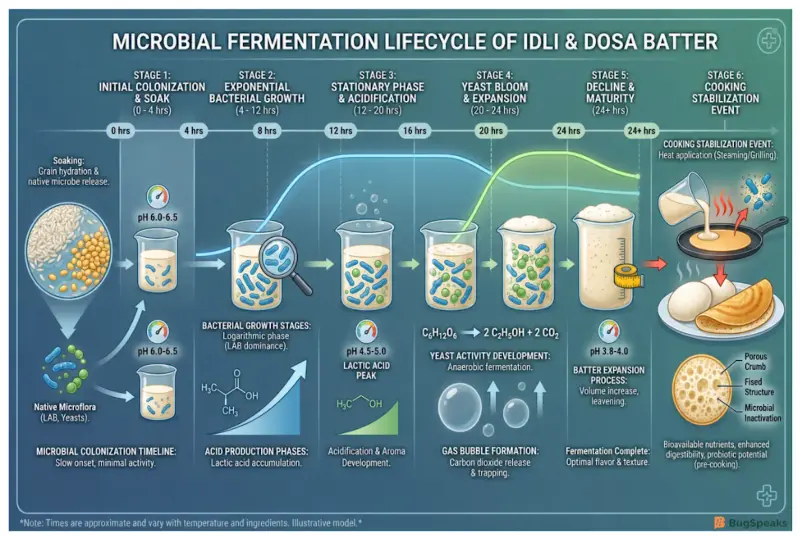
What happens to the microbial habitat if fermentation continues into the mature extended phase?
If fermentation continues into the mature extended phase, the microbial ecosystem becomes hyper-acidic, maximizing final mineral extraction but severely risking the physical collapse of the batter. Extending the microbial community growth timeline beyond twelve hours pushes the batter directly into this saturated phase. The early pioneer and growth phase microbes have now completely colonized every single millimeter of the Microbial Habitat. Their relentless biological activity pushes the physical and chemical limits of the environment. The Biological Activity Markers, specifically the organic acids and trapped gases, reach their absolute maximum levels, creating an intensely sour, highly pressurized internal environment [Annapurna & Andallu (2022)].
This extended mature phase does offer a very specific, measurable nutritional advantage regarding mineral release. Because the habitat stays intensely acidic for a prolonged twenty-four-hour timeline, the Phytase enzymes have much more time to dismantle any remaining Phytic Acid traps. Scientific studies comparing twelve-hour and twenty-four-hour timelines clearly show that the total extractability of minerals like calcium can nearly double during this extended period. The uninterrupted exposure to the massive microbial ecosystem ensures that almost every single micronutrient is chemically freed from the tough raw grains, maximizing the absolute nutritional density of the batter mixture [Annapurna & Andallu (2022)].
However, this mature twenty-four-hour timeline introduces massive physical risks to the habitat structure. The bacteria relentlessly produce massive amounts of acid, making the environment entirely toxic, which chemically dissolves the proteins holding the batter together. This causes Ecosystem Destabilization. The habitat completely loses its physical strength, and the thousands of trapped gas bubbles that provide fluffiness begin to actively pop. Visually, the batter becomes flat, completely exhausted, and overly sticky. The excessive acid also creates overwhelmingly pungent off-odors and highly sour flavors that most humans find totally unappealing, proving that longer fermentation is not always better [Annapurna & Andallu (2022)].
How does the final cooking step safely preserve the outcomes of this microbial timeline?
The final cooking step preserves the outcomes of the microbial timeline by instantly stopping all bacterial activity and permanently locking the newly formed nutrients into place. This is called a Biological Preservation Event. Heating the batter through steaming or pan-roasting acts as the non-negotiable finish line for the microbial community growth timeline. When the highly active batter is hit by extreme thermal heat, the Microbial Habitat is instantly sterilized. The living bacteria, wild yeasts, and the active Phytase enzymes are completely shut down. This sudden halt stops the ecosystem from crossing over into toxic, sour over-fermentation [Samantaray & Saha (2026)].
Even though the living microbes are eliminated by the extreme heat, their entire Metabolic Legacy remains perfectly intact. Cooking successfully captures all the hard work the microscopic community achieved during the growth phase. The precious calcium, iron, and zinc that were painstakingly freed from their restrictive traps are safely locked into their highly absorbable forms. The heavily transformed carbohydrates, including the healthy Resistant Starch fibers, are permanently stabilized within the solidifying food. The thermal heat essentially takes a perfect chemical snapshot of the batter at its absolute peak nutritional density and successfully freezes it in time [Annapurna & Andallu (2022);Hariharamohan et al. (2026)].
Beyond preserving nutrition, cooking is fundamentally required to capture the physical architecture built by the microbes. Throughout the timeline, the multiplying yeasts generated thousands of microscopic gas bubbles, safely trapped inside the sticky batter. As the intense heat penetrates the wet habitat, it causes Thermal Setting. The heat rapidly hardens the grain proteins directly around these delicate gas bubbles. This instant hardening transforms the wet, bubbly liquid into a soft, porous, and highly aerated solid food. Ultimately, applying heat permanently harvests the absolute best biological outcomes of the entire microbial timeline, creating a perfectly digestible meal [Annapurna & Andallu (2022)].
Table 2: The Microbial Community Growth Timeline
-Varsha V
Visualize the process- https://youtu.be/gxbFo9LRpI4
Reference
Samantaray, P., & Saha, S. (2026). Decoding the Microbial Diversity of Indian Fermented Foods: Integrating Ethnobiology, Multi-Omics and Functional Insights. Foods (Basel, Switzerland), 15(4), 687. https://doi.org/10.3390/foods15040687
Annapurna, A., & Andallu, B. Effect of Fermentation on the Nutritive Value, Bioavailability of Minerals and Acceptability of Pearl Millet Idli.
Hariharamohan, M., Chindarkar, M., Swain, H. S., Rajesh, N., & Rajesh, V. (2026). Integrating physicochemical and microbial characterization of red rice broth fermented over an 18-hour period augmented with metagenomic and metabolomic approaches. RSC advances, 16(23), 21129–21141. https://doi.org/10.1039/d6ra00382f
Veeranan Arun Giridhari, V., Uma Maheswari, T., Vanniarajan, C., Hariharan, T., & Karthikeyan, S. (2025). Probing the metagenome and nutritional composition of idli batter fortified with electrolytic iron for addressing anaemia. Journal of food science and technology, 62(8), 1481–1490. https://doi.org/10.1007/s13197-024-06119-5