Exploring the Cultural Significance of Fermentation in India
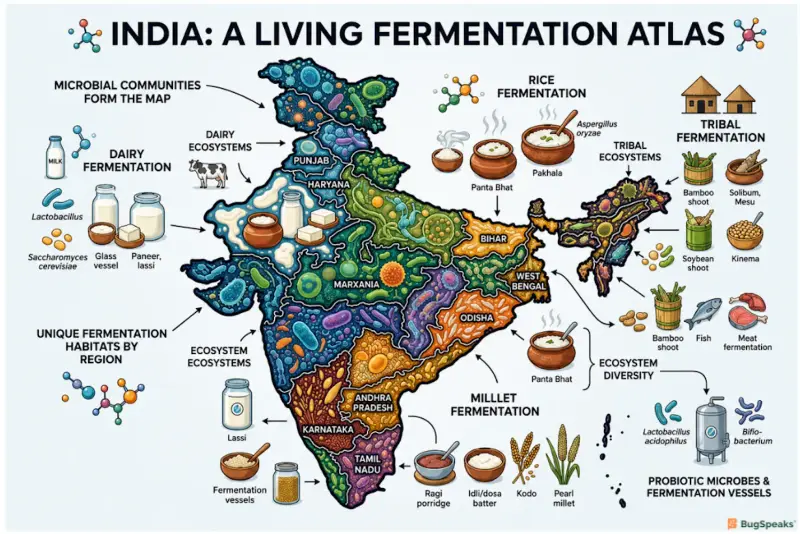
How does geography shape India's diverse probiotic drinks?
Geography shapes India’s diverse probiotic drinks by acting as a vast microbial continent where distinct climates, temperatures, and local agricultural ingredients select for highly specialized fermentation ecosystems. Across this massive landmass, every state operates as a self-sustaining biological region. The humid tropics of the south, the cold alpine stretches of the Himalayas in states like Sikkim, and the fertile deltas of Odisha and West Bengal each provide entirely different baseline climatesSamantaray and Saha (2026). Because microbes are highly sensitive to temperature and moisture, physical geography naturally dictates which microscopic populations can survive. As a result, the map of India is a living atlas of bacterial and fungal communities perfectly adapted to their local environments.
Within these distinct regional states, every traditional fermented drink serves as a specific local microbial habitat. For these habitats to flourish, they require ecosystem resources provided by locally available crops. In the northern plains of Punjab, vast dairy herds provide the foundational resources for milk-based microbial communities. In contrast, the high-rainfall regions of the northeast produce abundant rice and bamboo, creating carbohydrate-rich resources for entirely different microbesSamantaray and Saha (2026). The microbes do not migrate randomly; they establish permanent residency where their preferred food sources naturally grow, explaining why a rice-based bacterial community flourishes in the east while a milk-digesting community dominates the north.
The final element shaping these habitats is the environmental conditions applied by human preparation methods. Whether a local community boils their ingredients or buries them in earthen pots, these actions dramatically alter the living conditions within the beverage. In the cold Himalayan regions, low ambient temperatures select for cold-tolerant microbes that metabolize slowly, producing foods like Chhurpi and Gundruk. In contrast, in the humid southern coasts, warm temperatures accelerate microbial activitySamantaray and Saha (2026). Together, the geography, the available crop resources, and the traditional preparation methods form a tightly woven environmental web that maps exactly which probiotics native populations consume.
Which microbes inhabit the dairy-based ecosystems across India's diverse states?
The dairy-based ecosystems spanning India's Northern, Western, and Eastern states are primarily inhabited by resident fermentation communities of Lactic Acid Bacteria (LAB), such as Lactobacillus and Streptococcus thermophilus, which thrive in habitats heavily resourced by cow and buffalo milk. Across these regions, liquid milk forms the foundation for distinct local habitats: from the rich Lassi of Punjab and Malai Lassi of Rajasthan, to the highly diluted Taak of Maharashtra and Chaas of GujaratPrasad et al. (2026). Moving eastward, Bihar engineers Mattha using five-spice blends (panchforan), West Bengal creates a frothy, sweet-savory balance in Ghol, and the Northeast regions like Manipur blend yogurt with honey and lemon to create Dahi SharbatPrasad et al. (2026). Despite the visual and flavor differences, all these liquid habitats are dominated by naturally occurring LAB populations that rapidly consume lactose (milk sugar) to secure their survival.
As these resident bacteria consume the ecosystem resources, they initiate a process called acidification. By releasing lactic acid as a natural byproduct of their feeding, the LAB drastically lowers the overall pH of the beverage (Prasad et al., 2026). This shift acts as a biological defense mechanism; spoilage bacteria cannot survive in high acidity. As the environment becomes more acidic, the milk proteins clump together, transforming the thin liquid into the thick, creamy structure characteristic of these traditional drinks. The nutritional yield of this transformed habitat is deeply tied to complex structures like the Milk Fat Globule Membrane (MFGM), which is naturally present in the milk resources. During fermentation, resident communities interact with these structures, enhancing the availability of beneficial compounds that support human digestion and cellular repairPrasad et al. (2026).
When humans consume these regionally adapted dairy habitats, they ingest billions of highly specialized bacteria. Biology indicates that these dairy-adapted microbes can temporarily integrate into the human digestive tract, where they continue their natural behaviors: producing organic acids, fortifying the intestinal wall, and interacting with human immune cellsPrasad et al. (2026). By drinking Ghol, Taak, or Mattha, the microbial communities cultivated across different states effectively transfer their unique balancing and protective capabilities directly into the human biological network.
How do traditional fermentation methods create the tribal rice beer habitats of the Northeast?
Traditional fermentation methods create the tribal rice beer habitats of the Northeast by utilizing specific preparation techniques, such as roasting or steaming, to establish environmental conditions that selectively support diverse saccharolytic microbes. In the high-rainfall, biodiverse states of Assam and Nagaland, the Mishing community cultivates beverages like Apong using abundant local ecosystem resources: rice, forest botanicals, and indigenous starter cakes. These starter cakes act as concentrated biological seeds, carrying a dormant population of carefully preserved yeasts and bacteria. When introduced to the carbohydrate-rich rice resources, these microbes awaken and begin to systematically colonize their new liquid habitatDas et al. (2023).
The specific environmental conditions applied during preparation dictate exactly which microbes will survive. The Mishing community produces two distinct variations of Apong: Poro and Nogin. Poro utilizes solid-state fermentation, where roasted rice and alkaline rice husk ash are mixed, creating a nutrient-dense, dark environment that encourages the dominance of resident communities like Oscillibacter and Agathobacter. Conversely, Nogin is created using steamed rice in a traditional liquid suspension, selecting for entirely different microbial residents like the Eubacterium groupDas et al. (2023). By slightly altering the physical architecture and mineral content of the resources, the human preparers deliberately engineer two totally distinct microscopic ecosystems.
As these saccharolytic microbes break down complex starches, they release chemical byproducts that enrich the habitat, converting raw grain energy into accessible nutrients, mild alcohol, and highly beneficial Short-Chain Fatty Acids (SCFAs). When the local populations consume these rich microbial habitats, the ingested ecosystem merges with their own internal network. Studies show that regular consumers of these specific rice habitats possess elevated internal diversity, featuring prominent populations of Prevotella and Succinivibrio microbes heavily associated with processing plant-rich dietsDas et al. (2023). Thus, the external fermentation ecosystem has a direct, measurable influence on the internal metabolic landscape and blood sugar regulation of the human host.
What resources sustain the vegetable-based microbial communities in traditional Kanji?
The vegetable-based microbial communities in traditional Kanji are sustained by ecosystem resources, including black carrots, beetroot, and mustard seeds, which provide fermentable carbohydrates and natural antimicrobial compounds. In the northern regions of India (such as Punjab and Haryana), this deep purple beverage is created through spontaneous fermentation, meaning no external starter cakes are added. Instead, the raw vegetables themselves serve as the carriers for the initial microbial settlers. Once submerged in water, these resident fermentation communities wake up and begin extracting simple sugars from the root vegetables to fuel their rapid expansionVerma and Sharma (2026).
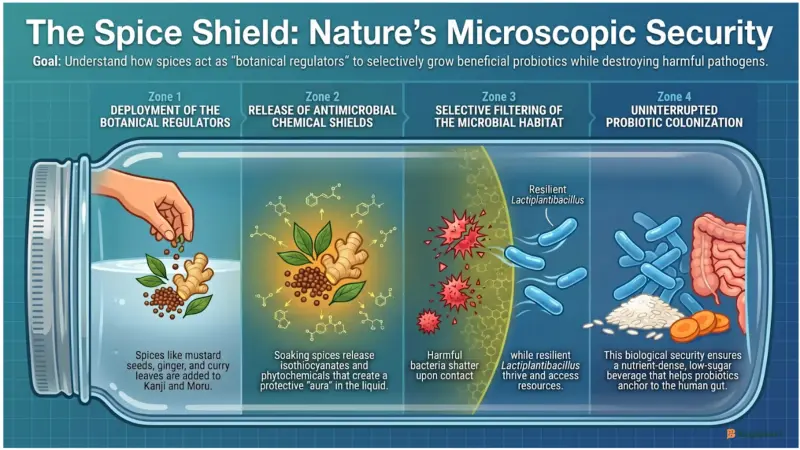
To ensure that only beneficial microbes take over this new aquatic habitat, the ecosystem is strictly regulated by the addition of crushed mustard seeds. As they soak, mustard seeds act as botanical regulators, releasing chemical compounds (isothiocyanates) that are toxic to harmful spoilage bacteria but relatively harmless to resilient LAB strains. This precise environmental condition ensures that highly adapted bacteria, specifically Lactiplantibacillus plantarum and Pediococcus acidilactici, quickly outcompete unwanted invadersVerma and Sharma (2026). As these robust bacteria multiply, they heavily acidify the water, finalizing the security of their habitat and creating the tangy flavor profile unique to Kanji.
During this intense biological activity, the microbes significantly upgrade the nutritional value of their habitat. Black carrots are naturally rich in anthocyanin pigments that provide high antioxidant capacity. As the bacteria break down the cellular walls of the carrots, they release these bound antioxidants into the surrounding liquid, making them easier for the human body to absorb. Because the resident microbes consume a significant portion of the natural vegetable sugars to survive, they drastically lower the carbohydrate load, resulting in a beverage with a lowered Glycemic Index (GI). When a person drinks Kanji, they are consuming a low-sugar, antioxidant-rich serum loaded with active, acid-resistant bacteria fully equipped to survive the human stomachVerma and Sharma (2026).
How do the Southern tropical habitats support resident probiotic communities in traditional beverages?
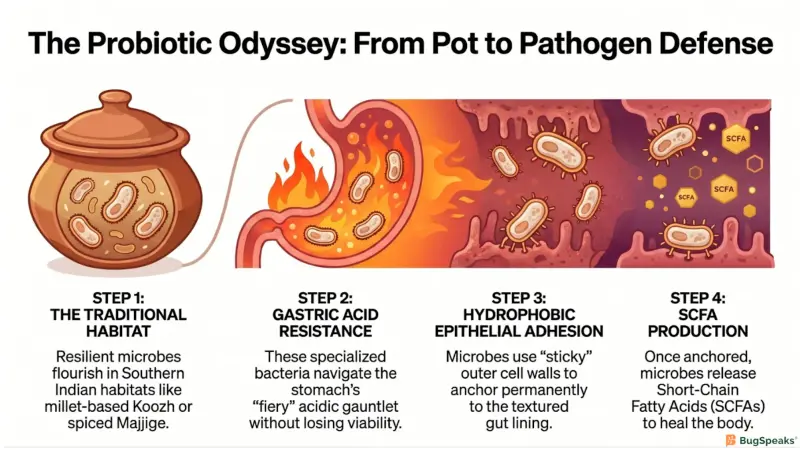
The Southern tropical habitats of Tamil Nadu, Karnataka, and Kerala support resident probiotic communities by utilizing starchy millets and spiced buttermilk as rich ecosystem resources, creating highly resilient bacterial environments perfectly adapted to the hot, humid climate. In Tamil Nadu, local populations engineer Koozh, a dense, porridge-like beverage made from finger milletIlango et al. (2016). This specific habitat undergoes a rigorous two-step spontaneous fermentation process, building an incredibly stable biological matrix. Because of the dense nature of the millets, only highly specialized LAB, specifically Enterococcus hirae and Lactobacillus plantarum, can successfully establish residency. To extract energy, these bacteria deploy specific enzymes that dismantle the tough outer structures of the grains, effectively destroying antinutritional factors like phytates. This biological unlocking dramatically increases the bioavailability of essential minerals, making calcium and iron accessible to the human bodyIlango et al. (2016).
Moving from dense millets to highly diluted liquid ecosystems, the neighboring states of Karnataka and Kerala cultivate specialized buttermilk habitats known as Majjige and Moru, while Tamil Nadu also produces Neer Mor. In the intense heat of the Southern tropics, these beverages function as unique thermoregulatory habitats, providing rapid hydration and internal coolingPrasad et al. (2026). Unlike the thick matrix of Koozh, these liquid ecosystems are up to 90% water and depend on botanical regulators to maintain microbial purity. In Kerala’s Moru, crushed garlic, turmeric, ginger, and mustard seeds tempered in coconut oil are introduced into the buttermilk, while Karnataka’s Majjige utilizes curry leaves, green chilies, and asafoetidaPrasad et al. (2026).
These specific local spices act as strict environmental filters. The essential oils and phytochemicals released by these spices suppress unwanted spoilage organisms, ensuring that only the most resilient, acid-producing bacteria secure the habitatPrasad et al. (2026). The physical traits of the surviving microbes make them exceptionally suited for human health. Testing reveals that these Southern strains possess high hydrophobicity, meaning their outer cell walls are naturally sticky. This allows them to safely navigate the harsh acids of the stomach and firmly anchor themselves to the lining of the human Gastrointestinal Tract (GIT)Ilango et al. (2016). By consuming these beverages, Southern Indian populations effectively transplant heavily defended, mineral-rich biological ecosystems directly into their own physiological networks.
-Varsha V
Visualize the process- https://youtu.be/zHu_lsOMAug
Reference
Verma, Usha, and Subhash Sharma. 2026. “Microbial Diversity and Identification Approaches in Traditional Fermented Kanji: A Comprehensive Review”. European Journal of Nutrition & Food Safety 18 (3):69-79. https://doi.org/10.9734/ejnfs/2026/v18i31975.
Prasad, H., Song, S., Jang, M. J., Kim, H., Razzak, M. A., Haque, M. A., ... & Ku, S. (2026). A Multidisciplinary Review of the Microbial, Functional, and Consumer Advancement of Indian Lassi. Probiotics and Antimicrobial Proteins, 1-26.
Samantaray, P., & Saha, S. (2026). Decoding the Microbial Diversity of Indian Fermented Foods: Integrating Ethnobiology, Multi-Omics and Functional Insights. Foods (Basel, Switzerland), 15(4), 687. https://doi.org/10.3390/foods15040687
Sharma, C., Sahota, P. P., & Kaur, S. (2021). Physicochemical and microbiological evaluation of antioxidant-rich traditional black carrot beverage: Kanji. Bulletin of the National Research Centre, 45(1), 143. https://doi.org/10.1186/s42269-021-00594-y
Dini, I. (2026). Probiotics and Fermented Foods in Human Nutrition. Molecules, 31(8), 1353. https://doi.org/10.3390/molecules31081353
Das, S., Özkurt, E., Joishy, T. K., Mukherjee, A. K., Hildebrand, F., & Khan, M. R. (2023). A single dietary factor, daily consumption of a fermented beverage, can modulate the gut bacteria and fecal metabolites within the same ethnic community. mSystems, 8(6), e0074523. https://doi.org/10.1128/msystems.00745-23
Ilango, S., Pandey, R., & Antony, U. (2016). Functional characterization and microencapsulation of probiotic bacteria from koozh. Journal of food science and technology, 53(2), 977–989. https://doi.org/10.1007/s13197-015-2169-5
Samantaray, P., & Saha, S. (2026). Decoding the Microbial Diversity of Indian Fermented Foods: Integrating Ethnobiology, Multi-Omics and Functional Insights. Foods (Basel, Switzerland), 15(4), 687. https://doi.org/10.3390/foods15040687
Pathi, B. K., Sahoo, J. P., Panigrahi, K., Pattnaik, S. S., Dash, S. K., Patro, S., Mishra, D., Pattnaik, D., Behera, M. R., & Das, M. K. (2025). Prevention of Clostridium Difficile Infection Among Hospitalized Elderly Patients Using Torani (Fermented Rice Water) and Xylitol Mixture Drink: The Study Protocol of an Open-Label Randomized Controlled Trial. Cureus, 17(6), e85635. https://doi.org/10.7759/cureus.85635
Tamang J. P. (2022). "Ethno-microbiology" of ethnic Indian fermented foods and alcoholic beverages. Journal of applied microbiology, 133(1), 145–161. https://doi.org/10.1111/jam.15382