Exploring the Health Benefits of Fermented vs. Probiotic Foods
Are all fermented foods considered probiotics?
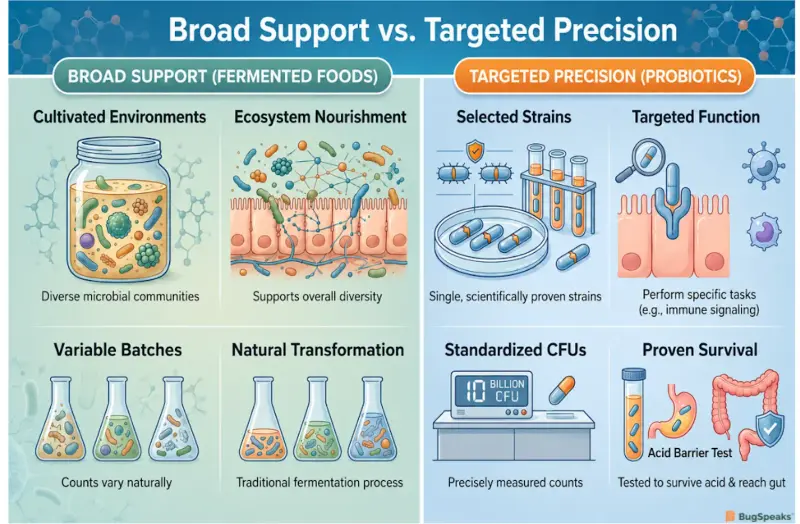
No, not all fermented foods are considered probiotics, because probiotics are specifically selected beneficial strains proven to support health, whereas fermented foods are broader categories of cultivated microbial environments.
Have you ever wondered whether yogurt, kimchi, kefir, or kombucha are true probiotics? The answer is more specific than most people realize. Scientists use strict standards before a microbe can officially be called a probiotic. A probiotic must be a live microbe that has been scientifically tested and proven to provide a measurable health benefit in humans (Dini, 2026).
Fermented foods work differently. They are created through a natural microbial transformation in which bacteria or yeast convert raw ingredients into new foods. Cabbage becomes sauerkraut, milk becomes yogurt, and tea becomes kombucha. These foods harbor diverse microbial communities, but the specific strains and quantities can vary from batch to batch (Mukherjee et al., 2024).
You can think of fermented foods as cultivated microbial environments. During fermentation, naturally occurring microbes reshape the food, improve flavor, and generate beneficial compounds. However, scientists often cannot guarantee which exact microbes survive in every jar or whether they remain alive after digestion. Because of this variability, fermented foods usually cannot be classified as true probiotics (Terpou et al., 2025).
True probiotics are far more controlled. These are specifically selected beneficial strains chosen for precise biological functions. Before approval, researchers test whether the microbes can survive stomach acid, tolerate digestive chemicals, and provide measurable health effects inside the gut. This survival process is part of a complex ecological adaptation process that allows the microbes to safely reach the large intestine (Uhegwu & Anumudu, 2025).
Another major difference is measurement. Probiotics are counted using Colony-Forming Units (CFU), which measure the exact number of living microbes in a serving. Scientists rely on these counts because many probiotic effects only occur at specific doses. Fermented foods may contain large numbers of live microbes, but their microbial populations are usually not standardized or precisely measured (Dini, 2026).
Both fermented foods and probiotics can support health, but they serve different biological roles. Fermented foods provide broad ecosystem nourishment, while probiotics deliver targeted microbial functions.

What happens to food during the microbial fermentation process?
During fermentation, microbes break down raw food through a controlled microbial transformation that improves digestion, nutrient availability, and food preservation.
Fermentation begins when bacteria or yeast consume natural sugars found inside foods like vegetables, grains, or milk. As the microbes feed, they reshape the food’s chemistry, flavor, texture, and acidity. This process turns milk into yogurt or cabbage into sauerkraut while creating an acidic environment that prevents harmful microbes from growing (Terpou et al., 2025).
One of the most important microbial groups involved is Lactic Acid Bacteria (LAB). These bacteria produce lactic acid, which lowers the food’s pH and helps preserve it safely. At the same time, the microbes generate Bioactive Metabolites such as vitamins, peptides, enzymes, and Short-Chain Fatty Acids (SCFAs) that can later support human gut health (Mukherjee et al., 2024).
Fermentation also improves nutrient absorption. Many plant foods naturally contain compounds that bind minerals like zinc, calcium, and iron, making them harder for the body to absorb. During fermentation, microbial enzymes help break down these compounds and release trapped nutrients. As a result, fermented foods often become easier to digest and nutritionally richer than their raw versions (Dini, 2026).
Even when live microbes do not survive digestion, fermentation still provides benefits. Dead microbes leave behind Postbiotics, which include microbial cell fragments, metabolites, and structural components that can still influence the immune system and help maintain gut barrier strength (Dini, 2026).
This means the value of fermented foods extends beyond live bacteria alone. The transformation process itself creates nutrients, microbial byproducts, and digestive support compounds that contribute to overall gut ecosystem health.
How do specific probiotic strains survive the human digestive system?
Specific probiotic strains survive digestion through an ecological adaptation process that protects them from stomach acid, bile salts, and intestinal washout.
The digestive system is an extremely hostile environment for microbes. The stomach contains highly acidic fluids designed to destroy dangerous organisms before they reach the intestines. Most ordinary bacteria cannot survive this environment. However, specifically selected beneficial strains are screened for acid resistance before being used as probiotics (Uhegwu & Anumudu, 2025).
After leaving the stomach, probiotics encounter bile salts in the small intestine. Bile helps digest fats, but it can also damage bacterial cell membranes. To survive, some probiotic strains produce Bile Salt Hydrolase (BSH) enzymes that help neutralize bile toxicity and protect the microbes during transit (Dini, 2026).
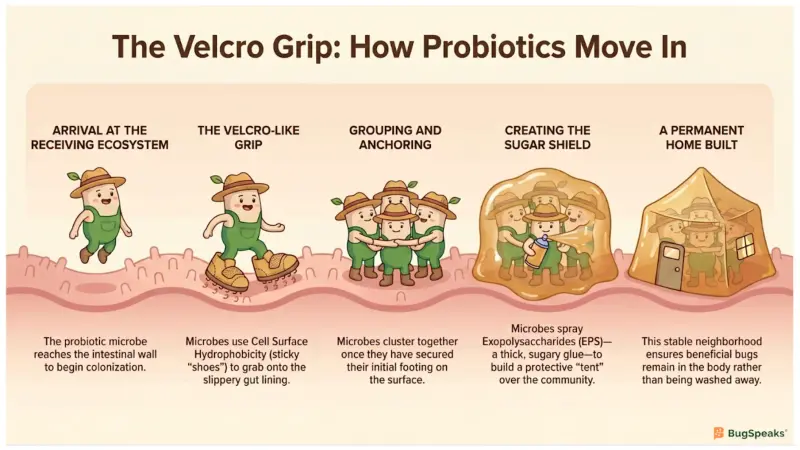
Reaching the large intestine is only part of the challenge. Microbes also need to remain attached long enough to function. Many probiotics use Cell Surface Hydrophobicity to stick to the intestinal lining. This improves their ability to temporarily colonize the gut and interact with nearby microbes and immune cells (Uhegwu & Anumudu, 2025).
Some strains also produce Exopolysaccharides (EPS), thick protective sugars that form a microbial shield around bacterial communities. EPS structures help microbes tolerate stress, improve adhesion, and create stable microbial neighborhoods inside the gut ecosystem (Mukherjee et al., 2024).
These survival traits explain why not every live microbe qualifies as a probiotic. Effective probiotics must remain stable, survive digestion, and demonstrate measurable health effects after entering the gut.
Why do prebiotics matter for these live microbial cultures?
Prebiotics matter because they act as growth-support nutrients that feed beneficial microbes inside the gut.
The gut microbiome is a highly competitive ecosystem where microbes constantly compete for resources. Even beneficial probiotic strains struggle to survive if they do not receive the nutrients they need. This is where Prebiotics become important. Prebiotics are specialized plant fibers that humans cannot digest, but gut microbes can ferment and use as fuel (Whelan et al., 2024).
When microbes ferment these fibers, they produce Short-Chain Fatty Acids (SCFAs) such as butyrate, acetate, and propionate. These compounds serve as major energy sources for cells lining the colon and help maintain the strength of the intestinal barrier (Terpou et al., 2025).
A healthy supply of prebiotic fibers also encourages beneficial microbes to grow and remain active. Diets rich in fiber are consistently associated with healthier microbial diversity and improved gut ecosystem stability (Mukherjee et al., 2024).
Scientists have even developed combinations called Synbiotics, which pair probiotics with their preferred prebiotic fuel source. These combinations are designed to improve microbial survival and increase the likelihood that beneficial strains remain active after reaching the gut (Whelan et al., 2024).
Supporting beneficial microbes, therefore, requires more than simply consuming probiotics. The surrounding nutritional environment also determines whether these microbes can survive, grow, and function effectively inside the receiving ecosystem.

How do fermented foods and targeted probiotics differ in supporting gut health?
Fermented foods provide broad microbial ecosystem support, while targeted probiotics are designed for specific biological functions.
Fermented foods such as kefir, kimchi, yogurt, miso, and sauerkraut support gut health through multiple mechanisms. They contain microbial metabolites, partially digested nutrients, vitamins, organic acids, and postbiotics created during fermentation. These compounds help nourish the gut environment even when live microbes are no longer active (Terpou et al., 2025).
This broad support makes fermented foods valuable for maintaining microbial diversity and improving overall gut ecosystem conditions. Their benefits come from the entire fermentation process rather than from one precisely defined microbial strain (Mukherjee et al., 2024).
Targeted probiotics work differently. Scientists select individual strains because they perform specific biological tasks, such as supporting immune responses, reducing digestive symptoms, improving lactose digestion, or helping defend against harmful microbes (Uhegwu & Anumudu, 2025). These effects require carefully tested strains with verified survival ability and measured doses.
Rather than competing with each other, fermented foods and probiotics often work best together. Fermented foods help maintain a supportive microbial environment, while targeted probiotics provide specialized functions when needed. Combining fermented foods, fiber-rich prebiotics, and evidence-based probiotics may offer the strongest long-term support for the receiving ecosystem (Dini, 2026).
Understanding this distinction helps explain why not all fermented foods are automatically probiotics, even though both can contribute to better gut health in different ways.
-Varsha V
Visualize the process- https://youtu.be/kuHf5gqjtRs
Reference
Dini, I. (2026). Probiotics and Fermented Foods in Human Nutrition. Molecules, 31(8), 1353.https://doi.org/10.3390/molecules31081353
Whelan, K., Alexander, M., Gaiani, C., Lunken, G., Holmes, A., Staudacher, H. M., Theis, S., & Marco, M. L. (2024). Design and reporting of prebiotic and probiotic clinical trials in the context of diet and the gut microbiome. Nature microbiology, 9(11), 2785–2794.https://doi.org/10.1038/s41564-024-01831-6
Mukherjee, A., Breselge, S., Dimidi, E., Marco, M. L., & Cotter, P. D. (2024). Fermented foods and gastrointestinal health: underlying mechanisms. Nature reviews. Gastroenterology & hepatology, 21(4), 248–266.https://doi.org/10.1038/s41575-023-00869-x
Terpou, A., Dahiya, D., & Nigam, P. S. (2025). Evolving Dynamics of Fermented Food Microbiota and the Gut Microenvironment: Strategic Pathways to Enhance Human Health. Foods (Basel, Switzerland), 14(13), 2361.https://doi.org/10.3390/foods14132361
Uhegwu, C. C., & Anumudu, C. K. (2025). Probiotic Potential of Traditional and Emerging Microbial Strains in Functional Foods: From Characterization to Applications and Health Benefits. Microorganisms, 13(11), 2521.https://doi.org/10.3390/microorganisms13112521