The Lifelong Impact of Early Nutrition on Gut Microbiome Health
How does the gut microbiome develop during the first years of life?
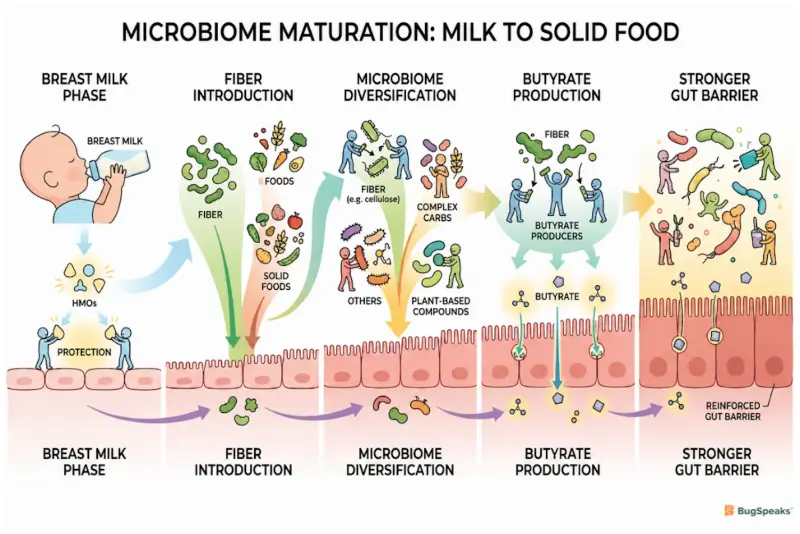
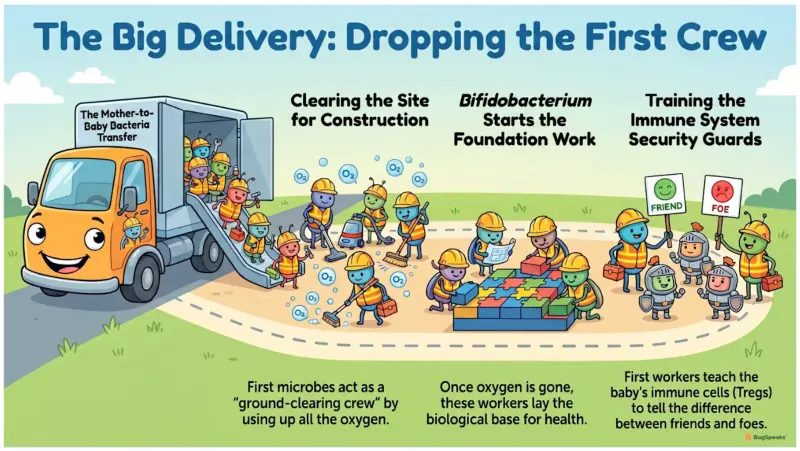
The gut microbiome builds itself step-by-step from birth to age three, creating a strong biological base for your lifelong health. During this critical developmental phase, a baby's gut is like an empty, developing construction site. Before birth, a baby's gut has almost no bacteria, meaning the real building work starts the exact moment they are born [de Groen et al. (2026)]. The very first microbes to arrive act like a ground-clearing crew. They quickly use up all the oxygen inside the newborn's gut. Once the oxygen is completely gone, special bacteria called Bifidobacterium can safely move in. These highly important workers begin laying down the foundational biological communities that keep the baby healthy.
As the baby grows, these foundational biological communities assemble in a very clear, step-by-step order. Scientists have found three main building stages: the early stage, the middle stage, and the stable stage [de Groen et al. (2026)]. At first, the gut only has a few types of bacteria. This means the foundation strength depends on a small crew of very hard workers, rather than a huge crowd of different bugs. As the toddler gets older, the building site gets much more complex. By the time a child reaches age three, their gut looks a lot like a grown-up’s fully built ecosystem [Nunez et al. (2025)]. This finishes the main biological construction project needed for a long, healthy life.
This step-by-step building process is not just about helping the stomach digest food; it is absolutely required to build the body’s integrated support infrastructure, which we call the immune system. The early microbial workers actively teach the baby's immune cells how to behave [Nunez et al. (2025)]. Coming into contact with these safe, helpful germs tells the body to create Regulatory T cells (Tregs) [de Groen et al. (2026)]. Think of these cells as security guards learning the rules. If the developing foundation site is built perfectly, these guards quickly learn to ignore safe things and only attack real dangers. This amazing training process secures the integrated support infrastructure so it works perfectly forever.
Why is breast milk so important for early gut health?
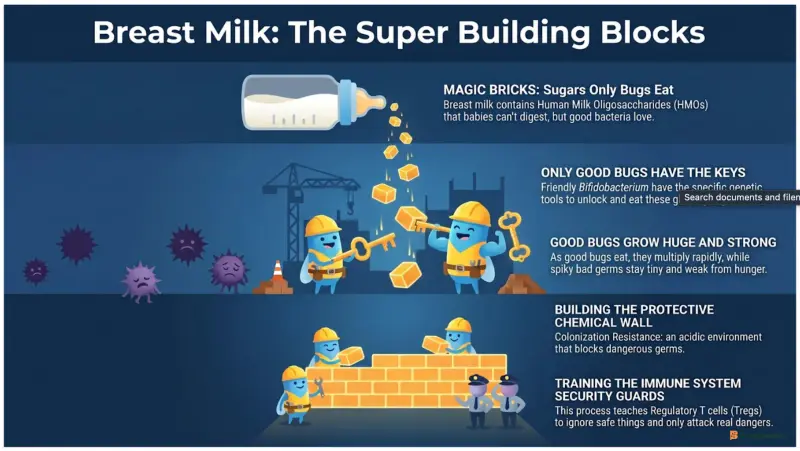
Breast milk is packed with special sugars that only feed the good bacteria, helping them multiply quickly while keeping the bad germs completely away. In our building simulation, breast milk is the premium construction material delivered straight to the developing foundation site. While the milk gives the baby protein to grow, a huge part of it is made of Human Milk Oligosaccharides (HMOs). A baby cannot digest these complex sugars at all [Nunez et al. (2025)]. Instead, these sugars travel untouched all the way down to the lower gut. They act strictly as perfect construction materials specifically designed to feed the foundational biological communities [Fontaine et al. (2026)]. This selective feeding guarantees the gut foundation is built right.
Only specific good bacteria, like certain types of Bifidobacterium, have the right genetic tools to unpack and eat these Human Milk Oligosaccharides [de Groen et al. (2026)]. When the good bugs eat these construction materials, they create helpful chemicals called Short-Chain Fatty Acids (SCFAs) [Nunez et al. (2025)]. These chemicals make the baby's gut slightly acidic. This acidic environment acts like a strong wall called Colonization Resistance. This wall makes the developing foundation site a terrible place for bad, invading germs to live [Nunez et al. (2025)]. Because of this clever chemical defense, only the safest and hardest-working microbes are allowed to stay and build the body's protective ecosystem.
Furthermore, breast milk constantly sends special immune proteins, like Secretory Immunoglobulin A (sIgA), straight into the baby’s gut to capture and destroy any sneaky bad germs [Fontaine et al. (2026)]. Babies who only drink regular commercial formula do not get these exact, perfectly made construction materials. Because they miss out on these materials, formula-fed babies often grow an unnatural foundation strength too quickly [de Groen et al. (2026)]. Their gut gets too many grown-up bacteria and tricky germs way too early, instead of the safe, carefully controlled environment that breast milk naturally creates [Nunez et al. (2025)]. Keeping this building process slow and controlled is incredibly important for keeping the child healthy.
How does introducing solid foods change the infant gut?
Adding solid foods brings completely new types of plant fibers into the gut, which drastically grows the bacterial workforce and changes how the whole system operates. In our learning simulation, this big change brings heavy-duty construction materials into the developing foundation site. This massive delivery forces the foundational biological communities to expand rapidly. For the first six months, the tiny workers only knew how to process liquid milk. However, when a baby starts eating solids, complex plant fibers suddenly arrive [Fontaine et al. (2026)]. This diet change forces the biological structure to adapt; the milk-drinking bugs step back, and brand-new workers called Firmicutes and Bacteroidetes rush in [de Groen et al. (2026)].
This huge diversification completely transforms what the developing foundation site produces. While the early milk workers mostly made one type of acid, the new grown-up workers, like the Lachnospiraceae family, are built to break down tough plant pieces into a super-fuel called Butyrate [Nunez et al. (2025)]. Butyrate provides massive energy directly to the cells lining the child's gut. When the body senses this new energy, it tells the integrated support infrastructure to lock its final structures into place [Nunez et al. (2025)]. Working together to chop up these heavy construction materials ensures the foundation strength hits its maximum level, readying the gut for a lifetime of eating all kinds of food.
The exact time you deliver these new construction materials matters deeply for lifelong health. Giving a baby solid food too soon before they are three or four months old makes the gut's diversity skyrocket too fast. This kicks out the protective milk-drinking bugs before the integrated support infrastructure is fully trained [Fontaine et al. (2026)]. On the flip side, giving healthy, plant-based foods at the right time safely boosts the foundation strength. When babies eat real vegetables and whole foods, their good bug populations soar. But if they eat highly processed junk food, dangerous inflammatory germs take over and permanently damage the strong biological walls they just finished building [Fontaine et al. (2026)].
What disrupts the early development of the infant gut?
Events like surgical births, strong medicines called antibiotics, and poor diets can wipe out the good bacteria, pausing normal growth and risking lifelong health problems. In our model, these sudden disruptions act like giant earthquakes at the developing foundation site. They rip away the essential foundational biological communities long before the integrated support infrastructure is finished. Babies born the natural way get their first good bugs straight from their mother. But babies born through surgery, known as a Cesarean Section, miss that important transfer [de Groen et al. (2026)]. This surgical birth creates an instant Dysbiosis, severely delaying the good bugs and dropping the foundation strength during the most fragile weeks of the critical development phase [de Groen et al. (2026)].
Strong medicines called antibiotics act like a wrecking ball at the developing foundation site. Whether the mother takes them during birth or the baby takes them right after, antibiotics aggressively blast away both the bad germs and the good foundational biological communities [Nunez et al. (2025)]. This sweeping destruction completely stops all normal building progress. It leaves the site empty, letting nasty weed-like germs called Pathobionts rapidly take over the area [de Groen et al. (2026)]. The integrated support infrastructure desperately needs constant chemical chatter from good bugs to set its alarms correctly. The sudden, eerie silence caused by antibiotics stops the immune system from learning the rules, causing terrible system failures later.
When these early building disasters happen, the bad results often show up later in childhood as allergies or skin problems. A major lack of good bugs and their helpful chemicals causes the gut's walls to become leaky and weak. This exact structural failure is heavily tied to kids getting Atopic Dermatitis, which is severe eczema, as well as diabetes and nasty food allergies [de Groen et al. (2026)]. Children born by Cesarean Section who fail to rebuild their foundational biological communities by their first birthday have a much higher chance of developing asthma [Nunez et al. (2025)]. This proves exactly why guarding the developing foundation site from huge early shocks is so important.
How do targeted interventions help repair the infant gut?
Giving a baby specific good bacteria and specialized fiber can successfully rebuild damaged microbial communities, fixing the environment and helping the immune system grow properly. When the developing foundation site suffers a major collapse, Probiotics act like an elite emergency repair crew. These helpful supplements drop living microbial workers and perfect construction materials right into the site to fix the broken walls. For instance, scientists gave a special multi-strain probiotic to babies who were at high risk for allergies [Coates et al. (2025)]. The babies who drank this repair crew built an unbelievably tough foundation strength. They ended up with much larger crowds of amazing, healthy bacteria than the babies who did not get the supplement [Coates et al. (2025)].
These emergency repair crews literally upgrade how the whole gut factory operates. By dropping in very specific helpful bugs, the daily output of the developing foundation site gets a massive boost. DNA testing shows that babies given these supplements gain magical abilities to chop up tough construction materials, like a special plant sugar named Stachyose [Coates et al. (2025)]. When the workers digest Stachyose, they pour out healthy acids that quickly lower the gut's pH level. This completely restores the gut's defenses and totally calms down any angry, red swelling inside the integrated support infrastructure. This shows exactly how giving the right tools can rescue a broken early ecosystem [Coates et al. (2025)].
Beyond just dropping in good bugs, doctors also use Synbiotics, a brilliant mixture of live workers packed with their absolute favorite food. Science proves that adding specific Synbiotics to commercial formula shifts a formula-fed baby's gut to look much more like the super-healthy gut of a breastfed baby [Fontaine et al. (2026)]. Also, successfully fixing the foundational biological communities actually lowers the amount of Antimicrobial Resistance Genes hiding in the baby's gut [Coates et al. (2025)]. By starving out the tricky bad bugs that hold these dangerous genetic codes, a properly repaired infant gut creates a tough, highly secure biological fortress that fights off chronic sickness for a lifetime.
Reference
de Groen, P., Gouw, S. C., Hanssen, N. M. J., Nieuwdorp, M., & Rampanelli, E. (2026). Early-Life Gut Microbiota: Education of the Immune System and Links to Autoimmune Diseases. Microorganisms, 14(1), 210. https://doi.org/10.3390/microorganisms14010210
Fontaine, F., Turjeman, S., Haib, M., Collado, M. C., Callens, K., & Koren, O. (2026). Programming the Infant Gut: How Maternal and Early Life Nutrition Shape the Infant Microbiome and Long-term Health-A Narrative Review. Molecular nutrition & food research, 70(2), e70385. https://doi.org/10.1002/mnfr.70385
Quin, C., Estaki, M., Vollman, D.M. et al. Probiotic supplementation and associated infant gut microbiome and health: a cautionary retrospective clinical comparison. Sci Rep8, 8283 (2018). https://doi.org/10.1038/s41598-018-26423-3
Coates, N., John, D. A., Jordan, S., Storey, M., Thornton, C. A., Garaiova, I., Wang, D., Allen, S. J., Michael, D. R., Plummer, S. F., & Facey, P. D. (2025). The Impact of Probiotic Supplementation on the Development of the Infant Gut Microbiota: An Exploratory Follow-Up of a Randomised Controlled Trial. Microorganisms, 13(5), 984. https://doi.org/10.3390/microorganisms13050984
Nunez, H., Nieto, P. A., Mars, R. A., Ghavami, M., Sew Hoy, C., & Sukhum, K. (2025). Early life gut microbiome and its impact on childhood health and chronic conditions. Gut microbes, 17(1), 2463567. https://doi.org/10.1080/19490976.2025.2463567