Why does a single 'superfood' supply chain fail?
Relying on a single 'superfood' creates a severe biological bottleneck, restricting the diverse metabolic outputs required to maintain the stability of the intestinal ecosystem.
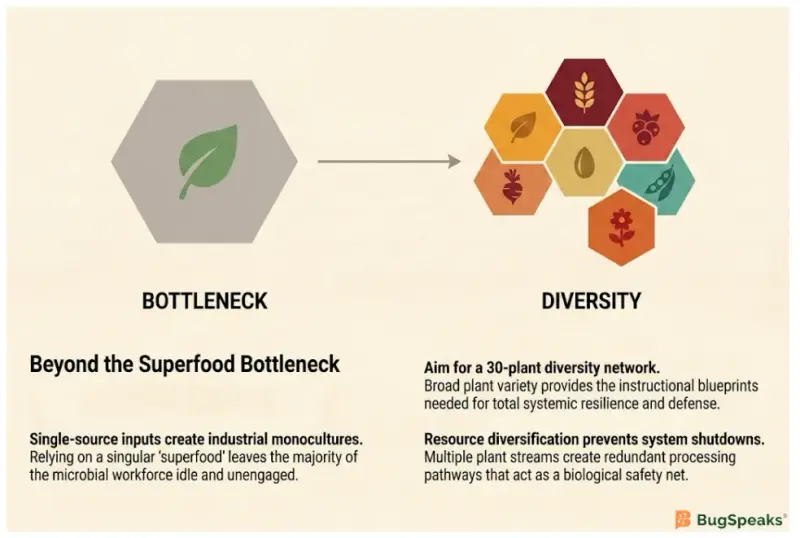
Within the biological architecture of the human body, the intestines function as a highly complex manufacturing hub governed by The Specialized Resource Supply Chain. When dietary interventions focus exclusively on a singular, premium-grade input often marketed by the wellness industry as a "superfood”, the system develops a profound Single-Source Vulnerability. Supplying the manufacturing floor with only one type of raw material creates an Industrial Monoculture. In this constrained logistical state, highly specific assembly lines may operate efficiently, but the vast majority of the microbial workforce is left entirely idle and unengaged. Clinical evidence demonstrates that administering a highly concentrated dose of anthocyanins from a single source, such as 210 grams of cooked black rice, successfully upregulates specific neuroprotective pathways to improve verbal memory metrics and significantly reduces the Pro-Inflammatory Cytokine Interleukin-6 (IL-6)Mekhora (2026). However, relying solely on this one premium input fails to activate the broad spectrum of microbial contractors necessary for total systemic resilience.
The profound dangers of an Industrial Monoculture become especially apparent when analyzing the standard Western Diet (WD). The WD operates as a fundamentally broken supply chain, characterized by high intakes of saturated fats, ultra-processed elements, refined grains, and added sugars, which completely destabilizes intestinal operationsVásquez (2026). This poor logistical framework introduces corrosive environmental contaminants to the factory floor, directly inciting chronic colonic inflammation, impairing mucosal immune regulation, and significantly increasing colorectal tumor burdenVásquez (2026). Furthermore, the WD is consistently associated with a reduced abundance of essential Short-Chain Fatty Acid (SCFA)-producing bacterial genera, such as Butyricicoccus and Lachnospiraceae, while promoting opportunistic pathogenic generaAslam (2026). Attempting to correct this massive logistical failure by introducing a single "superfood" is a biologically inadequate strategy. True optimization requires shifting away from fixed, monolithic inputs toward a highly diversified network of resources.
Table 1: Fixed Supply Chain vs. Diversified Network
What is the 30-Plant Diversity Quota?
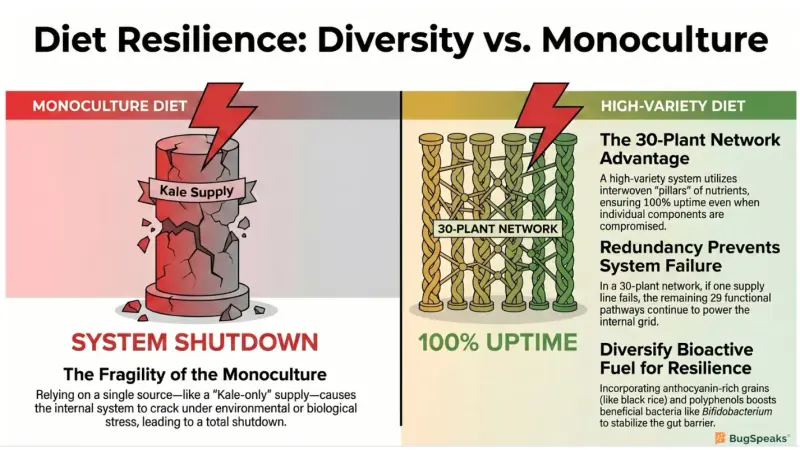
The 30-plant diversity quota is a comprehensive logistical procurement strategy that guarantees the continuous delivery of varied phytochemicals necessary for robust intestinal system stability.
To operate The Specialized Resource Supply Chain at maximal efficiency, the biological architecture demands a continuous influx of distinct Chemical Spec-Sheets, technically classified as dietary phytochemicals and polyphenols. These compounds encompassing diverse subclasses such as flavonoids, phenolic acids, stilbenes, and anthocyanins function as precise instructional blueprints for the microbial workforceToderescu (2026). Clinical meta-analyses confirm that integrating a wide variety of these Chemical Spec-Sheets into the intestinal factory yields mathematically measurable system upgrades. Broad polyphenol interventions exert a moderate-to-large positive effect, demonstrating a standardized mean difference (SMD) of 0.81 in upregulating keystone protective taxa such as BifidobacteriumToderescu (2026).
Resource Diversification is the only mechanism capable of delivering the vast array of instructions required to defend against systemic failure. Distinct plant sources provide unique biochemical blueprints that govern parallel processing lines simultaneously. For instance, supplying the system with anthocyanins derived from Aronia melanocarpa successfully downregulates glutaminase (GLS) and SLC1A5, suppressing the mTORC1 signaling pathway to inhibit tumor progressionVásquez (2026). Concurrently, integrating raw materials from black raspberries provides the specific instructions needed to alter histone acetylation upregulating histone acetyltransferases EP300 and MOF while inhibiting the histone deacetylase SIRT1 which aggressively suppresses oncogenic progressionVásquez (2026).
How are specialized production lines activated?
Specialized production lines are activated when distinct microbial taxa receive their specific required raw materials, initiating a sequential internal logistics relay known as metabolic cross-feeding.
Within the intricate environment of the intestines, The Specialized Resource Supply Chain relies entirely on highly compartmentalized Microbial Contractors. The biological architecture does not process incoming plant materials uniformly; instead, distinct fibers and complex polyphenols serve as highly selective catalysts that awaken specific Production Teams. When diverse raw materials such as those sourced from green tea, apples, and varied berries are delivered to the factory floor, they simultaneously activate distinct microbial specialists, including Bifidobacterium, Anaerostipes, and LactobacillusToderescu (2026).
This targeted activation establishes the foundation for Metabolic Cross-Feeding, an elegant internal logistics relay essential for manufacturing high-value therapeutics. In this relay, primary microbial contractors break down recalcitrant plant structures, yielding intermediate components like acetate and formate. While these intermediate outputs possess limited direct utility to the host, they are the exact raw materials required by secondary microbial contractors. These secondary operators retrieve the intermediate goods from the assembly line and finalize their processing, ultimately manufacturing Short-Chain Fatty Acids (SCFAs) such as butyrate and propionateToderescu (2026),Aslam (2026).
Table 2: Table of Microbial Contractors
What are the 'Chemical Dyes' of the Supply Chain?
The 'Chemical Dyes' of the supply chain consist of dietary polyphenols and anthocyanins, which undergo extensive microbial biotransformation to become highly bioactive systemic therapeutics.
Due to their incredibly complex structural configurations, the vast majority of these vividly pigmented compounds, the 'Chemical Dyes' sourced from foods like black rice, grapes, and plums exhibit extremely poor absorption in the upper digestive tract. Consequently, they bypass early digestive machinery and are delivered entirely intact to the intestinal factory floorToderescu (2026). Once these complex dyes arrive, they enter the Alchemist's Workshop: the specialized sector managed exclusively by the gut microbiota. Within the Alchemist's Workshop, microbial operatives dismantle these structural dyes through a rigorous biotransformation protocol, forging raw plant colors into specialized cellular medicine.
Clinical interventions confirm that supplying the Alchemist's Workshop with precise inputs such as cooked black rice yielding exactly 208.48 milligrams of pure anthocyanins triggers profound systemic upgradesMekhora (2026). Once the microbial workforce processes these dyes into active therapeutics, the compounds are exported into systemic circulation, significantly improving targeted cognitive domains like verbal and working memoryMekhora (2026).
How does variety provide System Stability?
Dietary variety provides supreme System Stability by establishing redundant, parallel microbial processing pathways that act as a biological safety net, preventing critical manufacturing shutdowns during periods of severe environmental stress.
Within the biological architecture of the intestines, Ecological Resilience is defined by the system's capacity to maintain continuous energy production despite toxic variables. If a sudden logistical shock occurs such as the influx of ultra-processed foods—a low-variety system experiences an immediate "System Shutdown"Vásquez (2026),Aslam (2026). To prevent this catastrophic failure, the biological architecture requires a massive safety net. Achieving the 30-plant diversity quota provides this by ensuring that multiple, distinct families of bacteria, including Faecalibacterium prausnitzii and Bifidobacterium, are constantly fueled and operationalToderescu (2026).
How do we monitor and maintain the Supply Chain?
Monitoring and maintaining the supply chain requires the deployment of data-driven architectural frameworks to map the factory floor, followed by the implementation of Rotational Planting to ensure continuous logistical resilience.
Operating the high-end manufacturing plant of the intestines strictly on assumption guarantees profound inefficiency. The biological architecture demands a transition into a framework of Active Architecture. Because human microbiomes exhibit profound interindividual variability, specific baseline gut profiles termed metabotypes dictate exactly how incoming raw materials are processedToderescu (2026). Supply Chain Resilience is permanently secured through the implementation of Rotational Planting, systematically alternating the types of Chemical Spec-Sheets introduced to the system to ensure multiple distinct defensive pathways are continuously trained and activatedVásquez (2026).
Why does the botanical source of the biological blueprint matter for rotational procurement?
Achieving the 30-plant quota is merely the foundational phase; true Supply Chain Excellence requires understanding that the geographical and botanical source of your "Chemical Spec-Sheets" fundamentally alters the instructional output. A manufacturing floor may require a specific grade of "Blue Pigment," but a purple carrot provides a significantly different biological blueprint than a purple grape, even though both are categorized as anthocyanin sources.
In the 2026 landscape, we recognize that the "Plant Matrix" , the specific way fibers, minerals, and polyphenols are structurally bound dictates the timing and location of nutrient release. While the grape may release its "High-Speed Data" early in the intestinal corridor, the carrot acts as a "Slow-Release Firmware Update," ensuring that deep-gut operatives receive their instructions. Implementing Rotational Procurement prevents the microbial workforce from becoming habituated to a single source, ensuring that multiple redundant defensive pathways are constantly refreshed.
How is a procurement list curated to maximize the output of secondary assembly operatives?
To maximize the output of your Secondary Assembly Operatives, specifically the elite butyrate-producer Faecalibacterium prausnitzii the supply chain must prioritize specific "High-Output Catalysts." Because these operatives rely on Metabolic Cross-Feeding, they do not consume raw materials directly; they require a precisely curated procurement list to stimulate the primary workers who feed them.
Strategic Procurement List for Faecalibacterium Support:
Leeks and Asparagus: Provides high-grade Inulin, the primary "Bio-fuel" for the upstream processing teams.
Pakhala (Fermented Rice Water): Delivers Resistant Starch Type 3, a "Long-Life Battery" for deep-gut assembly lines.
Green Tea & Pomegranate: Supplies specific polyphenols that act as "Performance Enhancers" for the Faecalibacterium workforce.
Black Rice & Black Raspberries: Delivers the precise anthocyanin "Spec-Sheets" required to suppress oncogenic interference during the manufacturing process.
By transitioning from "Superfood" consumption to Active Architectural Procurement, you ensure that the Master Loom of your intestines has every specialized thread required to weave a resilient, high-performance biological tapestry. The supply chain is now secure; the factory is optimized for 2026 and beyond.
-Varsha V
Visualize the process- https://youtu.be/4Czm5XXCtbk
Reference
Aslam, H., Trakman, G., Dissanayake, T., Todd, E., Harrison, P., Alby, C., Jabeen, T., Gamage, E., Travica, N., Marshall, S., Ruusunen, A., Rocks, T., Marx, W., Berk, M., O'Neil, A., McGuinness, A. J., Jennings, L., Jacka, F. N., & Dawson, S. L. (2026). Dietary interventions and the gut microbiota: a systematic literature review of 80 controlled clinical trials. Journal of translational medicine, 24(1), 39. https://doi.org/10.1186/s12967-025-07428-9
Toderescu, C. D., Parveen, M., Trifunschi, S., Oancea, A., Jurj, G. C. C., Cresneac, I. G., Munteanu, M. F., Ciopanoiu, I., Boru, C., Pogurschi, E. N., Ionite, C., Stefanache, A., & Lungu, I. I. (2026). Dietary Polyphenols as Modulators of Bifidobacterium in the Human Gut Microbiota. Nutrients, 18(5), 782. https://doi.org/10.3390/nu18050782
Vásquez, A., Zúñiga, P., Torres, K., Quest, A. F. G., & Simón, L. (2026). Beneficial effects of a high-anthocyanin diet versus a Westernized diet on colorectal cancer risk: a systematic review. Frontiers in immunology, 17, 1736018. https://doi.org/10.3389/fimmu.2026.1736018
Zhao, A., Chen, Y., Li, Z., Fan, Q., & Wu, J. (2026). Dietary diversity and its associations with sleep quality and chronotype in young and middle-aged adults. Frontiers in nutrition, 12, 1743065. https://doi.org/10.3389/fnut.2025.1743065
Ioana Ferențiu, Tiberia Ioana Pop, Alina Elena Pârvu, Meda Sandra Orăsan, Dinu Bolunduț, Marcel Pârvu, Florica Ranga, Ciprian Ovidiu Dalai, Mădălina Țicolea, Anca Elena But, Lia Oxana Usatiuc and Raluca Maria Pop Molecules, 2026, 31, 1012. DOI: 10.3390/molecules31061012