The Gut Immune Connection: Understanding Autoimmunity
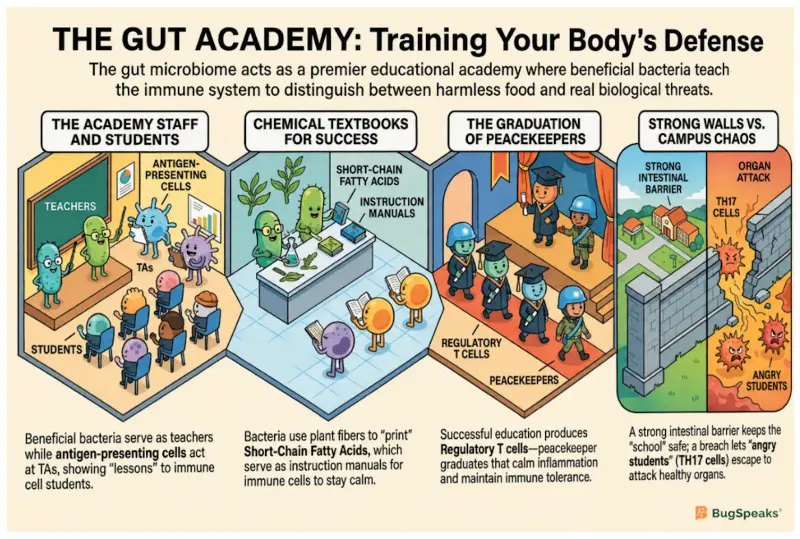
How does the gut microbiome train our developing immune system?
The gut microbiome serves as the primary school where our young immune system learns to distinguish safe foods from real biological dangers. During our first few years, the intestine acts as a busy classroom for new immune cells. In this important learning phase, friendly bacteria settle in and serve as the body's main teachers (de Groen, 2026). Specialized antigen-presenting cells act like teaching assistants, carefully showing microscopic pieces of bacteria to the student cells. When this teaching works perfectly, the body successfully achieves immune tolerancede Groen (2026). This means the immune system learns to stay completely peaceful and never attack harmless food or friendly bacteria passing through the gut.
A huge part of this training creates Regulatory T cells, which are special peacekeeper students that graduate with the skill to calm down inflammation. These peacekeepers make sure the whole immune system stays relaxed instead of panicking over harmless thingsde Groen (2026). Important early teachers, like Bifidobacterium, are absolutely required to teach these Regulatory T cells how to behave. If a child's early school environment lacks these excellent bacterial teachers because of antibiotic medicine or not breastfeeding, the training fails. Without enough peacekeepers, the immune system becomes angry and stressed, losing its ability to properly regulate the rest of the body's defense forces over timede Groen (2026).
Many outside factors help build this important educational facility right from the moment we are born. How a baby is delivered decides which bacterial teachers first enter the gut, while playing outside in the dirt introduces wonderful new soil microbes that give the students more things to studySzurek (2026). When a rich, colorful mix of bacterial teachers successfully moves into the intestine, they send chemical signals that beautifully educate the immune students. This creates a lifelong foundation of calmness that controls how the body reacts to the worldde Groen (2026). Without this critical early education, the immune system stays wild and easily confused for the rest of a person's life.
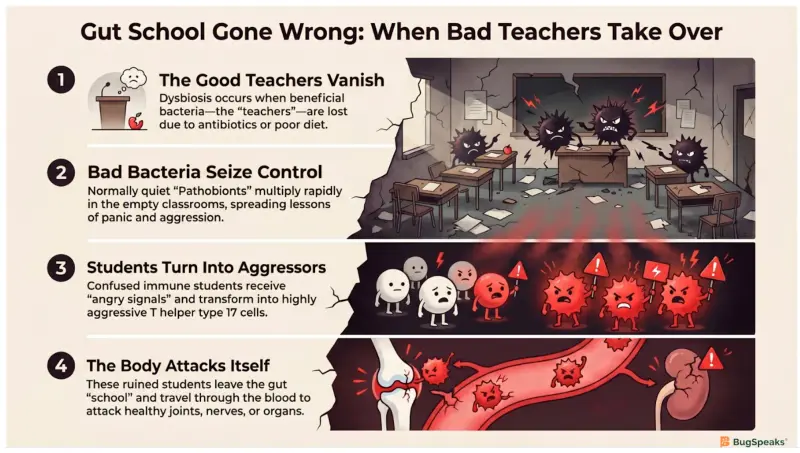
What happens when the immune education system breaks down?
When the gut's educational environment falls apart, immune cells get the wrong instructions and accidentally attack the body's own healthy tissues. This massive failure in learning is caused by dysbiosis, a highly unhealthy situation where the gut loses its diverse mix of good bacterial teachers. Without the right instructors around, the student cells become lost and easily tricked. Opportunistic pathobionts, which are normally quiet bacteria that turn bad quickly, multiply to take over the empty classroomsde Groen (2026). These terrible teachers give angry, aggressive lessons that push the immune system into a state of panic. This directly causes autoimmunity, a tragic mistake where the body attacks itselfVilela de Oliveira (2017).
The terrible results of this broken education are easy to see when we look at the immune cells moving through the body. A healthy gut perfectly balances the calm peacekeepers with aggressive defender cells known as T helper type 17 cells. When the school environment collapses, the bad bacterial teachers force the students to rapidly transform into these angry T helper type 17 cellsVilela de Oliveira (2017). These highly aggressive students then break out of the gut and travel far away to places like the joints or the brain. Once they escape the school, they cause the severe swelling and painful damage that we see in autoimmune diseasesde Groen (2026).
Different autoimmune illnesses simply show different kinds of mistakes in this important gut school. For example, in Type 1 Diabetes, losing specific good bacteria ruins immune tolerance, causing confused students to destroy the cells in the pancreas that make insulinde Groen (2026). In a joint disease called Rheumatoid Arthritis, an overgrowth of bad bacterial teachers gives angry lessons that activate violent immune students. These ruined students travel straight from the gut into the joints, where they start attacking the bone and causing terrible painVilela de Oliveira (2017). When the school's teaching staff is ruined, the immune system totally forgets how to live peacefully inside its very own human host.
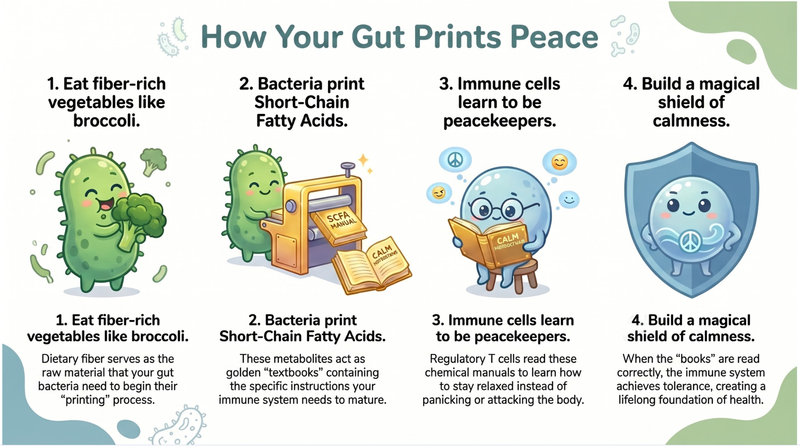
How do microbial metabolites act as essential learning materials?
Microbial metabolites work exactly like chemical textbooks and worksheets that give our immune cells the specific instructions they need to mature properly. Good bacteria cannot teach the immune students without proper supplies; they need us to eat plant fibers to create these books. The most famous of these chemical textbooks are called Short-Chain Fatty Acids. When our good bacteria eat the fiber from our food, they print out these Short-Chain Fatty Acids to act as clear, readable instructions for the immune systemLi (2026). These wonderful textbooks teach the immune cells how to stay calm, helping to grow more Regulatory T cells to keep the whole school perfectly peacefulde Groen (2026).
Besides eating fiber, the gut teachers also use proteins from our food to write highly specialized instruction manuals. For instance, when the microbiome breaks down a protein part called tryptophan, it creates special Tryptophan metabolitesBrown (2020). These unique chemical books hand-deliver messages straight to the immune cells, telling them to stop fighting and help heal the body. In serious diseases like multiple sclerosis, scientists see that these specific chemical textbooks are missing or ruined. Without these important reading materials, the immune system becomes hyperactive and deeply confused. This severe lack of good instructions makes autoimmune diseases much worse by letting chronic inflammation slowly destroy the body's tissues over timeBrown (2020).
In a very similar way, the microbiome takes digestive juices from the liver and changes them into Secondary bile acids, which act like advanced science books for the immune system. These newly written chemical books lock onto special switches in the body to lower heat and swelling, strongly enforcing beautiful immune toleranceFang (2024). Whenever dysbiosis stops the bacteria from printing these Secondary bile acids, the immune students completely lose their advanced calming instructions. This terrible loss immediately causes the immune system to act out and attack healthy areasLi (2026). Therefore, having good bacteria means nothing if we do not feed them the right food to print their chemical textbooks.
Why is a leaky gut barrier dangerous for immune tolerance?
A broken intestinal barrier lets untrained bacteria and garbage escape the school building, ringing dangerous alarm bells all over the entire body. For the immune school to be totally safe, it must be locked tightly inside a strong wall known as the intestinal barrier. This important wall is made of special cells glued tightly together. Normally, immune students only practice with bacteria inside this perfectly safe, closed area. However, when dysbiosis causes the sticky glue between the cells to dissolve, the physical walls of the school completely fall apartLi (2026). This terrifying collapse destroys the safe learning environment and puts the whole human body in terrible, immediate danger.
When the school walls break down, it causes translocation, a terrifying event where live bacteria and toxic trash spill out of the gut and into the blood. One of the worst pieces of trash that escapes is Lipopolysaccharides, which are sharp, ugly pieces of dead bacterial wallsFang (2024). When these Lipopolysaccharides float into the bloodstream, they trick the body into thinking a massive war has started. Untrained immune cells swimming in the blood see this bacterial trash and freak out. They trigger a massive, fiery response that damages healthy organs everywhere, causing severe long-term sickness because the safe school environment could not keep the trash locked insideMaślińska (2021).
Worse still, this escaping bacterial trash heavily increases the risk of molecular mimicry, which is a terrible case of mistaken identity. Because some pieces of bacterial trash look exactly like human body parts, the untrained immune students get incredibly confusedKhawar (2023). As these angry students grab their weapons to fight the escaped bacterial trash, they accidentally shoot at the host's completely healthy organs because they look identical. This scary breakdown of the school walls and the tragic mistaken identity that follows is a major reason why autoimmune diseases destroy the joints and the brainMaślińska (2021). Keeping the school walls strong is the only way to stop this chaos.
Can we retrain the immune system with targeted interventions?
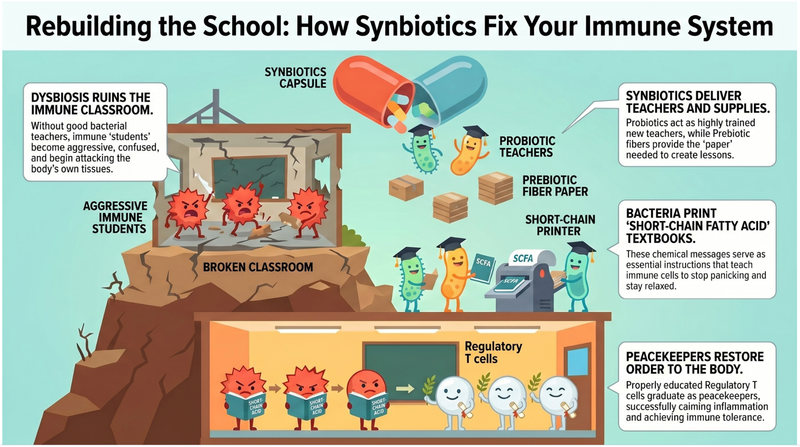
We can easily retrain a confused immune system by sending in fresh bacterial teachers and the right food to rebuild the gut's school. The main goal of treating autoimmunity is to completely fix this broken educational facility. Doctors often use Probiotics, which are pills filled with billions of living, incredibly helpful bacteriaVilela de Oliveira (2017). By putting highly trained teachers like Lactobacillus straight into the gut, doctors try to replace the missing staff and kick out the bad pathobionts. In many studies, these new probiotic teachers successfully calmed the angry students down, teaching them to become gentle peacekeepers again and shrinking the painful swelling of autoimmune diseasesVilela de Oliveira (2017).
However, these wonderful new teachers absolutely cannot do their jobs without fresh school supplies. This is why Prebiotics, which are special plant fibers that feed only the good bacteria, are incredibly important for fixing the school long-term. When doctors combine these fibers with live bacteria, they create super-treatments called SynbioticsLi (2026). This smart teamwork provides both the best teachers and the exact paper they need to print chemical textbooks, like Short-Chain Fatty Acids. By doing this, the new bacteria have all the food they need to survive the dark gut environment and happily resume the daily classes that keep the immune system perfectly peaceful and healthyde Groen (2026).
In extreme situations where the gut school has totally burned down, doctors use a powerful method called Fecal Microbiota Transplantation. This amazing medical procedure completely removes the failing, terrible teachers and replaces them with an entire, perfectly balanced school staff taken from a healthy personLi (2026). By swapping out the whole educational environment at once, Fecal Microbiota Transplantation instantly restarts the classes for immune tolerance. This massive replacement physically patches up the broken intestinal barrier and stops the confused immune students from attacking the body's organsKhawar (2023). It is the fastest way to save the body before the immune system destroys the joints or nerves.
Visualize the process- https://youtu.be/jdV0F9nUQ8o
Reference
Szurek, E. A., Ngo, V. L., Abo, H., Cebula, A., Chassaing, B., Howard, R. A., Hart, M., Hori, S., Weaver, C. T., Gewirtz, A. T., Ignatowicz, L., Denning, T. L., & Kuczma, M. P. (2026). Soil-derived microbiota induces T regulatory cells and protect against mouse colitis, metabolic disease, and sepsis. Gut microbes, 18(1), 2675089. https://doi.org/10.1080/19490976.2026.2675089
Li, Z., Samui, S., Liu, J., Yang, Y., Liu, X., Chen, Q., Li, J., Gopinath, D., Luo, P., & Shan, D. (2026). Gut microbiome and metabolic health: mechanisms and precision interventions. Gut microbes, 18(1), 2644677. https://doi.org/10.1080/19490976.2026.2644677
de Groen, P., Gouw, S. C., Hanssen, N. M. J., Nieuwdorp, M., & Rampanelli, E. (2026). Early-Life Gut Microbiota: Education of the Immune System and Links to Autoimmune Diseases. Microorganisms, 14(1), 210. https://doi.org/10.3390/microorganisms14010210
de Oliveira, G. L. V., Leite, A. Z., Higuchi, B. S., Gonzaga, M. I., & Mariano, V. S. (2017). Intestinal dysbiosis and probiotic applications in autoimmune diseases. Immunology, 152(1), 1–12. https://doi.org/10.1111/imm.12765
Brown J, Robusto B and Morel L (2020) Intestinal Dysbiosis and Tryptophan Metabolism in Autoimmunity. Front. Immunol. 11:1741. doi: 10.3389/fimmu.2020.01741
Maślińska, M., Trędzbor, B., & Krzystanek, M. (2021). Dysbiosis, gut-blood barrier rupture and autoimmune response in rheumatoid arthritis and schizophrenia. Reumatologia, 59(3), 180–187. https://doi.org/10.5114/reum.2021.107588
Khawar, M. M., Sr, Ijaz, S., Goyal, P., Kandambige, D., Sharifa, M., Maslamani, A. N. J., Al Kutabi, S., Saleh, I., Albshir, M. M., I Kh Almadhoun, M. K., Soomro, S. N., & Kumari, N. (2023). The Gut-Brain Axis in Autoimmune Diseases: Emerging Insights and Therapeutic Implications. Cureus, 15(11), e48655. https://doi.org/10.7759/cureus.48655
Fang, H., Rodrigues E-Lacerda, R., Barra, N. G., Kukje Zada, D., Robin, N., Mehra, A., & Schertzer, J. D. (2025). Postbiotic Impact on Host Metabolism and Immunity Provides Therapeutic Potential in Metabolic Disease. Endocrine reviews, 46(1), 60–79. https://doi.org/10.1210/endrev/bnae025