The Hidden Secret to Lasting Intestinal Integrity
Why is the architecture of the Gallery Floor so critical for metabolic health?
The architecture of the Gallery Floor is critical because it represents the primary biological barrier separating the external environment from the internal preservation vault of the human body. This gallery represents the intestinal lumen, a complex space where exhibits of nutrients and microbes interact before being processed. The floor is constructed from a single layer of enterocytes that must maintain perfect structural alignment to protect the body's internal milieu Dmytriv et al. (2024). Specialized Paneth cells act as security personnel within the crypts, secreting antimicrobial peptides to defend the tiles from overgrowth. To monitor the environment safely, the system utilizes TLR4 sensors on the underside of the tiles, ensuring the gallery only sounds an alarm when a true breach occurs.

How do the Airtight Seals protect the integrity of the Preservation Vault?
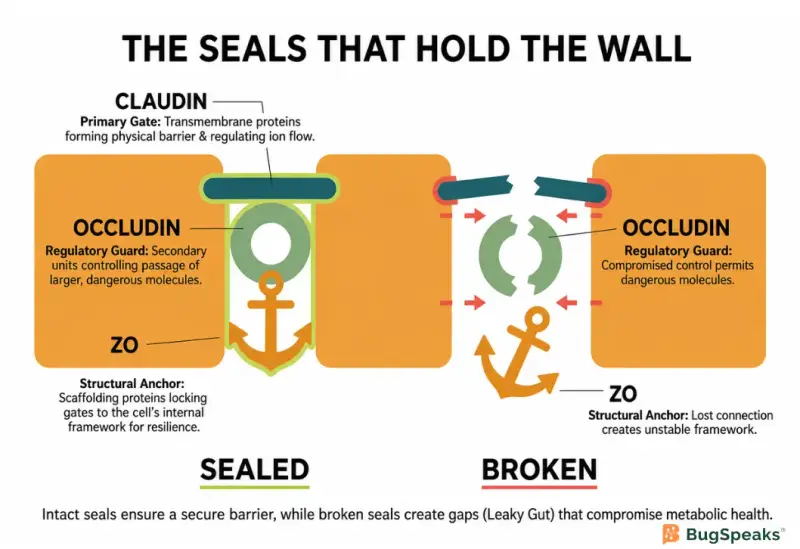
Airtight Seals protect the Preservation Vault by physically fusing the epithelial tiles to prevent any unauthorized paracellular diffusion between them. These seals, known as tight junctions, ensure that the gallery floor remains a secure barrier against unwanted guests. The structural integrity of these seals depends on the claudin family of proteins, which act as selective gates to regulate the flux of ions. Secondary regulatory units called occludins specifically control the passage of larger, more dangerous molecules. To keep the structure stable, Zonula Occludens (ZO) scaffolding proteins anchor these gates to the cell's internal framework, ensuring the floor remains resilient even during the mechanical stresses of digestion Ryan & Brayden (2026).

Who are the Curators of the Gallery and what is their primary role?
The Curators of the Gallery are the gut microbiota, a vast community of microorganisms that manage the metabolic environment above the floor. A healthy gallery requires high α-diversity, ensuring a wide variety of specialists are present to maintain ecological balance. These curators prevent the overgrowth of pathobionts while fostering a state of homeostasis where the host and microbes thrive together Li et al. (2026). When curators abandon their posts, a state of dysbiosis occurs, causing the gallery to fall into disrepair. This imbalance decouples the metabolic flux, allowing aggressive microbes to attack the Airtight Seals and threaten the safety of the Preservation Vault.
How does the biomanufacturing of chemical currency fund the Vault's defenses?
Biomanufacturing of chemical currency funds the vault's defenses by providing the essential SCFAs that the gallery floor needs for energy and repair. These SCFAs, primarily acetate, propionate, and butyrate, are produced by the Curators as they ferment complex fibers Dmytriv et al. (2024). Butyrate is the most valuable currency, serving as the main fuel for the floor tiles and activating the AMPK pathway to promote seal assembly. This currency also stabilizes HIF, a protein that coordinates structural repairs and strengthens the Airtight Seals. By binding to specialized receptors, these fatty acids epigenetically suppress inflammatory genes, keeping the Preservation Vault calm and protected from unnecessary systemic stress.
What role do the Velvet Ropes play in separating the Curators from the Floor?
Velvet Ropes maintain a physical distance between the Curators and the delicate tiles of the floor to prevent unwanted inflammatory triggers. These ropes are the protective mucus layer, a hydrated gel secreted by goblet cells that consists primarily of the MUC2 protein. The dense inner sublayer acts as a no-man's land, while the loose outer sublayer provides a space where curators feed on glycans. The quality of these ropes is influenced by the curators themselves, who signal the gallery to tailor the structure of the gel. If mucolytic bacteria become over-active, the ropes can thin out, exposing the floor tiles to direct contact with unauthorized guests and leading to a breach of the Airtight Seals Ryan & Brayden (2026).
How does the Security Override lead to a "Leaky Gut" scenario?
The Security Override leads to a Leaky Gut scenario by activating signaling units that dismantle the Airtight Seals between the gallery tiles. High-fat diets and stress trigger the release of Zonulin, a protein that signals the tiles to loosen their grip on one another Dmytriv et al. (2024). This process is executed by the MLCK enzyme, which causes the edges of the tiles to contract toward the center. This mechanical tension leads to the internalization of seal proteins, where they are swallowed by the cell and removed from the surface. The resulting structural gaps turn the floor into a sieve, allowing the contents of the gallery to flood the Preservation Vault and compromise systemic metabolic health.
What happens when Unauthorized Guests trigger the Alarms of Metabolic Endotoxemia?
Unauthorized Guests trigger the alarms of Metabolic Endotoxemia by entering the Preservation Vault and initiating a state of high-intensity inflammatory panic. The primary guest is LPS, a toxic molecule from bacterial walls that enters the bloodstream when Airtight Seals fail Li et al. (2026). Once in the vault, LPS activates the NF-κB transcription factor, which orders the mass production of inflammatory cytokines. These signals act as the sirens of the immune system, causing chronic, low-grade inflammation that degrades the vault from within. Over time, these persistent alarms lead to metabolic syndrome, as the body loses its ability to manage energy and becomes resistant to insulin signaling.
How can Exogenous Reinforcements act as restorative technicians for the Seals?
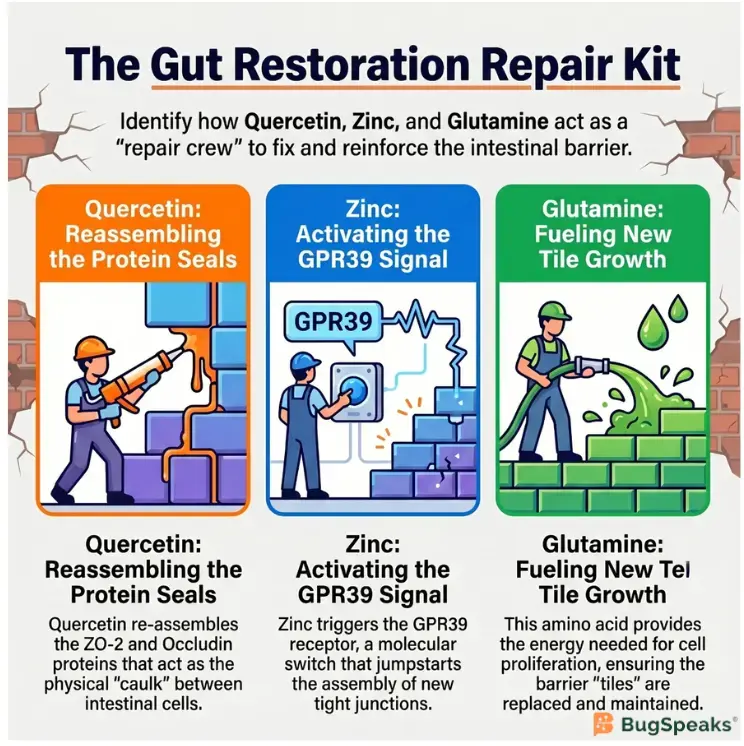
Exogenous Reinforcements act as restorative technicians by providing the molecular signals needed to repair cracks in the Gallery Floor. Dietary modulators like quercetin physically drive the reassembly of structural seals, increasing the TEER of the floor to restore electrical resistance Ryan & Brayden (2026). The trace element zinc reinforces these seals by activating the GPR39 receptor, which signals the cell to produce more barrier proteins. Additionally, the amino acid glutamine serves as the foundational building block for new tiles, fueling the rapid proliferation of enterocytes to replace damaged areas. By supporting the growth of a new epithelial monolayer, these reinforcements ensure the Preservation Vault remains protected even after a significant breach.
What is the Gallery’s Communication Network and how does it connect command centers?
The Gallery’s Communication Network is a bidirectional neuroendocrine system that allows the Curators to speak directly to the body's main command centers. Signals travel through the vagus nerve, a biological telephone line that connects the gut gallery to the hypothalamus in the brain Li et al. (2026). This network also reaches the pancreas, where specialized β-cells receive updates to manage the release of insulin. When the Gallery Floor is healthy, these communication lines ensure glucose levels remain stable and metabolic energy is managed efficiently. However, if a breach occurs, the network becomes filled with neuroinflammation, causing the command centers to become deaf to regulatory signals and leading to metabolic instability throughout the vault.
How will Precision Maintenance define the future of the Gallery's preservation?
Precision Maintenance will define the future of the gallery’s preservation by utilizing advanced technology to create customized restoration plans. Using multi-omics scanning, scientists can analyze the unique state of an individual's curators and floor tiles to identify specific deficiencies Li et al. (2026). Interventions like FMT allow for a total ecosystem reset, replacing a dysbiotic microbial staff with a healthy, diverse community. Synbiotics offer targeted repair by combining beneficial bacteria with the specific fuel they need to thrive and rebuild the Airtight Seals. In the future, CRISPR technology may even allow for the restructuring of microbial specialists to detect leaks and release healing bioactives immediately, ensuring the Preservation Vault remains secure against environmental stress.
How does the Intelligence Agency train the immune guard?
The Intelligence Agency trains the immune guard by utilizing a network of subterranean bunkers called Peyer’s Patches to identify and tag unauthorized guests before they can threaten the structural integrity of the Preservation Vault. Within this GALT network, specialized M-cells act as the primary Field Scouts, reaching out from the Gallery Floor to sample tiny fragments of incoming exhibits and deliver them directly to immune officers for rigorous inspection. This sophisticated surveillance allows the agency to manufacture and export sIgA molecules, which act as Diplomatic Passports that latch onto and neutralize rogue visitors within the mucus layer. By tagging these intruders before they can touch the tiles, the agency ensures the gallery remains peaceful and can distinguish between a harmless nutrient and a hostile viral infiltration, preventing the unnecessary security overrides that lead to chronic inflammation.
Why is the Regional Logistics Hub essential for cleaning the Gallery Floor?
The Regional Logistics Hub is essential because it provides the specialized surfactants and safety inspectors required to maintain the floor tiles and monitor the gallery’s metabolic status from a centralized location. The liver, acting as this hub, exports Bile Acids into the gallery, which serve as heavy-duty surfactants to break down fat exhibits while simultaneously functioning as safety inspectors. As these acids travel across the floor, they bind to specialized receptors like TGR5 and FXR, signaling the microbial curators to remain in a state of high metabolic efficiency and structural repair. This entire logistics chain depends on the Enterohepatic Circulation to recycle these acids; if this recycling protocol fails, "metabolic sludge" accumulates, eroding the floor tiles and triggering a systemic lockdown that threatens the stability of the Preservation Vault.
How can the Epigenetic Library edit the blueprints of the Gallery Floor?
The Epigenetic Library edits the blueprints by utilizing microbial currency to unlock genetic files that instruct the gallery floor tiles to increase their repair speed and resilience against environmental stress. When the curators produce Butyrate, it doesn't just fund the tiles with energy; it acts as a potent HDAC Inhibitor that "unpacks" the cellular Chromatin, allowing the tiles to access previously locked files for anti-inflammatory proteins. This real-time blueprint editing ensures that the gallery isn't just reacting to its surroundings but is actively evolving its defenses based on the chemical data provided by the curators. Without this library access, the tiles remain stuck with outdated, vulnerable blueprints, making them incapable of maintaining the Airtight Seals in the high-pressure environment of the modern world.
-Varsha V
Visualize the process- https://youtu.be/ALrjPP9JYjQ
Reference
Dmytriv TR, Storey KB and Lushchak VI (2024) Intestinal barrier permeability: the influence of gut microbiota, nutrition, and exercise. Front. Physiol. 15:1380713. doi: 10.3389/fphys.2024.1380713
Ryan SM and Brayden DJ (2026) Food-derived molecules as regulators of intestinal tight junctions and barrier function: mechanisms and implications. Front. Drug Deliv. 6:1692219. doi: 10.3389/fddev.2026.1692219
Li, Z., Samui, S., Liu, J., Yang, Y., Liu, X., Chen, Q., Li, J., Gopinath, D., Luo, P., & Shan, D. (2026). Gut microbiome and metabolic health: mechanisms and precision interventions. Gut microbes, 18(1), 2644677. https://doi.org/10.1080/19490976.2026.2644677