How do gut bacteria influence cholesterol levels in the bloodstream?
Your gut bacteria help control how much cholesterol enters the bloodstream. To understand this clearly, imagine the human body as a giant transportation city. Roads, tunnels, bridges, and delivery routes connect every neighborhood. In this city, the bloodstream functions like a massive highway network, carrying supplies everywhere. Oxygen, nutrients, hormones, and fats constantly travel through these routes to keep the body alive.
One of the most important delivery materials moving through this highway system is Cholesterol. The body needs cholesterol to build cell walls and produce hormones. But like delivery trucks crowding a highway, too much cholesterol creates dangerous traffic buildup inside blood vessels.
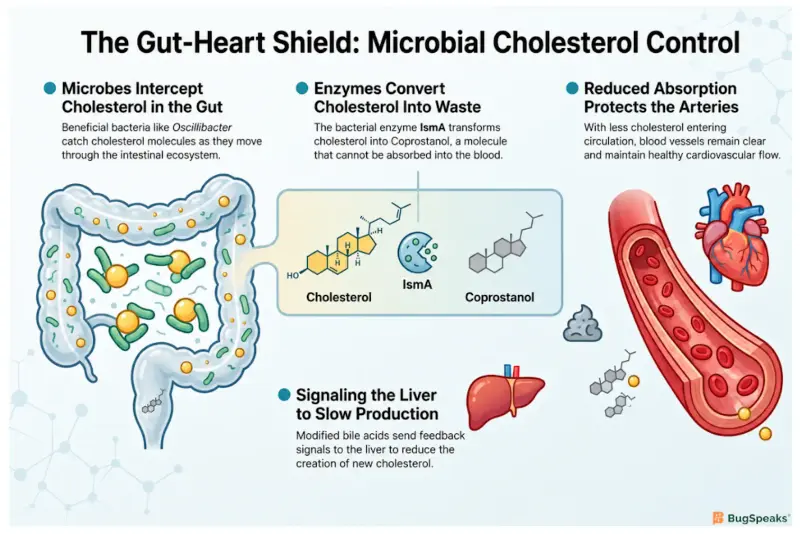
This is where the gut microbiota becomes incredibly important. These microscopic organisms live deep inside the digestive tract and work like intelligent logistics controllers stationed at the body’s loading docks. Every time food enters the intestines, these microbes help decide how much material gets allowed into the bloodstream. Instead of simply digesting food, they actively regulate traffic entering the cardiovascular highway systemLi et al. (2024).
One of their most powerful roles occurs within the Enterohepatic Circulation, a continuous recycling loop connecting the liver and intestines. The liver releases digestive compounds into the gut, and many of these compounds later return to the liver for reuse. Certain bacteria carefully monitor this recycling process. Specialized microbial groups like Oscillibacter and Eubacterium can physically capture excess cholesterol before it enters circulation and chemically reshape it into a harmless substance called CoprostanolLi et al. (2024).
The transformation happens through a bacterial enzyme called IsmA. First, the enzyme changes cholesterol into Cholestenone, an intermediate molecule. Then it completes the conversion into coprostanolLi et al. (2024).
This conversion is extremely important. Regular cholesterol can easily pass through the intestinal wall into the bloodstream. Coprostanol cannot. Once bacteria transform cholesterol into coprostanol, the body struggles to absorb it, so it stays inside the digestive tract and leaves as waste instead.
This inability to cross into the bloodstream comes down to a simple mismatch in shape and location. The cells in your gut use a specialized "gatekeeper" protein designed to grab cholesterol, which has a perfectly flat, straight shape. When bacteria reshape cholesterol into coprostanol, they bend the molecule into a sharp, L-shaped angle, making it physically impossible to fit into the gatekeeper's lock. On top of that, this transformation happens way down in the large intestine. By that point, the molecule has already bypassed the small intestine, which is the only part of the digestive tract equipped with the proper tools and machinery to absorb fats into the body.
Without these microbial controllers working at the loading docks every day, far more cholesterol would flood into the bloodstream. Over time, the transport highways would become crowded and damaged. This shows that heart health is not controlled only by the heart itself. Tiny microbial events happening deep in the gut strongly influence what eventually happens inside the arteries.
What is the role of bile acids in cardiovascular health?
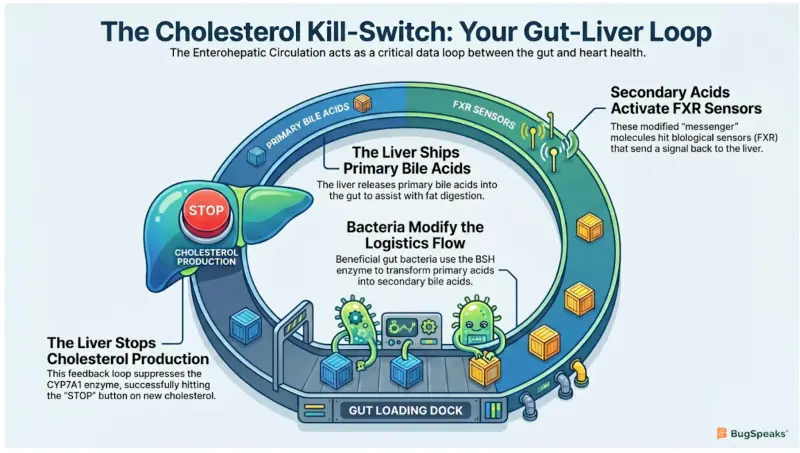
To understand bile acids, imagine the liver as a massive industrial processing center connected to the digestive system through a network of recycling channels. One of the liver’s main jobs is producing Bile Acids, special digestive compounds that help dissolve fats from food.
At first glance, bile acids seem like ordinary digestive fluids. But they actually behave more like biological communication signals. After helping digest fats, many bile acids travel back toward the liver, carrying important information about what is happening inside the gut.
This is where gut bacteria once again become essential system operators. Certain microbes chemically modify bile acids using an enzyme called Bile Salt Hydrolase (BSH). This process changes the structure of the bile acids and creates new signaling moleculesLiu et al. (2025),Chen & Gong (2025).
The modified bile acids, including Cholic Acid (CA) and Deoxycholic Acid (DCA), then interact with specialized biological sensors lining the intestines. Two of the most important sensors are the Farnesoid X Receptor (FXR) and the Takeda G protein-coupled receptor 5 (TGR5).
These receptors behave like monitoring stations placed throughout the transportation network. When they detect properly modified bile acids, they send instructions directly back to the liverChen & Gong (2025).
One of their biggest targets is an enzyme called Cholesterol 7alpha-hydroxylase (CYP7A1). This liver enzyme controls how much new cholesterol the body produces. When FXR and TGR5 receive the correct microbial signals, they suppress CYP7A1 activity, slowing cholesterol production inside the liverLiu et al. (2025).
Healthy gut bacteria, therefore, help maintain communication between the intestines and the liver. When microbial bile acid processing works properly, the liver receives accurate feedback and avoids overproducing cholesterol. When the system becomes disrupted, the liver may continue releasing excess cholesterol into circulation, increasing stress on the cardiovascular networkWang et al. (2026).
Why does gut inflammation cause problems for heart arteries?
A healthy gut environment keeps the transportation network stable and calm. But when the microbial system becomes unbalanced, inflammatory signals begin spreading throughout the body.
This imbalance is known as dysbiosis. During dysbiosis, helpful bacteria decrease while harmful microbial activity increases. The gut starts producing fewer protective compounds, such as Lithocholic Acid (LCA) and more inflammatory molecules insteadChen & Gong (2025).
As inflammation rises, an immune alarm system called the NOD-, LRR- and Pyrin Domain-Containing Protein 3 (NLRP3) inflammasome becomes activated. This sensor behaves like an emergency response center, detecting danger signals inside the body. Once activated, it releases strong inflammatory chemicals into the bloodstreamChen & Gong (2025).
These inflammatory signals eventually reach the arteries. Normally, artery walls are smooth and flexible, allowing blood to move efficiently through the cardiovascular highway system. But inflammation damages these surfaces. The walls become irritated, swollen, and sticky.
Now, cholesterol particles moving through the bloodstream begin attaching to damaged areas inside the arteries. The body sends immune cleanup cells called Macrophages to remove the trapped fats. At first, this seems helpful. But when too much cholesterol accumulates, the macrophages become overloaded.
The macrophages absorb so much cholesterol that they swell into dying structures called Foam Cells. Over time, these foam cells pile together and create thick plaques inside artery walls.
Eventually, this process develops into Atherosclerosis, a disease where arteries narrow and harden. Blood flow becomes restricted, increasing the risk of heart attacks and strokes. What started as a microbial imbalance inside the gut slowly evolved into physical damage within the cardiovascular system.
Which specific bacteria and enzymes help lower cholesterol?
Not all gut bacteria perform the same jobs. Some microbes specialize in cholesterol control and carry powerful biochemical tools that directly regulate fat metabolism.
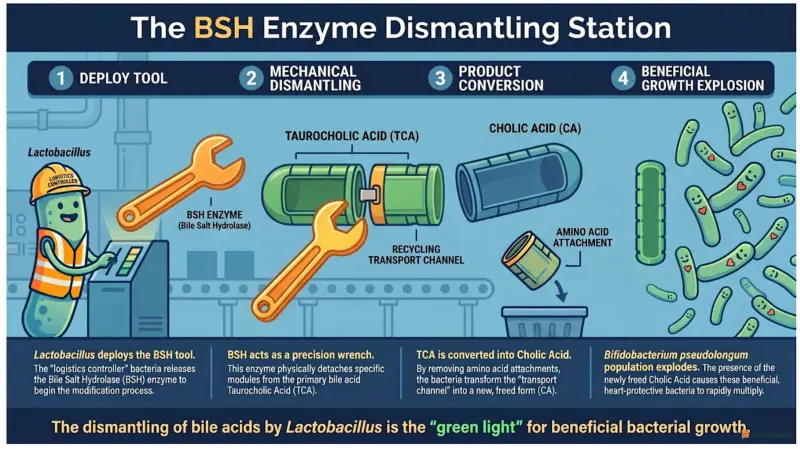
Among the most studied are Lactobacillus, Bifidobacterium, and OscillibacterLiu et al. (2025),Li et al. (2024). Lactobacillus bacteria use Bile Salt Hydrolase (BSH) to process bile compounds such as Taurocholic Acid (TCA). As these bile acids become modified, the gut environment changes in ways that support the growth of beneficial bacteria, especially Bifidobacterium pseudolongumLiu et al. (2025).
Once Bifidobacterium pseudolongum becomes established, it interacts with the Farnesoid X Receptor (FXR) signaling system. This creates a feedback signal that helps slow cholesterol production inside the liver. Oscillibacter uses a different strategy. It carries genes for Cholesterol-alpha-glucosyltransferase (CgT), an enzyme that chemically attaches sugar molecules to cholesterol. This creates modified cholesterol structures that are difficult for the body to absorb.
Oscillibacter also uses the IsmA enzyme pathway to convert cholesterol into cholestenone and coprostanol. Through these multiple systems, excess cholesterol becomes trapped inside the digestive tract rather than entering the bloodstreamLi et al. (2024).
Together, these bacteria form a coordinated microbial cleanup network that continuously reduces cholesterol pressure on the cardiovascular system.
Biological Data Table 1: Microbial Regulatory Controllers and Their Roles
How can certain foods improve the gut-heart relationship?
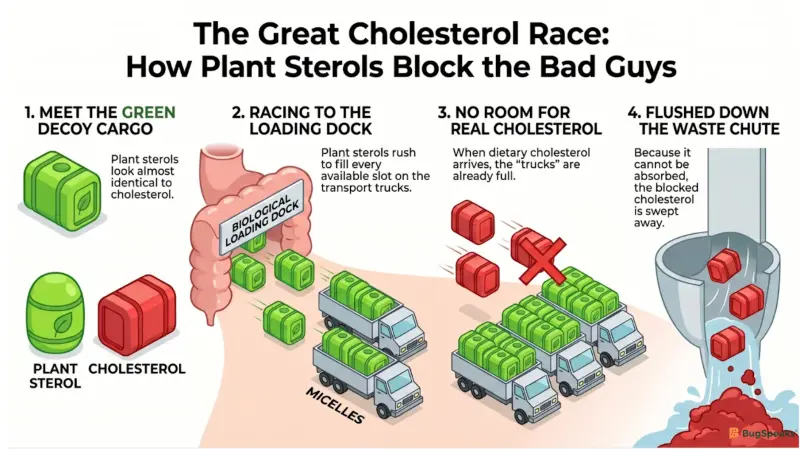
Food strongly influences how the gut-heart system operates. Every meal changes the environment inside the digestive tract, affecting which microbes grow, which enzymes become active, and how cholesterol is handled.
Some foods give beneficial bacteria the exact materials they need to improve cholesterol control. One important example is Plant Sterols. These molecules closely resemble human cholesterol. Because they look so similar, they compete for space at the intestinal absorption sites. The body mistakenly absorbs some plant sterols instead of cholesterol, leaving more cholesterol behind to be removed as wasteJacobo-Velázquez (2025).
Another major tool is Beta-glucan, a thick, soluble fiber found in oats and barley. Inside the gut, beta-glucan behaves like a gel-like sponge. It traps bile acids and carries them out of the body. Since the liver suddenly loses part of its recycled bile acid supply, it must pull additional Low-Density Lipoprotein (LDL) cholesterol from the bloodstream to manufacture new bile acidsJacobo-Velázquez (2025).
Scientists use the Cholesterol-Lowering Capacity Index (CLCI) to estimate how effectively foods support cholesterol reduction. Foods with higher CLCI scores usually influence multiple pathways at the same time, including cholesterol absorption, bile acid recycling, inflammation, and microbial balance.
When gut bacteria ferment dietary fibers, they also produce Short-Chain Fatty Acids (SCFAs). These molecules travel to the liver and help suppress cholesterol production while reducing inflammation throughout the bodyWang et al. (2026).
This means food does not simply feed the human body. It also feeds the microbial systems regulating cardiovascular health every day.
Biological Data Table 2: Nutritional Inputs and Cholesterol-Lowering Capacity Index (CLCI)
Visualize the process- https://youtu.be/ape0PkgxUuE
Reference
Li, C., Stražar, M., Mohamed, A. M., Pacheco, J. A., Walker, R. L., Lebar, T., ... & Xavier, R. J. (2024). Gut microbiome and metabolome profiling in Framingham heart study reveals cholesterol-metabolizing bacteria. Cell, 187(8), 1834-1852.
Liu, Y., Kuang, W., Li, M., Wang, Z., Liu, Y., Zhao, M., Huan, H., & Yang, Y. (2025). Cholesterol-Lowering Mechanism of Lactobacillus Bile Salt Hydrolase Through Regulation of Bifidobacterium pseudolongum in the Gut Microbiota. Nutrients, 17(18), 3019. https://doi.org/10.3390/nu17183019
Chen F and Gong L (2025) Bile acid–microbiota interactions in cardiometabolic diseases: mechanisms and emerging therapeutic approaches. Front. Microbiol. 16:1689026. doi: 10.3389/fmicb.2025.1689026
Wang J, Zhang Y, Wu Q, Zhong Y, Xu Z and Yang J (2026) Interactions of bile acids and gut microbiota modulate neurological health: a comprehensive review on mechanisms and therapeutic potential of dietary phytochemicals. Front. Microbiol. 17:1757551. doi: 10.3389/fmicb.2026.1757551
Jacobo-Velázquez, D. A. (2025). Functional Foods for Cholesterol Management: A Review of the Mechanisms, Efficacy, and a Novel Cholesterol-Lowering Capacity Index. Nutrients, 17(16), 2648. https://doi.org/10.3390/nu17162648
Li, S. W. L., Au, O. T. H., Lau, E. Y. T., Lu, R. Y., Zaleski, A. L., & Liang, J. Q. (2026). Interplay Between Gut Microbiota and Cholesterol Metabolism in Colorectal Cancer. International Journal of Molecular Sciences, 27(6), 2553. https://doi.org/10.3390/ijms27062553