Antioxidants: Your Skin's Best Defense Against Aging
Why does our skin change and age over time?
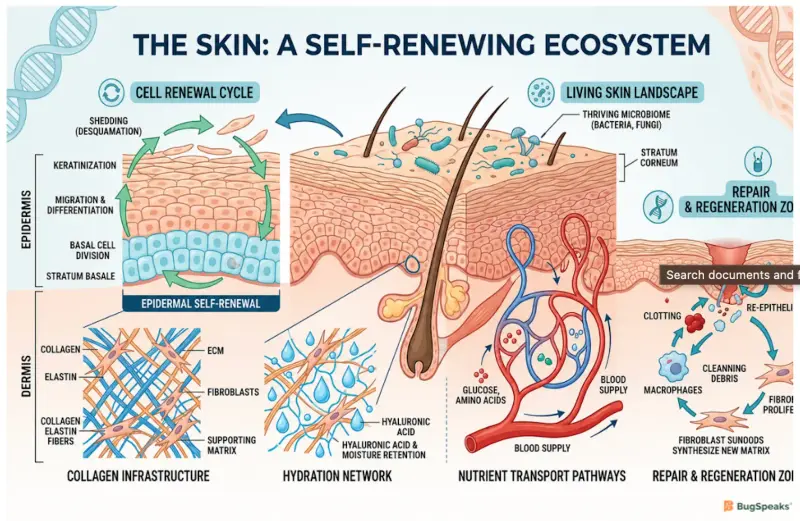
Our skin changes and ages over time because harsh external forces constantly attack it, which tires the body and permanently slows how quickly we can build new layers. Think of your skin as a vibrant, living renewal ecosystem, where continuously renewing cell populations work every day to replace worn-out cells and maintain a strong shield. When we are young, this ecosystem runs smoothly and fixes tiny damages instantly. However, as we grow older, invisible harmful rays from the sun crash into this peaceful environment. This daily attack causes a major problem called Skin Photoaging, which makes the whole ecosystem sluggish. The ongoing damage creates heavy burdens, leading to reduced renewal efficiency [Nowak-Perlak et al. (2025)].
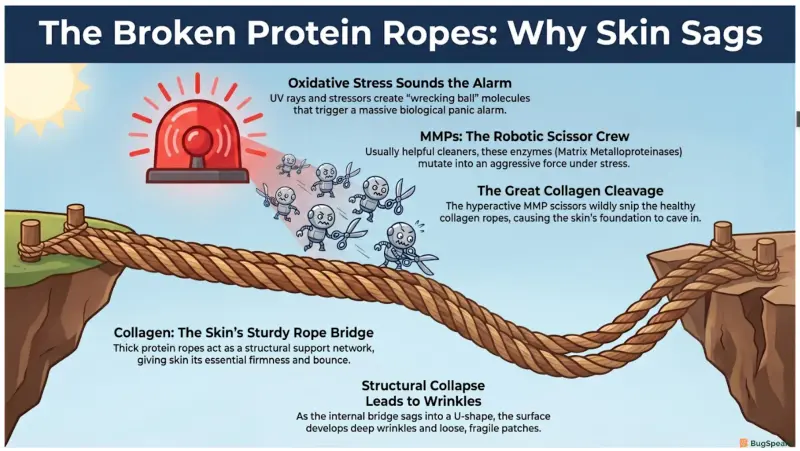
When the sun's invisible Ultraviolet (UV) Radiation hits the surface, it acts as a harsh environmental stressor that immediately disturbs the peaceful balance of our living ecosystem. This violent crash creates highly unstable molecules called Reactive Oxygen Species (ROS), which act like tiny biological wrecking balls [Liang et al. (2026)]. These dangerous particles bounce around uncontrollably, smashing into healthy, continuously renewing cell populations and causing massive destruction. Over time, the massive buildup of these wrecking balls creates a serious crisis known as Oxidative Stress, which completely exhausts the natural repair systems [Yang et al. (2025)]. The ecosystem gets so busy trying to survive the constant attacks that it simply forgets to build new cells.
This constant battle causes the living environment to suffer from low-level, permanent swelling, a problem that doctors call "inflammaging" [Woo and Kim (2024)]. In a perfectly healthy environment, tiny injuries are repaired in just a few days. But because the ecosystem is trapped in a permanent emergency, its reduced capacity for renewal prevents proper healing. Instead of constructing smooth, firm layers, the exhausted environment produces weak, dry patches that tear easily. This explains why older skin loses its beautiful bounce and becomes very fragile to the touch. The biological balance between daytime damage and nighttime repair breaks down entirely, leaving the living renewal ecosystem completely exposed to the elements [Nowak-Perlak et al. (2025)].
How do environmental stressors destroy the skin's framework?
Environmental stressors destroy the skin's framework by triggering chemical alarms that force the body to release aggressive enzymes that chop up the skin's foundational ropes. Deep inside our living renewal ecosystem, there is a brilliant structural support network built mainly from strong protein ropes called Collagen. These thick ropes act like the sturdy scaffolding of a building, giving the continuously renewing populations of cells a solid floor to walk on. However, when a harsh environmental stressor floods the area, it sounds a massive biological panic alarm. This alarm instantly signals the ecosystem to manufacture special cleanup enzymes called Matrix Metalloproteinases (MMPs) [Nowak-Perlak et al. (2025)]. In a perfectly peaceful environment, these Matrix Metalloproteinases (MMPs) are very helpful because they act like a careful recycling crew that gently removes old Collagen ropes. But under severe Oxidative Stress, these recycling enzymes go completely out of control and mutate into an aggressive, destructive force [Liang et al. (2026)]. Through complex master switches like Nuclear Factor Kappa B (NF-κB), the frightened cells command these enzymes to constantly slice up the healthy structural support network. As the beautiful protein ropes are violently chopped into tiny pieces, the solid floor of the ecosystem caves in. On the outside, this invisible internal breakdown looks like deep wrinkles and sagging, loose skin.
This mechanical collapse also ruins the skin's ability to hold onto vital water reserves. When the deeper scaffolding shatters, microscopic cracks appear in the Stratum Corneum, which is the topmost barrier of our ecosystem [Woo and Kim (2024)]. Precious moisture leaks through these damaged gaps in a disastrous process known as Trans-Epidermal Water Loss (TEWL) [Liang et al. (2026)]. Without enough water to drink, the continuously renewing populations of cells shrink, slow down, and struggle to communicate with each other. This total dehydration drops the reduced renewal efficiency even lower, ensuring the broken ecosystem remains extremely fragile and cannot bounce back from the simplest daily activities.
How do protective nutrients rescue the living ecosystem?
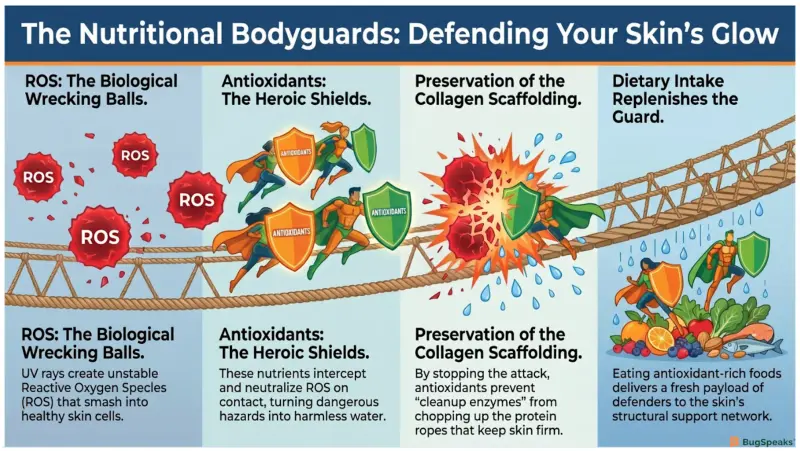
Protective nutrients rescue the living ecosystem by sacrificing themselves to intercept dangerous oxygen molecules before they can shatter the skin's physical barrier. To survive against daily destruction, the human body dispatches highly trained ecosystem-protective nutrients called antioxidants to constantly patrol the biological landscape. These heroic shields deliberately crash into the chaotic Reactive Oxygen Species (ROS) and instantly deactivate them upon contact [Nowak-Perlak et al. (2025)]. By swiftly neutralizing these violent hazards, the protective nutritional guards ensure that the delicate deeper structural support network remains perfectly safe. This brave interception completely prevents severe emergency alarms from triggering. Instead of fighting for survival, the continuously renewing populations of skin cells can simply focus their daily energy on healthy, normal growth.
Our living renewal ecosystem naturally manufactures its own internal squad of heroic shields to fight off mild daily stressors. These native defenders include powerful enzymes like Superoxide Dismutase (SOD) and Catalase (CAT), which efficiently hunt down and completely dismantle the incoming toxic particles [Liang et al. (2026)]. However, constant exposure to a powerful environmental stressor like extreme sunshine quickly drains our native reserves. Once these natural shields are fully exhausted, the ecosystem is suddenly left entirely defenseless against a fast structural collapse. To prevent a catastrophic failure, fresh dietary antioxidants must be rapidly imported from the food we eat to successfully replenish the exhausted patrol units.
Eating delicious, antioxidant-rich foods delivers massive payloads of ecosystem-protective nutrients straight to the deeply damaged tissue. This external nutritional rescue flips a cellular master switch known to scientists as the Nrf2 Pathway [Nowak-Perlak et al. (2025)]. Flipping this incredible biological switch commands the continuously renewing populations of skin cells to rapidly build huge numbers of brand new Superoxide Dismutase (SOD) defenders. By drastically multiplying the entire ecosystem's defensive strength, the skin successfully creates an invisible, powerful biological shield. A heavily fortified ecosystem easily manages the inevitable daily damage, meaning the terrible reduced renewal efficiency is fully reversed. Your hard-working body can finally rest and safely rebuild a tight, bouncy, and deeply hydrated surface.
Which specific foods act as powerful ecosystem defenders?
Specific antioxidant-rich foods provide specialized protective units that physically hug the skin's framework to block the sharp blades of destructive enzymes. Green tea contains an amazing ecosystem-protective nutrient called Epigallocatechin-3-gallate (EGCG), which behaves like a brilliant biological bodyguard [Nowak-Perlak et al. (2025)]. This powerful green tea defender physically locks onto the nasty Matrix Metalloproteinases (MMPs), jamming their cutting blades and preventing them from slicing the healthy structural support network. Meanwhile, enjoying delicious dark chocolate introduces Flavanols into the living renewal ecosystem [Yang et al. (2025)]. These dark chocolate compounds act as expert delivery drivers, expanding blood vessels to rush fresh supplies to the hungry, continuously renewing populations.
Certain red and orange foods carry fat-friendly defenders that dive deep into the cell walls to provide incredible stability. For example, pink salmon and tiny microalgae provide an unbelievably strong protector known as Astaxanthin [Nowak-Perlak et al. (2025)]. Because this bright red molecule easily dissolves into fat, it slides perfectly into the soft borders of the continuously renewing populations of cells. Once safely inside the cell walls, Astaxanthin instantly silences the loud inflammatory alarms and greatly improves the flexibility of the whole living renewal ecosystem. Turmeric root also joins the fight by supplying Curcumin, a bright yellow shield that completely unplugs the Nuclear Factor Kappa B (NF-κB) emergency switch.
Together, these delicious foods create a spectacular team tag-team operation that locks essential moisture inside the surface barrier. Fresh citrus fruits provide enormous doses of Ascorbic Acid (Vitamin C), which functions as a biological battery charger. When other vitamins get too tired fighting the fierce environmental stressor, this citrus charger instantly zaps them with fresh energy so they can keep battling [Nowak-Perlak et al. (2025)]. This beautiful teamwork securely seals the Stratum Corneum, absolutely preventing any dangerous Trans-Epidermal Water Loss (TEWL) [Liang et al. (2026)]. A perfectly sealed, heavily watered environment fully cures the reduced renewal efficiency, leaving your beautiful biological home completely resilient, tightly woven, and wonderfully hydrated.
How does the gut talk to the skin ecosystem?
The gut talks to the skin by acting as a giant refinery that digests complex foods into tiny, calming messages that travel through the blood to halt skin emergencies. This biological magic happens through an incredible communication highway known as the Gut-Skin Axis [Woo and Kim (2024)]. Our distant gut contains trillions of friendly microbes that work hard to unpack the tough fibers found in ecosystem-protective nutrients. When we eat vegetables, these smart microbes happily munch on the fibers and produce tiny glowing messengers called Short-Chain Fatty Acids (SCFAs). These newly forged messengers are dropped into the bloodstream and rushed straight to the living renewal ecosystem.
When the glowing Short-Chain Fatty Acids (SCFAs) arrive at the skin, they immediately cool down the overheated alarms caused by any harsh environmental stressor [Woo and Kim (2024)]. They whisper deeply calming instructions to the continuously renewing populations, ensuring that the dangerous Matrix Metalloproteinases (MMPs) stay completely locked away. However, if our gut refinery breaks down, a sad condition known to doctors as Dysbiosis, this beautiful long-distance communication entirely stops. Without the daily delivery of these calming messages, the skin's panic alarms ring constantly. This terrible biological silence guarantees massive internal swelling, ruining the lovely structural support network and allowing essential water to rapidly escape from the deeply damaged surface layer.
To keep this amazing processing center humming, we must feed it Probiotics and healthy plant fibers [Woo and Kim (2024)]. These helpful additions act like skilled mechanics, upgrading the gut machinery so it never breaks down under pressure. By constantly maintaining a happy, diverse factory down below, the powerful Gut-Skin Axis can easily deliver an endless pipeline of soothing medicine. This wonderful relationship permanently blocks massive Oxidative Stress attacks from destroying the distant skin barrier. Ultimately, a perfectly tuned gut engine flawlessly cures the reduced renewal efficiency, keeping our wonderful living renewal ecosystem incredibly soft, famously resilient, and wonderfully glowing for many years to come.
Reference
Nowak-Perlak, M., Olszowy, M., & Woźniak, M. (2025). The Natural Defense: Anti-Aging Potential of Plant-Derived Substances and Technological Solutions Against Photoaging. International Journal of Molecular Sciences, 26(16), 8061. https://doi.org/10.3390/ijms26168061
Yang Q, Li H, Zhang H, Ma L, Zhang X and Wu J (2025) Effectiveness of dietary supplements for skin photoaging in healthy adults: a systematic review and meta-analysis of randomized controlled trials. Front. Med. 12:1582946. doi: 10.3389/fmed.2025.1582946
WANG, Y. (2024). THE IMPACT OF NUTRITIONAL DIET ON SKIN HEALTH AND ANTI-AGING. HIGHLIGHTS IN SCIENCE, ENGINEERING AND TECHNOLOGY Учредители: Darcy & Roy Press Co. Ltd., 123, 336-344.
Woo YR and Kim HS (2024) Interaction between the microbiota and the skin barrier in aging skin: a comprehensive review. Front. Physiol. 15:1322205. doi: 10.3389/fphys.2024.1322205
Liang, Y., Xu, Y., & Kim, J. E. (2026). Impact of Antioxidant-Rich Whole Foods or Supplements on Skin Health: A Systematic Review and Meta-Analysis of Preclinical and Clinical Studies. Antioxidants, 15(3), 301. https://doi.org/10.3390/antiox15030301
Zhao, Y., Yu, C., Zhang, J., Yao, Q., Zhu, X., & Zhou, X. (2025). The gut‑skin axis: Emerging insights in understanding and treating skin diseases through gut microbiome modulation (Review). International journal of molecular medicine, 56(6), 210. https://doi.org/10.3892/ijmm.2025.5651