How to Use Good Bacteria to Fight Aging and Revitalize Your Skin
Why Is Your Belly the Secret Foundation of a Beautiful House?
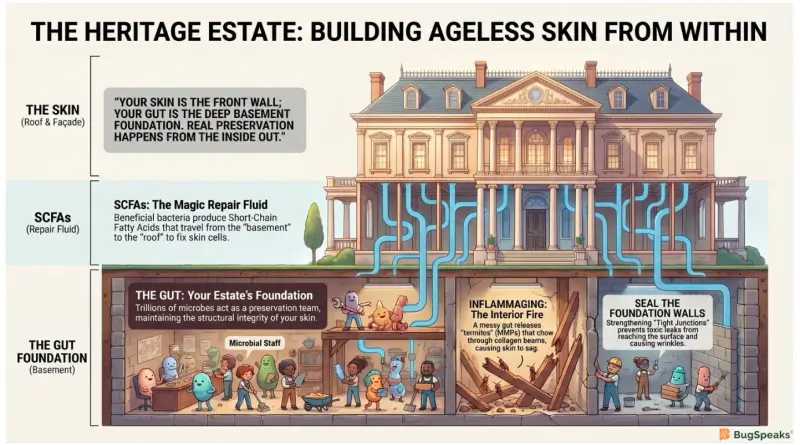
Your skin stays young and healthy because of a tiny team of workers living inside your belly that keep the rest of your body from falling apart. Imagine that your body is a Century-Old Heritage Estate, a beautiful house that everyone admires, where the skin is the front wall and the gut is the deep basement foundation. While chronological aging happens on the calendar, the actual look of the house depends on the microbiome, a permanent preservation team of trillions of tiny living things. When these workers are happy, they send supplies up to the surface to keep the walls bright and strong, ensuring that the metabolic shifts of getting older do not make the house crumble. A healthy gut creates short-chain fatty acids (SCFAs), which act as a repair fluid that travels from the basement to the roof to fix every cellKim (2026).
The visible signs of aging on your face are actually signals about how well your basement foundation is being managed. Most people think wrinkles are unavoidable, but they are often just a sign that the preservation team in your intestines is shrinking or getting tired. When the gut is full of diverse and helpful microbes, they act like a virtual organ that talks to your skin, making sure the natural weathering of life happens very slowly. If the foundation is ignored, the bad workers take over, and the whole house begins to look gray and tired. To keep your skin beautiful, you must stop just painting over the cracks and instead go into the basement to help your preservation team get back to work by providing them the right biological supplies.
Establishing a strong foundation requires understanding that your belly workers are the primary producers of your body's "Youth Currency." These tiny guests take the fiber you eat and transform it into messages that tell your skin to stay thick and elastic. This communication line is what scientists call the gut-skin axis, and it is the most important logistics route in your entire Heritage Estate. If the workers in the basement are starving, they cannot produce the short-chain fatty acids (SCFAs) needed to seal the walls, leading to the metabolic crumbles we see as fine lines. By supporting your microbiome, you are investing in the long-term structural integrity of your home, ensuring that the chronological aging of the calendar doesn't match the youthful glow in the mirror through these metabolic shifts.
How Does a Messy Basement Cause the "Beams" of Your Skin to Sag?
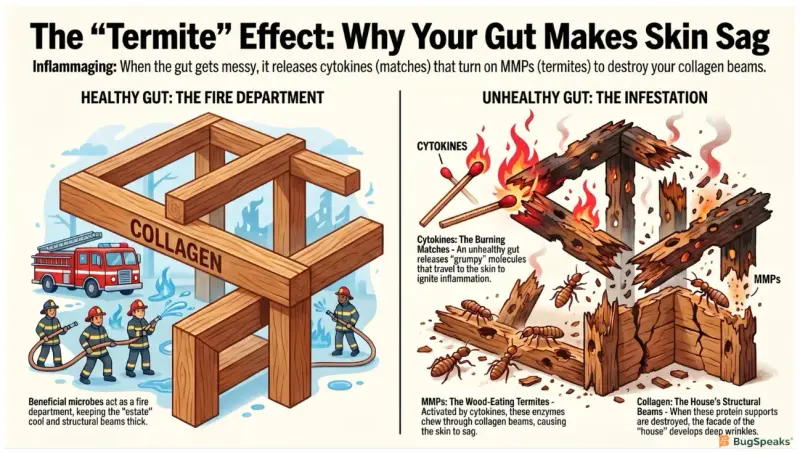
The sagging beams of your skin happen because an internal fire called inflammaging starts in your gut and slowly burns through the structural supports of your entire body. In our Heritage Estate, the wood beams are made of a protein called collagen, but when the gut gets messy, it releases grumpy molecules called cytokines that act like matches. These molecules travel through the hallways of your body to the skin, where they turn on wood-eating termites known as matrix metalloproteinases (MMPs). These termites chew up the collagen beams, causing the walls of your house to droop and create deep wrinklesYiğit et al. (2026).
This internal fire is often a sign of immunosenescence, which is when your house's security system gets too old and confused to stop the damage. When the preservation team in the basement is strong, they act like a fire department that keeps the whole estate cool and calm. But if we don't take care of our gut, the fire department gets smaller, and the bad microbes start throwing matches everywhere. Scientists have proven this by moving the gut crew from an old mouse into a young one, which caused the young mouse to age instantly! To keep the house standing tall, you must protect the intestinal lining so that the fire of inflammaging never has a chance to spread to your skin and activate the matrix metalloproteinases (MMPs).
To manage this staff effectively, you must understand that different microbes have different jobs in the aging fire department. Some workers focus entirely on dousing the sparks of inflammation before they become a blaze. Others are master builders who keep the basement walls thick and hydrated so that no smoke escapes into the upper floors. If your security system falls into a state of immunosenescence, the mess-maker workers begin to dominate, leading to a permanent state of red alert. By hiring a diverse team of specialized workers, you ensure that the shouting cytokines stay silent and your collagen beams remain strong enough to support the beautiful front wall of your house.
Table 1: Managing the Estate’s Microbial Staff
What Tools Does the Preservation Team Use to Fix the House?
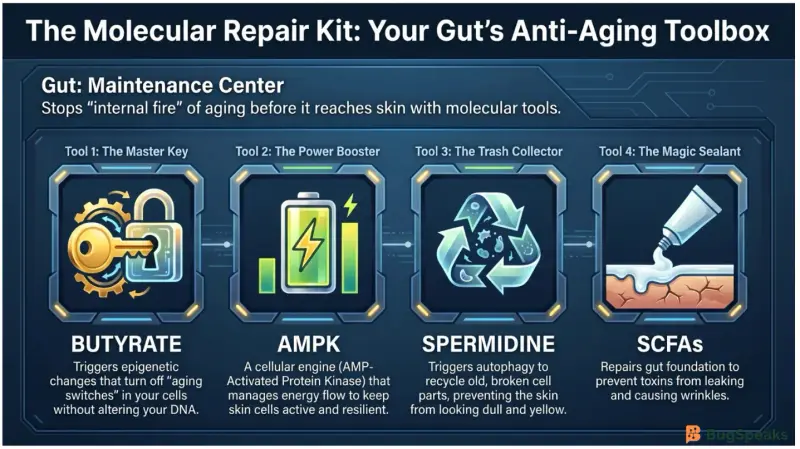
The preservation team uses a toolkit of special chemicals called metabolites, with butyrate being the most important sealant for the estate’s walls. Butyrate is a type of repair fluid that gut workers make when they eat fiber, and it travels through your blood to the skin to tell cells to act young again. This process is called an epigenetic change, where the microbes use a master key to turn off the aging switches in your cells without changing your Deoxyribonucleic Acid (DNA) code. By activating a power-booster called amp-activated protein kinase (AMPK), these tools help your house generate clean energy so that every cell stays chargedHamdi et al. (2025).
Another amazing tool in the kit is a process called autophagy, which is the house’s way of taking out the trash and recycling old, broken parts. When the preservation team has the right supplies, they trigger this self-cleaning mode to keep the skin from looking dull and yellow. However, if the gut is messy, the bad workers produce toxic waste that travels to the skin and stops the autophagy system from working. By giving your gut workers plenty of fiber and vegetables, you are providing them with the raw materials they need to keep the amp-activated protein kinase (AMPK) power-booster running, which keeps your skin thick and hydrated through the magic of butyrate.
This epigenetic master key is the secret to why some people seem to never age; their microbes are simply better at keeping the youth switches turned on. Every time you eat a healthy meal, you are handing the Master Saucier a new set of keys to unlock the beauty recipes stored in your cells. The butyrate sealant goes to work immediately, patching the microscopic cracks in your foundation and signaling the crew to begin their work. If the cells are not recycled through autophagy, they become "Zombie Cells" that just sit around and cause trouble. By supporting your microbial toolkit, you ensure that every cell in the Heritage Estate is perfectly refurbished to maintain its classic beauty.
Table 2: The Estate’s Repair Kit Inventory
How Do We Seal the "Brickwork" to Stop the Leaks?
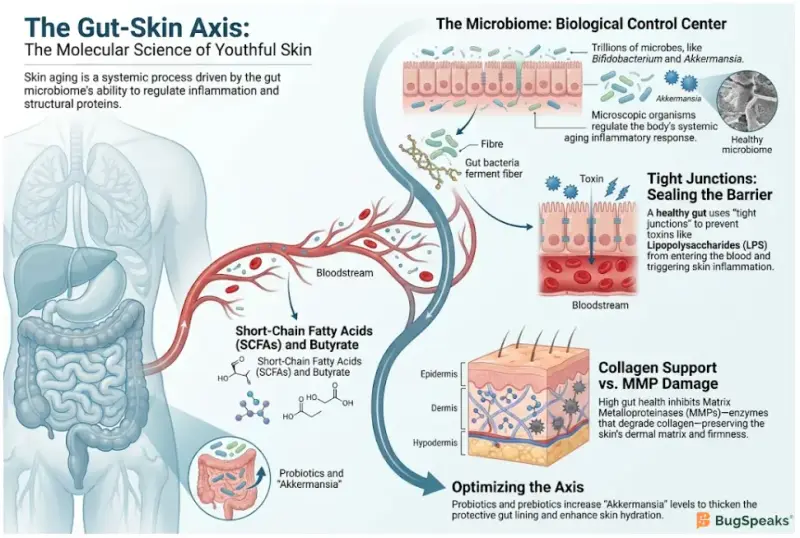
Sealing the brickwork means keeping your epithelial barrier so tight that trash and smoke from the basement foundation can never leak into the living rooms of your house. Your intestinal walls are held together by tiny staples called tight junctions, which ensure that only good nutrients enter your blood while keeping dangerous germs out. When your preservation team is weak, these staples pop off, leading to a condition called endotoxemia where toxic trash floods your system. This state of red alert tells the skin to stop making collagen and start preparing for a fight, which is a major cause of sagging beams and wrinklesWJG (2026).
One specific signal that breaks these staples is a protein called zonulin, which bad microbes use like a wrench to loosen the bricks and cause trouble. To fix this, you need master masons like the microbe Akkermansia to build a thick layer of protective slime over the bricks. This ensures that even if the basement foundation is busy, the toxic smoke of endotoxemia can never reach the rest of the Heritage Estate. Once you seal the leaks in your gut and tighten the tight junctions, the internal fire dies down, and your body can finally focus on repairing the front facade. A house with a sealed epithelial barrier is the only kind of house that stays beautiful for a hundred years.
This checkpoint log at the gates of your gut is the most important security protocol in your body. If the gatekeepers are asleep, the zonulin wrench is used to create gaps in the walls, allowing toxins to enter your blood and travel to your face. This is why a leaky gut often looks like leaky skin when the foundation is compromised, the front wall becomes red and dry. By supporting the workers who manufacture the biological glue, you ensure that the tight junctions remain fastened and the endotoxemia is kept far away from your precious front facade. It is a simple logistics problem: keep the bad cargo out of the house, and the house will stay beautiful.
Table 3: The Estate’s Checkpoint Log
How Do We Hire New Workers and Upgrade the Power Grid?
We hire new workers by using probiotics, prebiotics, and postbiotics to transform the basement foundation from a mess into a high-tech maintenance center. You don't fix a heritage estate by just wishing; you have to hire a fresh crew of workers, known as probiotics, and give them the fiber-snacks they love to eat. Clinical studies have shown that using specialized workers, such as tyndallized or heat-killed microbes, can actually decrease wrinkle depth and make the dermal matrix much firmerKim et al. (2026). These new workers immediately start fixing the brickwork and telling the rest of the body to stay young by repairing the scaffold of the skin.
Sometimes we only need the workers' uniforms and tools, which we call postbiotics, to get the job done safely without using live bacteria. Scientists use these tyndallized microbes to send signals to your body’s security sensors, telling them to calm down and stop the aging fire of the dermal matrix. Additionally, every cell in your skin has a tiny battery called a mitochondrion that provides the electricity needed for renovation. As the estate gets older, these batteries often stop holding a charge, but gut workers can produce super-chargers to recycle old batteries. By taking care of your foundation with the right food, you ensure that the power grid of your skin stays online and your internal clocks are synchronized.
This inside-out makeover is the ultimate secret to keeping the estate’s facade looking smooth and firm for decades. Your Heritage Estate follows a strict shift schedule known as the circadian rhythm, where repairs happen primarily at night while the front wall is not being weathered by the sun. If your basement crew is missing the right specialists, your skin becomes much more vulnerable to solar weathering, which leads to thin, papery walls. By supporting the probiotics and providing them with the supplies to make postbiotics, you are installing an invisible shield that keeps the facade bright. It is an inside job that starts on your plate and ends with a youthful glow that proves your Heritage Estate is well-maintained.
Table 4: Advanced Logistics & Infrastructure
-Varsha V
Visualize the process- https://youtu.be/wCtEHL9rJ2c
Reference
https://pmc.ncbi.nlm.nih.gov/articles/PMC12943245/
Kim, H., Bang, W. Y., Jeong, K. H., Jung, Y. H., Yang, J., & Moon, J. S. (2026). Effects of Heat-Killed Lactobacillus acidophilus IDCC 3302 on Skin Aging Parameters: A Randomized, Double-Blind, Placebo-Controlled Trial in Healthy Adults. Nutrients, 18(4), 596. https://doi.org/10.3390/nu18040596
https://pubmed.ncbi.nlm.nih.gov/41747787/
Yiğit, İ. K., Türsen, Ü., Türsen, B., Solak, B., Bakay, Ö. S. K., & Kroumpouzos, G. (2026). Probiotics for skin aging and skin conditions in the elderly. Clinics in dermatology, S0738-081X(26)00057-X. Advance online publication. https://doi.org/10.1016/j.clindermatol.2026.02.016
https://pmc.ncbi.nlm.nih.gov/articles/PMC12828327/
Kim J. Y. (2026). Gut Microbiota, Probiotics, and Aging: Molecular Mechanisms and Implications for Healthy Aging. Journal of microbiology and biotechnology, 36, e2511046. https://doi.org/10.4014/jmb.2511.11046
https://pmc.ncbi.nlm.nih.gov/articles/PMC12387267/
Hamdi, A., Lloyd, C., Eri, R., & Van, T. T. H. (2025). Postbiotics: A Promising Approach to Combat Age-Related Diseases. Life (Basel, Switzerland), 15(8), 1190. https://doi.org/10.3390/life15081190