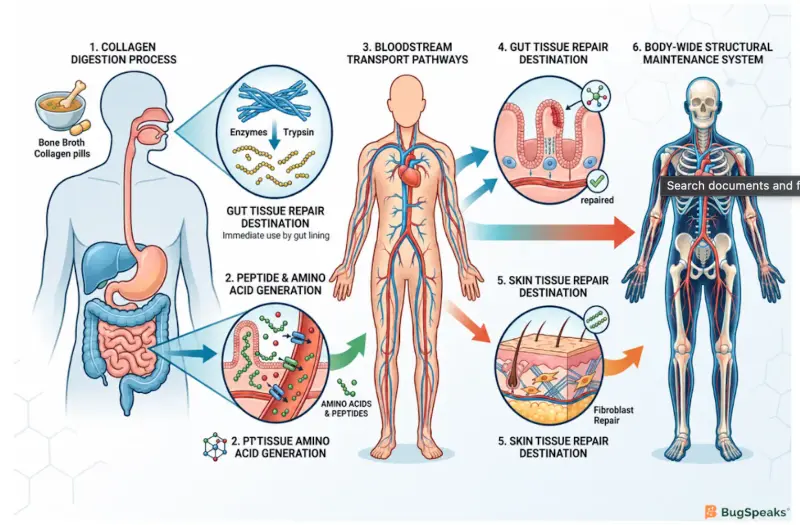
What happens to collagen supplements when they enter the digestive system?
Collagen supplements are immediately dismantled by the digestive system into tiny, absorbable amino acids and peptides before entering the bloodstream to support tissue maintenance. Native collagen is a massive, complex protein structure that the human body cannot absorb directly in its raw form. When you consume a collagen supplement, it enters the digestive tract, which utilizes enzymes to break down these large, rigid proteins into much smaller fragments known as bioactive collagen peptides and individual amino acids. These tiny fragments are then small enough to easily pass through the intestinal wall and enter the bloodstream, which acts as the primary distribution system for structural maintenance and tissue repairBochniak (2026).
In the Dual-Tissue Resource Allocation Network, a collagen supplement acts as a massive shipment of incoming structural resources arriving at the central resource processing center (the digestive system). Because these raw materials are far too large and complex to transport through the network, the processing center must actively dismantle them into smaller, reusable building materials. The structural integrity of the original collagen is broken down into highly specific components, primarily the amino acids glycine, proline, and hydroxyproline. Collagen breaks down predominantly into those three amino acids because its unique triple-helix structure is built using a repeating pattern where glycine, proline, and hydroxyproline make up over half of the entire molecule. Once carefully sorted and processed, these materials are loaded into the resource allocation network (the bloodstream) for delivery wherever structural maintenance is required throughout the biological system.
The efficiency of this biological processing depends heavily on the supplement's initial form. Unprocessed native collagen has a high molecular weight and strongly resists enzymatic breakdown, making it a poor source of immediate building blocks. In contrast, hydrolyzed collagen has already undergone thermal or enzymatic processing outside the body, effectively breaking the rigid triple helix into smaller polypeptidesBochniak (2026). Advanced manufacturing processes yield even smaller bioactive collagen peptides, which typically weigh less than 3 kilodaltons. Because of their tiny size, these peptides are rapidly absorbed into the resource allocation network to support tissue repair and structural integrity with minimal processing effort required by the bodyPaula-Vieira (2026).
These reusable building materials possess a very unique chemical signature that the body specifically requires for tissue repair. Approximately one-third of the incoming resources consists of glycine, while another fifth is composed of proline and hydroxyprolineBochniak (2026). This highly specific ratio is critical because the resource allocation network actively searches for these exact materials to repair connective tissues. Without this precise combination of amino acids, the body would struggle to manufacture the structural scaffolding necessary to maintain the physical stability of both the internal and external barrier infrastructures.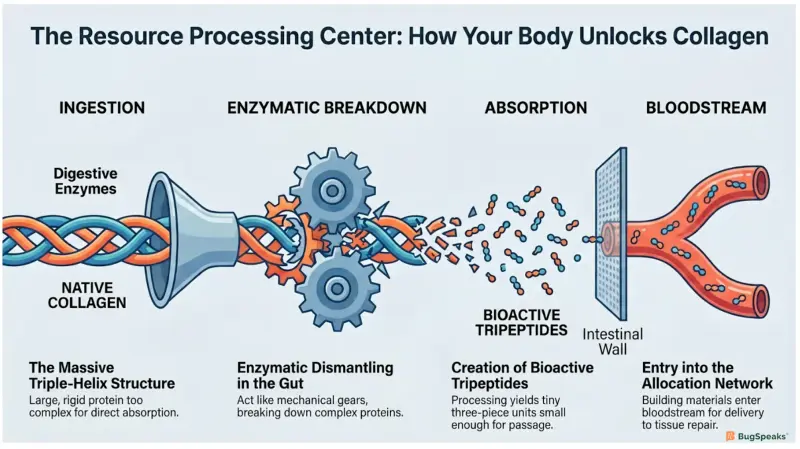
How does the digestive system use collagen to strengthen its own lining?
The digestive system utilizes specific collagen peptides as prebiotic fuel to nourish beneficial bacteria and physically fortify the intestinal barrier against inflammation. Before any collagen reaches the outer layers of the body, a significant portion interacts directly with the gut microbiota residing in the lower intestines. Certain protease-resistant collagen fractions bypass initial digestion and travel deep into the hindgut, where they alter the microbial community structure and aggressively stimulate the growth of highly beneficial bacterial strainsZhang (2025).
Within the Dual-Tissue Resource Allocation Network, the digestive tract is not merely a resource processing center; it is also a vital internal barrier infrastructure that must be continuously maintained. When incoming structural resources arrive, the local microscopic workforce (the microbiome) utilizes specific, resistant fragments as operational fuel. This localized consumption ensures that the internal barrier remains securely sealed, preventing unauthorized leaks and structural collapse. By feeding the local workforce, these reusable building materials indirectly fortify the very processing center that manages the body's entire resource allocation network.
Scientific studies demonstrate that collagen peptides possess powerful prebiotic-like properties that actively remodel the bacterial landscape of the intestines. When tripeptide-rich collagen reaches the lower intestine, it significantly increases the overall diversity of the microbiome and boosts the population of specific bacteria, particularly Lachnoclostridium and Roseburia, which are responsible for producing short-chain fatty acids (SCFAs)Zhang (2025). These short-chain fatty acids (SCFAs) are crucial metabolic byproducts that provide direct cellular energy to the intestinal lining, reducing local inflammation and maintaining a tight, impenetrable seal against the outside environment.
Furthermore, this localized intestinal healing forms the foundational baseline of the gut-skin axis, a systemic biological signaling network that directly links gastrointestinal health to dermatological appearance. When collagen peptides modulate the gut environment and enhance the production of short-chain fatty acids (SCFAs), they trigger the release of systemic regulatory signals, including anti-inflammatory cells that travel far beyond the digestive tractZhang (2025). A stable, well-resourced internal barrier infrastructure ultimately reduces systemic physical stress, allowing the resource allocation network to confidently ship its remaining building materials outward to the external barrier infrastructure.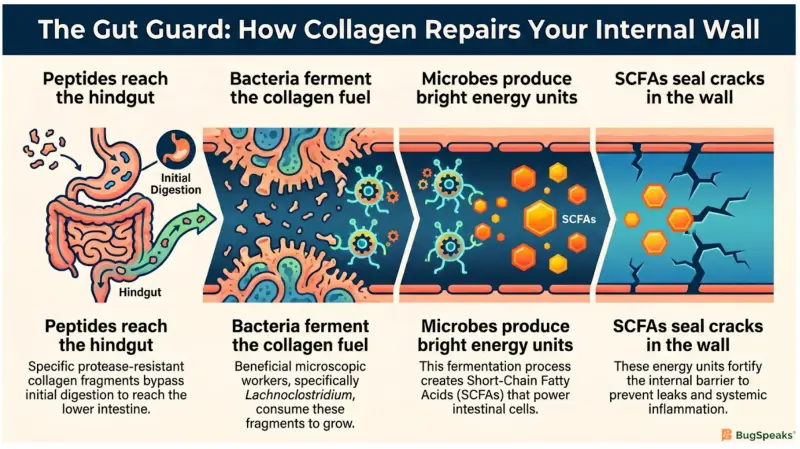
How do collagen building blocks reach and repair the skin?
Specialized collagen dipeptides travel through the bloodstream directly to the skin, where they stimulate local cellular factories to synthesize new structural proteins and moisture-binding molecules. After surviving the digestive breakdown in the gut, specific low-molecular-weight sequences such as Pro-Hyp (proline-hydroxyproline) enter systemic circulation and physically accumulate in the dermal layers of the skin. Once they arrive, they do not simply become passive building blocks; they actively signal specialized skin cells called fibroblasts to begin rapidly proliferating and producing new collagen, elastin, and hyaluronic acidWang (2025).
In the Dual-Tissue Resource Allocation Network, the skin serves as the crucial external barrier infrastructure, constantly subjected to environmental weathering and mechanical wear. The resource allocation network delivers highly specific, reusable building materials directly to this outer perimeter. Once these targeted materials arrive, they act as both physical construction supplies and active biological work orders. They signal the local manufacturing units to immediately increase the production of structural scaffolding and hydration-retaining matrix, ensuring the external barrier infrastructure remains firm, flexible, and fully operational against outside elements.
The dermal layer of the skin is predominantly composed of a dense extracellular matrix, a supportive physical framework that dictates skin elasticity, firmness, and overall moisture retentionWang (2025). This complex matrix relies heavily on type I collagen, which provides rigid mechanical strength, and type III collagen, which imparts flexibility and soft elasticityBochniak (2026). Supplementation provides the exact amino acid signatures required to successfully replenish this matrix. Clinical studies show that continuous intake of bioactive peptides for 12 weeks significantly increases dermal density and dermal thickness, indicating robust, measurable structural repair deep within the skinWang (2025).
Beyond simple protein synthesis, the arrival of these specific dipeptides dramatically enhances the skin's ability to retain deep tissue moisture. The Pro-Hyp sequences activate genetic pathways that increase the natural synthesis of hyaluronic acid, a powerful molecule capable of binding substantial amounts of water within the extracellular matrixWang (2025). This biological mechanism explains why oral collagen supplementation has been consistently proven to reduce transepidermal water loss and significantly improve overall facial moisture content, creating a stronger, more resilient external barrierWang (2025).
How does the body decide whether to allocate collagen to the gut or the skin?
The body strictly prioritizes the reduction of systemic internal inflammation and the repair of vital tissues before allocating any remaining structural resources to external aesthetic enhancements. This systemic allocation is heavily regulated by powerful signaling molecules, such as Transforming growth factor-beta (TGF-β), which controls cellular proliferation and repair, and Klotho, an anti-aging protein involved in defending against cellular stress and maintaining tissue balancePaula-Vieira (2026). When nutritional resources are scarce or internal tissue damage is high, these signaling pathways ensure critical physiological functions are maintained over superficial external repairs.
The Dual-Tissue Resource Allocation Network operates on a strict survival hierarchy. The network constantly assesses the condition of both the internal barrier infrastructure and the external barrier infrastructure. If the resource processing center is experiencing high levels of structural damage or active inflammation, the network will automatically intercept incoming structural resources to secure the central core. Only when the internal infrastructure achieves total stability will the network authorize the outward export of reusable building materials to the peripheral external barrier for routine maintenance and structural enhancement.
The biological communication between these competing tissues is facilitated by the gut-skin axis, driven largely by molecular messengers. When bioactive collagen peptides are ingested, they stimulate the production of Transforming growth factor-beta (TGF-β) in both the gut and the bloodstreamZhang (2025). This powerful signaling molecule acts as a systemic anti-inflammatory agent, downregulating aggressive immune responses and creating a pro-regenerative environment throughout the entire bodyPaula-Vieira (2026). By calming internal inflammation first, the body effectively clears the logistical pathways needed for resources to safely reach the skin without being aggressively consumed by internal immune defense mechanisms.
Furthermore, oral supplementation has been shown to significantly elevate circulating levels of Klotho in middle-aged individualsPaula-Vieira (2026). This protein actively suppresses the breakdown of the extracellular matrix and enhances antioxidant defenses, effectively slowing the aging process across multiple organ systems. Simultaneously, collagen peptides help block matrix metalloproteinases (MMPs), which are destructive enzymes responsible for actively degrading existing collagen fibersWang (2025). Together, these mechanisms ensure that once the body allocates resources to the skin, those structural gains are protected from immediate enzymatic destruction.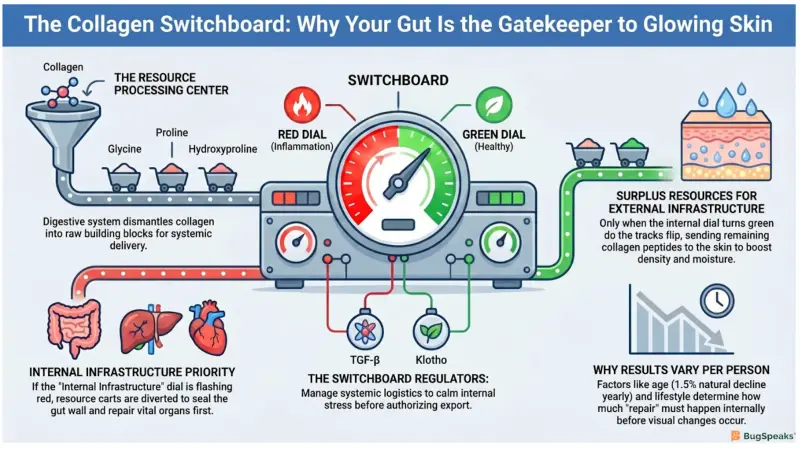
Why do collagen benefits vary so much from person to person?
Individual variations in baseline collagen density, gut microbiome health, age-related metabolic decline, and lifetime environmental exposure dictate exactly how efficiently each body processes and utilizes the supplement. Starting around age 30, natural collagen synthesis steadily declines by approximately 1% to 1.5% every single year, accompanied by the progressive fragmentation and disorganization of existing collagen fibersBochniak (2026). Therefore, individuals with severe pre-existing degradation will naturally require significantly more time and material to rebuild their structural foundation compared to those with only minor age-related deficits.
In the Dual-Tissue Resource Allocation Network, visual results depend entirely on the pre-existing condition of a person's infrastructure. If one individual has a highly efficient resource processing center and minimal internal wear-and-tear, the incoming structural resources are rapidly exported to the external barrier infrastructure, yielding swift visible improvements. Conversely, if another individual suffers from a highly compromised processing center or widespread internal logistical roadblocks, the network must dedicate all reusable building materials to invisible internal repairs, substantially delaying any aesthetic upgrades to the outer perimeter.
External lifestyle factors severely disrupt this internal resource management. Chronic exposure to ultraviolet radiation triggers severe photoaging, accelerating the destruction of the extracellular matrix by directly upregulating the production of collagen-degrading enzymesBochniak (2026). Smoking and environmental pollution cause similar structural havoc, reducing the natural synthesis of type I collagen and type III collagen by up to 22%Bochniak (2026). These aggressive external stressors act like constant physical attacks on the barrier network, forcing the body to use incoming supplements simply to replace daily microscopic losses rather than building new, enhanced structures.
Finally, hormonal fluctuations play a massive role in network efficiency. During menopause, the drastic reduction in estrogen levels triggers an abrupt and severe decline in systemic collagen production, drastically thinning the skin and weakening connective tissuesBochniak (2026). Genetic predispositions encoded within our Deoxyribonucleic Acid (DNA) also permanently determine our baseline collagen density and the inherent speed of our natural cellular degradation processesBochniak (2026). Ultimately, collagen supplementation successfully provides the necessary chemical building blocks, but the individual's highly unique biological environment strictly dictates exactly where and how fast those blocks are deployed.
Visualize the process- https://youtu.be/jMzf5UFaGJM
Reference
Paula-Vieira, R. H. R., Dias, S. R., Silva-Reis, A., Moura-Maia, M. S., Ramos-Gomes, N. V., Jesus-Silva, K., Oliveira-Leal, Y. R., Castro-Pimentel, L. T., Carvalho, W. S. F., Melo, F., Martins, J. L. R., Bachi, A. L. L., & Vieira, R. P. (2026). Immune-Modulatory Effects of Bioactive Collagen Peptides Improve Skin Health in Middle-Aged Women. Dermatology and therapy, 16(2), 1385–1397.https://doi.org/10.1007/s13555-026-01654-9
Wang, Y., Zhu, W., Luo, W., Ma, Y., & Zhou, Y. (2025). The Sustained Effects of Bioactive Collagen Peptides on Skin Health: A Randomized, Double-Blind, Placebo-Controlled Clinical Study. Journal of cosmetic dermatology, 24(12), e70565.https://doi.org/10.1111/jocd.70565
Zhang, H., Yao, Z., Song, Y., Hua, Q., Geng, X., Zhou, F., Li, Q., Li, Z., Luo, Z., Sun, J., Qi, C., & Li, D. (2025). Collagen peptides promote skin collagen synthesis by modulating the gut microbiota and activating the TGF-β pathway. Food & function, 16(13), 5326–5344.https://doi.org/10.1039/d5fo01649e
Bochniak, O., & Piotrowska, K. (2026). Collagen Supplements in Skin Aging and Treatment—A Narrative Review. Applied Sciences, 16(8), 3880.https://doi.org/10.3390/app16083880