Exploring the Gut-Health Consequences of Fast Food Consumption
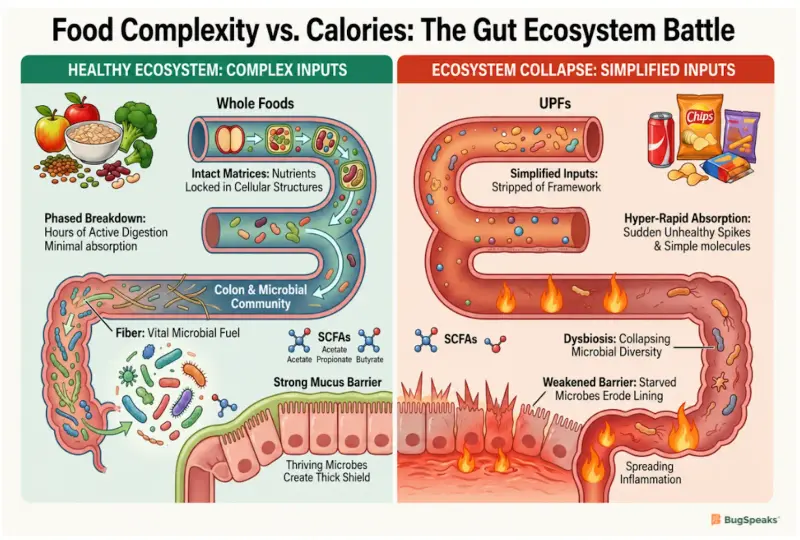
Why does food complexity matter more than calories in our biological processing ecosystem?
Food complexity determines how resources are distributed across our biological processing ecosystem, meaning that identical calorie counts from different sources produce different biological results. In our digestive tract, foods represent complex instructional inputs guiding cellular behavior rather than simple fuel. Minimally processed whole foods function as diverse biological inputs because they are chemically intricate and locked in physical cellular matrices. This complex structure requires our digestive tract and resident microbes to perform active, coordinated, and phased breakdown processes to extract nutrients slowly over several hours. In contrast, ultra-processed food products serve as simplified industrial inputs that disrupt this natural timeline, causing rapid, unhealthy spikes.
These simplified industrial inputs are rapidly absorbed in the upper gastrointestinal (GI) tract, leaving the lower colon empty and starving our helpful microbes. This hyper-rapid absorption triggers sudden spikes in blood glucose and insulin levels, destabilizing our glucose homeostasisMiclotte and Van de Wiele (2020). While the host absorbs simplified sugars and fats in the small intestine, the lack of complex structures leaves colonic microbes starved. Replacing whole foods with processed inputs directly impairs glucose homeostasis and insulin sensitivityCapra et al. (2024). When deprived of diverse inputs, the ecological balance of our gut collapses, leaving our body highly vulnerable to metabolic diseases.
This explains why calories alone do not tell the whole story of nutrition and metabolic health. Two meals with identical energy counts can have opposite effects on our gut depending on their physical structure. A meal of diverse biological inputs promotes a stable, diverse, and protective microbial network, whereas a meal of simplified industrial inputs starves our beneficial microbes and alters our systemic metabolism. Maintaining a healthy gut requires us to shift our focus from simple caloric math to the complex structural needs of our internal biological ecosystem, helping even young readers understand that our gut microbes are active partners in processing our daily food.
How do simplified industrial inputs alter the resource profile of our gut?
Simplified industrial inputs alter the resource profile of our digestive tract by replacing cell-bound nutrients with highly refined sugars, fats, and additives. In whole foods, nutrients are locked inside a cellular architecture that our body slowly dismantles over several hours. Manufacturing ultra-processed items strips away this structural frameworkCapra et al. (2024). This creates an altered resource profile in the gut lumen, replacing diverse nutrients with a constant, dangerous flood of highly absorbable simple sugars, fats, and chemicals, which acts like a harsh detergent on our delicate internal liningDale et al. (2025) and completely disrupts our entire biological ecosystem.
This altered resource profile is characterized by the widespread presence of industrial emulsifiers and additives. These chemicals are used to bind ingredients together, extend shelf life, and enhance texture. Common synthetic emulsifiers, such as carboxymethylcellulose (CMC) and polysorbate 80 (P-80), are frequently consumed in highly processed dietsCapra et al. (2024). Chronic exposure to these substances directly erodes the protective mucus lining of the gut, allowing bacteria to migrate into close physical contact with our intestinal cells. This direct contact triggers low-grade inflammation, causing severe gut barrier irritationDale et al. (2025) in our microscopic world and completely disrupting our body's natural physical defenses.
Furthermore, the constant introduction of these non-natural substances alters the chemical landscape of the colonic lumen. When our biological processing ecosystem is exposed to a highly processed, low-fiber diet, the microbes are forced to adapt. Instead of producing beneficial metabolic compounds, the gut bacteria shift their activity, producing molecules that promote cellular stress and disrupt gut barrier functionMiclotte and Van de Wiele (2020). This chemical instability compromises our gut's internal defenses, making us far more vulnerable to both chronic inflammatory conditions and metabolic imbalances, altering the entire biological network and making our entire digestive tract struggle to constantly function properly.
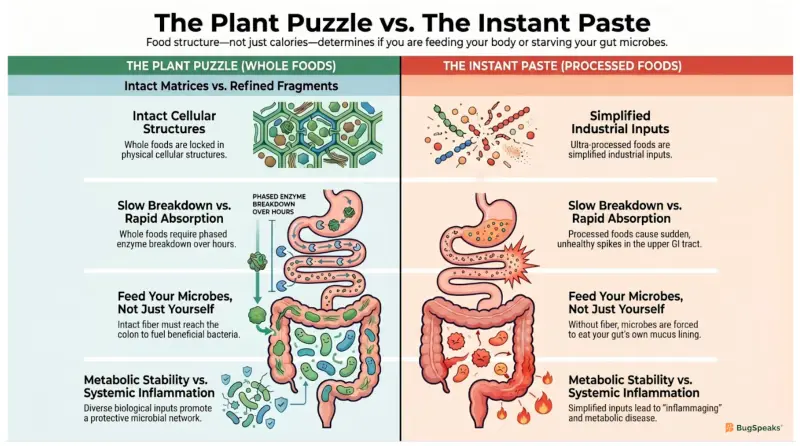
Why is microbial fuel essential for maintaining a healthy ecosystem outcome?
Microbial fuel, in the form of dietary fiber and resistant starch, is essential because it is the primary substrate that beneficial gut bacteria ferment to produce protective short-chain fatty acidsRomaní-Pérez et al. (2021). When we consume diverse biological inputs, the complex plant polysaccharides that resist human digestion in the small intestine travel safely to the colon. Here, they serve as the vital microbial fuel that sustains our biological processing ecosystem. Beneficial microbial groups, including the genera Bifidobacterium, Lactobacillus, and Roseburia, rely on this organic fuel to power their metabolic activities, grow their populations, and maintain their overall numbers to keep our gut healthy.
Fermenting this microbial fuel produces organic metabolites, most notably short-chain fatty acids like acetate, propionate, and butyrateRomaní-Pérez et al. (2021). These are highly valuable resources that protect the host. Butyrate, for example, serves as the primary energy source for the cells lining the colon, fueling the repair of our gut barrier. Starving our microbes of this fuel by consuming a fast-food diet drops the abundance of these protective organisms, causing a severe decline in microbial diversityLane et al. (2020). Without this diversity, the gut's defenses collapse, letting bad microbes take over the biological network and damage our health.
When deprived of external plant-based fuel, the starved microbes are forced to seek alternative resources to survive. Several species in our biological processing ecosystem possess enzymes that allow them to digest the glycoproteins making up our gut's own protective mucus barrierDale et al. (2025). This degradation of our internal protective shield directly compromises our intestinal integrity, allowing opportunistic, pro-inflammatory bacteria to contact and penetrate our epithelial lining, leading to a highly unstable ecosystem outcome. Sustaining a healthy gut requires us to consistently provide our microbial partners with the complex microbial fuel they need to thrive and build a strong shield.
What are the clinical consequences of running our biological ecosystem on simplified inputs?
Running our biological processing ecosystem on simplified industrial inputs increases the risk of serious inflammatory diseases and metabolic disorders by breaking down gut barrier integrity and promoting systemic inflammation. A major clinical risk associated with high ultra-processed food intake is the development of inflammatory bowel disease, which comprises Crohn's disease and Ulcerative Colitis. A massive prospective cohort study involving over 116,000 adults across 21 countries showed that higher intake of ultra-processed food was associated with a higher risk of incident inflammatory bowel diseaseNarula et al. (2021), providing robust prospective evidence linking highly processed inputs directly to serious structural gut damage.
In addition to inflammatory bowel disease, diets dominated by ultra-processed inputs are strongly linked to irritable bowel syndrome. Large-scale epidemiological studies, including the French NutriNet-Santé cohort and the United Kingdom Biobank prospective cohort, demonstrate a consistent, dose-dependent relationship between high processed food intake and a higher prevalence of irritable bowel syndrome symptoms, such as abdominal pain and bloatingDale et al. (2025). This clinical association is thought to be driven by the pro-inflammatory effects of chemical additives and the direct irritation of the gut lining, which sensitizes enteric nerves and drives visceral hypersensitivity in human patients, leading to ongoing abdominal pain.
The metabolic consequences of this dietary pattern are equally severe, particularly in mid-life adults who are susceptible to metabolic decline. Controlled feeding trials show that ultra-processed diets impair insulin sensitivity and glucose tolerance, accelerating prediabetes and type 2 diabetesCapra et al. (2024). This metabolic impairment is closely linked to the development of inflammaging, a state of chronic, low-grade systemic inflammation driven by the loss of protective, short-chain fatty acid-producing bacteria and the subsequent leakage of inflammatory bacterial components into our bloodstream, showing why avoiding simplified industrial inputs protects our long-term health and keeps our entire metabolism balanced, safe, and strong.

How does the gut-brain axis coordinate metabolic signaling when our biological processing ecosystem is disrupted?
Disruption of our biological processing ecosystem impairs the gut-brain axis by corrupting the vital neural and hormonal pathways that control appetite, satiety, and systemic energy homeostasis. The gastrointestinal tract acts as a huge sensory organ, transmitting detailed information about nutrient availability directly to the brain's appetite control centersRomaní-Pérez et al. (2021). This sensory dialogue is mediated by specialized enteroendocrine cells in the gut lining that detect nutrients and release metabolic hormones like glucagon-like peptide-1, peptide tyrosine tyrosine, and cholecystokinin. These hormones travel through the bloodstream or stimulate nearby vagal afferent nerve terminals, signaling satiety directly to the brain and telling us when we are full.
When our diet consists primarily of simplified industrial inputs, this precise communication network is thrown into disarray. The rapid, premature absorption of refined carbohydrates and lipids in the upper small intestine overstimulates our sensory mechanisms in the short term, but leads to a blunted, resistant response over time, contributing to overeating and weight gainRomaní-Pérez et al. (2021). Furthermore, the lack of fermentable fuel in the lower colon deprives the body of local, short-chain fatty acid-induced triggers that normally stimulate hormone release, disrupting the body's homeostatic control of appetite and systemic energy homeostasis in human hosts, making us eat more than we need.
Beyond hormones, our gut microbes produce specific cellular proteins and components that act as direct metabolic messengers to our brain. For example, certain strains of Escherichia coli in our biological processing ecosystem produce a heat-shock protein called caseinolytic peptidase B, which acts as an antigen mimetic of the host's own satiety neuropeptideRomaní-Pérez et al. (2021). Conversely, when dysbiosis impairs the gut barrier, pro-inflammatory components like lipopolysaccharide leak into the system, causing low-grade brain inflammation that disrupts appetite-regulating circuits, leading to constant hunger. This is why we must protect our intestinal ecosystem with complex foods and feed our microscopic workers the right fuel.
Visualize the process- https://youtu.be/s9tNhMtxlJo
Reference
Narula, N., Wong, E. C., Dehghan, M., Mente, A., Rangarajan, S., Lanas, F., ... & Yusuf, S. (2021). Association of ultra-processed food intake with risk of inflammatory bowel disease: prospective cohort study. Bmj, 374.
Lane, M., Howland, G., West, M., Hockey, M., Marx, W., Loughman, A., ... & Rocks, T. (2020). The effect of ultra-processed very low-energy diets on gut microbiota and metabolic outcomes in individuals with obesity: A systematic literature review. Obesity research & clinical practice, 14(3), 197-204.
Miclotte, L., & Van de Wiele, T. (2020). Food processing, gut microbiota and the globesity problem. Critical Reviews in Food Science and Nutrition, 60(11), 1769–1782.https://doi.org/10.1080/10408398.2019.1596878
Capra, B. T., Hudson, S., Helder, M., Laskaridou, E., Johnson, A. L., Gilmore, C., ... & Davy, B. M. (2024). Ultra-processed food intake, gut microbiome, and glucose homeostasis in mid-life adults: Background, design, and methods of a controlled feeding trial. Contemporary clinical trials, 137, 107427.
Romaní-Pérez, M., Bullich-Vilarrubias, C., López-Almela, I., Liébana-García, R., Olivares, M., & Sanz, Y. (2021). The Microbiota and the Gut-Brain Axis in Controlling Food Intake and Energy Homeostasis. International journal of molecular sciences, 22(11), 5830.https://doi.org/10.3390/ijms22115830
Dale, H. F., Kolby, M., & Valeur, J. (2025). Ultra-Processed Food Consumption and Irritable Bowel Syndrome: Current Evidence and Clinical Implications. Nutrients, 17(22), 3567.https://doi.org/10.3390/nu17223567