From Soil to Supplement: The Journey of Soil-Based Organisms (SBOs)
What are soil-based organisms and why do they sleep?
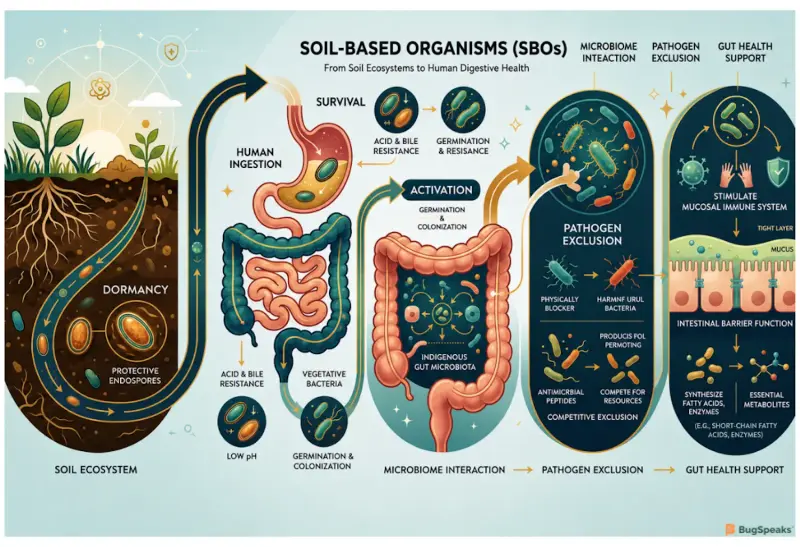
Soil-based organisms are special bacteria found in dirt that form tiny, hard armor shells called spores to sleep and survive when their environment lacks food or becomes too harshPayne (2024). These soil bacteria have adapted over millions of years to live in extreme environments, like deserts, by developing a brilliant survival strategy called the Dormancy & Reactivation SystemFaherty-McGrath (2026). Instead of dying when food disappears or temperatures get too hot, they simply curl up inside their microscopic pods, turning off their metabolism to wait for a better day. They are the ultimate biological sleepers, waiting patiently in the dirt.
In this dormant biological form, the bacteria stop growing and do not consume any energy at all, which is incredibly unique compared to normal probioticsPayne (2024). Most common probiotics, like those found in yogurt, are active vegetative cells, meaning they are awake, fragile, and constantly need food to survive. Soil-based organisms spend much of their existence completely asleep inside their protective outer structures. This sleeping state acts like a strong biological pause button that protects the bacteria's precious genetic recipe, keeping it completely safe from extreme cold, intense heat, drying out, and even toxic chemicals in the natural dirt environment.
These bacteria sleep because the soil environment is a wild place where conditions change constantly from wet to bone-dryFaherty-McGrath (2026). When rain falls and nutrients appear, the spores can sense these changes and wake up to help plants grow. But as soon as the dirt dries up again, they build their tough armor shells and go back to sleep. This natural cycle of sleeping and waking makes these organisms incredibly tough and durable. These amazing abilities explain how they live for years in nature. Understanding this deep-sleep behavior is the key to seeing how these unique dirt-dwelling bacteria can help our own bodies.
How do these dormant bacteria survive the trip to our gut?
Soil-based organisms survive stomach acid by packing their delicate DNA inside a tough, multi-layered protective shell called a sporePayne (2024). The human stomach is a highly acidic barrier designed to break down food and destroy incoming germs before they can reach our intestines. While standard, fragile probiotics often get dissolved and killed during this rough passage, the sleeping soil bacteria remain completely unaffected. They treat this acidic transit phase as just another temporary environmental stressor, relying on their multi-layered survival pods to protect them from any chemical damage. This amazing protective shield is what keeps them safe during the trip.
During this transit phase through the Gastrointestinal Tract (GIT), normal active bacteria are easily crushed by the stomach's harsh juicesSudan (2021). However, our soil-based helpers are in a highly resilient dormant biological form, meaning their internal systems are temporarily shut down. They do not need to eat or breathe while traveling through the stomach's acid. This allows them to sail through the most dangerous parts of our digestive system without losing their viability. Their tough protective outer coat acts like a miniature heat shield, keeping the precious bacterial core safe and intact, and delivering it safely on its way.
This survival is possible because of the spore's incredible structure, which includes a thick protein coat and a rigid inner cortexPayne (2024). This cortex is made of strong cell wall material that wraps around an impermeable inner membrane, locking the bacterial DNA inside a tightly dehydrated core. This unique design keeps water and harmful digestive chemicals out, ensuring that the sleeping bacterium remains perfectly preserved. Because they are so well protected, nearly all of these soil-based spores arrive in our intestines alive and ready to perform their beneficial duties and deliver them exactly where they need to go to start their work.
What wakes these sleeping bacteria up inside us?
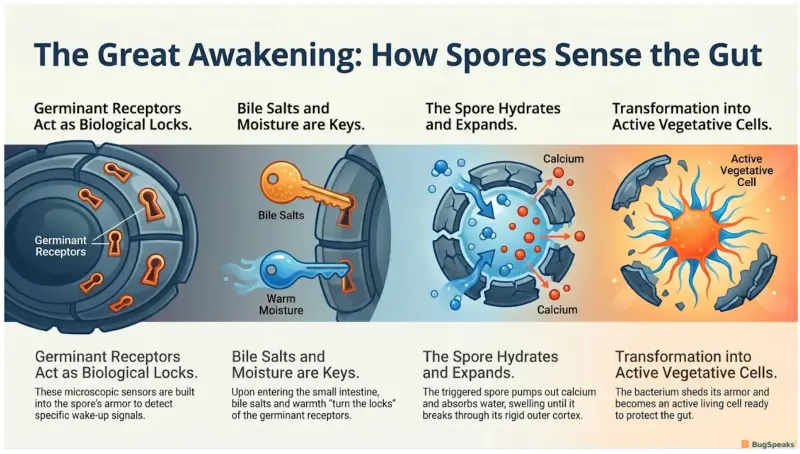
Soil-based organisms wake up inside us because they detect specific chemicals in our small intestine that act as the perfect activation triggersFaherty-McGrath (2026). After passing through the highly acidic stomach, the spores enter a much friendlier environment filled with moisture, warmth, and abundant nutrients. This change in surroundings sends a clear signal to the sleeping bacteria that their journey through the harsh transit phase is finally over. Once they recognize these favorable conditions, they begin their rapid transformation from dormant pods into active, living cells, ready to set up their temporary home. This transition is a beautiful and highly coordinated process.
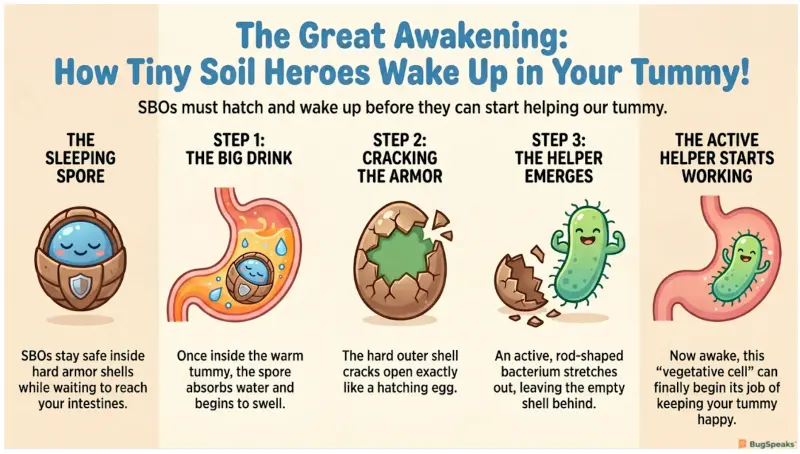
This waking process happens in our intestine, which acts as the official reactivation zone for these dormant biological formsFaherty-McGrath (2026). The spores possess specialized sensors called germinant receptors that can detect the presence of essential nutrients and digestive juices like bile salts. When these bile salts and nutrients bind to the receptors, they trigger a rapid chain reaction. The spore quickly pumps out calcium, absorbs water, and breaks down its rigid outer cortex. This hydration process allows the dormant core to expand, swelling up as it prepares to break free, making it ready to face the world once again.
This beautiful transition from a sleeping pod to an awakened state restores the bacterium's active metabolism and growthPayne (2024). Within minutes, the bacterium sheds its armor, stretches out, and becomes an active vegetative cell that can eat, divide, and work. This process of outgrowth is the true start of their probiotic journey inside our bodies. Instead of trying to permanently colonize our gut, these soil-based helpers act as a highly specialized visitor task force. These helpful little bacteria are designed to visit. They wake up, perform their helpful duties, and eventually form new spores to help support our digestive health during their visit.
What helpful jobs do they do once they wake up?
Once they wake up, these bacteria help us by pushing out bad germs and creating healthy vitamins to support our bodySudan (2021). These active soil bacteria are like highly trained security guards that temporarily join our native gut microbial community to maintain order. They do not need to stay forever to be helpful; their active presence alone is enough to change our gut environment for the better. By consuming extra nutrients and taking up physical space, they make it extremely difficult for harmful, unwanted germs to settle down inside our bellies. This creates a very happy, comfortable, and balanced gut ecosystem.
This protective activity is called pathogen exclusion, where the active soil bacteria crowd out bad germs like Enterotoxigenic Escherichia coli (ETEC)Sudan (2021). To fight these invaders, our soil-based helpers can produce powerful natural compounds called antimicrobial peptides that directly stop bad bacteria from growing. They can even downregulate, or turn off, the harmful toxin genes of bad bugs, making them much less dangerous to our delicate intestinal lining. This direct contact inhibition ensures that our gut remains a safe, peaceful harbor so that we can feel great, stay strong, and grow healthy and active every single day.
Additionally, these active bacteria help our native microbes by sharing food in a friendly process called cross-feedingFaherty-McGrath (2026). By breaking down complex fibers, they produce simple sugars and nutrients that our local gut microbes love to eat. This cooperative behavior encourages our native bacteria to produce short-chain fatty acids, like butyrate, which strengthen our mucosal firewallBelkaid (2014). The mucosal firewall is like a smart protective fence inside our gut. These fatty acids act like fuel for our intestinal cells, repairing the gut barrier, helping to build a highly resilient barrier that keeps us healthy, and lowering overall inflammation.
Are these soil-based bacteria safe for us to eat?
Soil-based bacteria are safe for us to eat when they have been carefully tested by scientists and approved as high-quality supplementsRathi (2024). Because these bacteria originate in the soil, people sometimes worry that eating soil microbes might make them sick. However, scientists have spent decades studying specific strains to ensure they do not produce any harmful toxins or carry bad genes. When we consume proper, scientifically checked soil probiotics, they act as gentle, transient helpers. They do their jobs beautifully, support our gut-brain axis, and then leave our bodies safely without causing any infections or unwanted health problems.
To demonstrate their safety, top health organizations have given specific spore-forming strains, such as Bacillus subtilis and Bacillus coagulans, very special safety ratings (Payne, 2024). These ratings include the Generally Recognized As Safe (GRAS) status from the United States Food and Drug Administration. They also hold the Qualified Presumption of Safety (QPS) status from European food safety experts. These trusted safety ratings show that the bacteria have a long, documented history of being completely safe for humans to consume and can be used in many healthy foods. Scientists always screen these strains carefully to be sure they are excellent helpers.
In clinical studies, these tested bacteria have shown incredible power in helping people who suffer from drug-induced constipation and uncomfortable bloatingRathi (2024). Many common medications can disrupt our gut microbiota, slowing down our digestion and causing hard, painful stools. Supplementing with specific soil-based strains, like Bacillus coagulans LBSC, helps restore normal gut motility and significantly improves stool consistency and expulsion. When our digestion works normally, our stools become soft, comfortable, and easy to pass. No adverse events were reported in these trials, proving that these durable spore-formers are highly effective, helping our bodies feel amazing and balanced every single day.
Visualize the process- https://youtu.be/Woe8zyhm8Qo
Reference
Sudan, S., Flick, R., Nong, L., & Li, J. (2021). Potential Probiotic Bacillus subtilis Isolated from a Novel Niche Exhibits Broad Range Antibacterial Activity and Causes Virulence and Metabolic Dysregulation in Enterotoxic E. coli. Microorganisms, 9(7), 1483. https://doi.org/10.3390/microorganisms9071483
Faherty-McGrath, L. B., van Sinderen, D., & Browne, H. P. (2026). Developing spore-forming gut bacteria as model organisms. Trends in microbiology, S0966-842X(26)00097-1. Advance online publication. https://doi.org/10.1016/j.tim.2026.04.006
Payne, J., Bellmer, D., Jadeja, R., & Muriana, P. (2024). The Potential of Bacillus Species as Probiotics in the Food Industry: A Review. Foods (Basel, Switzerland), 13(15), 2444. https://doi.org/10.3390/foods13152444
Rathi, A., & Pagare, R. (2024). Efficacy and Safety of Bacillus coagulans LBSC in Drug Induced Constipation Associated With Functional Gastrointestinal Disorder: A Double-Blind, Randomized, Interventional, Parallel, Controlled Trial a Clinical Study on Bacillus coagulans LBSC for Drug Induced Constipation Associated With FGIDs. Global advances in integrative medicine and health, 13, 27536130241286511. https://doi.org/10.1177/27536130241286511
Belkaid, Y., & Hand, T. W. (2014). Role of the microbiota in immunity and inflammation. Cell, 157(1), 121–141. https://doi.org/10.1016/j.cell.2014.03.01