Understanding SIBO: A Comprehensive Guide to Managing Your Symptoms
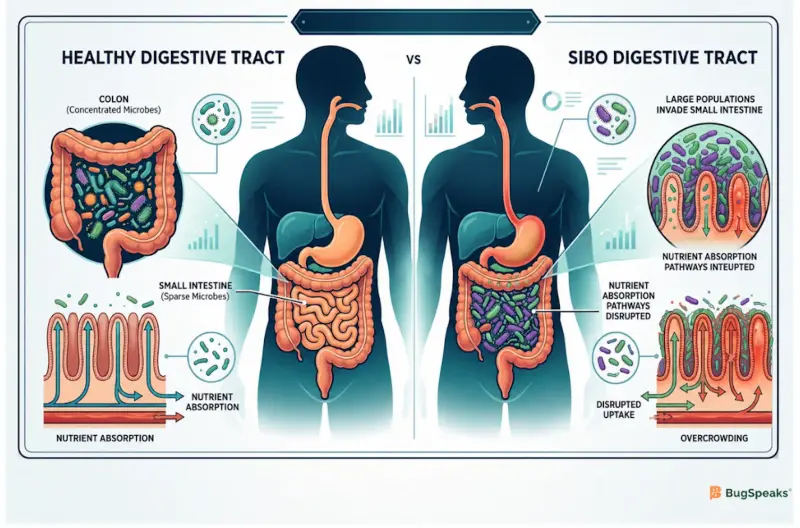
Why is SIBO best understood as a failure of biological zoning?
Small Intestinal Bacterial Overgrowth (SIBO) is best understood as a failure of biological zoning because it occurs when tiny microbial residents from your large intestine move into your small intestine, where they do not belongWawrzeńczyk et al. (2025). Your digestive tract is built like a town with two main districts that do very different jobs. The small intestine is a high-speed processing zone where your body quickly absorbs nutrients from the food you eatŠuran et al. (2026). Meanwhile, the large intestine is a high-density microbial residential zone where trillions of bacteria live and work peacefully. Keeping these biological occupants in their correct districts is vital for your health.
When this zoning system breaks down, it creates a state of gut imbalance called dysbiosis, which can cause severe chronic bloatingŠuran et al. (2026). This unauthorized occupancy means that too many bacteria are crowding into the high-speed processing zone, where they cause operational interference. These bacteria are not bad on their own, but they are in the wrong place at the wrong time. This zoning failure is also linked to Irritable Bowel Syndrome (IBS) because the symptoms of both conditions overlapŠuran et al. (2026). Your body gets confused, struggles to perform its daily duties correctly, and fails to keep the peace.
To find out if these biological occupants have moved into the wrong district, doctors use a carbohydrate breath testWawrzeńczyk et al. (2025). This test measures the gas produced by the bacteria when they ferment sugars in the wrong zone. If the test shows too much gas, it means there is an occupancy violation in your small intestine. Sometimes, the overgrowth is caused by different microbes like archaea, which is called Intestinal Methanogen Overgrowth (IMO)Wawrzeńczyk et al. (2025). Understanding which zone-specific operations are failing helps your doctor design the best plan to restore biological zoning and fix the entire neighborhood.
How do protective barriers and transit sweeping systems regulate zone occupancy?
Your body regulates zone occupancy by using strong chemical acid checks and a powerful transit sweeping system to stop bacteria from movingŠuran et al. (2026). The first big check is stomach acid, which acts like a biological gatekeeper to destroy unauthorized occupants before they enter the processing zone. However, if you take proton pump inhibitors (PPIs) to treat gastroesophageal reflux disease (GERD), you lower this acid checkRevaiah et al. (2018). This allows many bacteria to slip past the gatekeeper and start colonizing the wrong area. Without strong acid checks, the boundary lines of your digestive districts quickly become weak and stop working.
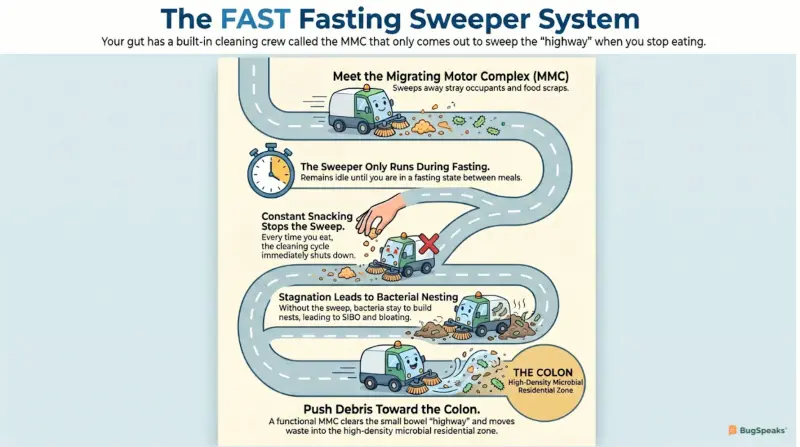
In addition to chemical barriers, your body relies on a cleaning routine called the migrating motor complex (MMC) to sweep away stray occupantsŠuran et al. (2026). This system acts like a nighttime clearing wave that runs when you are fasting, pushing food scraps and bacteria forward into the colon. If this fasting sweep is damaged or weak, bacteria can stay in the high-speed processing zone and build nests. Stagnation is the main reason these microbial residents can settle down in the wrong district. When the clearing wave breaks down, the high-speed zone becomes cluttered with unwanted biological occupants that build heavy nests.
A weak fasting sweep slows down your orocecal transit time (OCTT), which is the time it takes for food to travel through the processing zoneRevaiah et al. (2018). This delay gives bacteria more time to multiply and ferment nutrients prematurely. Fortunately, using prokinetics can help by stimulating your gut muscles to speed up the sweeping processRevaiah et al. (2018). These gut-moving agents help restore normal transit and prevent bacteria from staying in the wrong zone. By keeping the clearing wave active and running, you can maintain clear boundaries, protect your tissues, and keep your digestive system operating smoothly and perfectly.
What happens when unauthorized occupants cause operational interference in the high-speed processing zone?
When unauthorized occupants ferment food in the high-speed processing zone, they release gas that stretches your tissues and causes painful bloatingŠuran et al. (2026). In a healthy system, food is processed quickly, but here, bacteria eat your lunch first and release hydrogen and methane gases. This gas buildup balloons your intestine, setting off a hypersensitive alarm system known as visceral hypersensitivity. This condition means your gut nerves are highly sensitive, so even a tiny bit of gas feels like a giant stretch in your belly. This gas buildup can quickly make you feel very full, heavy, and uncomfortable after eating.
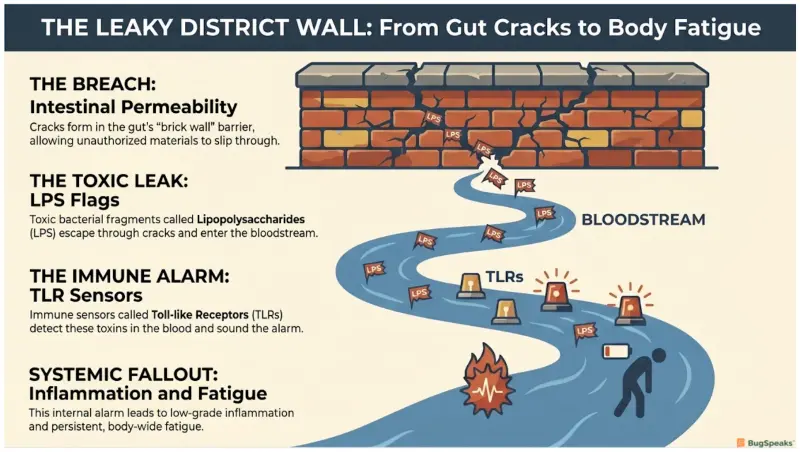
The nesting of these bacteria damages your delicate gut lining, leading to a leaky barrier known as intestinal permeabilityWawrzeńczyk et al. (2025). This barrier breach allows toxic bacterial components like lipopolysaccharide (LPS) to escape from your gut and enter your bloodstream. Once in your blood, these toxic fragments trigger host Toll-like receptors (TLRs), which are like tiny immune sensors that detect dangerWawrzeńczyk et al. (2025). This interaction sets off an alarm of low-grade inflammation, making your body feel tired and irritated. A damaged barrier cannot absorb food properly, leading to nutritional deficiencies, local injury, and long-term fatigue in your daily life.
To make matters worse, other invaders like yeasts can join the overgrowth, leading to Small Intestinal Fungal Overgrowth (SIFO)Wawrzeńczyk et al. (2025). These fungal occupants team up with bacteria to build tough, protective shelters called biofilms, which act like slimy shields. These shields make the occupants highly resistant to your immune system and standard treatments, letting them hide in the processing zone. This cooperative nesting makes the overgrowth much harder to clear. By understanding how these biofilms protect unauthorized occupants, we can see why chronic bloating requires a smart, multi-step strategy to fully clean the district and keep it clear.
What regulatory strategies can clear unauthorized occupants and restore proper zoning?
Doctors use targeted clearance tools like the non-absorbable antibiotic rifaximin to clear unauthorized occupants and restore proper zoning in the processing zone. Unlike other drugs, this antibiotic works only in your small intestine, leaving your colon's residents alone. For methane-producing occupants, doctors combine it with neomycin to break their tough defenses. This precise strategy clears the high-speed zone without disturbing the high-density residential zone. By using these local cleaners, your digestive system can safely clear out the excess occupants, clean the entire processing district, and prepare the neighborhood for a complete, healthy, and happy recovery with fresh energy.
In addition to standard antibiotics, doctors can use natural herbal antimicrobials like oregano, thyme, and berberine to suppress overgrowthWawrzeńczyk et al. (2025). Another powerful strategy is an elemental diet, which is a pre-digested liquid formula that gets absorbed immediately in your upper gutWawrzeńczyk et al. (2025). This liquid formula nourishes your body while completely starving the bacteria in your lower small intestine, because no food scraps are left for them. This smart approach deprives the unauthorized occupants of resources, forcing them to move out of the high-speed processing zone and restoring normal digestive operations in your daily routine.
During this clearance process, doctors can also introduce friendly probiotic yeast like Saccharomyces boulardii to protect the vacant districtWawrzeńczyk et al. (2025). This helpful yeast acts like temporary security guards, preventing opportunistic fungi from moving into the empty spaces left by cleared bacteria. This dual-action approach prevents secondary infections and keeps the high-speed processing zone stable. By safely clearing the area, your body can begin repairing the delicate gut lining and recovering its normal digestive functions. This protective phase is crucial for ensuring that the newly cleaned zone remains peaceful, stable, and completely secure for long-term health and wellness.
How do we maintain long-term zone stability and prevent future occupancy violations?
Maintaining long-term zone stability requires keeping your gut muscles moving with prokinetics and supporting healthy boundaries to prevent future occupancy violationsRevaiah et al. (2018). These motility-enhancing agents keep the clearing waves active, ensuring that any new bacteria are swept away before they can build nests. By keeping the high-speed processing zone clear of debris, you reduce the risk of recurring overgrowth. This continuous motion is your gut's primary defense system against new bacterial invasions. Without regular movement, stagnation quickly returns, allowing wandering bacteria to settle back down in the wrong district and start building nests again very quickly and easily.
Once the zone is cleared, transitioning from a restrictive low-FODMAP (Fermentable Oligosaccharides, Disaccharides, Monosaccharides, and Polyols) diet to a fiber-rich Mediterranean diet helps nourish your native colonic residentsWawrzeńczyk et al. (2025). This balanced diet helps your friendly bacteria produce helpful molecules called short-chain fatty acids (SCFAs) like butyrate, which strengthen your gut wallsŠuran et al. (2026). These beneficial fatty acids nourish your gut cells and keep your defensive barriers strong, making it harder for unauthorized occupants to cross. By feeding your friendly microbes the right foods, you build a natural shield that keeps everyone in their proper districts, ensuring long-term health, peaceful operations, and great digestion.
Finally, managing your stress through the gut-brain axis and considering advanced therapies like fecal microbiota transplantation (FMT) can help maintain harmonyŠuran et al. (2026);Wawrzeńczyk et al. (2025). Stress sends emergency signals that freeze your clearing waves, so calming your mind through mindfulness or gut-directed hypnotherapy keeps the cleaning system running. For stubborn cases, transplanting a healthy microbiome can completely reset the district's balance and re-establish peace. This complete, mind-and-body approach ensures your biological zones stay well-regulated, stable, and healthy. By protecting your gut-brain connection, you keep the entire digestive tract running smoothly and happily for many years to come.
Visualize the process- https://youtu.be/zUyTYpy6wMA
Reference
Nickles, M. A., Hasan, A., Shakhbazova, A., Wright, S., Chambers, C. J., & Sivamani, R. K. (2021). Alternative Treatment Approaches to Small Intestinal Bacterial Overgrowth: A Systematic Review. Journal of alternative and complementary medicine (New York, N.Y.), 27(2), 108–119. https://doi.org/10.1089/acm.2020.0275
Šuran, J., Pavlović, N., Božić, J., Kumrić, M., Vukojević, K., Filipović, N., & Radić, B. (2026). IBS and SIBO: Gut Microbiota, Pathophysiology, and Non-Pharmacological Interventions. Antibiotics (Basel, Switzerland), 15(3), 251. https://doi.org/10.3390/antibiotics15030251
Wawrzeńczyk, A., Czarnowska, M., Darwish, S., Ćwirko-Godycka, A., Lis, K., Szota, M., Treichel, P., Wojtkiewicz, A., & Napiórkowska-Baran, K. (2025). Methane, Bacteria, Fungi, and Fermentation: Pathophysiology, Diagnosis and Treatment Strategies for Small Intestinal Bacterial Overgrowth, Intestinal Methanogen Overgrowth and Small Intestinal Fungal Overgrowth. Current issues in molecular biology, 47(9), 713. https://doi.org/10.3390/cimb47090713
Revaiah, P. C., Kochhar, R., Rana, S. V., Berry, N., Ashat, M., Dhaka, N., Rami Reddy, Y., & Sinha, S. K. (2018). Risk of small intestinal bacterial overgrowth in patients receiving proton pump inhibitors versus proton pump inhibitors plus prokinetics. JGH open : an open access journal of gastroenterology and hepatology, 2(2), 47–53. https://doi.org/10.1002/jgh3.12045