The Ultimate Guide to Gas & Bloat: Normal vs. SOS
What is the difference between normal digestion gas and uncomfortable bloating?
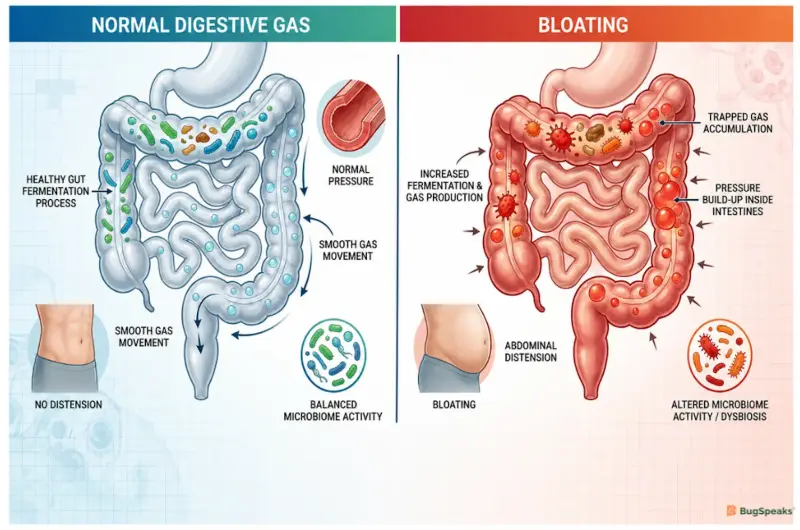
Normal gas is a harmless byproduct of digestion, while bloating happens when gas gets trapped or when your gut nerves are overly sensitive. Imagine your digestive tract is a massive fermentation ecosystem inside a monitoring station. When you eat, food travels down the conveyor belts into the lower intestines. Here, microscopic workers digest the food. When everything runs perfectly, the gas they make is simply normal fermentation output. This gas escapes easily without you even noticing. It is a completely natural part of how your body processes meals every single dayCrucillà et al. (2024).
However, sometimes the station malfunctions, causing a painful accumulation of fermentation products. The gas builds up and gets trapped inside the winding tunnels of your intestines. Because the ventilation pathways are blocked, the trapped gas creates intense pressure against the intestinal walls. This buildup often involves extra physical matter and water, known as intraluminal content, pooling inside the tubeCrucillà et al. (2024). When this exhaust has nowhere to go, it pushes outward. Your stomach feels overly full, tight, and stretched like a balloon that has been pumped with too much air.
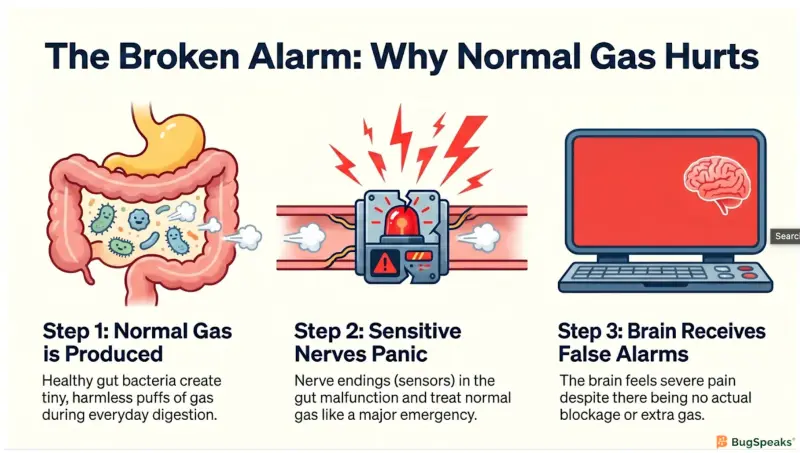
Sometimes, there isn't actually extra gas, but the station’s alarm sensors are broken. This glitch is called visceral hypersensitivity, meaning the nerve endings in your gut are way too sensitivevan Gils et al. (2026). Your brain feels the normal amount of gas and mistakenly thinks it is a huge, painful blockage. Other times, the conveyor belt itself slows down. The speed food travels is called gastrointestinal transitvan Gils et al. (2026). If it stalls, food ferments for too long, creating too much exhaust and triggering the pain alarms in your monitoring station.
Why do healthy gut bacteria produce gas in the first place?
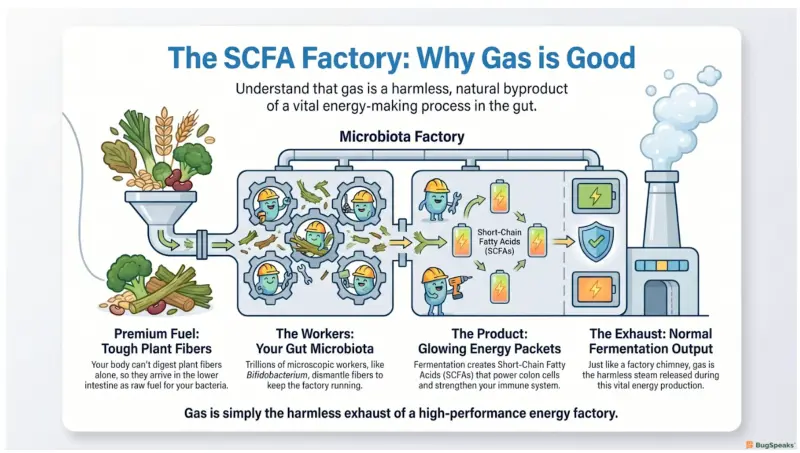
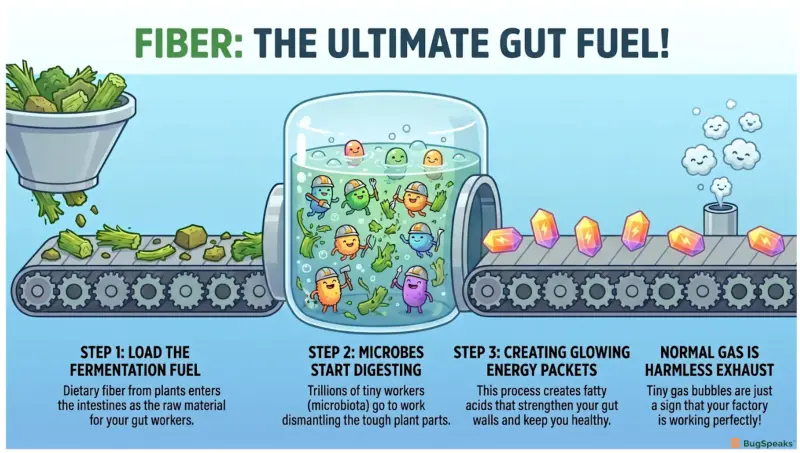
Healthy gut bacteria produce gas because they must break down tough plant fibers that our human bodies cannot digest on their own. We are great at absorbing sugars, but we lack the tools to break down tough plant parts. These intact fibers arrive in the lower intestine as premium fermentation fuel for the trillions of tiny workers living there, called the microbiotaCrucillà et al. (2024). As these microbes work hard to dismantle the tough fibers, they release tiny bubbles of gas. This is a clear sign of a healthy, active station.
Making gas is not the main goal; it is just harmless exhaust from a very important factory process. The real purpose of this digestion is to create short-chain fatty acids (SCFAs), like butyrate and acetateSunnetci Akkoyunlu et al. (2025). These fatty acids are glowing energy packets that feed the cells lining your colon. They strengthen the gut walls, calm down inflammation, and keep your immune system strongLi et al. (2026). Without this steady supply of fuel and the hard work of the bacteria, your station would break down, and you would get sick.
A well-run station relies on highly specialized workers, like Bifidobacterium and Faecalibacterium prausnitzii, to do the job rightSunnetci Akkoyunlu et al. (2025). These good bacteria break down the fiber smoothly, creating a manageable, steady flow of normal fermentation output. Scientists can check which workers are inside you by looking at their deoxyribonucleic acid (DNA), which is the unique instruction manual inside every living cellSunnetci Akkoyunlu et al. (2025). This proves that passing gas is not a mistake. It means your microscopic workers are successfully turning tough foods into vital energy to keep you healthy!
What causes our internal fermentation system to produce excessive gas and bloating?
Excessive gas happens when the gut loses its best bacterial workers, creating a chaotic environment that makes too much exhaust too quickly. When bad bacteria take over and outnumber the good ones, it is called dysbiosisSunnetci Akkoyunlu et al. (2025). This ruins the teamwork in your gut. Instead of breaking down food slowly, these rogue workers aggressively consume the fermentation fuel. This chaos creates imbalanced fermentation patterns. The station enters an overactive production state, creating huge amounts of gas that block the ventilation shafts and lead to painful bloating and trapped air.
Doctors can measure this teamwork by looking at the Firmicutes-to-Bacteroidetes ratio, comparing the two largest groups of bacteria in your gutSunnetci Akkoyunlu et al. (2025). When this ratio is low, it means the workforce is weak and lacks diversity. In people with severe bloating, helpful bacteria like Akkermansia muciniphila disappear. Meanwhile, bad bacteria like Proteobacteria multiply rapidlySunnetci Akkoyunlu et al. (2025). These bad microbes are messy workers. Instead of making healthy fatty acids, they produce toxic waste and massive clouds of trapped gas that physically stretch your gut and cause sharp stomach pains.
This chaotic, overactive production state also triggers the body's security alarms. When bad bacteria multiply, your immune system spots the danger and attacks. It releases defense proteins, such as calprotectin and secretory immunoglobulin A (sIgA), to fight the invadersSunnetci Akkoyunlu et al. (2025). This battle causes the walls of your intestines to swell up and become leaky. The swelling makes the trapped gas feel even worse. What started as just a little extra exhaust turns into a major biological emergency, causing intense pain and serious damage to your fermentation station.
How can we tell if bloating is just a temporary reaction or a signal of a deeper problem?
Bloating is a deeper problem if it happens constantly, physically stretches your stomach, and interferes with your daily life. Everyone's monitoring station occasionally spikes after a heavy meal of beans or broccoli. The workers briefly enter an overactive production state, clear the gas, and return to normal. But if the warning lights flash every week for months, doctors call this functional abdominal bloating (FAB)Crucillà et al. (2024). This is a chronic condition where you constantly feel the miserable sensation of trapped exhaust, making it hard to concentrate, sleep, or simply enjoy your day.
Sometimes, the problem goes beyond just a feeling, and your stomach actually balloons outward where people can see it. When the accumulation of fermentation products physically pushes the walls of your gut out, it is called functional abdominal distension (FAD)Crucillà et al. (2024). Bloating is the invisible feeling of pressure, while distension is the visible stretching of your bellyvan Gils et al. (2026). About 30% of adults suffer from these uncomfortable symptomsCrucillà et al. (2024). If you can visually see your stomach sticking out, your stomach is experiencing a serious structural overload.
These frequent alarms are also a major sign of irritable bowel syndrome (IBS), a tricky disorder where the gut and brain miscommunicateChoi et al. (2025). In IBS, imbalanced fermentation patterns mix with broken conveyor belts. The intestines either spasm wildly or freeze completely, trapping all the gas inside. Sometimes, your diaphragm muscle pushes down while your stomach muscles relax, forcing your belly out even when there is not much gas thereCrucillà et al. (2024). If this happens often, it means your whole monitoring station needs a complete reboot to function properly again.
How do we restore balance to an overactive fermentation ecosystem?
We restore balance by changing the fuel we eat, adding good bacteria, and sometimes using medicines to reset the system. The quickest way to cool down an overactive production state is by restricting tricky foods called Fermentable Oligosaccharides, Disaccharides, Monosaccharides, and Polyols (FODMAPs)Choi et al. (2025). These are fast-burning sugars that chaotic bacteria gobble up too quickly. By following a low FODMAP diet, you stop delivering this explosive fuel. This starves the bad microbes and gives your exhausted station workers enough time to clear out the trapped exhaust and reduce the swelling.
Once the station cools down, you need to hire better workers to fix the imbalanced fermentation patterns. Probiotics are living, helpful bacteria that you can eat in foods or supplementsCrucillà et al. (2024). These new workers patch up the leaks and calm down the alarms. To keep these new workers strong, you must feed them prebiotics, which are special, slow-burning plant fibersPatil & Mehdi (2025). Prebiotics act like premium tools that only the good bacteria can use, helping them multiply and safely take back control of your gut from the chaotic rogue microbes.
In the worst cases, doctors might send in a special cleaning crew. They use safe, targeted antibiotics like Rifaximin to wipe out the overgrown bad bacteria hiding in the wrong parts of the gutCrucillà et al. (2024). This medicine acts like a master reset button for your station, clearing out the worst blockages. Exercising, like walking or yoga, is also great because it mechanically massages your bellyChoi et al. (2025). Moving your body physically helps push the trapped normal fermentation output through the tunnels, turning a broken system back into a peaceful, healthy ecosystem.
Visualize the process- https://youtu.be/zAPgHXCbbuw
Reference
Crucillà, S., Caldart, F., Michelon, M., Marasco, G., & Costantino, A. (2024). Functional Abdominal Bloating and Gut Microbiota: An Update. Microorganisms, 12(8), 1669. https://doi.org/10.3390/microorganisms12081669
Akkoyunlu, D. S., Celebi, A., Gur, B., Kanli, A., Ugurtas, C., Ozer, T., Sarikaya, N. K., Keskin, S. E., Cine, N., & Savli, H. (2025). Functional Abdominal Bloating Is Associated With Gut Microbiota Dysbiosis and Altered Intestinal Barrier Function: Experimental Evidence. In vivo (Athens, Greece), 39(6), 3320–3332. https://doi.org/10.21873/invivo.14130
Choi, Y., Youn, Y. H., Kang, S. J., Shin, J. E., Cho, Y. S., Jung, Y. S., ... & Sung, I. K. (2025). 2025 Seoul consensus on clinical practice guidelines for irritable bowel syndrome. Journal of neurogastroenterology and motility, 31(2), 133.
Patil, S., & Mehdi, S. S. (2025). The Gut-Brain Axis and Mental Health: How Diet Shapes Our Cognitive and Emotional Well-Being. Cureus, 17(7), e88420. https://doi.org/10.7759/cureus.88420
Patil, S., & Mehdi, S. S. (2025). The Gut-Brain Axis and Mental Health: How Diet Shapes Our Cognitive and Emotional Well-Being. Cureus, 17(7), e88420. https://doi.org/10.7759/cureus.88420
van Gils, T., Katsumata, R., Hreinsson, J. P., Drossman, D. A., Tack, J., Törnblom, H., Le Nevé, B., Quinquis, L., Hassouna, R., Schmulson, M. J., Bangdiwala, S. I., Palsson, O. S., & Simrén, M. (2026). Bloating, Visible Abdominal Distension, and Other Intestinal Gas-Related Symptoms in Irritable Bowel Syndrome and Functional Dyspepsia. United European gastroenterology journal, 14(1), e70186. https://doi.org/10.1002/ueg2.70186
Li, Z., Samui, S., Liu, J., Yang, Y., Liu, X., Chen, Q., Li, J., Gopinath, D., Luo, P., & Shan, D. (2026). Gut microbiome and metabolic health: mechanisms and precision interventions. Gut microbes, 18(1), 2644677. https://doi.org/10.1080/19490976.2026.2644677