How to Ensure Probiotic Viability Through Effective Storage Solutions
Why do some probiotics need to stay cold while others can sit on a shelf?
Some probiotics need to stay in a cold refrigerator because the freezing air safely slows down their tiny bodies so they do not starve. At the same time, other types can sit on a regular shelf because scientists have built incredibly strong shields around them to help them sleep safely (Jin and Wang, 2026). In our Microbial Survival & Storage Network, these helpful bacteria act exactly like living biological travelers that must survive a very long trip before they can actually help your bodyMaftei et al. (2026). Because they are living creatures, they have an active metabolism, meaning they still need to eat and they still produce dangerous waste even after they are packed inside a bottle.
For these very fragile bacteria, the refrigerator acts as a controlled preservation environment. The extreme cold is like a pause button that drastically slows down their internal enginesSah et al. (2015). For example, bacteria inside cold yogurt, known as Lactic Acid Bacteria (LAB), constantly turn sugars into acid. If they get too warm, they will eat the sugar too fast and drown in their own acidic wasteMaftei et al. (2026). By keeping them perfectly chilled inside the cold storage network, we keep them in a slow-motion state. This cold-chain system is an active, ongoing life-support system that guarantees the living biological travelers stay healthy and completely alive while they wait inside the grocery store.
On the other hand, shelf-stable probiotics do not need a refrigerator at all because they use completely different protected survival systems. Instead of using cold air, scientists use heavy machinery to pull all the water away from the bacteria. One popular method is called freeze-drying, which uses extreme cold and a strong vacuum to safely suck the moisture out of the living cellsJin and Wang (2026). Without any water, the bacteria are forced into a state of deep, inactive biological sleep. Because they are completely dry and totally asleep, their engines stop running. They do not need to eat, and they do not make any acidic waste, which completely removes the need for a cold refrigerator network entirely.
How does heat change the way living probiotic travelers survive?
Heat hurts living probiotic strains by melting their protective shields and quickly breaking down their delicate cell walls, causing them to dieJin and Wang (2026). Within our storage network, high heat acts as a highly dangerous environmental stress factor. If you take a dry, sleeping bacteria powder and leave it in a warm room at thirty degrees Celsius, it might only survive on the shelf for a few short monthsJannah et al. (2022). If the temperature gets hotter, the helpful bacteria will suffer a massive structural collapse and die in just a few days. Even a tiny bit of extra heat significantly speeds up the biological decay of these fragile biological travelersSah et al. (2015).
At a microscopic level, heat physically destroys the protected survival systems holding the bacteria. The tiny bit of moisture left hiding inside their dry powder capsule gets warm and acts like a liquid softener. This extra heat forces their hard, glass-like shield to turn into a soft, unstable, rubbery messJin and Wang (2026). When the shield gets soft and loose, it completely loses its structural strength. This allows bad, destructive gases from the air and room humidity to leak straight inside the previously safe capsule. Once the strong shield breaks, the deep-sleeping bacteria are violently woken up in a space that has zero food and zero water.
This sudden leak of hot air causes severe oxidative stress, which means unstable oxygen molecules begin attacking the helpless bacteria. The main target of this attack is the bacterial cell membrane, which is the soft, fragile outer skin holding the bacteria togetherJin and Wang (2026). The dangerous oxygen causes a chain reaction known as lipid peroxidation, which literally rips apart the fat molecules that make up their skinJin and Wang (2026). Without a strong, intact skin, the bacteria leak their important inside fluids, instantly losing their ability to function. Keeping the bacteria inside a cold preservation environment locks all the molecules in place, keeping the shell perfectly hard.
How do shelf-stable packages protect probiotics from bad weather?
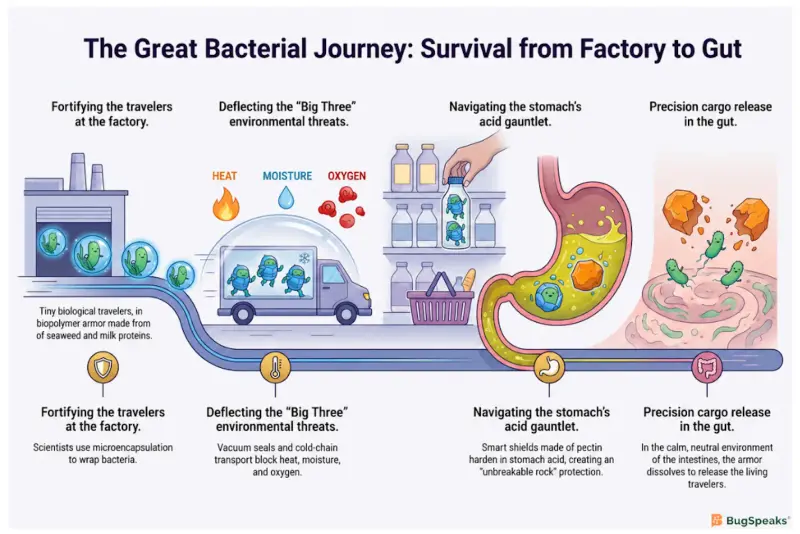
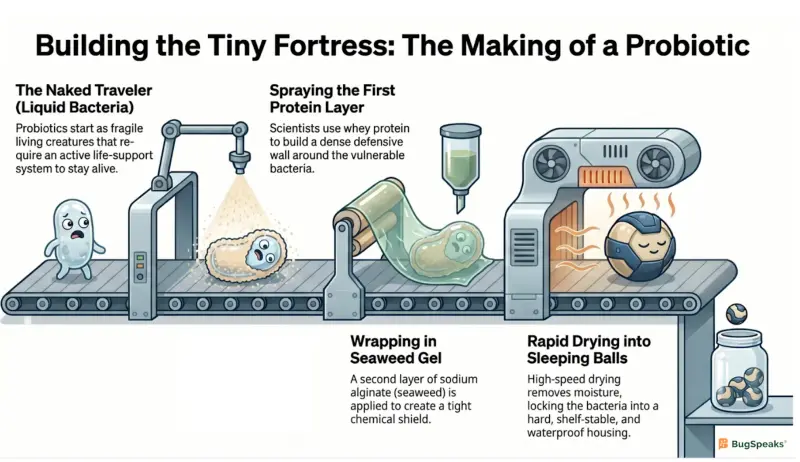
Shelf-stable packages protect probiotics by wrapping them in special, microscopic armor made from strong natural materials that completely block out heat, moisture, and dangerous oxygenJin and Wang (2026). To build these advanced protected survival systems, scientists use a fascinating manufacturing process called microencapsulationJin and Wang (2026). This means they construct a custom, tiny protective housing right around the vulnerable living biological travelers. By wearing this tight chemical armor, the bacteria do not need a refrigerator anymore. They can wait safely on a store shelf without getting hurt by normal environmental stress factors like room temperature and everyday humidity. This amazing armor ensures they are always perfectly safe.
What is this microscopic armor actually made of? Scientists use strong, natural building blocks known as biopolymers. Excellent examples include sodium alginate, which is extracted from brown seaweed, and whey protein, which is extracted from milkJin and Wang (2026). During the factory process, the liquid bacteria are sprayed into hot air to quickly dry them into a powder. To make sure the extreme heat does not burn the biological travelers, special protective sugars are mixed in. These sugars instantly form a hard, thermal crust that completely blocks the heat, guaranteeing that the fragile microbes easily survive the violent drying process and go to sleep safelyJin and Wang (2026). This keeps the bacteria perfectly secure.
Sometimes, for extremely sensitive bacteria, scientists use heavy freezing instead of heat to dry them. Because sharp, jagged ice crystals can easily poke holes in a bacteria’s skin, special sugars called cryoprotectants are pumped into the mixtureJin and Wang (2026). These smart sugars act like antifreeze, stopping dangerous ice from forming inside the cells. Pushing the limits of defense, modern scientists now use a brilliant trick called multi-layer embeddingJin and Wang (2026). This means they wrap the bacteria in many different overlapping layers of armor, similar to wearing a thick sweater under a heavy raincoat. This specialized protective housing ensures the internal travelers remain perfectly dry, heavily shielded, and totally safe.
Why are vacuum bags and dryness so important for probiotic survival?
Vacuum bags and complete dryness are extremely important because oxygen acts like a harsh poison to bacteria, and leftover moisture acts like a fake alarm clock that wakes them up so they starve and quickly dieSah et al. (2015). Inside the Microbial Survival & Storage Network, the outside aluminum foil wrapper is the absolute final layer of protective housekeeping the sleeping bacteria completely safe from the harsh world outside. In strict laboratory tests, putting dry probiotic powders inside a completely vacuum-sealed aluminum bag helped them live much longerSah et al. (2015). This happens because the tight vacuum perfectly sucks all the surrounding air away from the microscopic environment, successfully stopping damage before it even starts.
Removing the air is completely necessary because free oxygen operates as a highly toxic environmental stress factor for many helpful gut bugs. Many of the most popular probiotics are strictly anaerobic microorganisms, which simply means they are completely allergic to oxygen and can only live in spaces with absolutely zero airJin and Wang (2026). If air sneaks through a cheap, broken wrapper, it turns into volatile reactive oxygen species (ROS). These are unstable oxygen molecules that aggressively crash into the bacteria, causing massive damage that permanently breaks the biological travelersJin and Wang (2026). The vacuum seal stops these tiny wrecking balls from ever hitting the protective housing. This keeps the sleeping travelers completely intact.
Just as dangerous as oxygen is the scary threat of hidden water. Scientists carefully measure a number called water activity, which tells them exactly how much loose, free water is hiding inside a dry powder. For probiotics to stay asleep, this number must stay strictly below the safety line of 0.60Sah et al. (2015). If the outside bag gets a tiny hole and humid room air leaks inside, the water activity quickly goes up. This invisible moisture acts as a fake biological trigger, accidentally signaling the protected survival systems to turn their engines back on. Because there is zero food inside the bag, the awakened bacteria immediately starve and rapidly perish before you can eat them.
How do these biological travelers finally make it to your gut safely?
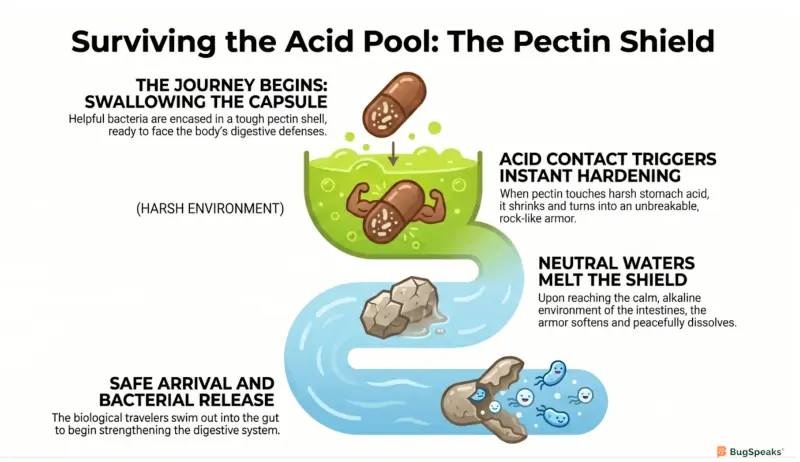
Biological travelers safely reach your gut because their special armor is chemically programmed to stay tightly locked in your highly acidic stomach, but to easily melt away in your calm, neutral intestinesJin and Wang (2026). The whole purpose of the Microbial Survival & Storage Network is to guarantee that the live cargo safely reaches the gut delivery zone. Before the bacteria can set up camp in your intestines, they must first survive a trip through the human stomach. The stomach acts as a terrifying environmental stress factor, filled with boiling gastric acid and slicing enzymes built to destroy germs and melt foodOglio et al. (2026). This intense acid pool destroys completely unprotected bacteria very rapidly.
If you swallow live bacteria without any strong chemical shielding, the extreme burning acid of the stomach will quickly melt right through their cell walls. This instantly cooks their inside proteins and kills the whole population before they can help you. To proactively stop this disaster, the protected survival systems are built using smart, acid-proof materials like pectin to heavily fortify their outer shellsJin and Wang (2026). Pectin is a natural plant material with an amazing defense trick: when it touches boiling stomach acid, it physically shrinks and pulls its molecules closer together. This intelligent reaction turns the protective housing into an unbreakable rock that easily deflects the dangerous stomach acid, keeping the travelers incredibly safe.
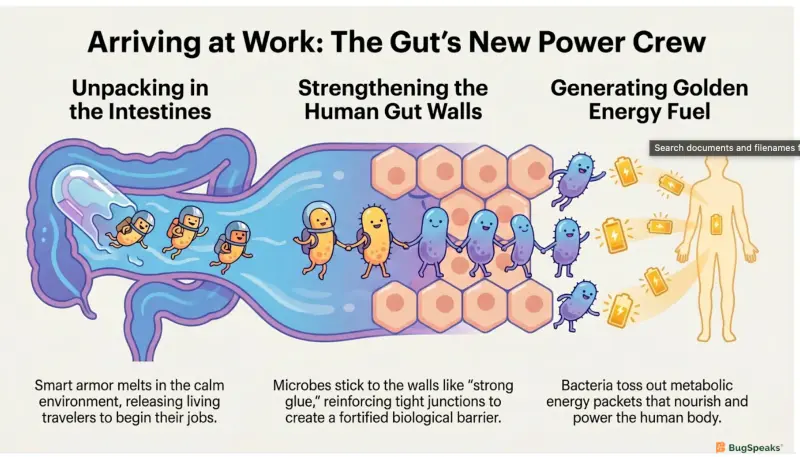
As the armored capsules float safely out of the burning stomach and fall into the calm environment of the lower intestines, the chemistry around them completely changes. The intestines are not acidic at all. When the smart armor feels this new, safe, alkaline environment, the protective polymers naturally loosen up, swell with water, and peacefully dissolve awayJin and Wang (2026). This perfectly timed release safely drops the living biological travelers right into their final destination, totally unharmed and fully ready to begin their biological jobs inside your body. Once they unpack in your gut, these surviving microbes get straight to work, eating healthy fiber and rapidly strengthening the walls of your wonderful human digestive system.
-Varsha V
Visualize the process- https://youtu.be/MSV8JRtAvA0
Reference
Maftei, N. M., Ambrose, L., Dogaru, E., Răileanu, R., Mierlan, O. L., Amariței, O., Ramos-Villarroel, A., Răuță Verga, G. I., Gurău, T. V., & Gurău, G. (2026). From Probiotics to Postbiotics-An Update on Their Biotherapeutic Potential and the Emerging Strategies in Human Health. International journal of molecular sciences, 27(5), 2218. https://doi.org/10.3390/ijms27052218
Jin, Z., & Wang, Y. (2026). Recent Progress in Probiotic Encapsulation: Techniques, Characterization and Food Industry Prospects. Foods (Basel, Switzerland), 15(3), 431. https://doi.org/10.3390/foods15030431
Jannah, S. R., Rahayu, E. S., Yanti, R., Suroto, D. A., & Wikandari, R. (2022). Study of Viability, Storage Stability, and Shelf Life of Probiotic Instant Coffee Lactiplantibacillus plantarum Subsp. plantarum Dad-13 in Vacuum and Nonvacuum Packaging at Different Storage Temperatures. International journal of food science, 2022, 1663772. https://doi.org/10.1155/2022/1663772
Oglio, F., Coppola, S., Cadavere, A., Di Santillo, R., Mauriello, V., Michelini, M., Iorio, R. F., Caldaria, E., & Carucci, L. (2026). Novel Food Supplement Containing a Combination of Postbiotics and Plant-Derived Compounds Regulates Epithelial Barrier Integrity and Immune Response in Human Enterocytes. Foods (Basel, Switzerland), 15(5), 922. https://doi.org/10.3390/foods15050922
Sah, B. N. P., Vasiljevic, T., McKechnie, S., & Donkor, O. N. (2015). Effect of refrigerated storage on probiotic viability and the production and stability of antimutagenic and antioxidant peptides in yogurt supplemented with pineapple peel. Journal of Dairy Science, 98(9), 5905-5916.