The Pathobyte Series: Clostridium tetani: From Tiny Wound to Systemic Crisis
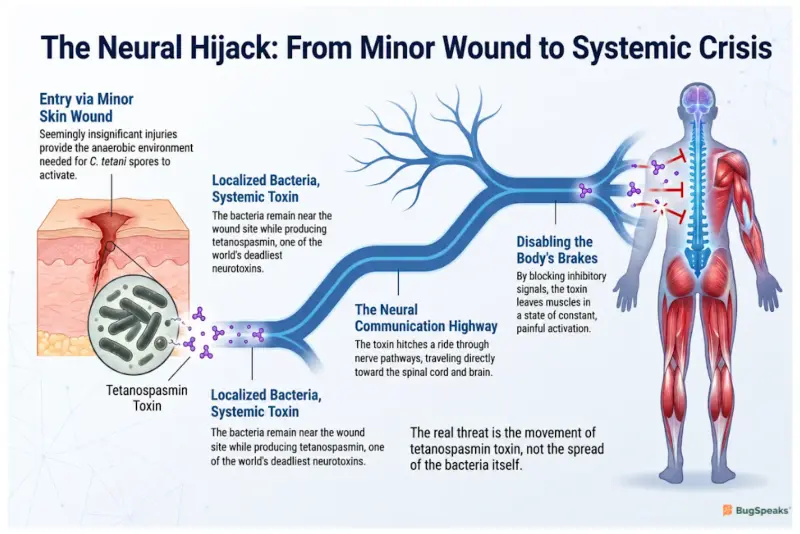
Clostridium tetani is a versatile Gram-positive bacterium capable of causing a wide array of human illnesses. Driven by an advanced arsenal of virulence factors and toxins like tetanospasmin, it effortlessly evades host immunity, spreading rapidly through contaminated wounds and environmental spores. Infections range from localized muscle stiffness to life-threatening systemic conditions, including lockjaw and severe generalized spasms. Accurate diagnosis leverages classic clinical presentations and modern tools like polymerase chain reaction assays. While treatment typically requires targeted antibiotic therapy alongside urgent antitoxin administration for active infections, robust prevention relies heavily on routine toxoid immunization and proper wound care protocols.
Why Has Clostridium tetani Been Feared for More Than 2,000 Years?
Clostridium tetani has been feared for centuries because it can transform a small injury into a devastating disease that affects the entire body. Long before scientists knew that bacteria existed, physicians recognized a frightening pattern. A person might suffer a seemingly minor wound, appear healthy for days, and then gradually develop muscle stiffness, jaw tightness, and painful spasms that spread throughout the body. Ancient Greek physicians described these symptoms more than two thousand years ago, yet nobody understood what caused them.
The mystery began to unravel during the late nineteenth century when microbiologists connected tetanus to a specific bacterium living in soil. Scientists eventually discovered that Clostridium tetani was not dangerous because it spread rapidly between people. Instead, it was dangerous because it produced an extraordinarily powerful Neurotoxin. This discovery completely changed how doctors viewed the disease. The real threat was not the bacterium itself but a toxin capable of interfering with the body's most important communication network: the Nervous System.
The name of the bacterium reflects both its appearance and its effects. The word Clostridium comes from a Greek term meaning spindle, referring to the swollen shape the bacterium develops when it forms a mature Spore. The word tetani comes from a Greek term meaning tension or rigidity, which perfectly describes the severe muscle contractions caused by the disease. Few microorganisms have names that so accurately describe their biology.
Today, tetanus is far less common in countries with strong vaccination programs, but the bacterium remains one of the most important organisms in medical history. Its discovery helped shape modern microbiology, immunology, and vaccine science. More importantly, it taught scientists that tiny organisms could influence the body in ways far beyond simple infection.
How Does Clostridium tetani Survive in the Environment for So Long?
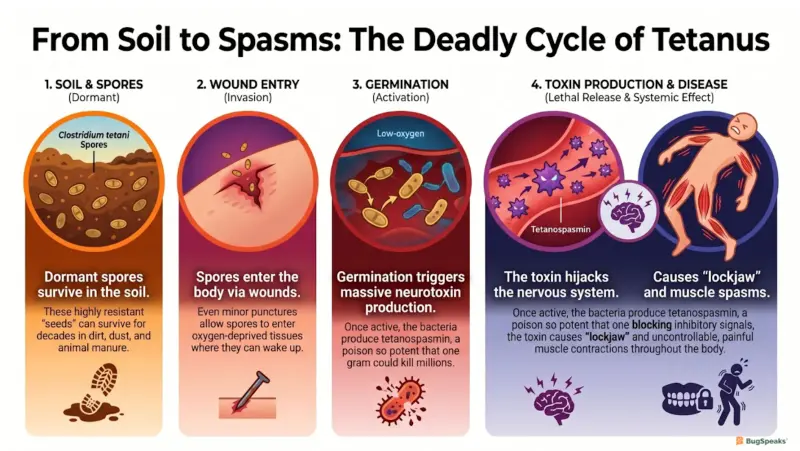
Clostridium tetani survives so successfully because it can transform itself into an incredibly durable spore whenever conditions become unfavorable. If most bacteria are like delicate plants that require constant care, C. tetani is more like a seed that can wait patiently for years until the right opportunity appears. This survival strategy has allowed the bacterium to spread across nearly every continent on Earth.
The primary habitat of C. tetani is soil, particularly warm soils rich in organic material and animal manure. However, the bacterium also spends part of its life inside the intestines of animals such as horses, cattle, sheep, and dogs. These animals act as natural reservoirs, continuously releasing bacterial cells and spores into the environment. As a result, soil becomes replenished with fresh spores year after year, creating a cycle that is almost impossible to interrupt.
One of the most fascinating aspects of the bacterium is its relationship with oxygen. Active bacterial cells grow best in Anaerobic conditions, meaning environments with very little oxygen. In the open air, the vegetative cells are fragile and struggle to survive. The spore, however, is an entirely different story. Protected by multiple layers, it can tolerate heat, drying, sunlight, and many environmental stresses that would kill active bacteria.
This remarkable resilience explains why tetanus remains a global disease despite decades of vaccination efforts. Unlike diseases that depend on continuous transmission between people, C. tetani can thrive independently in nature. Even if every human case disappeared tomorrow, the bacterium would continue existing in soil and animal environments around the world. From an evolutionary perspective, it is one of the most successful environmental Pathogens ever discovered.
How Can a Tiny Bacterium Hijack the Body's Communication Network?
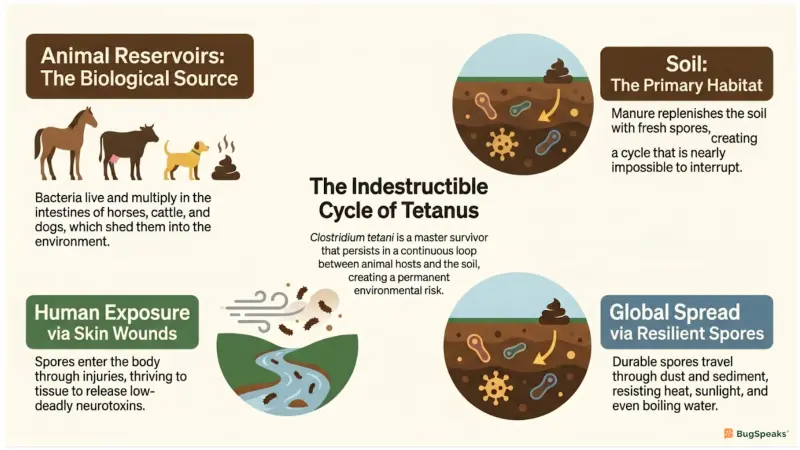
Clostridium tetani causes disease by producing a neurotoxin that interferes with communication inside the nervous system. This is what makes tetanus so unusual. Many bacterial infections cause damage by spreading throughout tissues and organs. In tetanus, the bacterium often remains near the original wound while the toxin travels far beyond it.
The toxin responsible for the disease is called tetanospasmin. Once produced, it enters nearby nerves and begins an extraordinary journey toward the spinal cord and brain. Scientists often describe the nervous system as the body's communication network because it constantly sends signals between the brain and muscles. Every movement, from blinking to walking, depends on these signals being carefully regulated.
Under normal circumstances, certain Neurons send signals that activate muscles while other neurons send signals that calm them down. This balance is maintained through chemical messengers known as neurotransmitters. Tetanospasmin specifically targets inhibitory pathways. It prevents the release of key neurotransmitters that normally act as brakes within the system. Without those brakes, muscles receive continuous instructions to contract.
The result is the classic progression of tetanus symptoms. Jaw muscles often become stiff first, creating the condition known as lockjaw. Over time, spasms can spread to the neck, back, abdomen, and limbs. In severe cases, muscles involved in breathing may also be affected. The frightening aspect of tetanus is that the body's own communication system becomes trapped in a state of constant activation. What begins as a microscopic infection can ultimately affect the entire body through the action of a single neurotoxin.
Scientists continue studying tetanospasmin because it provides valuable insights into how neurons communicate. By understanding how the toxin disrupts nerve signaling, researchers have learned a great deal about normal nervous system function.
Has Clostridium tetani Ever Benefited Humanity?
Although Clostridium tetani is best known for causing disease, studying it has produced enormous benefits for medicine and public health. In fact, some of humanity's most successful vaccines exist because scientists learned how to neutralize and harness the bacterium's deadly toxin.
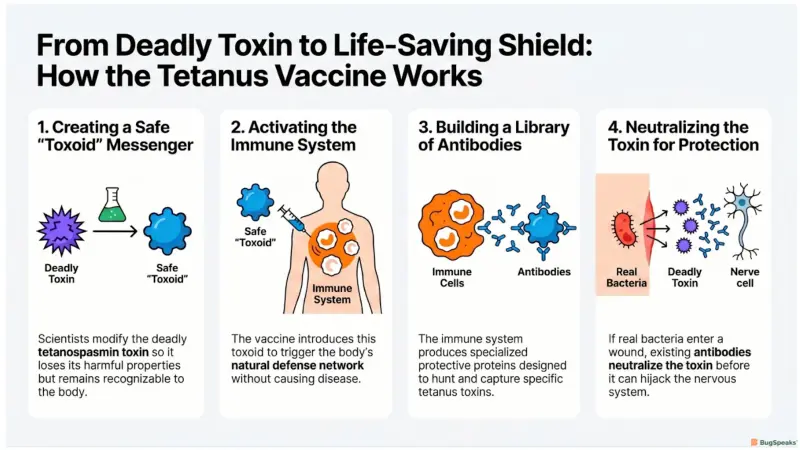
Researchers discovered that tetanospasmin could be chemically modified so that it lost its harmful properties while still stimulating the Immune System. This modified form, called a Toxoid, became the foundation of the tetanus Vaccine. When administered, the Vaccine teaches the Immune System to recognize the toxin before exposure occurs. As a result, the body produces protective Antibodies capable of neutralizing the toxin if infection ever happens.
The success of the tetanus vaccine is one of the great achievements of modern medicine. Before widespread immunization, tetanus caused countless deaths around the world. Today, the disease is largely preventable in populations with adequate vaccination coverage. This dramatic reduction in illness demonstrates the power of preventive medicine and the remarkable adaptability of the immune system.
The influence of tetanus research extends far beyond tetanus itself. Scientists frequently use tetanus toxoid as a carrier protein in other vaccines. Some disease-causing bacteria possess protective outer coatings that are difficult for the immune system to recognize. By attaching these coatings to tetanus toxoid, researchers can create stronger immune responses. This approach has contributed to vaccines that protect against meningitis, pneumonia, and several other serious infections.
Modern researchers are also exploring whether non-toxic portions of tetanus toxin can be used to deliver therapeutic molecules into the nervous system. Although these technologies remain under investigation, they demonstrate how studying dangerous organisms can sometimes produce unexpected medical breakthroughs.
Why Does Clostridium tetani Still Matter in the Modern World?
Clostridium tetani still matters because it continues to shape scientific research, public health policy, and our understanding of microbial evolution. While vaccination has dramatically reduced tetanus cases in many countries, the disease has not disappeared. Regions with limited healthcare access and incomplete immunization programs continue to experience significant numbers of infections each year.
Recent advances in Genomics have revealed that C. tetani is more diverse than scientists once believed. For many years, researchers assumed that most strains behaved similarly. Modern genome sequencing has shown that different lineages can vary in toxin production, environmental adaptation, and genetic composition. These discoveries remind us that bacterial species are rarely uniform. Instead, they are constantly evolving populations shaped by environmental pressures.
The bacterium also provides an important lesson about the relationship between humans and the wider microbiome of the planet. Although C. tetani is not considered a beneficial member of the human microbiome, it is part of a vast microbial ecosystem that exists in soils, animals, and environmental habitats around the world. Understanding how organisms interact within these ecosystems helps scientists better understand disease emergence and microbial ecology.
From a scientific perspective, C. tetani remains one of the most fascinating examples of microbial adaptation. Its ability to survive through spores, exploit anaerobic environments, produce a powerful neurotoxin, and persist independently of human hosts demonstrates extraordinary evolutionary success. Few microorganisms have influenced medicine as profoundly while remaining so deeply connected to the natural environment.
Ultimately, Clostridium tetani is far more than the cause of tetanus. It is a master survivor, a valuable scientific teacher, and a reminder that some of the world's most influential organisms are completely invisible to the naked eye.
Taxonomic classification:
Microbe Profile:
Fun facts
The Mnemonic Morphology: Under light microscopy, sporulating Clostridium tetani bacilli present a highly distinctive "drumstick" or "tennis-racket" appearance. This classic visual marker occurs because the mature endospore is spherical, terminal, and wider than the vegetative rod, causing the cell wall to bulge outward at one end.
Extreme Environmental Resilience: Tetanus spores can survive decades in dry soil, resist boiling temperatures for several minutes, survive freezing conditions, and remain viable when exposed to highly concentrated ethanol or standard household disinfectants.
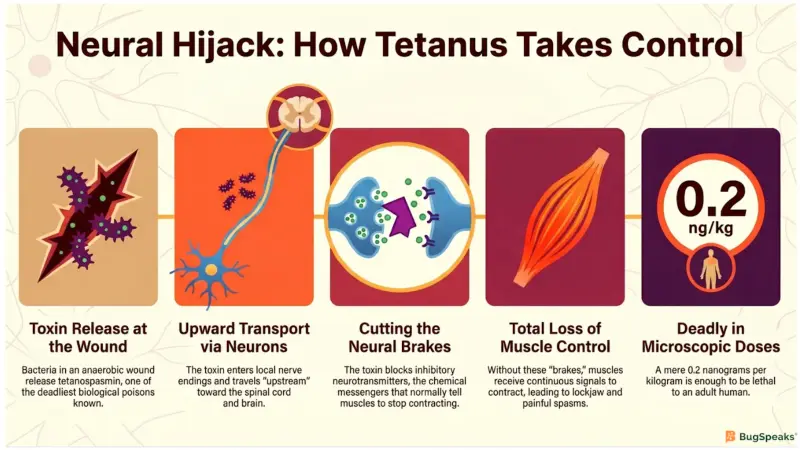
Potency Scale: Tetanospasmin is one of the most deadly biological poisons known, second only to botulinum neurotoxin. The minimum lethal dose for an adult human is estimated at a mere $0.2\ \text{ng/kg}$ of body weight; a single gram of purified toxin is theoretically sufficient to kill several million people.
The Ingestion Safety Paradox: Unlike Clostridium botulinum toxins, which are synthesized with accessory hemagglutinin proteins that protect them from enzymatic digestion, C. tetani produces a naked toxin that lacks these protective proteins. Consequently, ingesting pure tetanospasmin is non-toxic because stomach acids and proteolytic digestive enzymes rapidly break down the polypeptide before it can cross the intestinal mucosa.
Paleoculturomic Evidence: Recent genomic research utilizing teeth collected from a 1590 plague burial site in France successfully cultured and sequenced C. tetani from ancient dental pulp, proving the pathogen can remain trapped in calcified biological matrices for centuries.
Reference
Shitada, C., Sekizuka, T., Yamamoto, A., Sakamoto, C., Hashino, M., Kuroda, M., & Takahashi, M. (2023). Comparative pathogenomic analysis reveals a highly tetanus toxin-producing clade of Clostridium tetaniisolates in Japan. mSphere, 8(6), e0036923. https://doi.org/10.1128/msphere.00369-23
Sudarshan, R., Sayo, A. R., Renner, D. R., de Saram, S., Godbole, G., Warrell, C., Duong, H. T. H., Thwaites, C. L., Mehta, A. R., & Coughlan, C. (2025). Tetanus: recognition and management. The Lancet. Infectious diseases, 25(11), e645–e657. https://doi.org/10.1016/S1473-3099(25)00292-0
Shitada, C., Ohira, M., Sekiguchi, M., Koda, T., Takahashi, M., & Kuroda, M. (2025). Characterization of a Highly Toxigenic Clostridium tetani Strain from a Calf’s Castration Site. Veterinary Sciences, 12(10), 945. https://doi.org/10.3390/vetsci12100945
Gregg, B. M., Gupta, S., Tepp, W. H., & Pellett, S. (2024). Expression of Recombinant Clostridial Neurotoxin by C. tetani. Microorganisms, 12(12), 2611. https://doi.org/10.3390/microorganisms12122611
Möller, J., Kraner, M. E., & Burkovski, A. (2019). More than a Toxin: Protein Inventory of Clostridium tetani Toxoid Vaccines. Proteomes, 7(2), 15. https://doi.org/10.3390/proteomes7020015
Cohen, J. E., Wang, R., Shen, R. F., Wu, W. W., & Keller, J. E. (2017). Comparative pathogenomics of Clostridium tetani. PloS one, 12(8), e0182909. https://doi.org/10.1371/journal.pone.0182909
Abdolmohammadi Khiav, L., & Zahmatkesh, A. (2022). Major pathogenic Clostridia in human and progress toward the clostridial vaccines. Iranian journal of basic medical sciences, 25(9), 1059–1068. https://doi.org/10.22038/IJBMS.2022.65518.14417
Stala, O., Patel, S., Donlon, C., Hussain, S. S., Hirani, R., & Etienne, M. (2026). Tetanus Control in the United States and Global Disaster Settings: Public Health Disparities and Prevention Strategies. Medicina (Kaunas, Lithuania), 62(2), 338. https://doi.org/10.3390/medicina62020338
Chang, M. J., Ollivault-Shiflett, M., Schuman, R., Ngoc Nguyen, S., Kaltashov, I. A., Bobst, C., Rajagopal, S. P., Przedpelski, A., Barbieri, J. T., & Lees, A. (2022). Genetically detoxified tetanus toxin as a vaccine and conjugate carrier protein. Vaccine, 40(35), 5103–5113. https://doi.org/10.1016/j.vaccine.2022.07.011
Chapeton-Montes, D., Plourde, L., Deneve, C., Garnier, D., Barbirato, F., Colombié, V., Demay, S., Haustant, G., Gorgette, O., Schmitt, C., Thouvenot, C., Brüggemann, H., & Popoff, M. R. (2020). Tetanus Toxin Synthesis is Under the Control of A Complex Network of Regulatory Genes in Clostridium tetani. Toxins, 12(5), 328. https://doi.org/10.3390/toxins12050328
Shitada, C., Sekizuka, T., Yamamoto, A., Sakamoto, C., Hashino, M., Kuroda, M., & Takahashi, M. (2023). Comparative pathogenomic analysis reveals a highly tetanus toxin-producing clade of Clostridium tetani isolates in Japan. mSphere, 8(6), e0036923. https://doi.org/10.1128/msphere.00369-23
Markowska, K., Szymanek-Majchrzak, K., Pituch, H., & Majewska, A. (2024). Understanding Quorum-Sensing and Biofilm Forming in Anaerobic Bacterial Communities. International journal of molecular sciences, 25(23), 12808. https://doi.org/10.3390/ijms252312808