MicroByte–Pathogen Series Salmonella enterica: The Biological Intrusion System That Reprograms the Host
Is Salmonella just a foodborne contaminant?
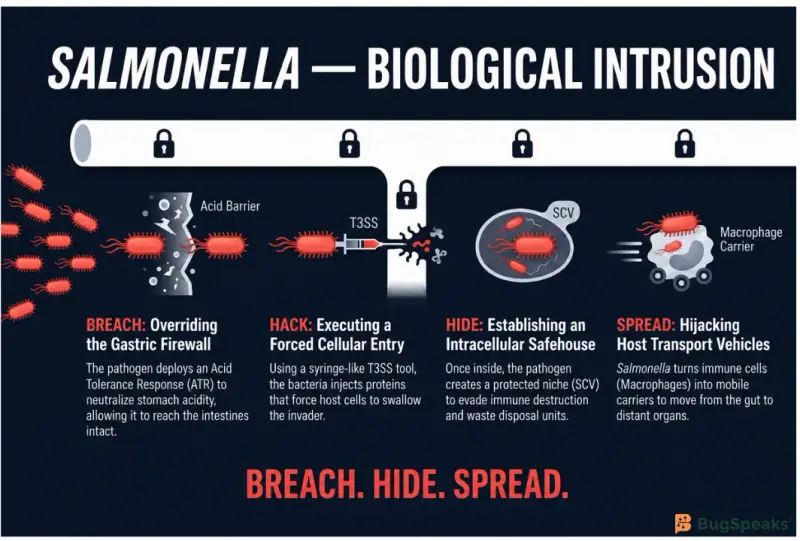
Salmonella enterica is a highly engineered biological intrusion system that infiltrates Host defenses and hijacks cellular infrastructure to sustain its survival. What appears externally as a simple foodborne infection is, at the cellular level, a coordinated breach of multiple security layers within your biological grid. Once ingested, this pathogen does not passively endure environmental conditions; it actively adapts by using genetic “attack modules” to move from the gut lumen into protected Intracellular environmentsLi et al. (2026).
How does the pathogen bypass the gastric firewall?
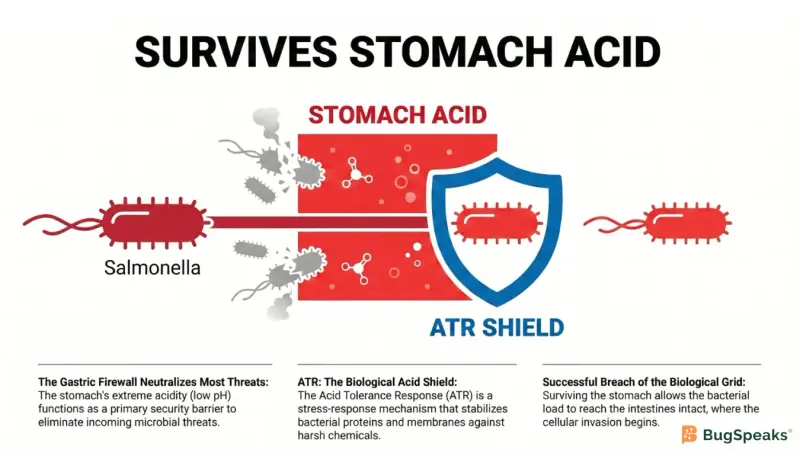
Salmonella survives the stomach by activating a specialized ATR that neutralizes the body’s strongest chemical security barrierLi et al. (2026). The gastric environment of the stomach functions as a primary firewall designed to eliminate incoming microbial threats through extreme acidity or low pH. However, Salmonella enterica deploys the ATR, a stress-response mechanism that stabilizes its proteins and membranes under these harsh conditions. This initial survival step is critical; it allows the bacterial load to pass through the stomach intact and reach the Intestine, where the true invasion beginsWang et al. (2026).
How does Salmonella execute a cellular breach in the intestines?
Salmonella invades host cells in the Intestines by using a syringe-like T3SS to inject molecular effectors that force the cell to engulf it. Upon reaching the intestinal epithelium, the pathogen activates the T3SS, a precision intrusion tool that functions as a molecular device. Through this system, it injects effector proteins into host cells, triggering rapid rearrangements in the cell's "skeleton." These changes cause the cell surface to fold inward and swallow the bacterium, a forced entry that bypasses normal phagocytosis and all other security controlsLi et al. (2026).
What is the intracellular 'safehouse' strategy?
After entry, Salmonella creates a protected niche called the SCV that shields it from immune destruction while it begins to replicateLi et al. (2026). Instead of being routed toward the cell’s lysosomes for destruction, the SCV is actively modified by the bacteria to become a biological safehouse. This specialized compartment prevents the cell's "trash disposal" units from fusing with it and destroying the intruder. By staying inside the SCV, the Pathogen can persist within immune cells like macrophages, effectively turning them into transport vehicles for a systemic spreadXu et al. (2025).
How does the pathogen evade immune surveillance?
Salmonella evades immune surveillance by suppressing inflammatory signals and neutralizing ROS, the body’s primary antimicrobial weaponsLi et al. (2026). Within its safehouse, the pathogen deploys proteins that interfere with the cell's "alarm system," preventing the immune system from noticing the breach. Simultaneously, it produces enzymes that neutralize ROS highly reactive molecules produced by immune cells specifically to destroy invaders. This dual strategy allows the intruder to remain undetected long enough to establish a permanent foothold on the grid.
How does local infection escalate into a system-wide breach?
Once the intestinal barrier is compromised, the release of endotoxins triggers a cascade of cytokines that causes inflammation far beyond the gut. The invasion process destroys the "seals" of the intestines, allowing bacterial components like endotoxins to leak into the bloodstream. These toxic molecules activate immune receptors, triggering a massive release of cytokines, which are signaling proteins that coordinate your body's immune response. This escalation transforms a small, local problem into a systemic disturbance that can affect your liver, joints, and nervous systemXu et al. (2025).
How does Salmonella travel beyond the gut?
Salmonella spreads throughout the body by hijacking your Macrophages and exploiting your internal transport pathwaysXu et al. (2025). After surviving inside these immune cells, the pathogen uses these "mobile carriers" to reach distant tissues like the liver and spleen. This strategy enables the development of invasive infections, such as bacteremia, and in severe cases, systemic diseases. This represents a critical shift for the intruder moving from a localized breach in the intestines to full infiltration of your biological infrastructureWang et al. (2026).
Table 1: Pathogen Intrusion Log
Can this intrusion trigger chronic system instability?
Yes, persistent Salmonella activity can create long-term immune dysregulation and chronic inflammatory states known as dysbiosisLiang et al. (2026). Unresolved infections maintain a continuous "Alarm Signal" in the body, which can alter your metabolic pathways and immune balance over time. This chronic activation is linked to long-term complications like reactive arthritis and prolonged gastrointestinal dysfunction. What begins as an acute breach in the intestines can evolve into a sustained system failure affecting multiple physiological networksXu et al. (2025).
How do we prevent a biological system breach?
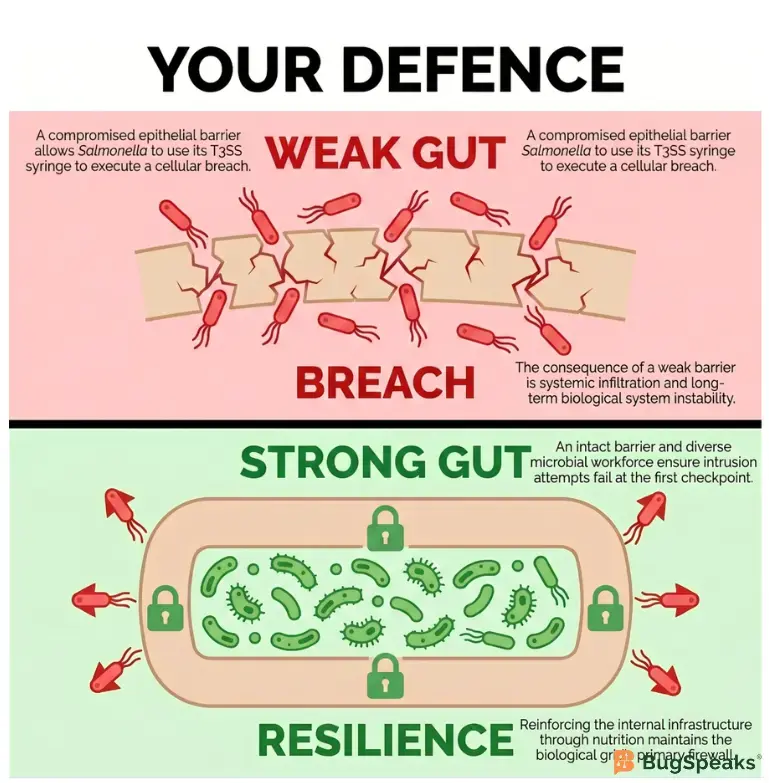
Preventing a Salmonella breach requires reinforcing your internal resilience through a healthy gut barrier and a diverse workforceLiang et al. (2026). Once the Pathogen is inside, maintaining a strong epithelium and a balanced microbiome through proper nutrition is critical in preventing the infection from escalating. Prevention is not just about killing the bacteria; it is about ensuring your biological infrastructure is strong enough that intrusion attempts fail at the very first checkpoints. Wang et al. (2026).
Reference
Ghoshal, M., Bechtel, T. D., Gibbons, J. G., & McLandsborough, L. (2023). Adaptive laboratory evolution of Salmonella enterica in acid stress. Frontiers in microbiology, 14, 1285421. https://doi.org/10.3389/fmicb.2023.1285421
Kubori, T., & Galán, J. E. (2002). Salmonella type III secretion-associated protein InvE controls translocation of effector proteins into host cells. Journal of bacteriology, 184(17), 4699–4708. https://doi.org/10.1128/JB.184.17.4699-4708.2002
Kalimuddin, S., & Ooi, E. E. (2025). A helping hand against severe dengue. Cell host & microbe, 33(7), 1050–1051. https://doi.org/10.1016/j.chom.2025.06.012
Zha, L., Garrett, S., & Sun, J. (2019). Salmonella Infection in Chronic Inflammation and Gastrointestinal Cancer. Diseases (Basel, Switzerland), 7(1), 28. https://doi.org/10.3390/diseases7010028