The Hidden Risks of Street Food During the Monsoon Season
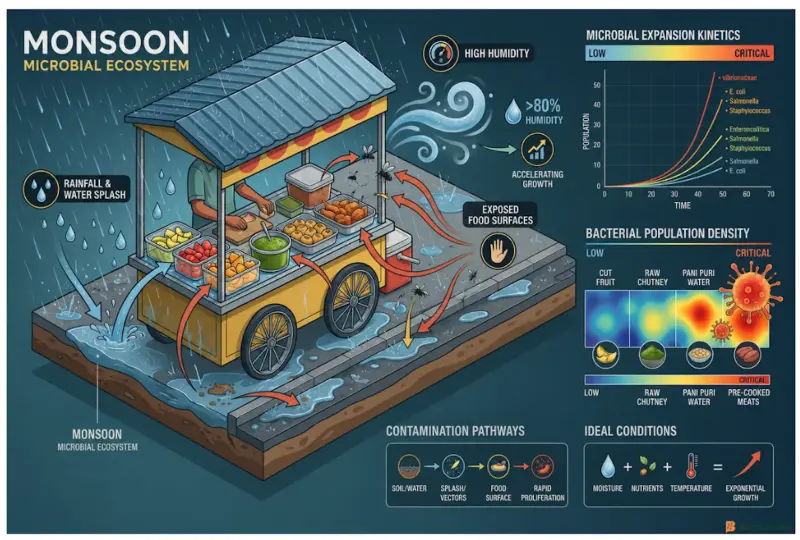
Why does street food spoil so much faster during the rainy season?
Street food spoils rapidly during the rainy season because the monsoon acts as a powerful environmental transition event that turns warm, moist air into a microbial growth accelerator on every exposed food surface. When the skies open and rain falls, the amount of water vapor in the outdoor air rises dramatically. This high humidity acts like a supercharging power button for microscopic bacteria. Normally, drier weather slows down these tiny creatures, but wet air allows them to multiply at lightning speed. Any open snack left sitting on an outdoor counter quickly becomes an active playground where these invisible germs rapidly double their numbers.
This rapid spoilage is directly driven by high relative humidity, which scientific studies prove can dramatically increase the survival and spread of harmful pathogens. When outdoor food stands prepare meals, the ingredients are constantly in contact with the heavy, damp monsoon air. Researchers likeIskandar et al. (2025) have shown that wet environments make it much easier for bacteria like coliforms to colonize ready-to-eat foods. These indicator organisms show us that general cleanliness is failing because of the changing weather. When you eat food left in these damp conditions, you are swallowing a highly concentrated dose of active bacteria that can easily make you sick.
To make matters worse, these tiny germs can trigger a dangerous biological reaction in our bodies known as gut microbiome toxicity. When we swallow spoiled street food, the environmental toxins and active pathogens disrupt the healthy community of microscopic bugs living inside our bellies. This disruption has been defined by scientists likeTu et al. (2020) as a form of organ toxicity that damages our natural digestion. Instead of smoothly processing our meals, our digestive system gets deeply irritated by the toxic chemicals produced by the invading germs. This internal irritation is what causes the painful cramps and swelling we experience.
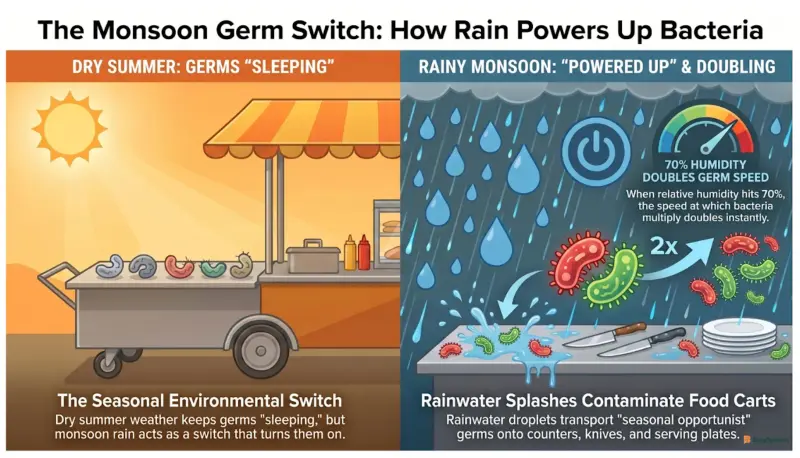
How do rainy-season germs survive on outdoor food carts?
Rainy season germs survive on outdoor food carts by transforming themselves into seasonal opportunists that exploit wet surfaces and cool temperatures to resist natural decay. These microbes are incredibly stubborn, and they treat rain-slicked counters, wet knives, and damp serving plates as their personal safety shields. When rainwater splashes onto food preparation areas, it spreads these germs far and wide. Instead of drying up and dying, the germs thrive in the cool shade of the cart's canopy. They wait patiently for a hungry customer to order a plate of food, ready to jump from the plate directly into a human belly.
This survival is backed by serious science, which shows how specific viruses remain active for long periods on wet food surfaces. Researchers likeLee et al. (2015) studied the survival of major foodborne viruses, including Hepatitis A Virus (HAV) and Murine Norovirus (MNV), which is a stand-in for human norovirus. They discovered that high relative humidity, like the seventy percent humidity we experience during monsoon rains, actually helps certain viruses survive much better on wet food surfaces. Instead of breaking down and dying, these highly contagious virus particles stay perfectly intact on fresh ingredients, remaining fully capable of infecting people who eat them.
These viruses can cling to vegetables and seafood for up to two full weeks under typical outdoor storage conditions. For example, the study showed that bacteriophage MS2, another viral surrogate, is highly resistant to temperature changes when kept in moist environmentsLee et al. (2015). When street vendors wash their peppers or onions in contaminated water, they are not cleaning them; they are actually coating them in active pathogens. Because these germs do not decay quickly in wet weather, the natural passage of time does not make the food any safer to eat, meaning we must be very careful when choosing our food.
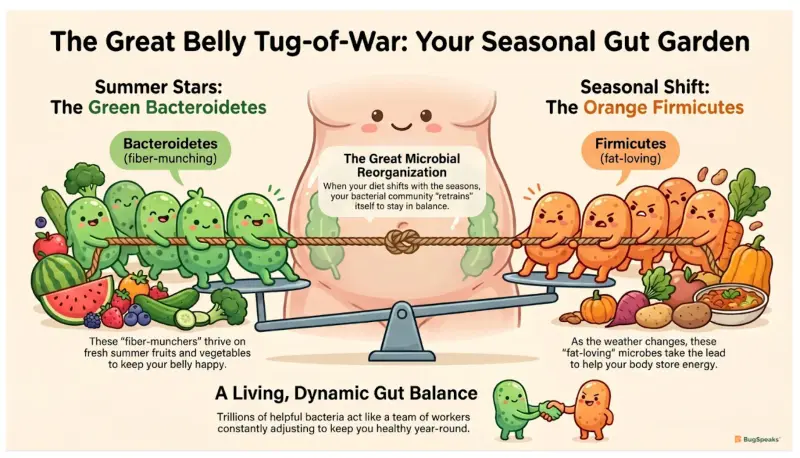
Why does our gut struggle to adjust during the monsoon?
Our gut struggles to adjust during the monsoon because our digestive tract behaves like a complex biological adaptation system that gets thrown off balance by sudden seasonal changes in our diet. Inside our intestines live trillions of helpful bacteria that act like a team of tiny workers, keeping us healthy. This internal community is highly sensitive to the external environment. When we transition from hot, dry summer days to cool, rainy monsoon weeks, our body's internal rhythms must adjust. If we flood our system with dirty street food during this delicate transition, our internal defenses experience major confusion and fail.
This struggle is linked to natural changes in our gut's microbial makeup, which fluctuates significantly between different times of the year. A landmark study byDavenport et al. (2014) tracked how our inner microbes change when seasons shift. They found that the abundance of major bacterial families, such as Bacteroidetes and Firmicutes, fluctuates with what we eat and the weather. When the external environment shifts rapidly, our gut bacteria undergo a massive reorganization. Introducing heavy, germ-laden street food during this transition period overwhelms our gut's ability to adapt to these changes and keep us safe smoothly.
When this reorganization fails, we experience painful symptoms like diarrhea and bloating, which are clear signs of biological adaptation failures in our digestive tract. Our gut's friendly bacteria normally help us digest fiber and block harmful invaders from taking over. But when the delicate balance is rapidly disrupted by monsoon germs, our intestinal wall becomes weak and inflamedTu et al. (2020). The helpful microbes can no longer protect us, allowing toxic waste to build up inside our intestines. This failure of our inner ecosystem is why even a small plate of unhygienic street food can make us feel so incredibly sick.
How does drinking cold rainwater or beverages affect our digestion?
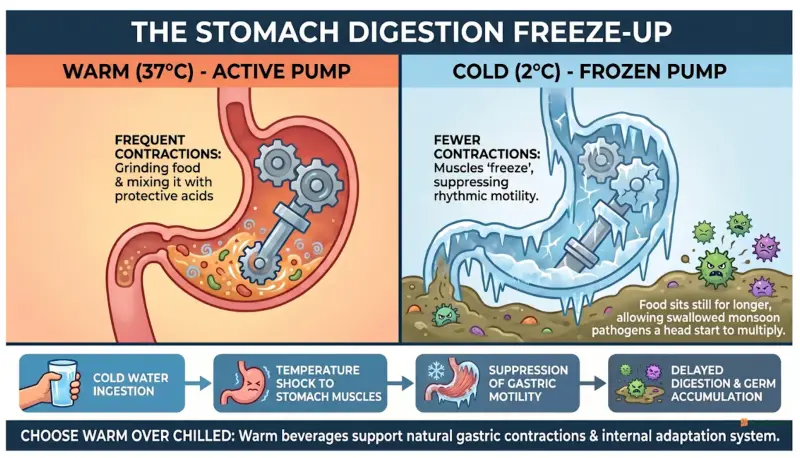
Drinking cold rainwater or chilled beverages reduces our gut's natural motility, which severely delays digestion and allows swallowed germs to sit in our gut for much longer. When we consume very cold liquids, our gut muscles experience a sudden temperature shock. This physical coldness causes the gut's regular pumping and grinding motions to slow down or freeze up completely. Instead of quickly processing food and acidifying it to kill germs, the gut becomes a stagnant pool. This delay in digestion gives any swallowed monsoon pathogens a perfect head start to multiply and cause severe trouble in our bellies.
This digestive freeze has been carefully measured by scientists studying how liquid temperatures change the way our guts contract. In a study byFujihira et al. (2019), researchers tested how water at different temperatures affects the gut's muscle movements. They discovered that drinking water at a cold two degrees Celsius significantly suppresses our normal gastric contractions compared to warm water. These contractions are the squeezing motions that push food forward through our digestive system. When these squeezing motions are slowed down by cold water, food sits in the gut for a much longer time, causing a heavy, bloated feeling that makes us feel uncomfortable.
This slow digestion is directly linked to a drop in energy intake and a weaker ability to destroy swallowed pathogens. The researchers found a strong positive relationship between the frequency of gut contractions and how hungry or full the subjects felt after eatingFujihira et al. (2019). When cold water suppresses gut contractions, it also tricks the brain into feeling full, while leaving raw, undigested food sitting in a cold gut. This cold, lazy environment prevents stomach acid from mixing properly with food, allowing dangerous street food pathogens to slip past our first line of defense very easily and make us sick.
How can we protect our digestive systems from monsoon infections?
We can protect our digestive systems from monsoon infections by applying a One Health approach that recognizes how closely our personal health is linked to the cleanliness of our water and the surrounding outdoor environment. Protecting our bellies is not just about washing our hands; it is about managing the entire system around us. During heavy rains, poor sewage systems can easily leak into municipal tap water. If busy street vendors use this tap water to wash their plates, utensils, or fresh vegetables, they are spreading germs. We must all understand these environmental connections to stay healthy throughout the wet season.
To make sure we do not fall victim to adaptation failures, we must encourage street food vendors to practice strict Good Hygiene Practices (GHP) on their carts. Simple steps, like keeping ingredients covered with protective food covers and using bottled or filtered water, can make a massive difference. Scientists likeIskandar et al. (2025) have shown that when vendors avoid bare-hand contact and maintain clean cooking surfaces, contamination rates drop dramatically in these busy outdoor markets. By choosing to eat only at clean, dry, and well-covered food stalls, we protect our gut microbiome from toxic overloads that make us feel sick and tired.
Finally, we can support our digestive health by eating warm, fully cooked foods and avoiding raw vegetables or cold drinks during the peak monsoon weeks of the heavy monsoon season. Fully cooking our street food acts like a thermal shield that destroys stubborn viruses and bacteria, making it much safer than raw salads. Keeping our body warm also supports healthy gut contractions, helping our natural adaptation system work perfectly and keep us highly energetic. By understanding how the wet weather changes the microbial world around us, we can enjoy the rainy season without ever having to suffer from a painful monsoon belly or a ruined vacation.
-Varsha V
Visualize the process- https://youtu.be/lkF7ZOjAMug
Reference
Iskandar, C. F., Khalil, R. A., Gereige, N., Massarra, L., & Abiad, M. G. (2025). Environmental and seasonal drivers of microbiological contamination in street-vended foods. Scientific reports, 16(1), 2567. https://doi.org/10.1038/s41598-025-32430-y
Davenport, E. R., Mizrahi-Man, O., Michelini, K., Barreiro, L. B., Ober, C., & Gilad, Y. (2014). Seasonal variation in human gut microbiome composition. PloS one, 9(3), e90731. https://doi.org/10.1371/journal.pone.0090731
Fujihira, K., Hamada, Y., Yanaoka, T., Yamamoto, R., Suzuki, K., & Miyashita, M. (2020). The effects of water temperature on gastric motility and energy intake in healthy young men. European journal of nutrition, 59(1), 103–109. https://doi.org/10.1007/s00394-018-1888-6
Lee, S. J., Si, J., Yun, H. S., & Ko, G. (2015). Effect of temperature and relative humidity on the survival of foodborne viruses during food storage. Applied and environmental microbiology, 81(6), 2075–2081. https://doi.org/10.1128/AEM.04093-14
Tu, P., Chi, L., Bodnar, W., Zhang, Z., Gao, B., Bian, X., Stewart, J., Fry, R., & Lu, K. (2020). Gut Microbiome Toxicity: Connecting the Environment and Gut Microbiome-Associated Diseases. Toxics, 8(1), 19. https://doi.org/10.3390/toxics8010019