The Best Practices for Maintaining a Healthy Skin Microbiome
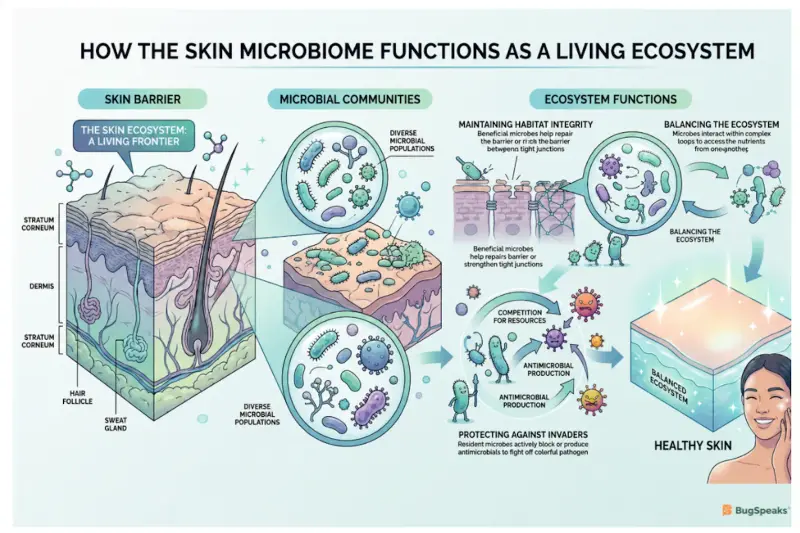
What is the skin microbiome and how does it function as a living ecosystem?
The Skin Microbiome is a bustling community of tiny living things that act as resident stabilizing species, keeping your body's outer living ecosystem strong and healthy. Imagine your skin is not just a flat wall but a vibrant forest (Oh & Voigt, 2025). The very top layer of this forest is called the Stratum Corneum, which acts as the main physical structure of your ecosystem habitat. It is built from tightly packed skin cells named Keratinocytes, glued together by special natural fatsSkotnicki (2020). Helpful microbes live right here, eating natural skin oils and turning them into tools that repair the habitat. This amazing teamwork ensures the physical environment stays tough against daily wear and tear.
These resident stabilizing species do more than just hang out; they are the brave protectors of the living ecosystem. By taking up space across the skin, they claim their own territories and build a strong shieldEllis et al. (2019). This active teamwork physically blocks bad, invading germs from finding any food or empty room to grow. It is like planting thick, healthy grass so that weeds cannot sprout. Because these friendly microbes constantly guard the area, no single dangerous germ can take over. This fierce microscopic competition keeps the whole environment perfectly balanced and peaceful. It is a natural security system that successfully stops bad bacteria from causing trouble and protects your skin every day.
A constant, quiet conversation between the Skin Microbiome and your body helps create a state of peaceful immune tolerancePrescott et al. (2017). This means your body’s internal guards learn to ignore the friendly resident stabilizing species while staying highly alert for real danger. The survival of this delicate living ecosystem depends on keeping everything stable and calm. When the ecosystem habitat is left alone, it can easily fix minor changes on its own without setting off a harsh ecosystem stress response. Think of these helpful microbes as an invisible, living blanket covering you from head to toe. They provide a vital layer of daily protection that is necessary for your skin to stay healthy and strong.
How do antibacterial soaps disrupt the natural balance of the skin ecosystem?
Antibacterial soaps act as broad-spectrum ecosystem disruptors that wipe out both good and bad germs while destroying the ecosystem habitat by raising its pH level. People often think that being clean means destroying all bacteria with strong soaps. However, these harsh products act like bulldozers, working as broad-spectrum ecosystem disruptors that cannot tell the difference between dangerous invaders and your helpful resident stabilizing speciesEllis et al. (2019). When you wash away the good microbes, the living ecosystem is left empty and completely unprotected. Without friendly guards to defend the area, bad germs quickly take over, causing a harmful biological imbalance known as DysbiosisZhang et al. (2024). This massive loss of microbial diversity deeply damages your skin's natural defense.
Beyond just washing away your friendly germs, these broad-spectrum ecosystem disruptors totally ruin the chemical balance of the ecosystem habitat. Healthy skin needs to be slightly acidic, meaning it has a low pH, to keep the stratum corneum working properlySkotnicki (2020). Unfortunately, most strong soaps are highly alkaline, meaning they have a high pH. This chemical shock acts like acid rain on a forest. The special natural tools that repair the glue between your keratinocytes only work in acidic spacesSkotnicki (2020). When soapy water raises the pH, these repair tools shut down entirely. At the same time, destructive tools wake up and literally melt the skin's glue, causing tiny, invisible cracks everywhere.
When the ecosystem habitat cracks open and friendly microbes disappear, the skin panics and starts an intense ecosystem stress response. The broken barrier lets irritating pollution and bad germs sneak deep inside the skin. In defense, the body uses alarm bells called Toll-Like Receptors to spot the danger, which immediately causes swelling and rednessOh & Voigt (2025). This non-stop ecosystem stress response wastes the skin's energy, taking it away from normal healing jobs. Washing every single day with these broad-spectrum ecosystem disruptors traps your skin in a terrible loop of physical damage and swelling. Over time, this daily destruction makes the living ecosystem incredibly weak, dry, and unable to protect itself from the outside world.
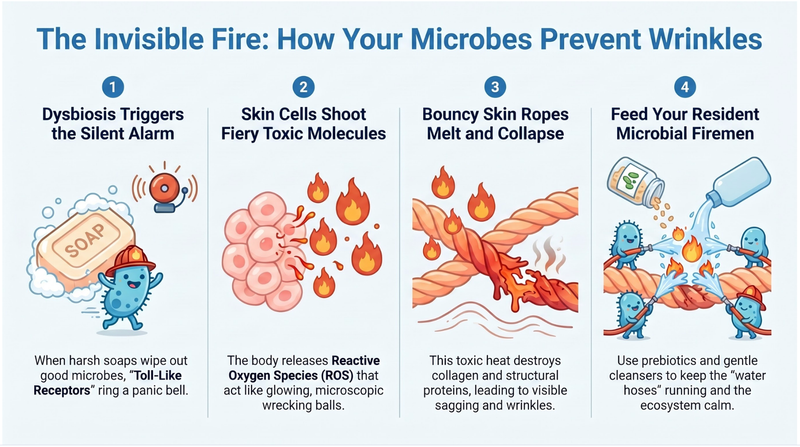
Why does microbiome disruption accelerate the skin aging process?
Ruining the skin microbiome speeds up aging by causing a constant ecosystem stress response that creates toxic molecules, driving the gradual ecosystem degradation of your skin. The physical signs of getting older, like wrinkles and sagging, happen faster when your living ecosystem loses its balance. When broad-spectrum ecosystem disruptors wash away your friendly resident stabilizing species, the skin's panic system turns on. This creates a state of low-level, hidden swelling called Inflammaging, which slowly hurts your body over many yearsPopkes & Valenzano (2020). During this panic, the skin's guards shoot out dangerous molecules known as Reactive Oxygen Species to fight invisible enemies, creating a highly toxic space that damages everything nearbyNi et al. (2022).
This never-ending toxic attack is the main reason behind the gradual ecosystem degradation of your skin. Too many Reactive Oxygen Species act like tiny wrecking balls, smashing the important proteins that keep the ecosystem habitat firm, plump, and young. Normally, your helpful resident stabilizing species act like protective shields, producing natural antioxidant proteins that neutralize these Reactive Oxygen SpeciesOh & Voigt (2025). But when those good germs are wiped out by harsh soaps, your skin loses its best firemen. Because of this, sunlight and dirty air can dig much deeper into your skin, creating even more toxic damage. This perfectly explains why losing your microbial friends speeds up wrinkles and causes rapid structural collapse.
Furthermore, when the ecosystem habitat breaks apart, it completely loses its ability to hold onto water, causing a severe drying effect known as Transepidermal Water Loss Skotnicki (2020). Deep water storage is super important for your living ecosystem to heal and stay healthy. As the stratum corneum loses its natural oils and dries out, the skin forgets how to shed old cells. Dead keratinocytes pile up like a messy heap of dry leaves, making the skin look rough and old. The painful combination of hidden Inflammaging, dangerous toxic molecules, and heavy Transepidermal Water Loss turns a tiny microbial problem into massive tissue damage. This is how soap-induced damage visibly ages your skin much faster.
How do resident stabilizing microbes protect the skin from environmental damage?
Resident stabilizing microbes defend you by making special food like Short-Chain Fatty Acids and natural oils that physically rebuild the ecosystem habitat and fight off bad germs. The true strength of your skin's living ecosystem comes directly from the protective compounds made by your friendly microbes. One of their best tricks is chewing up skin oils and turning them into Short-Chain Fatty Acids Ellis et al. (2019). These fatty juices are absolute super-tools for the skin. They give your skin cells instant energy to grow, they help maintain the perfect acidic pH of the stratum corneum, and they quickly calm down redness. By keeping the environment peaceful, they stop destructive ecosystem stress responses before they start.
Besides making protective compounds, some specific resident stabilizing species actually work like tiny builders to fix the walls of your ecosystem habitat. These highly specialized germs have unique tools that create tough fats called CeramidesOh & Voigt (2025). Ceramides act exactly like waterproof cement, perfectly filling the tiny holes between the keratinocytes in your stratum corneum. This living cement creates a tight seal that permanently stops transepidermal water loss and blocks nasty dirt from entering. Finding out that friendly microbes literally build the skin's armor proves how amazing the living ecosystem truly is. It is a perfect recycling factory where microbes turn your waste oils into a hydrated shield that protects you from the harsh outside world.
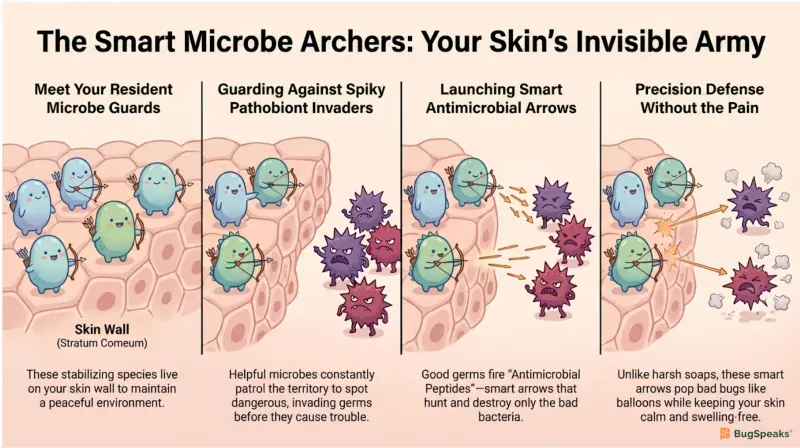
Finally, your resident stabilizing species act like fierce little soldiers, using brilliant tactics to fight off bad germs and infections. They crowd the skin so completely that dangerous invaders, known as Pathobionts, cannot find any room to landPopkes & Valenzano (2020). The friendly germs even shoot out tiny, glowing arrows called Antimicrobial Peptides Zhang et al. (2024). These smart arrows only hunt and destroy the bad bacterial invaders, keeping you and the other good microbes totally safe. By quietly destroying enemy threats before they cause swelling and pain, your friendly microbial soldiers completely prevent the gradual ecosystem degradation of your skin. They are the ultimate invisible army working tirelessly to keep your living ecosystem perfectly safe.
How can we manage the skin ecosystem to promote long-term resilience and youthfulness?
We can keep our skin young and tough by throwing away broad-spectrum ecosystem disruptors, using gentle products, and actively feeding our microbes to stop gradual ecosystem degradation. Having healthy, youthful skin means you must stop treating your body like a dirty floor that needs harsh scrubbing. You have to start treating it like a living ecosystem. A wonderful first step is gently swapping out harsh antibacterial soaps for milder alternatives. By ditching these toxic chemicals, your skin microbiome is finally safe from constant destruction. Instead, you should wash with soft, gentle cleansers that protect the natural pH of your stratum corneumSkotnicki (2020). Keeping your skin slightly acidic allows your natural repair tools to work flawlessly.
Once you stop hurting your skin, you can use science to actively feed your friendly germs. You can apply special skin foods called Prebiotics directly to your face and bodyPrescott et al. (2017). These awesome nutrients act like magical fertilizer that only feeds your good resident stabilizing species. When you feed them well, these happy microbes quickly multiply and produce massive amounts of Short-Chain Fatty Acids and ceramides. By giving them the exact food they crave, Prebiotics help your good bugs easily defeat the bad pathobionts. This powerful nutritional support makes the defenses of your ecosystem habitat incredibly thick and strong. It calms down the skin's alarm bells and prevents the swelling that causes rapid aging.
The most exciting new way to protect your skin is by putting live, friendly germs straight onto it, which scientists call Probiotics. Exciting tests show that rubbing happy resident bacteria on your skin can instantly defeat bad germs, lower toxic stress, and quickly fix the skin's armorOh & Voigt (2025). These live helpers act like fresh backup troops, dropping huge loads of antimicrobial peptides right where your skin needs them the most. By planting new resident stabilizing species onto your skin, you quickly cure dysbiosis and restore total harmony. Treating your skin as a glowing, vibrant living ecosystem is the absolute best way to stop gradual ecosystem degradation and keep your face looking beautifully soft, bouncy, and young.
Visualize the process- https://youtu.be/CTaxQ4UvJiw
Reference
Prescott, S.L., Larcombe, DL., Logan, A.C. et al. The skin microbiome: impact of modern environments on skin ecology, barrier integrity, and systemic immune programming. World Allergy Organ J10, 29 (2017). https://doi.org/10.1186/s40413-017-0160-5
Ni Q, Zhang P, Li Q and Han Z (2022) Oxidative Stress and Gut Microbiome in Inflammatory Skin Diseases. Front. Cell Dev. Biol. 10:849985. doi: 10.3389/fcell.2022.849985
Miriam Popkes, Dario Riccardo Valenzano; Microbiota–host interactions shape ageing dynamics. Philos Trans R Soc Lond B Biol Sci 28 September 2020; 375 (1808): 20190596. https://doi.org/10.1098/rstb.2019.0596
Zhang, X. E., Zheng, P., Ye, S. Z., Ma, X., Liu, E., Pang, Y. B., … Guo, J. (2024). Microbiome: Role in Inflammatory Skin Diseases. Journal of Inflammation Research, 17, 1057–1082. https://doi.org/10.2147/JIR.S441100
Oh, J., Voigt, A.Y. The human skin microbiome: from metagenomes to therapeutics. Nat Rev Microbiol23, 771–787 (2025). https://doi.org/10.1038/s41579-025-01211-9
Ellis, S. R., Nguyen, M., Vaughn, A. R., Notay, M., Burney, W. A., Sandhu, S., & Sivamani, R. K. (2019). The Skin and Gut Microbiome and Its Role in Common Dermatologic Conditions. Microorganisms, 7(11), 550. https://doi.org/10.3390/microorganisms7110550