The human gastrointestinal tract is home to trillions of microorganisms that collectively possess a genome exceeding our own by a factor of nearly 1,000. This vast microbial community functions as a "central microbial hub," communicating with distal organs through the production of low-molecular-weight metabolites. These small molecules often reach concentrations in host circulation that equal or exceed those of typical pharmaceutical agents. By acting as signaling molecules and metabolic substrates, these metabolites create a complex multi-kingdom dialogue that dictates the balance between health and disease.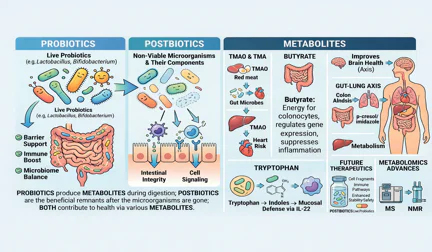
The Power of Short-Chain Fatty Acids (SCFAs)
Short-chain fatty acids, primarily acetate, propionate, and butyrate, are the best-studied class of microbial metabolites. Produced through the anaerobic fermentation of indigestible dietary fibers, they typically exist in a 60:20:20 molar ratio within the colon.
Butyrate: Acts as the primary energy source for colonocytes and is a potent histone deacetylase (HDAC) inhibitor, regulating gene expression to maintain mucosal integrity and suppress inflammation.
Propionate: Predominantly utilized by the liver for gluconeogenesis and has been shown to reduce weight gain and improve insulin sensitivity.
Acetate: The most abundant SCFA in peripheral circulation, it plays a critical role in systemic energy metabolism and can cross the blood-brain barrier to suppress appetite.
These molecules exert their effects largely by binding to G-protein-coupled receptors, specifically GPR41, GPR43, and GPR109A, which are found on immune cells, adipocytes, and enteroendocrine cells.
Tryptophan Derivatives and Immune Maturation
Dietary tryptophan that reaches the colon is transformed by resident bacteria into various indole derivatives. These metabolites function as ligands for the aryl hydrocarbon receptor (AhR), a critical environmental sensor on immune cells. AhR signaling is essential for maintaining the intestinal epithelial barrier, promoting the production of protective mucus, and coordinating mucosal defenses against pathogens via IL-22 release. Furthermore, up to 90% of the body's serotonin is produced in the gut, where microbial signals heavily influence its synthesis and subsequent impact on gut motility and mood.
Bile Acids: Hormonal Messengers
While primary bile acids are synthesized in the liver to aid fat digestion, the gut microbiota performs the essential task of converting them into secondary bile acids like deoxycholic acid (DCA) and lithocholic acid (LCA). These secondary bile acids act as hormones, signaling through the farnesoid X receptor (FXR) and TGR5 to regulate glucose, lipid, and energy homeostasis. However, an imbalance in these profiles is linked to inflammatory bowel disease (IBD) and certain cancers, such as hepatocellular carcinoma.
The TMAO Controversy and Cardiovascular Risk
One of the most clinically significant metabolites is trimethylamine-N-oxide (TMAO). Gut microbes convert dietary choline and L-carnitine (found in red meat and eggs) into TMA gas, which is then oxidized in the liver by the FMO3 enzyme into TMAO. Elevated plasma TMAO levels are strongly associated with a higher risk of major adverse cardiovascular events, including stroke and myocardial infarction. While some debate exists on whether TMAO is a causative agent or merely a biomarker of renal dysfunction or dysbiosis, it remains a powerful tool for risk stratification.
Beyond the Gut: The Gut–Lung Axis
Metabolites do not remain confined to the intestines; they bypass the gut to influence distant sites like the lungs. High-fiber diets that increase SCFA production have been shown to protect against allergic airway inflammation and protect the lungs from damage caused by cigarette smoke. Metabolites like p-cresol sulfate and imidazole propionate also reach the respiratory tract via the bloodstream to modulate immune responses and improve barrier integrity.
The Future of Therapeutics: Postbiotics
As the limitations of live probiotics (such as transient colonization and variable survival) become clearer, the field is shifting toward postbiotics. Defined by ISAPP in 2021 as a "preparation of inanimate microorganisms and/or their components that confers a health benefit," postbiotics offer enhanced stability and safety. These preparations can include inactivated cells, cell fragments, and the very metabolites discussed above, providing a targeted way to trigger specific immunological pathways.
Analytical Advances in Metabolomics
Unlocking this chemical language requires sophisticated tools. Mass Spectrometry (MS), often coupled with Gas or Liquid Chromatography, is the gold standard for its high sensitivity and ability to perform untargeted discovery of unknown molecules. Nuclear Magnetic Resonance (NMR) provides complementary structural information and is highly reproducible, allowing researchers to map the metabolic flux between the host and its microbes.
Conclusion
The growing understanding of gut microbial metabolites marks a fundamental shift in clinical science, positioning the gastrointestinal tract as a "central microbial hub" that coordinates a vast, multi-kingdom dialogue influencing systemic human health. These low-molecular-weight molecules—ranging from short-chain fatty acids that set the immunological tone to secondary bile acids acting as hormonal messengers—serve as critical signaling intermediates that regulate energy homeostasis, immune maturation, and barrier integrity across the body. As research transitions from associative findings toward a mechanistic understanding, postbiotics and personalized nutrition emerge as the next frontier, offering a more stable and targeted approach to therapy than live microorganisms. By integrating high-sensitivity metabolomic tools with a focus on individual metabolic variability, we can begin to translate this chemical language into precision medicine strategies for treating chronic cardiometabolic, respiratory, and neurological disorders.
-Kumar Sankaran
Also Read: The Science Behind Midnight Cravings: A Gut Microbiome Story
References
Rahman, S., et al. (2023). Gut microbial metabolites and its impact on human health. Annals of Gastroenterology.
Krautkramer, K. A., et al. (2020). Gut microbial metabolites as multi-kingdom intermediates. Nature Reviews Microbiology.
Takeuchi, T., et al. (2024). Microbial Metabolites and Gut Immunology. Annual Review of Immunology.
Bulanda, E., & Wypych, T. P. (2022). Bypassing the Gut–Lung Axis via Microbial Metabolites. Frontiers in Microbiology.
Vinderola, G., et al. (2022). The Concept of Postbiotics. Foods.
Cho, C. E., & Caudill, M. A. (2017). Trimethylamine-N-Oxide: Friend, Foe, or Simply Caught in the Cross-Fire? Trends in Endocrinology & Metabolism.
Jariyasopit, N., & Khoomrung, S. (2023). Mass spectrometry-based analysis of gut microbial metabolites of aromatic amino acids. Computational and Structural Biotechnology Journal.
Liikonen, V., et al. (2023). The effects of whole grain cereals on tryptophan metabolism and intestinal barrier function. Proceedings of the Nutrition Society.
Ande, S., et al. (2025). The Emerging Role of Short Chain Fatty Acids in Human Physiology. IJARSCT.
GMFH Editing Team. (2025). Key advances in gut microbiome research during 2025. Gut Microbiota for Health.