The Ultimate Guide to Fermented vs. Fresh: Adding Bugs vs. Feeding Them
What is the biological difference between eating fermented foods and fresh plant foods?
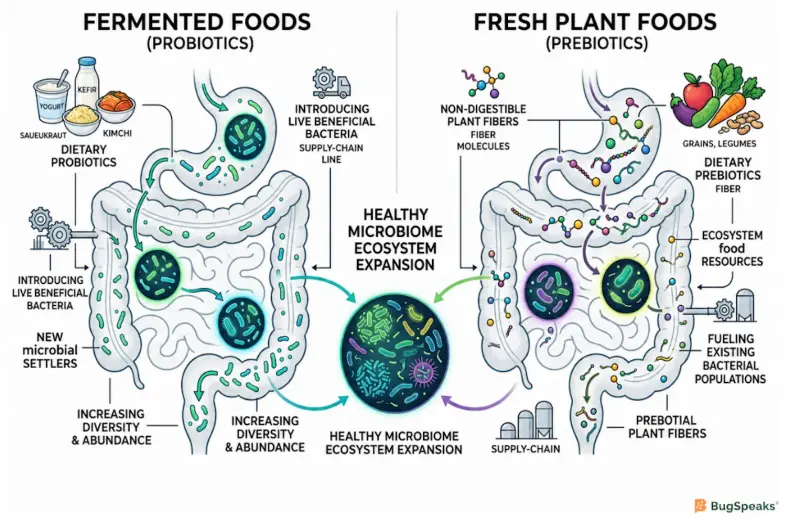
Fermented foods introduce live beneficial microorganisms into your digestive tract, while fresh plant foods provide the essential fibers needed to feed the microorganisms already living thereHill et al. (2014),Gibson et al. (2017). You can think of the Gut Microbiome as a highly active living ecosystem inside you. Consuming fermented foods is just like bringing incoming beneficial species, or new settlers, into this busy habitat. On the other hand, eating fresh plant foods provides access to important ecosystem nutrient resources. Without these new settlers, the ecosystem might lose its special skills. Without the right food resources, the existing helpful populations will just starve and fail to build a strong community.
The scientific words for these two important inputs are Probiotics and Prebiotics. Fermented foods, like simple yogurt and traditional kimchi, naturally contain live probiotics (Hill et al., 2014). When you eat enough of these foods, the live bugs travel safely to your lower intestine. As new settlers, they bring fresh tools to the environment, helping to fight off bad bugs and calm down irritation. However, just dropping these new settlers into a tough environment is not enough for them to survive. The newcomers must have strong building materials and daily food resources to grow, multiply, and become a permanent part of the ecosystem.
This is exactly why fresh plant foods are biologically critical for your health. Fresh vegetables, fruits, and whole grains contain specific dietary fibers that the human stomach cannot break down. Because they survive the long journey completely intact, these fibers arrive in the large intestine as dedicated food resources for the microbial settlement. These special fibers act as prebiotics, which are foods selectively used by helpful bugs to keep you healthyGibson et al. (2017). By eating fresh plants, you make sure that both the newly arrived settlers and the native bugs have the fuel required to keep the living ecosystem perfectly balanced.
How do the bacteria from fermented foods physically establish themselves in the digestive system?
Live bacteria from fermented foods survive the harsh stomach juices to settle on the intestinal wall, where they block harmful pathogens from taking over. When these incoming beneficial species enter the living ecosystem, they must complete a careful process of ecological settlement. The intestine is a highly crowded space with strict biological rules for survival. To build a successful outpost, the new settlers must firmly attach themselves to the gut walls and defend the area against dangerous invaders. The primary settlers from fermented foods belong to a group called Lactic Acid BacteriaBevilacqua et al. (2024). They are perfectly designed to be strong, specialized colonizers in your gut.
When these new settlers arrive, they stick directly to the Epithelial Barrier, which is the single layer of human cells lining the inside of the intestine. By taking up this physical space, the new settlers perform an important ecosystem service called Competitive Exclusion. Harmful invading bugs absolutely need space to attach and grow. Because the helpful settlers have already claimed the best spots on the cell walls, the dangerous bugs are starved of territory. They cannot find a place to anchor, so they simply get washed out of the environment safely before they can cause any serious sickness or harm.
These helpful settlers do more than just take up space; they actively change the environment to make it totally unsafe for bad bugs. Once they settle in, they release natural bug-fighting liquids called Bacteriocins. In our biological network, these special liquids act as a local defense system, destroying toxic bacteria without hurting the host. This process also sends signals to the human body to strengthen the gut wall, preventing tiny leaksFilidou et al. (2024). If the ecosystem is damaged by junk food, the new settlers struggle to attach. You need daily fermented foods to keep the settlement strong.
Why is it absolutely essential to feed existing gut bacteria with fresh plant foods?
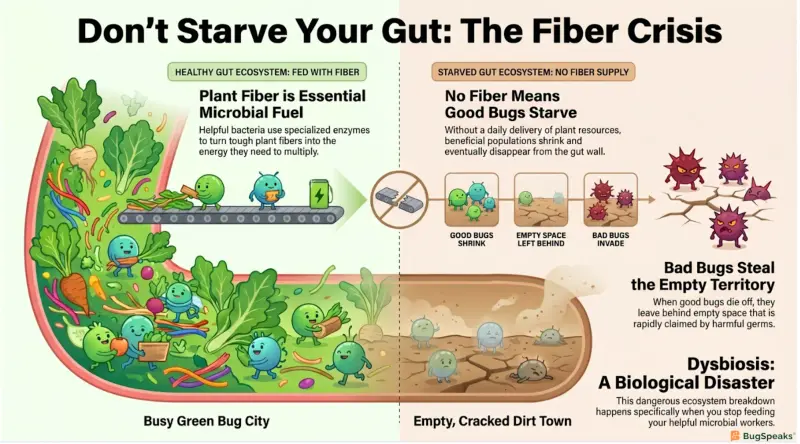
Existing gut bacteria require specific indigestible fibers from fresh plants to create energy, multiply, and maintain their helpful populations within the digestive system. In our ecological settlement, fresh plant foods act as the main supply lines that deliver critical ecosystem nutrient resources. Even the strongest bacterial settlement will quickly collapse if it does not receive its basic biological food. The helpful microbes in your gut have special biological tools to digest tough plant parts that human stomachs cannot process. Therefore, eating fresh plants is really about feeding the entire living ecosystem, not just feeding your own body.
The raw materials delivered by fresh plants arrive in complex chemical shapes, such as Inulin, Fructo-oligosaccharides, and Galacto-oligosaccharides. When you eat fiber-rich foods like garlic, asparagus, or bananas, these tough carbohydrates travel safely down your digestive pipeline. Once they reach the lower gut, the waiting microbes use Carbohydrate-Active Enzymes to carefully break open the thick fiber walls. This intense biological work creates the exact biochemical fuel the bacteria need to grow. If these food resources are plentiful, the helpful populations expand their territory and make the entire biological network much stronger.
When your daily diet lacks these fresh plant resources, the ecological settlement faces a terrible food shortage. The helpful bacteria, completely starved of their main nutrient supply, begin to die very quickly. As their numbers drop, they leave behind empty biological space. This empty territory is rapidly stolen by bad bugs that love to eat unhealthy sugars and unhealthy fats. This dangerous breakdown of the living ecosystem is known as Dysbiosis. Providing a steady, daily supply of ecosystem nutrient resources through fresh plants is the only way to prevent this collapse and keep the helpful bugs in charge.
What biological advantage occurs when we combine fermented microorganisms with fresh plant nutrients?
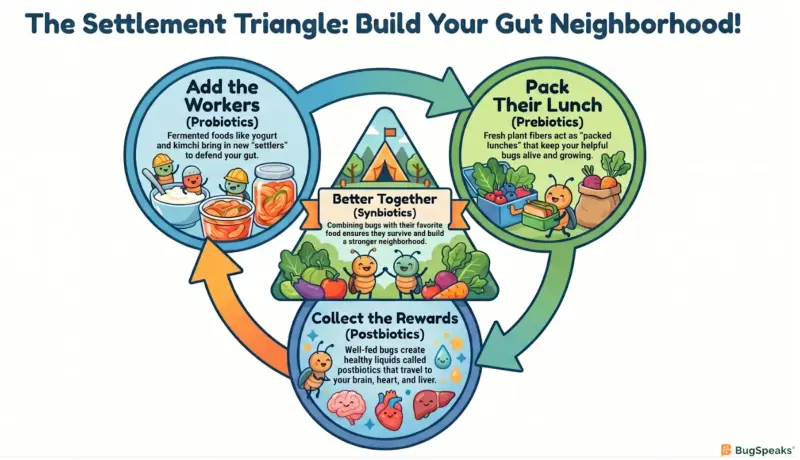
Combining live microorganisms with specific plant fibers creates a powerful biological teamwork that massively improves the survival and growth of the beneficial bacteriaSwanson et al. (2020). In our gut environment, this brilliant combination is the perfect colonization package. Instead of sending incoming beneficial species into the settlement with empty hands, they are dropped in with a massive supply of their favorite ecosystem nutrient resources. This guarantees that the fresh settlers do not have to fight existing bugs for scarce food when they finally arrive. They already have the exact fuel they need to start building, expanding, and permanently defending the local habitat from harm.
In modern biology, the extremely smart pairing of live bacteria with their specific nutritional fuel is formally called SynbioticsSwanson et al. (2020). These synbiotics are highly organized biological supply drops. The most advanced type is a Synergistic Synbiotic. In this very precise pairing, the fresh plant fibers are chosen only because they are the absolute favorite food for the matching fermented bacteriaSwanson et al. (2020). This creates a super-powered biological event called Selective Enrichment. When the specialized settlers arrive in the gut, they use their private food supply to multiply much faster and more easily than they normally would on their own without any extra help.
Because these new bugs have exclusive access to their ideal energy source, they easily skip past all the local competition. They rapidly build their outposts and safely lock themselves into the living ecosystem. This combined method explains perfectly why adding bugs alone is rarely enough to heal a damaged gut. Without a guaranteed food supply, weak bacterial strains will likely starve before they can even unpack their bags. By using a synbiotic plan by adding the bugs while simultaneously feeding them, you maximize the biological power of your digestive tract and ensure a deeply stabilized, highly resilient internal environment for the long term.
How do the chemical products of a well-nourished microbial ecosystem benefit the rest of the human body?
When well-nourished gut bacteria digest complex plant fibers, they produce special health compounds that travel through the blood to support your immune system and distant organsAhlawat et al. (2021). In our ecological settlement, these newly created compounds act as highly valuable ecosystem services. Once the settlers are safely established and fed with plenty of fresh resources, their daily biological work results in the mass production of exported goods. These goods do not just sit around inside the local intestine. They are carefully loaded into the body's bloodstream and shipped out to support the biological framework of your entire body.
Scientists call these biologically active chemical rewards PostbioticsSalminen et al. (2021). The most important postbiotics made inside the gut ecosystem are Short-Chain Fatty Acids (SCFAs), like butyrate and acetateTan et al. (2014). When helpful bugs completely tear apart fresh plant fibers, SCFAs are released as a healthy byproduct. Butyrate is especially important because it is the favorite energy source for the cells lining your colon. It directly powers the physical strength of the intestinal wall. Once safely absorbed into the blood, these amazing microbial messengers travel far away to talk directly with other vital organs located throughout the human body.
They use the Gut-Organ Axis, a massive communication highway connecting the intestinal settlement to places like the liver and heartAhlawat et al. (2021). Some messengers travel straight to the liver to lower bad cholesterol and stop swellingAlbillos et al. (2020). Other signals travel up special nerves to the brain through the Gut-Brain Axis, helping to improve your mood, fix your sleep, and lower stressMayer et al. (2014). Eating fermented foods provides the required bug workers. Eating fresh plants provides the raw materials. Together, they create powerful ecosystem services that naturally defend your whole body against serious sickness.
-Varsha V
Visualize the process- https://youtu.be/g08iYy44Y60
Reference
Kim, Y. T., & Mills, D. A. (2024). Exploring the gut microbiome: probiotics, prebiotics, synbiotics, and postbiotics as key players in human health and disease improvement. Food science and biotechnology, 33(9), 2065–2080. https://doi.org/10.1007/s10068-024-01620-1
Li, Z., & Luo, X. (2025). Probiotics, Prebiotics, Synbiotics, Postbiotics, and Paraprobiotics-New Perspectives on Functional Foods and Nutraceuticals. Foods (Basel, Switzerland), 14(15), 2613. https://doi.org/10.3390/foods14152613
Maftei, N. M., Ambrose, L., Dogaru, E., Răileanu, R., Mierlan, O. L., Amariței, O., Ramos-Villarroel, A., Răuță Verga, G. I., Gurău, T. V., & Gurău, G. (2026). From Probiotics to Postbiotics-An Update on Their Biotherapeutic Potential and the Emerging Strategies in Human Health. International journal of molecular sciences, 27(5), 2218. https://doi.org/10.3390/ijms27052218