Restoring Balance: A Holistic Approach to Gut Microbe Recovery
What happens to your body's resilience-support network when a fever and antibiotics challenge it?
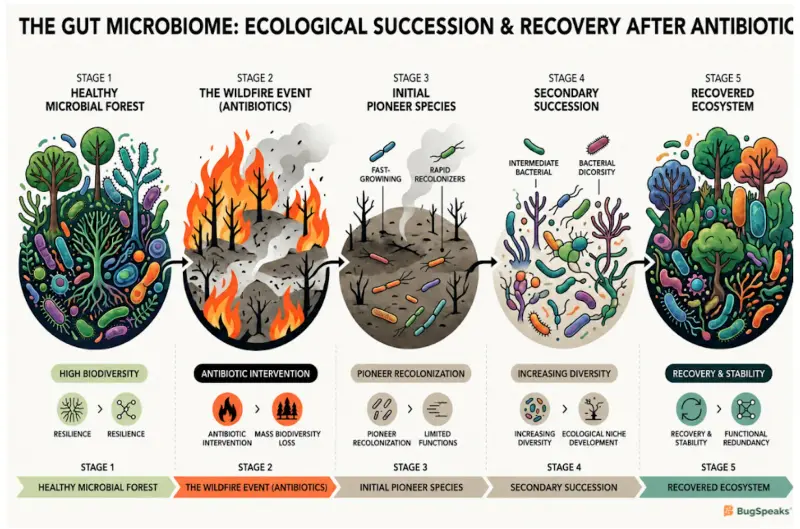
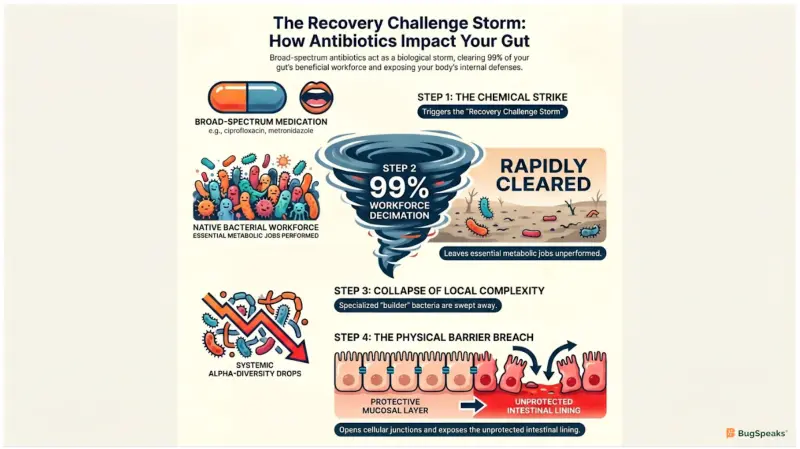
A course of antibiotics poses a major recovery challenge, wiping out your gut's beneficial bacterial helpers and temporarily breaking down your internal resilience-support network during a period of biological stress. Inside your gut, a massive team of friendly microscopic workers, known as the microbiome, works hard to build your body's primary protective barrier, known as the gut barrier (Suez et al., 2018). When you get a high fever, your body enters a stressful period of illness, and taking strong medications helps fight off the bad germs. Unfortunately, these non-selective medicines act like a sweeping storm that clears away almost all your friendly defense workersPalleja et al. (2018).
With the protective helpers suddenly gone, the system's local variety drops dramatically, leaving the intestinal wall without its essential maintenance crew and lowering your overall alpha-diversity. This protective lining is normally cared for by highly active bacterial groups like Bacteroidetes, which act as trained builders keeping the wall tightly sealed and sturdyJohnson et al. (2015). When the recovery challenge removes these builders, the entire defensive structure weakens, and your body's self-healing systems are put on a long pauseSuez et al. (2018). This loss of microscopic labor makes you feel incredibly tired and weak, even after the initial fever has completely gone away.
This massive clearing of your internal helpers also creates empty, unmonitored spaces where opportunistic bugs called pathobionts can quickly multiply and cause trouble. In a healthy gut, these resident troublemakers are kept quiet because the friendly helpers occupy every single spot on the defensive wallPalleja et al. (2018). However, when the helpful workforce is swept away, these bad bugs take over the unused food and empty spaces, triggering a state of imbalance called dysbiosisSuez et al. (2018). This physical disruption causes serious gut aches and digestive issues, showing how a single challenge can knock your entire protective network completely out of balance, leaving you very sensitive.
Why does the recovery of your intestinal network proceed in distinct, sequential stages?
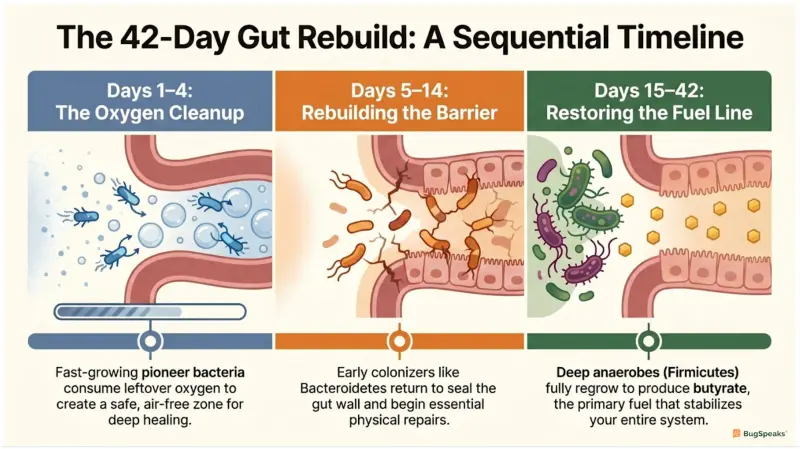
Rebuilding your gut's resilience-support network is a slow, step-by-step process of ecological succession because different types of bacteria must regrow in a precise order. In our Recovery & Resilience Development System, this phased rebuilding takes quite a long time, with healthy adult systems requiring about one and a half months to fully recoverPalleja et al. (2018). First, fast-growing pioneer bacteria clean up the debris left by the challenge. As these early cleanup crews do their jobs, they consume any leftover oxygen, preparing a perfect, oxygen-free zone that allows the slower, highly beneficial anaerobic bacteria to return and resume their long-term protective operations safely.
During this phased recovery, your body works hard to rebuild its core bacterial groups, including the essential Firmicutes and Bacteroidetes familiesPalleja et al. (2018). Soon, specialized fiber-processing helpers regrow and begin producing a high-grade byproduct fuel called butyrate, which directly feeds your gut cells and calms down inflammation in your body. Rebuilding this vital fuel production line is a massive milestone for your system, showing that the body is successfully transitioning from emergency repairs back to standard operations. This progress helps you regain your natural strength, restores your active energy levels, and makes your entire internal gut feel happy, stable, and completely normal again.
In clinical settings, doctors can instantly restore this entire supportive team by using a medical procedure called fecal microbiome transplantation (FMT). Receiving an autologous fecal microbiome transplantation (aFMT), which utilizes a processed, frozen backup sample of your own pre-illness helpers, reintroduces your exact, native, and highly personalized microbial communitySuez et al. (2018). While aFMT is a specialized medical backup system, studying it proves that normal, spontaneous recovery naturally requires about forty-two days to return to near-baseline levelsPalleja et al. (2018). This timeline demonstrates that your biological health is always built on sequential, highly coordinated stages of microbial regrowth and stabilization that cannot be bypassed at all.
How do prebiotics act as raw materials to rebuild the gut's physical barrier?
Prebiotics act as essential rebuilding resources that your resident bacteria ferment to produce short-chain fatty acids (SCFAs), directly nourishing your colonic cells and sealing the protective wall. Unlike regular food components that are absorbed in your stomach, these specialized, non-digestible plant fibers pass through your upper digestive tract completely untouched. When these complex carbohydrates arrive in the lower gut, they serve as dedicated raw materials for your remaining helpful workforceLeeming et al. (2019). This targeted feeding allows beneficial microbes to multiply rapidly, helping them construct a highly secure, non-leaky protective surface that blocks harmful things and keeps your entire internal body safe.
Delivering these rebuilding resources is equivalent to sending high-quality construction supplies directly to the active repair sites on your protective wall. For instance, feeding your system a complex plant fiber called pectin specifically helps the helpful Bacteroidetes group multiply and start repairsJohnson et al. (2015). Similarly, introducing a highly popular prebiotic fiber named inulin acts as a superfood that greatly boosts Bifidobacterium, a key defense team that helps protect your gut wall from further damageJohnson et al. (2015). This selective feeding ensures that the rebuilding project is completely dominated by friendly helpers, giving them a massive and permanent competitive advantage over unhelpful bugs.
As these friendly helpers ferment these resources, they generate critical fuels like butyrate that help seal your intestinal wall tight. This physical wall strength can be measured by scientists using an electrical integrity metric called transepithelial electrical resistance (TEER)Leeming et al. (2019). High TEER values indicate that the cellular barrier is tightly sealed, successfully preventing harmful bacterial toxins from leaking into the bloodstream and triggering systemic, low-grade inflammationLeeming et al. (2019). Consuming a wide variety of fiber-rich plant foods daily is therefore the absolute best way to reinforce this physical barrier, making your body's natural defense systems feel incredibly strong, stable, and highly resilient.
What are the biological risks of over-relying on probiotic supplements for recovery?
Overusing commercial probiotics after a recovery challenge can significantly delay the recovery of your gut's native bacteria and impair the natural restoration of your tissue's genetic readout. Although swallowing billions of live bacteria seems like a quick way to heal, clinical trials have revealed a surprising biological tradeoff. Instead of helping, these mass-produced, foreign microbes can crowd out the space, creating a severe bottleneck that actively blocks your personalized, native helper team from growing backSuez et al. (2018). This competitive block can leave your gut in a prolonged, highly artificial state of dysbiosis, keeping your gut sensitive and unbalanced.
In our system, these exogenously introduced microbes behave like aggressive temporary helper teams that hog the entire operational surface. These generic teams, typically consisting of standard Lactobacillus and Bifidobacterium helper strains, establish an exceptionally tight, stubborn foothold on the depleted intestinal liningSuez et al. (2018). Laboratory tests reveal that Lactobacillus secretes soluble chemical factors that actively prevent your native, fuel-producing bacteria from growing backSuez et al. (2018). By releasing these hostile compounds, the temporary teams keep your local helper variety, or alpha-diversity, very low, extending the time your gut remains unbalanced, sensitive, and highly vulnerable to future digestive issues and discomfort.
This prolonged probiotic dominance also delays the recovery of your gut tissue's local master blueprint, which scientists call the transcriptome. Genome-wide analyses of intestinal tissue show that post-antibiotic probiotic supplementation significantly impairs the expression of genes responsible for tissue repair and immune communicationSuez et al. (2018). Without these native and essential genetic instructions, your gut cells remain highly confused and struggle to return to their healthy, pre-challenge configuration. Forcing generic helper teams into your gut can therefore halt the natural, essential recovery of your body's personalized biological infrastructure, doing much more harm than good for your long-term digestive wellness.
How does a long-term dietary pattern sustain the resilience of this infrastructure?
Your stable, habitual diet is the primary environmental factor that shapes your gut's core microbial profile, maintaining long-term resilience and stabilizing the beta-diversity of your biological infrastructure. While sudden, extreme dietary shifts can temporarily alter your bacterial population within forty-eight hours, these changes are highly transientLeeming et al. (2019). Your core bacterial groupings, known as enterotypes, are deeply established over your lifetime and always try to return to their baseline stateLeeming et al. (2019). To permanently improve your gut's ecological homeostasis, you must make sustainable, healthy changes to your daily, lifelong eating patterns, choosing whole plant foods your friendly helpers love.
In our system, keeping your helper network stable requires a steady, diverse stream of resources rather than temporary emergency patches. This is achieved by focusing on dietary diversity, which means eating a wide variety of different plant foods each week to support multiple bacterial jobsLeeming et al. (2019). Eating different plants is directly linked to higher alpha-diversity because each plant provides unique fibers that feed different workersLeeming et al. (2019). A massive study confirmed that people who eat over thirty different plant types weekly have a much more robust microbial workforce, making their entire body's defenses exceptionally strong, healthy, and resilient.
Conversely, severely restricting your nutrient intake without a medical reason can starve your friendly workers and permanently reduce your gut's overall complexity. Studies show that long-term restriction of fermentable fibers results in a major loss of beneficial species, allowing potentially harmful bacteria to take over Leeming et al. (2019). These dietary losses can lead to permanent extinctions within your core microbial profile, leaving important helper jobs forever unperformed. By focusing on eating a wide range of colorful plants every day, you will naturally support your unique helper network and give these friendly crews exactly what they need to stay strong, rebuild your body's natural defenses, and keep your gut happy.
-Varsha V
Visualize the process- https://youtu.be/FywGHcRyeFE
Reference
Suez, J., Zmora, N., Zilberman-Schapira, G., Mor, U., Dori-Bachash, M., Bashiardes, S., Zur, M., Regev-Lehavi, D., Ben-Zeev Brik, R., Federici, S., Horn, M., Cohen, Y., Moor, A. E., Zeevi, D., Korem, T., Kotler, E., Harmelin, A., Itzkovitz, S., Maharshak, N., Shibolet, O., … Elinav, E. (2018). Post-Antibiotic Gut Mucosal Microbiome Reconstitution Is Impaired by Probiotics and Improved by Autologous FMT. Cell, 174(6), 1406–1423.e16.https://doi.org/10.1016/j.cell.2018.08.047
Palleja, A., Mikkelsen, K.H., Forslund, S.K. et al. Recovery of gut microbiota of healthy adults following antibiotic exposure. Nat Microbiol3, 1255–1265 (2018).https://doi.org/10.1038/s41564-018-0257-9
Johnson, L. P., Walton, G. E., Psichas, A., Frost, G. S., Gibson, G. R., & Barraclough, T. G. (2015). Prebiotics Modulate the Effects of Antibiotics on Gut Microbial Diversity and Functioning in Vitro. Nutrients, 7(6), 4480-4497.https://doi.org/10.3390/nu7064480
Leeming, E. R., Johnson, A. J., Spector, T. D., & Le Roy, C. I. (2019). Effect of Diet on the Gut Microbiota: Rethinking Intervention Duration. Nutrients, 11(12), 2862.https://doi.org/10.3390/nu11122862