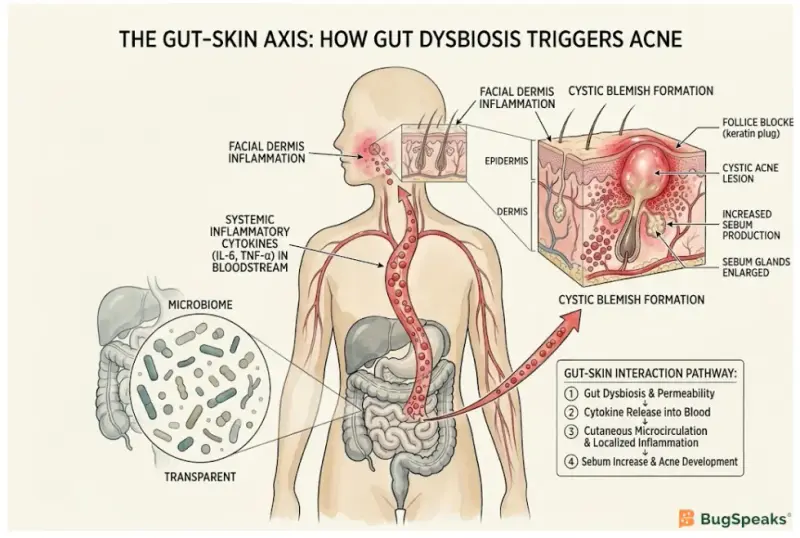
Why does a "System Wipe" affect the outer casing?
Antibiotics act as an aggressive, non-selective anti-malware protocol that inadvertently deletes essential microbial software, causing a total loss of maintenance data flow to the skinZhao et al. (2025). While these medical tools are engineered to target specific "rogue scripts" or bacterial infections, they lack the precision to distinguish between pathogenic threats and the foundational workforce of your gut bioreactor. From a biological systems engineering perspective, this results in a "System Wipe" that silences the core unit’s primary processing teams. Because your skin casing relies on a constant, high-bandwidth stream of updates from the Neuro-immuno-endocrine Axis, the sudden cessation of data from the core unit causes the outer casing of the skin to experience widespread glitches and signal loss.
Without the microbial workforce to compile health-focused data packages, the environment within the intestines shifts from a state of productivity to a state of high-stress dormancy. This initial wipeout is the definitive starting point of a dangerous chain reaction. When your beneficial software is deleted, the operational state of Homeostasis, the system’s factory-default balance is lost. The core unit then enters a period of severe Microbial Dysbiosis, where the loss of diversity allows hidden, secondary error codes to proliferate. This imbalance is the primary mechanical driver of casing errors, manifesting as sudden breakouts, increased sensitivity, and localized redness on the external surfaceZhao et al. (2025).
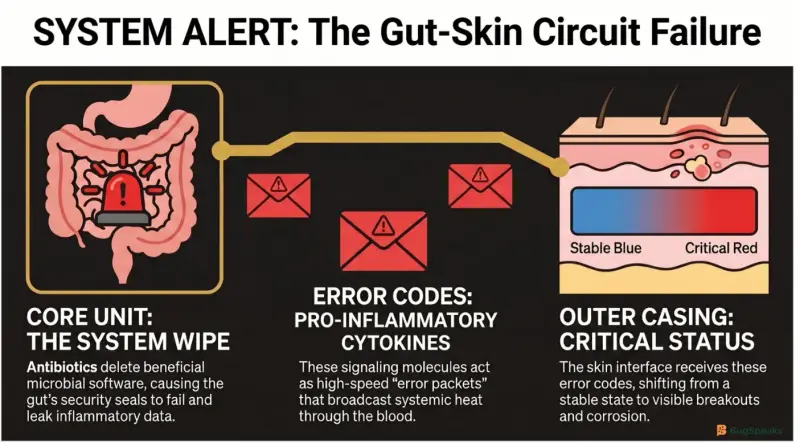
How does structural seal failure lead to surface corrosion?
The deletion of the microbial maintenance crew causes the core unit’s security seals to fail, allowing toxic "error codes" to leak into the communication bus and corrode the skinJimenez-Sanchez et al. (2025). Beneficial bacteria in the Intestines are the active operators responsible for maintaining the physical walls of the gut bioreactor. These microbes produce the molecular energy required to keep the "security seals" scientifically known as Tight Junctions firmly locked. When an antibiotic protocol wipes out this maintenance crew, the biological infrastructure of the gut wall begins to degrade, leading to a state of Epithelial Permeability.
Once these seals are compromised, the gut functions as a "leaky bioreactor." Internal toxins, undigested proteins, and "rogue data" from the lumen spill directly into the host's bloodstream. This influx triggers a systemic state of high operational heat known as Metabolic Endotoxemia. The host’s immune sensors identify these leaks as a major security breach and respond by flooding the system with Pro-inflammatory Cytokines. These cytokines act as aggressive, inflammatory error codes that travel through the blood and dock directly onto the skin’s surface. The result is "surface corrosion" , the visible redness, irritation, and barrier breakdown that represents a deep internal system failure rather than a simple topical issueMahmud et al. (2022).

How does an 'Estrobolome Glitch' disrupt skin oil production?
The "System Wipe" disrupts a specialized sub-routine known as the Estrobolome, the microbial genes responsible for recycling estrogen, which causes excess hormones to recirculate and "hack" the skin's oil glandsZhao et al. (2025). In a healthy system, these specific workers in the Intestines ensure that hormonal signals are processed and cleared correctly. When antibiotics delete these workers, the system loses its ability to manage "Hormonal Data Flow."
This results in Signal Cross-Talk, where excess estrogen is recirculated back into the bloodstream. This hormonal interference travels directly to the outer casing and "hacks" the oil-producing glands, leading to deep, cystic breakouts specifically along the jawline. For the skin to clear, the Estrobolome workers must be re-installed to ensure that hormonal data is managed properly. This confirms that your skin's clarity is directly dependent on the "Data Management" taking place deep within your core unitZhao et al. (2025).
Why does a lack of "Security Patches" weaken the surface firewall?
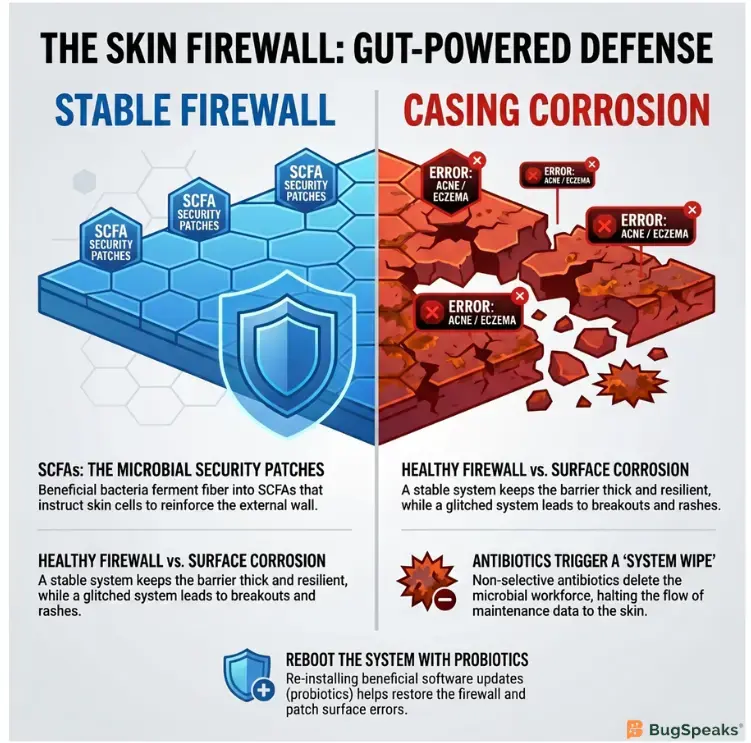
The removal of the microbial workforce halts the production of the "security patches" that the skin requires to maintain its external immune firewallMahmud et al. (2022). A primary output of a healthy gut workforce is the fermentation of dietary fiber into Short-Chain Fatty Acids (SCFAs). These molecules function as high-speed security patches that travel to the surface casing and provide the specific instructions required for Keratinocytes, the building blocks of the skin to reinforce the external wall. These patches ensure that the casing remains thick and resilient.
When a "System Wipe" occurs, the synthesis of these patches drops toward zero. Without this constant flow of maintenance fuel and instructional data, the skin’s external firewall becomes thin and unresponsive. This depletion is why skin often becomes hypersensitive or dry following an antibiotic protocol. Furthermore, the absence of these patches prevents the calibration of Regulatory T cells (Tregs). These immune cells are the system's "moderators," designed to stop the skin's defense units from becoming too aggressive. Without them, the skin’s firewall begins to malfunction, attacking harmless environmental inputs and causing the chronic inflammation associated with Atopic DermatitisZhao et al. (2025).
What is the 'Secondary Glitch' that causes fungal acne?
When an antibiotic protocol deletes the bacterial software, the system often experiences a Secondary Glitch, the rapid overgrowth of the Mycobiome (fungi)Jimenez-Sanchez et al. (2025). In a healthy gut, bacterial "Security Guards" keep opportunistic fungal scripts like Candida and Malassezia in check through constant competition. Once the bacterial guards are wiped, these fungal scripts proliferate without opposition in the Intestines.
This "Fungal Static" sends systemic signals that trigger Fungal Acne, itchy, uniform bumps that often appear on the forehead or chest post-antibiotics. Unlike standard "Antibiotic Acne," which is bacterial in nature, this glitch requires a specific antifungal patch to recalibrate the casing. Identifying this Secondary Glitch is essential for any operator who sees surface errors that do not respond to standard antibacterial treatmentsJimenez-Sanchez et al. (2025).
How does the "Stress Loop" accelerate antibiotic damage?
A "Mainframe Overheat" or psychological stress can drastically accelerate the antibiotic chain reaction by sending panic signals that amplify casing failureMahmud et al. (2022). The entire biological grid is governed by the Gut-Brain-Skin Axis. When the central mainframe is under stress, it broadcasts emergency alerts down the line. One of the most destructive signals generated during this state is a neuropeptide called Substance P.
When the core unit is already vulnerable from a "System Wipe," this extra panic signal acts like a virus in the communication bus. It travels directly to the outer casing and triggers Neurogenic Inflammation. This specific type of inflammation causes the skin’s casing to become hypersensitive and induces a flare-up of external lesions. Essentially, a stressed mainframe turns a standard antibiotic side effect into a total system meltdown. Protecting the mainframe through stress-reduction protocols while simultaneously repairing the intestines is essential for maintaining total casing integrityZhao et al. (2025).
What causes the 'Energy Brownout' in skin cells?
A final, often overlooked consequence of a "System Wipe" is the Mitochondrial Brownout, where cellular power plants lose their ability to generate repair energyZhao et al. (2025). Because our cellular power plants Mitochondria evolved from ancient bacteria, certain antibiotic classes can inadvertently cause a power surge that damages their internal machinery. In the skin, this brownout manifests as Anabolic Resistance.
Your casing loses its "glow," becomes sallow, and heals significantly slower from minor scratches or blemishes because the cells lack the "High-Voltage" energy needed for quick repairs. Restoring the system requires not just live software updates, but "Antioxidant Coolants" to repair the damaged power plants and restore the skin’s vitality. Without fixing the Mitochondria, your surface casing will remain in a state of structural decay regardless of what topical products you applyZhao et al. (2025).
Can we "Reboot" the system to repair casing side effects?
Restoring the gut’s microbial software through a strategic "reboot" protocol can successfully patch casing errors and halt the chain reaction caused by antibioticsZhao et al. (2025). In biological systems engineering, simply applying topical treatments to the casing "corrosion" is insufficient if the core unit remains glitched. The system requires Immunomodulation, a therapeutic process of using live software updates Probiotics and high-grade fuel Prebiotics to re-install the foundational data networks in the Intestines.
For operators experiencing "Antibiotic Acne" or sudden eczematous rashes, this internal patching is the only mathematically sound way to restore system integrity. By introducing specific, verified bacterial strains back into the core unit, the system can "force-quit" the production of inflammatory error codes. These new microbial teams tell the gut to rebuild its security seals and resume the production of surface-fortifying patches. Clinical evidence confirms that utilizing focused strains can recalibrate the communication bus, leading to a clearer, more durable outer casing that can once again withstand environmental stressMahmud et al. (2022).
Table 1: System Restore Protocols (Post-Antibiotic Calibration)
-Varsha V
Visualize the process- https://youtu.be/jp8hMOH-o7M
Reference
Zhao, Y., Yu, C., Zhang, J., Yao, Q., Zhu, X., & Zhou, X. (2025). The gut‑skin axis: Emerging insights in understanding and treating skin diseases through gut microbiome modulation (Review). International journal of molecular medicine, 56(6), 210. https://doi.org/10.3892/ijmm.2025.5651
Jimenez-Sanchez, M., Celiberto, L. S., Yang, H., Sham, H. P., & Vallance, B. A. (2025). The gut-skin axis: a bi-directional, microbiota-driven relationship with therapeutic potential. Gut microbes, 17(1), 2473524. https://doi.org/10.1080/19490976.2025.2473524
Mahmud, M. R., Akter, S., Tamanna, S. K., Mazumder, L., Esti, I. Z., Banerjee, S., Akter, S., Hasan, M. R., Acharjee, M., Hossain, M. S., & Pirttilä, A. M. (2022). Impact of gut microbiome on skin health: gut-skin axis observed through the lenses of therapeutics and skin diseases. Gut microbes, 14(1), 2096995. https://doi.org/10.1080/19490976.2022.2096995
https://www.frontiersin.org/journals/microbiology/articles/10.3389/fmicb.2025.1745985/full