Exploring the Power of RychBiome Probiotics for Women Over 50
What happens to a woman's body after the age of fifty?
A woman's body changes a lot around the age of fifty because of a natural event called menopause. During this time, the ovaries naturally complete their active cycle of releasing eggs, which causes a big drop in special chemical messengers called estrogens. These chemicals act like tiny keys that unlock many doors in the body, keeping things running smoothly. In our beautiful botanical conservatory, when the main climate control system shuts down, every single room feels the difference. The loss of these protective chemical messengers means a woman's body has to adjust to a brand-new phase of life, which marks the beginning of healthy ageing.
As estrogen levels drop, the digestive system slows down, often causing stomach discomforts like bloating, gas, and slow digestion. At the same time, bones begin to lose their mineral density, which can make them thin and fragile over time. In our conservatory, if the soil loses its essential minerals, the support beams of the plants weaken and become brittle. This is exactly what happens in the body as bone strength decreases, putting women at a much higher risk of developing osteoporosis. This clearly shows how closely our daily gut health is linked to the long-term strength of our bones and joints as we grow older.
Finally, turning fifty brings changes to the immune system, making the gut wall weaker and more prone to leaking. This allows tiny food particles and bad bacteria to slip into the blood, triggering low-grade swelling throughout the body. This gradual weakening of our body defenses is called immunosenescence, and it can make us feel tired and less active. Because these different physical changes happen all at once, women over fifty have very unique nutritional and microbiome needs. Helping the gut stay balanced is the single most important step for enjoying a happy, healthy, and healthy ageing journey for years to come.
What role does the gut microbiome play after menopause?
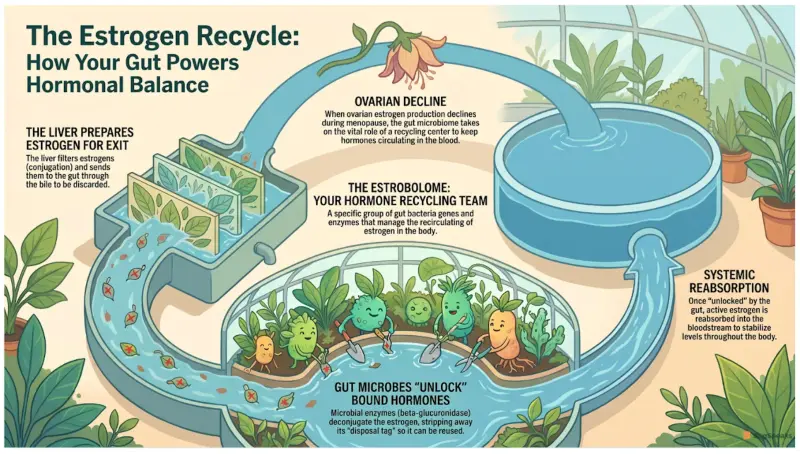
The gut microbiome plays a super important role after menopause by helping to control the hormones in our body. Deep inside the gut lives a special group of bacterial genes and enzymes called the estrobolome. This system is responsible for recycling estrogens, which helps keep our hormone levels stable even after the ovaries stop producing them. Just as a conservatory relies on a diverse network of soil microbes to recycle vital nutrients, a healthy gut requires high microbial diversity. Unfortunately, the onset of menopause often causes a major drop in this diversity, leading directly to a gut imbalance known as dysbiosis.
When a gut imbalance like dysbiosis occurs, the estrobolome cannot recycle hormones properly, which can make hot flashes much worse. This gut disruption also makes the digestive tract sensitive, leading to constant digestive discomfort like bloating, stomach pain, and irregular bathroom habits. In our light conservatory analogy, if the soil microbes are out of balance, the plants become highly sensitive to temperature changes. In the human body, this same imbalance allows harmful pathobionts to grow, which weakens the gut wall and lets toxins escape. This unfortunate escape triggers constant inflammation, leaving women feeling drained of energy and experiencing severe daily fatigue.
A damaged gut microbiome also directly contributes to reduced bone strength, poor immune health, and brain fog. Healthy gut bacteria produce special helper molecules called short-chain fatty acids, which assist the body in absorbing calcium for bones. Without these short-chain fatty acids, bone density drops faster, and the immune system becomes weak and easily irritated. Additionally, the inflammation from a leaky gut can travel to the brain, affecting cognitive well-being and causing forgetfulness and confusion.
Why was RychBiome Women 50+ designed specifically for women over fifty, and how is it different from traditional probiotics?
To help with these complex changes after fifty, RychBiome Women 50+ was created as a highly targeted, age-specific formulation. Most traditional probiotics are simple, general blends designed only for basic stomach issues, but they completely lack the specific help older women need. In contrast, RychBiome Women 50+ is a microbiome-focused support system designed from deep scientific data. In our conservatory, mature plants need a highly specific, nutrient-dense compost rather than a generic fertilizer to stay healthy. RychBiome Women 50+ acts as that customized compost, giving the postmenopausal gut exactly what it needs to quickly rebuild its natural strength and daily vitality.
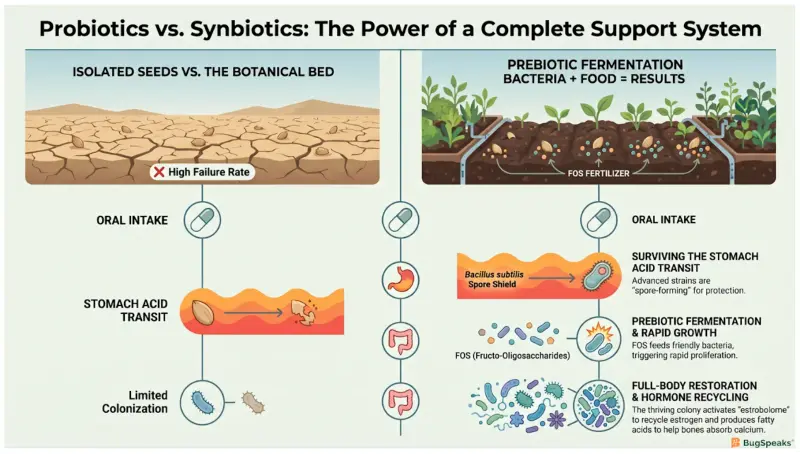
What makes RychBiome Women 50+ special is that it is a complete synbiotic formula, not just a standard supplement. This means it combines beneficial living probiotics with a nourishing prebiotic, which acts as specialized food for the bacteria. Traditional probiotics often struggle to survive the harsh acids in our stomach and completely fail to stay in the gut. However, this age-specific nutritional support ensures that the helpful bacteria have all the food they need to grow, colonize, and multiply quickly. This powerful combination helps the gut recover from dysbiosis and allows the body to naturally recycle and reuse its own protective female hormones.
By combining probiotics, prebiotics, and essential nutrients, RychBiome Women 50+ offers a complete, full-body health solution. The added vitamins and minerals work hand-in-hand with the friendly bacteria to support bone strength, immune defenses, and nerve functions. Since the gut microbiome determines how well we absorb these nutrients, taking them together in one capsule makes them far more effective. Instead of swallowing many different pills, women over fifty can rely on this single, premium capsule for their daily needs. This targeted design is a major upgrade in self-care, helping women stay active, strong, and highly energized throughout the entire day.
What ingredients are present in RychBiome Women 50+ and how do they support women's health?
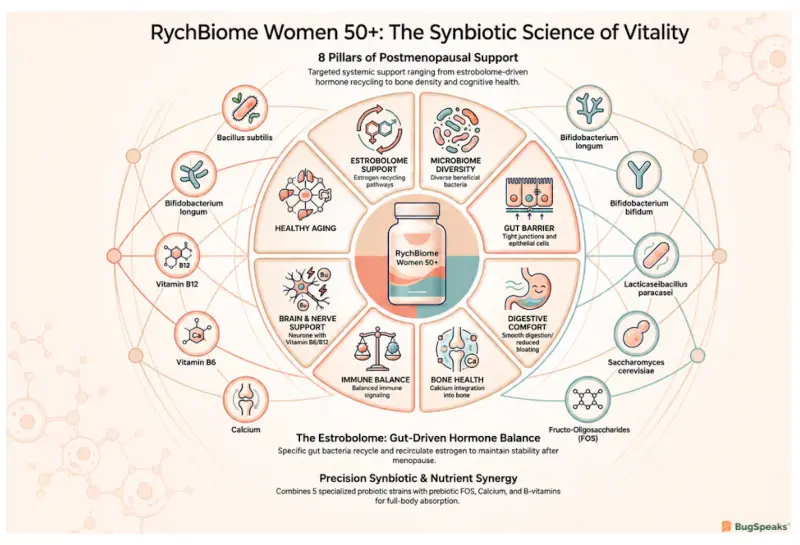
Every capsule of RychBiome Women 50+ contains five highly active probiotic strains chosen specifically for women over fifty. First, Bacillus subtilis is a super-tough, spore-forming bacterium that easily survives the harsh stomach acid to clean up the gut. Next, Bifidobacterium longum is included to reduce postmenopausal digestive discomfort and bloating and to help reinforce the gut barrier. Bifidobacterium bifidum is added because it plays a major role in helping the body absorb essential bone-building minerals like calcium from our food. Together, these strains work like expert caretakers in our conservatory, quickly restoring the soil to a highly balanced, fertile, and thriving state.
The probiotic blend is enhanced by Lacticaseibacillus paracasei and the beneficial yeast Saccharomyces cerevisiae. Lacticaseibacillus paracasei is a highly active strain that supports general immune function, helps maintain a balanced gut flora, and successfully counteracts the low-grade systemic inflammation associated with aging. Saccharomyces cerevisiae is a safe, non-pathogenic yeast that supports gut well-being and helps the friendly bacteria crowd out bad pathobionts. To feed these living helpers, a prebiotic fiber called Fructo-Oligosaccharides, or FOS, is added to the capsule. This prebiotic fiber acts as a targeted fertilizer, giving the friendly bacteria the exact energy they need to multiply, grow, and colonize the gut successfully.
To complete the formula, RychBiome Women 50+ includes three essential vitamins and minerals: Calcium, Vitamin B6, and Vitamin B12. Calcium is included to support bone strength, helping to replace the bone minerals that are lost during menopause. Vitamin B6 plays a vital role in supporting brain health, regulating hormones, and keeping the immune system strong and responsive. Vitamin B12 is essential for nerve function, red blood cell production, and fighting off the daily feeling of tiredness. This smart and comprehensive blend ensures that both the gut microbiome and the body's major systems get complete, targeted support every single day of our lives.
Why does supporting the gut microbiome become increasingly important after fifty?
Supporting the gut microbiome becomes increasingly important after fifty because it is the foundation of healthy ageing. A balanced gut microbiota helps protect our bones, keep our weight stable, and control low-grade inflammation throughout the body. By fermenting prebiotic fibers, the friendly gut bacteria produce short-chain fatty acids, which make the gut environment more conducive to calcium absorption. In our conservatory, nourishing the microscopic soil ecosystem ensures that plant roots can absorb all the minerals needed to stay strong. A well-supported gut microbiome ensures that our bones remain dense, our joints feel comfortable, and our immune system stays strong and healthy.
Additionally, a balanced gut microbiome is essential for maintaining hormonal balance and total digestive well-being after fifty. Through the active enzymes of the estrobolome, the gut bacteria help recycle estrogens, keeping hormone levels more stable. This natural hormonal balance is key to easing hot flashes and protecting our skin from dryness while keeping sensitive areas comfortable. At the same time, a thriving gut community prevents bad pathobionts from taking over, which successfully eliminates bloating, gas, and stomach pain. By keeping the gut balanced, women over fifty can enjoy smooth digestion, stable energy levels, and a much better quality of life.
In summary, taking care of your gut is the most powerful way to support healthy aging and full-body vitality. To help your body navigate this transition, integrating a premium synbiotic like RychBiome Women 50+ into your daily self-care routine is highly recommended. This advanced formula, developed by the experts at BugSpeaks, is designed to restore microbial diversity and support your natural hormonal balance. By choosing this targeted, age-specific support, women over fifty can take proactive charge of their own wellness. Start your personal journey toward lasting health, stronger bones, and a much happier gut by supporting your gut bacteria every single day.
-Varsha V
Visualize the process- https://youtu.be/HEC2Iw1G1s4
Reference
Peters BA, Santoro N, Kaplan RC, Qi Q. Spotlight on the Gut Microbiome in Menopause: Current Insights. Int J Womens Health. 2022 Aug 10;14:1059-1072. doi: 10.2147/IJWH.S340491. PMID: 35983178; PMCID: PMC9379122.
Lim, M. J. S., Parlindungan, E., See, E., Gan, C. H., Yap, R., & Yong, G. J. M. (2026). Diet, the Gut Microbiome, and Estrogen Physiology: A Review in Menopausal Health and Interventions. Nutrients, 18(7), 1052. https://doi.org/10.3390/nu18071052
Ferrando, M. L., Busonero, F., Crobu, F., & Sanna, S. (2025). Aging in Women–the Microbiome Perspective. Ageing Research Reviews, 102950.
Baker JM, Al-Nakkash L, Herbst-Kralovetz MM. Estrogen-gut microbiome axis: Physiological and clinical implications. Maturitas. 2017 Sep;103:45-53. doi: 10.1016/j.maturitas.2017.06.025. Epub 2017 Jun 23. PMID: 28778332.
Lim MJS, Parlindungan E, See E, Gan CH, Yap R, Yong GJM. Diet, the Gut Microbiome, and Estrogen Physiology: A Review in Menopausal Health and Interventions. Nutrients. 2026 Mar 26;18(7):1052. doi: 10.3390/nu18071052. PMID: 41978103; PMCID: PMC13074627.
Saravinovska K, Santi D, Costantino F, Prete A, Šojat AS, Spaggiari G, Ivović M, Lambrinoudaki I, Armeni E, Jurišić A, Mihajlović S, Vujović S and Marina LV (2026) The impact of estrogen status on the gut microbiome: a systematic review and meta-analysis. Front. Endocrinol. 17:1780806. doi: 10.3389/fendo.2026.1780806
Lephart ED, Naftolin F. Estrogen Action and Gut Microbiome Metabolism in Dermal Health. Dermatol Ther (Heidelb). 2022 Jul;12(7):1535-1550. doi: 10.1007/s13555-022-00759-1. Epub 2022 Jun 25. PMID: 35752663; PMCID: PMC9276867.
Peters BA, Lin J, Qi Q, Usyk M, Isasi CR, Mossavar-Rahmani Y, Derby CA, Santoro N, Perreira KM, Daviglus ML, Kominiarek MA, Cai J, Knight R, Burk RD, Kaplan RC. Menopause Is Associated with an Altered Gut Microbiome and Estrobolome, with Implications for Adverse Cardiometabolic Risk in the Hispanic Community Health Study/Study of Latinos. mSystems. 2022 Jun 28;7(3):e0027322. doi: 10.1128/msystems.00273-22. Epub 2022 Apr 13. PMID: 35675542; PMCID: PMC9239235.
Liaquat M, Minihane AM, Vauzour D, Pontifex MG. The gut microbiota in menopause: Is there a role for prebiotic and probiotic solutions? Post Reprod Health. 2025 Jun;31(2):105-114. doi: 10.1177/20533691251340491. Epub 2025 May 7. PMID: 40335047; PMCID: PMC12209548.
Chaudhary, R., Bansal, N., Sharma, S., Rohilla, M., Chauhan, S., Gupta, S., & Bansal, S. (2025). Mechanistic pathways of estrogen mitigating postmenopausal gut dysbiosis. Molecular biology reports, 53(1), 45. https://doi.org/10.1007/s11033-025-11179-7
Ding, K., Hua, F., & Ding, W. (2020). Gut Microbiome and Osteoporosis. Aging and disease, 11(2), 438–447. https://doi.org/10.14336/AD.2019.0523
Wang, Y., Xu, M., Dong, Q., Lin, X., Zhang, Q., Shi, H., ... & Shen, J. (2026). The gut-bone axis: impact of diet on gut microbiome and osteoporosis. Bone Research, 14(1), 61.
Amsterdam, D., & Ostrov, B. E. (2018). The Impact of the Microbiome on Immunosenescence. Immunological investigations, 47(8), 801–811. https://doi.org/10.1080/08820139.2018.1537570
Daniłowska, K., Picheta, N., Piekarz, J., Żyła, D., Zych, K., Szklener, K., & Mańdziuk, S. (2025). Age Versus Immunity: Dietary Influences on Immunosenescence. Journal of clinical medicine, 14(23), 8313. https://doi.org/10.3390/jcm14238313
Kim, J. M., & Park, Y. J. (2017). Probiotics in the Prevention and Treatment of Postmenopausal Vaginal Infections: Review Article. Journal of menopausal medicine, 23(3), 139–145. https://doi.org/10.6118/jmm.2017.23.3.139
Barrea, L., Verde, L., Auriemma, R. S., Vetrani, C., Cataldi, M., Frias-Toral, E., Pugliese, G., Camajani, E., Savastano, S., Colao, A., & Muscogiuri, G. (2023). Probiotics and Prebiotics: Any Role in Menopause-Related Diseases?. Current nutrition reports, 12(1), 83–97. https://doi.org/10.1007/s13668-023-00462-3
Vicariotto, F., Malfa, P., Viciani, E., Dell'Atti, F., Squarzanti, D. F., Marcante, A., Castagnetti, A., Ponchia, R., Governini, L., & De Leo, V. (2024). Efficacy of Lactiplantibacillus plantarum PBS067, Bifidobacterium animalis subsp. lactis BL050, and Lacticaseibacillus rhamnosus LRH020 in the Amelioration of Vaginal Microbiota in Post-Menopausal Women: A Prospective Observational Clinical Trial. Nutrients, 16(3), 402. https://doi.org/10.3390/nu16030402
Kim, H. J., Kim, K. M., Yun, M. K., Kim, D., Sohn, J., Song, J. W., & Lee, S. (2024). Anti-Menopausal Effect of Heat-Killed Bifidobacterium breve HDB7040 via Estrogen Receptor-Selective Modulation in MCF-7 Cells and Ovariectomized Rats. Journal of microbiology and biotechnology, 34(8), 1580–1591. https://doi.org/10.4014/jmb.2402.02035
Muho K. H. (2025). Impact of Vitamin D status on age at menopause: A prospective cohort study. Journal of advanced pharmaceutical technology & research, 16(4), 190–194. https://doi.org/10.4103/JAPTR.JAPTR_52_25
Mei, Z., Hu, H., Zou, Y., & Li, D. (2023). The role of vitamin D in menopausal women's health. Frontiers in physiology, 14, 1211896. https://doi.org/10.3389/fphys.2023.1211896
Zhang, Z., Li, Y., Li, J., Yuan, Y., Liu, K., & Shi, X. (2025). The effect of vitamin K2 supplementation on bone turnover biochemical markers in postmenopausal osteoporosis patients: a systematic review and meta-analysis. Frontiers in endocrinology, 16, 1703116. https://doi.org/10.3389/fendo.2025.1703116
Voulgaridou, G., Papadopoulou, S. K., Detopoulou, P., Tsoumana, D., Giaginis, C., Kondyli, F. S., Lymperaki, E., & Pritsa, A. (2023). Vitamin D and Calcium in Osteoporosis, and the Role of Bone Turnover Markers: A Narrative Review of Recent Data from RCTs. Diseases (Basel, Switzerland), 11(1), 29. https://doi.org/10.3390/diseases11010029