A Comprehensive Guide to Skin-Soothing Foods That Act as Internal Moisturizers
How does the food we eat directly control the moisture levels of our skin?
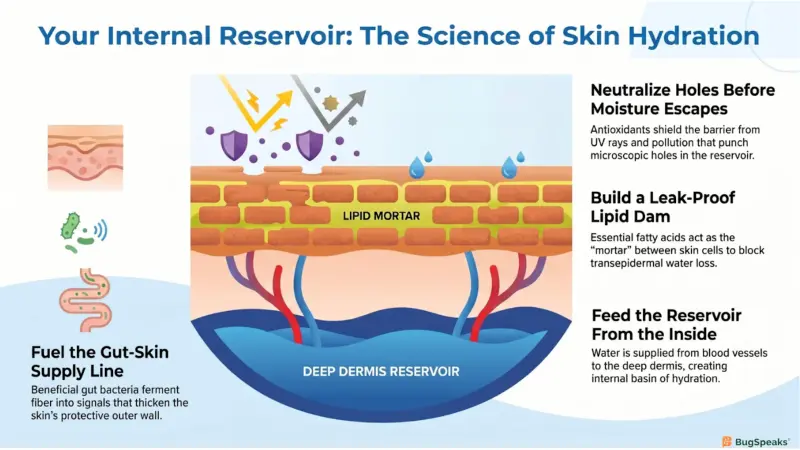
The food we eat directly controls skin hydration by providing the internal incoming replenishment resources necessary to construct and maintain the physical seals that prevent water from evaporating off the body. Think of your skin as a water reservoir with a wall that stops water from escaping. This outermost wall is the stratum corneum, which functions as a shield that blocks water from floating away into the dry air in a process called transepidermal water loss (TEWL)Ryczaj et al. (2026). When we eat healthy food, our body gets incoming replenishment resources that travel through the blood to fix this wall, acting like a delivery truck bringing new bricks to keep the wall strong.
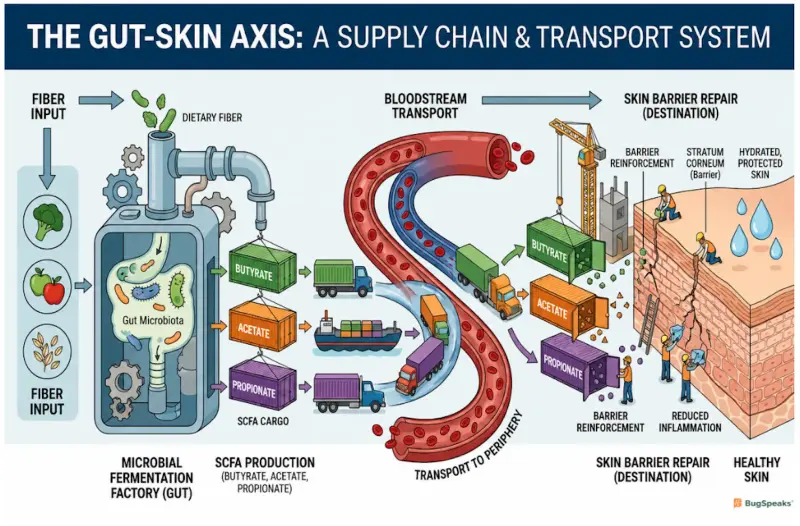
This connection between your gut and your skin is called the gut-skin axis, which works like a long-distance highway. The food you swallow is broken down in your stomach and intestines, where the body extracts important building blocks. These blocks are shipped through your bloodstream to the deep layers of your skin, which is our moisture-regulating surface. Your skin cannot hold onto its internal moisture just by splashing water on its surfaceMahmud et al. (2022). When the gut-skin highway is clear and active, your skin reservoir stays filled with fresh water, remains soft, and glows with health. This internal shipping route is active twenty-four hours a day to keep the system running.
If you do not eat the right foods, your skin experiences dehydration and becomes dry, which is a major moisture-loss factor. When the skin wall lacks building blocks, it starts to crack, allowing water to escape much faster. These cracks trigger a warning inside your body, causing low-grade inflammation that makes the skin look red and feel itchyTampa et al. (2022). This irritation weakens the wall even more, creating a loop where water leaks out and causes more dryness. To stop this, we must constantly eat healthy foods that act as continuous internal support for our skin, keeping the wall safe, strong, and completely leak-proofMahmud et al. (2022).
Why do essential fatty acids act as the ultimate barrier-support materials for skin hydration?
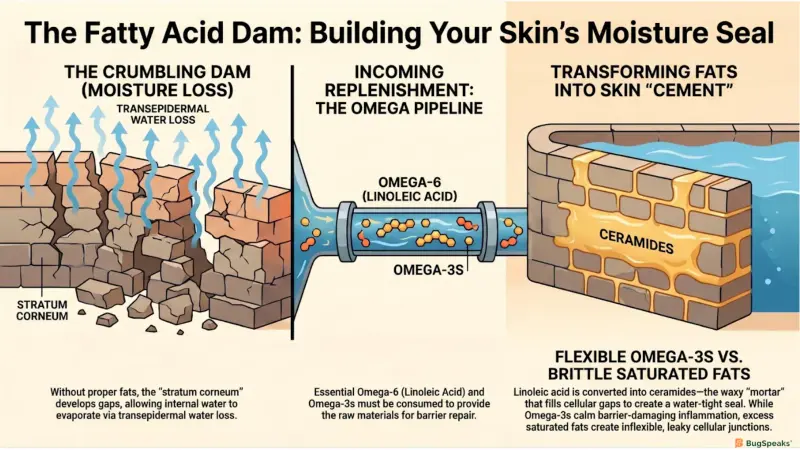
Essential fatty acids act as the ultimate barrier-support materials because they are the mandatory structural building blocks used by the body to construct the dense, water-resistant lipid layer that seals the skin's internal reservoir. Within the stratum corneum, skin cells are arranged much like a brick wall, where the cells act as the bricks and the surrounding lipid matrix acts as the mortar. This protective mortar is composed of a precise ratio of ceramides, cholesterol, and free fatty acids. Linoleic acid, an essential omega-6 fatty acid, is a critical precursor required for the biological synthesis of omega-hydroxy ceramides, which physically organize the skin's lipid bilayers into tightly packed sheetsRyczaj et al. (2026).
Beyond constructing the physical walls of the reservoir, specific dietary fats function as advanced regulatory tools to control inflammation, which is a major moisture-loss factor. Polyunsaturated fatty acids (PUFAs) from the omega-3 family, specifically eicosapentaenoic acid (EPA) and docosahexaenoic acid (DHA), are highly effective anti-inflammatory barrier-support materials. When integrated into the skin's cellular membranes, eicosapentaenoic acid and docosahexaenoic acid compete with pro-inflammatory molecules, effectively calming the immune responses that would otherwise degrade the skin barrier. By reducing these inflammatory signals, omega-3 fatty acids prevent the physical breakdown of the stratum corneum, ensuring that the reservoir remains structurally intact and capable of holding vast amounts of hydration deep within the tissueRyczaj et al. (2026).
Conversely, a diet high in industrially produced saturated fatty acids (SFAs) introduces defective materials into the skin's supply chain. High intake of saturated fatty acids reduces the natural expression of tight junction proteins in the skin, which are microscopic anchors that hold adjacent cells together. Furthermore, these heavy, inflexible fats reduce the natural synthesis of essential ceramides, creating a faulty lipid matrix. This biological disruption exacerbates epithelial barrier dysfunction, widening the microscopic gaps in the skin and allowing vital moisture to leak out into the environment. By consuming high-quality essential fatty acids, the internal skin reservoir is fortified with the exact biochemical materials needed to maintain a plump, deeply hydrated surfaceRyczaj et al. (2026).
How does a healthy gut microbiome function as a nutrient-support ecosystem for skin moisture?
A healthy gut microbiome functions as a nutrient-support ecosystem by actively fermenting indigestible dietary fibers into specialized biochemical messengers that travel to the skin to physically reinforce its protective surface. The human digestive tract is populated by trillions of microorganisms that rely on incoming replenishment resources to survive and perform vital metabolic services. When we consume specific prebiotics, beneficial bacterial populations thrive and break down these complex fibers. This fermentation process produces short-chain fatty acids (SCFAs), primarily acetate, propionate, and butyrate. These short-chain fatty acids are the key biological currency of the gut-skin axis, acting as powerful signaling molecules that coordinate the health of the entire moisture-regulating surfaceMahmud et al. (2022),Ryczaj et al. (2026).
Once generated in the gut, short-chain fatty acids enter the bloodstream and are transported to the skin, where they execute highly specific barrier-repair protocols. At the skin level, molecules like butyrate stimulate the production of new structural proteins and enhance keratinocyte differentiation. A keratinocyte is the primary skin cell type in the epidermis, and its proper maturation is strictly required to build the thick, protective outer walls of the internal skin reservoir. Furthermore, these short-chain fatty acids help acidify the skin's surface pH, creating an inhospitable environment for harmful external bacteria. This coordinated microbial activity directly thickens the stratum corneum, making the reservoir significantly more capable of holding onto deep hydrationRyczaj et al. (2026).
However, if the nutrient-support ecosystem is starved of fiber or overwhelmed by heavily processed diets, a state of dysbiosis occurs. Dysbiosis is an imbalance in the microbial community where harmful bacteria outcompete beneficial ones. In this degraded state, harmful gut bacteria must break down leftover proteins instead of healthy fibers, producing toxic byproducts like p-cresol and free phenol. These harmful molecules leak into the bloodstream and travel to the skin, where they actively disrupt the natural keratinization process and significantly reduce skin hydration. Therefore, maintaining the moisture-regulating surface requires constant feeding of the gut microbiome, ensuring that the biochemical supply lines deliver protective short-chain fatty acids rather than barrier-destroying toxinsMahmud et al. (2022).
What role do dietary antioxidants play as protective compounds against moisture loss?
Dietary antioxidants play a critical role as protective compounds by chemically neutralizing highly unstable molecules that physically punch microscopic holes in the cellular structures responsible for trapping water within the skin. Throughout the day, the moisture-regulating surface is bombarded by environmental stressors, most notably ultraviolet (UV) radiation and pollution. These invisible forces penetrate the skin and generate reactive oxygen species, which are chaotic, electron-stealing molecules. This biological state, known as oxidative stress, acts as a severe moisture-loss factor. If these unstable molecules are not immediately stopped, the skin's barrier becomes highly porous, allowing internal water supplies to rapidly evaporate into the atmosphere and drain the internal reservoir completelyFarhan (2024),Tampa et al. (2022).
To combat this constant microscopic degradation, the diet must supply high volumes of polyphenols, which act as the primary protective compounds within the moisture management system. Polyphenols are advanced plant-based antioxidants found in fruits, vegetables, and teas. When these incoming replenishment resources arrive at the skin via the bloodstream, they act as a chemical shield. Because polyphenols possess specialized structural rings, they can safely donate electrons to unstable reactive oxygen species without becoming dangerous themselves. By neutralizing the reactive oxygen species on contact, polyphenols halt the chain reaction of cellular destruction, preserving the flexible lipid matrix and keeping the walls of the internal skin reservoir completely sealedFarhan (2024).
Beyond neutralizing free radicals, specific polyphenols actively protect the structural scaffolding that supports the skin's moisture capacity. Flavonoids such as epigallocatechin-3-gallate (EGCG) (abundant in green tea) have been shown to inhibit the activity of matrix metalloproteinases (MMPs). Matrix metalloproteinases are destructive enzymes triggered by oxidative stress; their primary function is to break down collagen, the crucial protein network that gives the skin its structural volume. When collagen degrades, the internal skin reservoir loses its physical architecture, leading to sagging and a massive decrease in water-holding capacity. By suppressing matrix metalloproteinases, compounds like epigallocatechin-3-gallate ensure the reservoir remains structurally dense and capable of trapping high levels of hydrationFarhan (2024),Mahmud et al. (2022).
How do fermented foods improve the efficiency of the internal skin reservoir?
Fermented foods improve the efficiency of the internal skin reservoir by supplying pre-processed, highly bioavailable nutrients and beneficial bacteria that directly boost the structural integrity of the moisture-regulating surface. Fermentation is an advanced biological process where microorganisms break down the tough cellular walls of plants before they are even consumed. This process acts as a biological unlocking mechanism, releasing trapped active compounds and converting them into smaller, more easily absorbed molecules. When these highly refined incoming replenishment resources enter the body, they bypass sluggish digestive pathways and are rapidly transported to the skin, where they provide immediate material support to the stratum corneum, thickening the barrier and drastically lowering water lossFei et al. (2024).
Scientific clinical trials demonstrate the precise efficiency of these fermented replenishment resources. For example, the traditional herbal plant Dendrobium officinale contains numerous beneficial polysaccharides and antioxidants. When scientists fermented this plant using a specific probiotic strain called Lactobacillus plantarum GT-17F, they created a highly active ingredient known as fermented Dendrobium officinale (FDO). The fermentation process significantly enhanced the bioavailability of the plant's active compounds. When human subjects ingested these fermented nutrients over fifty-six days, clinical instruments recorded massive quantifiable improvements in the physical architecture of their skin, proving that these nutrients actively repaired microscopic damage caused by environmental moisture-loss factorsFei et al. (2024).
The mechanical results of integrating these fermented materials into the skin's supply chain are visibly profound. Subjects utilizing fermented Dendrobium officinale showed a statistically significant increase in the actual water content held within their stratum corneum. Furthermore, this targeted nutritional intervention successfully tightened the physical cellular gaps in the skin, leading to a marked decrease in transepidermal water loss. By reinforcing the barrier-support materials with pre-processed, high-efficiency nutrients, the skin reservoir became visibly plumper, more resilient, and structurally tighter, proving that maintaining a highly active supply line is the key to protecting the skin against environmental drynessFei et al. (2024).
-Varsha V
Visualize the process- https://youtu.be/6Hz2dPlRuu0
Reference
Ryczaj, K., Pawankar, R., & Venter, C. (2026). Immunonutrition: Feeding the gut, skin, and immune system. Asia Pacific Allergy, 16(1), 45-55.
Mahmud, M. R., Akter, S., Tamanna, S. K., Mazumder, L., Esti, I. Z., Banerjee, S., Akter, S., Hasan, M. R., Acharjee, M., Hossain, M. S., & Pirttilä, A. M. (2022). Impact of gut microbiome on skin health: gut-skin axis observed through the lenses of therapeutics and skin diseases. Gut microbes, 14(1), 2096995. https://doi.org/10.1080/19490976.2022.2096995
Fei, W., Noda, M., Danshiitsoodol, N., & Sugiyama, M. (2024). Skin Anti-Aging Efficacy of a Lactobacillus plantarum GT-17F Fermented Dendrobium officinale Ingredient: A Randomized, Double-Blind, Placebo-Controlled Clinical Study. Cosmetics, 11(1), 26. https://doi.org/10.3390/cosmetics11010026
Tampa, M., Neagu, M., Caruntu, C., Constantin, C., & Georgescu, S. R. (2022). Skin Inflammation-A Cornerstone in Dermatological Conditions. Journal of personalized medicine, 12(9), 1370. https://doi.org/10.3390/jpm12091370
Farhan M. (2024). The Promising Role of Polyphenols in Skin Disorders. Molecules (Basel, Switzerland), 29(4), 865. https://doi.org/10.3390/molecules29040865