Why do your muscles need to talk to your gut?
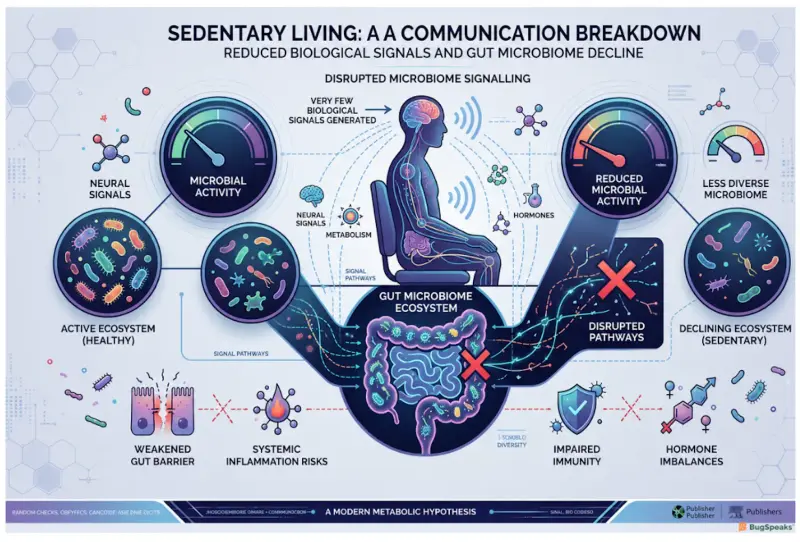
Your muscles must talk to your gut because active skeletal muscles send vital chemical signals that help your tiny digestive helpers grow and keep your whole body healthyWang et al. (2026). This biological connection is called the gut-muscle axis, where active muscles act as activity generators that communicate with your gutVarghese et al. (2024),Wu et al. (2026). Every time you walk, run, jump, or play, your muscles release special chemical signals that travel through your bodyWang et al. (2026). These signals are biological signaling events that tell your tiny gut bacteria how to stay active and growVarghese et al. (2024).
Your gut microbiome is a massive downstream responder that waits for these chemical signals from your active musclesVarghese et al. (2024). When you move, your blood flows faster, your digestive tract moves better, and the environment inside your gut becomes extremely healthyWang et al. (2026). This signals the downstream responder to grow stronger and more diverse, which means you get more kinds of good microbesPérez-Prieto et al. (2024). Having a diverse microbiome is like having a well-trained rescue team inside youVarghese et al. (2024). These tiny helpers work together to fight bad germs, digest complex foods, and keep your body running smoothly.
Among these helpful gut microbes, the short-chain fatty acid producers are your muscles' favored partnersVarghese et al. (2024). These favored partners love to eat the healthy, complex food fibers that your body cannot digest on its ownWang et al. (2026). When your muscles create biological signaling events, they encourage these specific partners to thrive and multiplyWu et al. (2026). They are called anaerobic species because they do not need oxygen to live, and they love the deep, quiet corners of your gutVarghese et al. (2024). Together, your active muscles and these helpful bacteria form a perfect, lifelong health team for your body.
How does sitting down all day break this conversation?
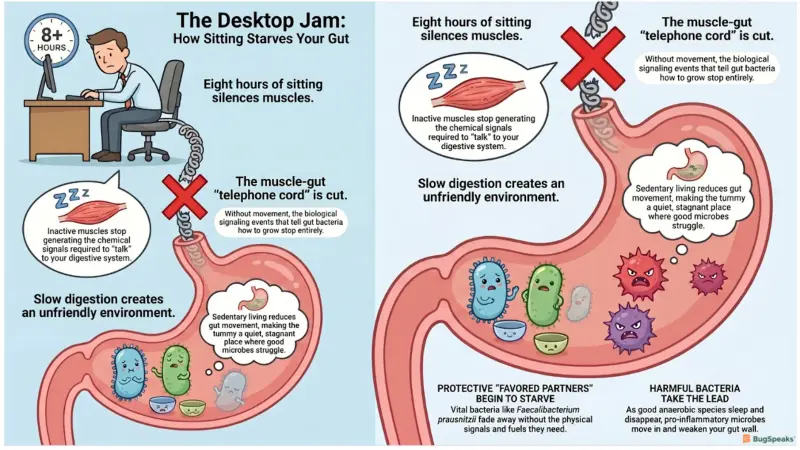
Sitting down for a long time breaks this conversation because inactive skeletal muscles stop sending signaling chemicals, leaving your gut bacteria completely quiet and without instructionsPérez-Prieto et al. (2024). When you sit at a desk for school or work for many hours, your muscles go completely quietWang et al. (2026). Since they are not moving, they stop generating the vital biological signaling events that your gut helpers are waiting forWu et al. (2026). This sudden lack of activity acts like a broken telephone line between your body and your gut. The crucial communication loop stops working entirely, leaving them silent.
This partnership breakdown happens during sedentary living, which means sitting for eight or more hours a day with very little physical exerciseWang et al. (2026). Sedentary living alters the gut's normal functions, slowing down digestion and reducing the healthy digestive system flowWang et al. (2026). When the gut stops moving, the environment becomes unfriendly for the good bacteria that require active signals to stay aliveWu et al. (2026). Instead of a thriving, diverse microbial ecosystem, your gut becomes a slow, quiet place where helpful bacteria grow inactive and disappear. Without muscle signals, the entire biological system suffers.
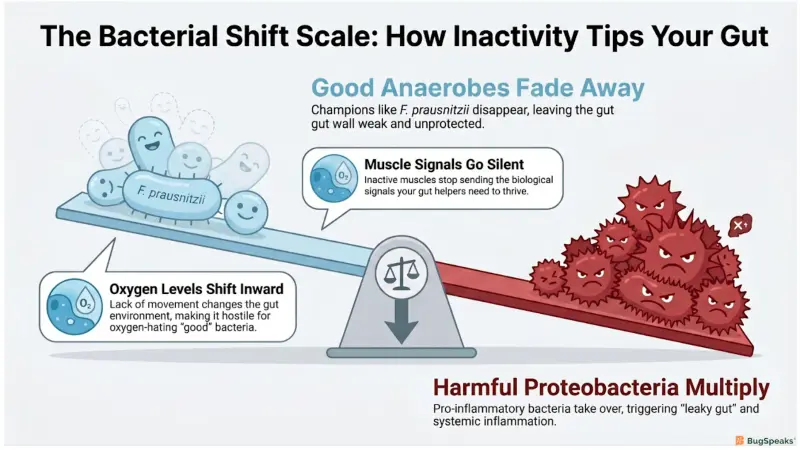
Without the active signals from your muscles, the dominant anaerobic species inside your gut begin to lose their leadVarghese et al. (2024). They are slowly replaced by less helpful microbes called facultative species, which do not produce beneficial health chemicalsVarghese et al. (2024). This shift from good anaerobic species to facultative species disrupts normal biological processes and can cause a bad reaction called gut dysbiosisVarghese et al. (2024). Dysbiosis means your gut is unbalanced, which can make you feel tired, bloated, and less healthy in your daily life. This is why sitting down too much is very dangerous for your body's inner helpers.
What happens to your gut partners when you stop moving?
When you stop moving your body, your favored partners in the gut starve because they no longer receive the physical signals and prebiotic fuels they need to surviveWang et al. (2026). These good microbes rely on your muscles to keep the gut moving and healthyWu et al. (2026). Without physical activity, your digestion slows down, and the good bacteria lose their favorite nesting spotsPérez-Prieto et al. (2024). Since they cannot get the right signals or materials, they start to go hungry and fade away. This quiet, inactive state makes it extremely difficult for helpful gut partners to survive and perform their daily duties.
One of the most important helpful bacteria that starts to disappear is called Faecalibacterium prausnitziiWang et al. (2026). This tiny organism is a champion at keeping your gut healthy, and its levels are much higher in people who are activeVarghese et al. (2024). When you sit all day, Faecalibacterium prausnitzii cannot thrive, which means your body loses its protective servicesWang et al. (2026). Other good bacteria, like Bifidobacterium, also begin to decrease because they lack the physical signals that prompt their growth. When these protectors go away, the inner lining of your gut becomes weak and unprotected from harmful invaders.
As the good partners fade, harmful bacteria like Proteobacteria can easily multiply and take over your gutVarghese et al. (2024). These bad bacteria are pro-inflammatory, which means they can trigger bad swelling and redness inside your bodyWang et al. (2026). They release harmful toxins called lipopolysaccharides that can seep into your blood if your gut wall gets weakWang et al. (2026). This condition is often called a leaky gut, and it makes your body feel constantly stressed, tired, and unhappy. It literally breaks down the strong defense system and intestinal barrier that keep you healthy and full of life.
Why is butyrate the most important output of this partnership?
Butyrate is the ultimate partnership output because it acts like a super-fuel that repairs your gut walls and stops bad inflammation from spreadingVarghese et al. (2024). This special substance is a type of short-chain fatty acid made by your favored partners when they digest healthy food fibersWang et al. (2026). When your body gets enough of this super-fuel, it feeds the cells lining your colon, making them strong and tightly closedVarghese et al. (2024). This strong barrier keeps bad things from leaking out of your stomach into your bloodstream, which protects your entire body from harmful infections.
When you do not have enough butyrate, your body can experience low-grade systemic inflammationWang et al. (2026). This inflammation is like a tiny, hidden fire that stays lit inside your body, irritating your tissues and making you feel unwellWang et al. (2026). It can increase your risk of metabolic syndrome, which is a group of health issues like high blood pressure, high blood sugar, and extra belly fatWang et al. (2026). Butyrate helps put out this hidden fire, keeping your immune system calm and protecting your organs from damage. This is why having active muscles to help make butyrate is so important.
Butyrate also helps your body manage sugar levels and insulin sensitivityVarghese et al. (2024). It acts as a guide that helps your muscles absorb sugar from your blood, giving you more physical energyWu et al. (2026). This process prevents your blood sugar from spiking too high, which is super important for avoiding health issues like type 2 diabetesWu et al. (2026). Without this important partnership output, your body can lose its biological balance, leading to daily fatigue, unexpected weight gain, and diabetes. Having active muscles keeps your metabolic system working perfectly every single day of your life.
How can you rebuild this forgotten muscle-gut partnership?
You can rebuild this forgotten partnership by moving your body to create active signals and eating healthy dietary fiber to nourish your downstream respondersWang et al. (2026). Regular moderate exercise like brisk walking, cycling, or playing sports is the best way to wake up your musclesVarghese et al. (2024). When you combine this physical activity with healthy prebiotic fibers from oats and vegetables, you give your gut partners everything they needWang et al. (2026). This dual action resets your body's communication lines and helps your inner garden grow beautifully. It is a simple recipe for feeling great again.
To do this, you can aim for moderate-intensity home exercise for thirty to forty-five minutes, five times a weekWang et al. (2026). You should also eat functional fibers like resistant starch, inulin, and beta-glucanWang et al. (2026). These fibers are the perfect food for your gut partners, helping them grow and produce plenty of butyrateWang et al. (2026). This simple daily routine can lower your body's harmful inflammation levels by over thirty-five percent, giving you much more physical strength, mental vitality, and clean energy. It turns your inactive body into a powerful, self-healing machine that successfully resists many different diseases.
As your gut partners grow, they also increase your overall gut microbiota alpha diversityWang et al. (2026). This means you will have a wider variety of helpful microbes, making your gut stronger and more resilientVarghese et al. (2024). It also reduces feelings of fatigue and greatly improves your daily quality of lifeWang et al. (2026). By taking small steps to move your body and eat healthy fiber, you can easily repair the forgotten partnership inside you and live a very long, happy life. Your muscles and microbes will thank you for the wonderful support you provide them.
Visualize the process- https://youtu.be/LdXjSIcTbvw
Reference
Wu, Y., Wang, Y., Zhang, Q., Yao, L., Ma, Z., & Chen, L. (2026). Gut microbiota: new links between exercise and disease. Frontiers in microbiology, 17, 1746359.https://doi.org/10.3389/fmicb.2026.1746359
Wang W, Tao Y and Zhu M (2026) Effects of functional dietary fiber supplementation combined with home-based exercise on gut microbiota diversity and low-grade inflammation in urban sedentary adults. Front. Nutr. 13:1769785. doi: 10.3389/fnut.2026.1769785
Pérez-Prieto, I., Plaza-Florido, A., Ubago-Guisado, E., Ortega, F. B., & Altmäe, S. (2024). Physical activity, sedentary behavior and microbiome: A systematic review and meta-analysis. Journal of science and medicine in sport, 27(11), 793–804.https://doi.org/10.1016/j.jsams.2024.07.003
Varghese, S., Rao, S., Khattak, A., Zamir, F., & Chaari, A. (2024). Physical Exercise and the Gut Microbiome: A Bidirectional Relationship Influencing Health and Performance. Nutrients, 16(21), 3663.https://doi.org/10.3390/nu16213663