Unlocking the Health Benefits of Pickle: A Probiotic Secret
How do traditional pickles turn simple vegetables into powerful probiotic foods?
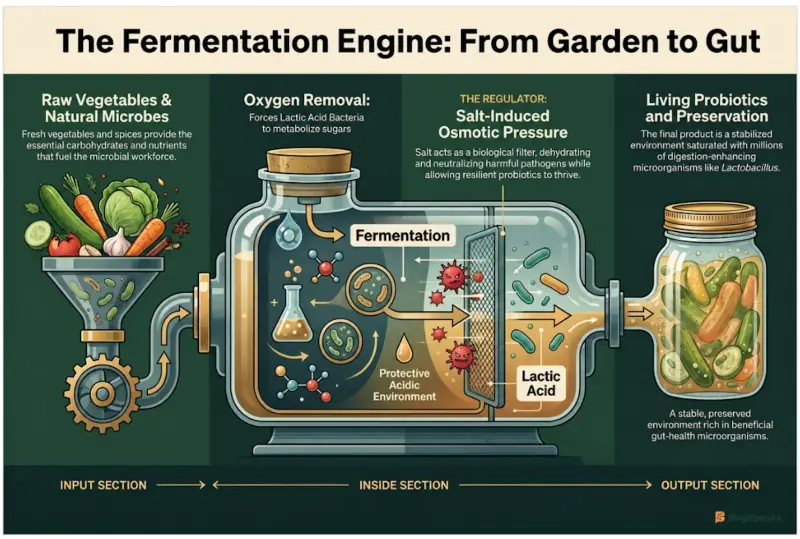
Traditional pickles turn simple vegetables into powerful probiotic foods through a natural process where beneficial bacteria consume raw ingredients to prevent decay. When vegetables like cabbage or turmeric rhizomes are harvested, they are naturally coated with microscopic life. To transform these vegetables into preserved health foods, they must be placed inside a sealed fermentation vessel acting as a highly specific controlled habitat. Inside this oxygen-free environment, the raw vegetables function as the primary fermentation substrate. This fermentation substrate is packed with natural carbohydrates and essential nutrients locked inside the plant cells. As moisture leaves the vegetables, a nutrient-rich liquid is formed, establishing the baseline conditions for the internal biological ecosystem to undergo systematic transformation and safely preserve the raw agricultural materials.
Once the controlled habitat is successfully established, the microscopic organisms originally present on the vegetables begin functioning as highly responsive, adapting biological communities. They detect the abundant carbohydrates leaking from the fermentation substrate and rapidly begin consuming them to generate internal energy. Because the sealed container completely lacks oxygen, these microorganisms are forced to utilize an anaerobic metabolic pathway to process the available nutrients. The primary group of organisms capable of thriving under these specific restrictions is Lactic Acid Bacteria (LAB). As these bacterial groups systematically metabolize the available sugars, they effectively initiate the biological conversion process, transforming a simple mixture of raw ingredients into a deeply complex and entirely stabilized living ecosystem over a period of several weeks.
As the Lactic Acid Bacteria (LAB) continuously consume the fermentation substrate, they generate significant quantities of lactic acid as a natural metabolic byproductTamang et al. (2016). The steady accumulation of this acid within the controlled habitat drastically lowers the overall acidity level of the surrounding liquid. This acidic shift fundamentally alters the internal chemistry, creating a protective shield that effectively neutralizes dangerous spoilage organisms. Through this precise biological sequence, the adapting biological communities successfully stabilize the environment, ensuring the vegetables remain structurally intact and entirely safe for human consumption. This meticulous balance of nutrient consumption and acid production engineers the ultimate transformation, yielding a preserved food product that is entirely saturated with millions of living, digestion-enhancing microorganisms.
Why is salt necessary for making healthy traditional pickles?
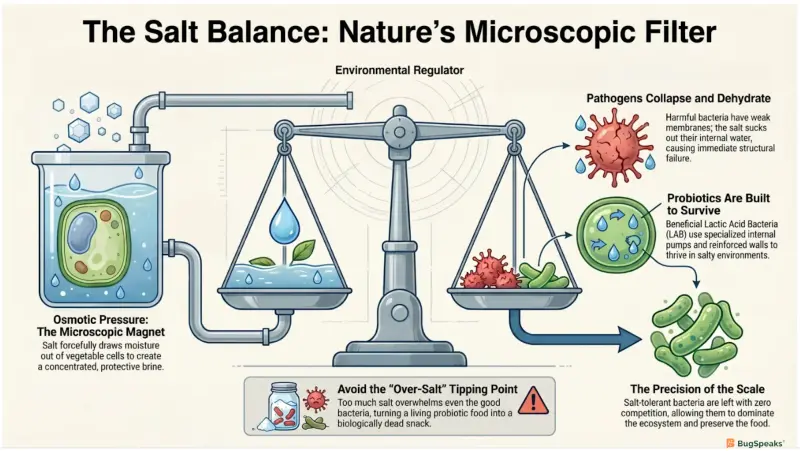
Salt is necessary for making healthy traditional pickles because it functions as a precise biological filter that eliminates harmful bacteria while allowing beneficial probiotics to thrive. When salt is added to the controlled habitat, it operates as a powerful environmental regulator. The salt immediately creates a high level of osmotic pressure within the sealed jar, operating exactly like a microscopic magnet that forcefully draws moisture directly out of the vegetable cells. As this extracted water mixes with the solid salt, it forms a highly concentrated brine. This salty liquid acts as the primary chemical baseline for the entire ecosystem, strictly controlling which specific microbial populations are permitted to grow and which ones are actively destroyed.
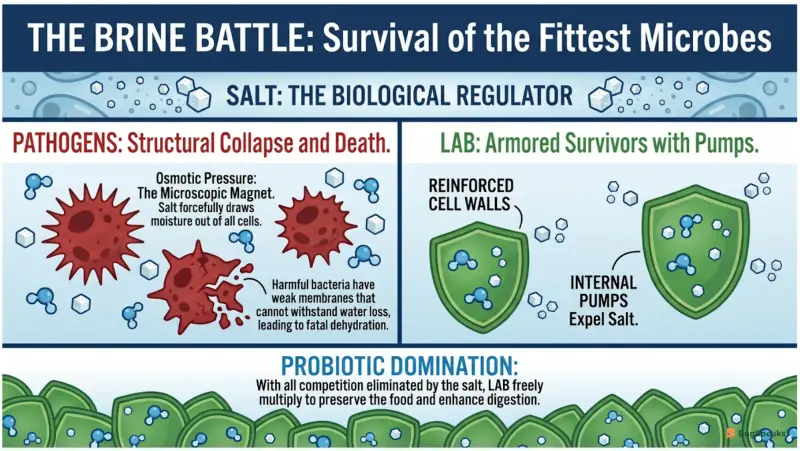
The establishment of this environmental regulator is a matter of life and death for the microscopic populations within the jar. Dangerous pathogens and common spoilage bacteria typically possess exceptionally weak cellular membranes that cannot withstand extreme external forces. When these harmful organisms are exposed to the intense osmotic pressure of the brine, the salt rapidly extracts the essential water from their internal structures. Without this critical internal moisture, the dangerous bacteria experience immediate structural collapse and die off completely. By systematically neutralizing these biological threats, the environmental regulator perfectly sanitizes the internal ecosystem, guaranteeing that the fermentation substrate will remain entirely safe from rotting or toxic contamination during the entire preservation lifecycle.
While harmful pathogens are rapidly destroyed by the environmental regulator, the highly resilient, adapting biological communities of Lactic Acid Bacteria (LAB) easily survive the ordeal. These beneficial microorganisms have specifically evolved to possess highly reinforced cell walls and specialized internal pumps that actively expel excess saltTokatlı et al. (2015). In traditional Indian recipes, the addition of ingredients like mustard oil and fenugreek seeds introduces secondary chemical regulators that work perfectly alongside the saltChandel et al. (2020). Together, they fine-tune the controlled habitat, eliminating unwanted competitors. Consequently, the salt-tolerant beneficial bacteria are left with absolutely zero competition, allowing them to freely consume the fermentation substrate and dominate the entire biological landscape.
What happens when there is too much salt in commercial pickles?
When there is too much salt in commercial pickles, it creates extreme cellular stress that destroys the beneficial probiotic bacteria, turning a living, healthy food into a biologically dead snack. Within the mechanics of the microbial preservation system, salt is only beneficial when utilized as a balanced environmental regulator. It must remain perfectly calibrated to eliminate weak pathogens while simultaneously supporting the robust, adapting biological communities. However, when commercial manufacturers drastically elevate salt concentrations to artificially maximize shelf life, this fundamental biological balance is violently shattered. The salt immediately stops functioning as a helpful regulator and instead transforms into a massive, highly destructive environmental stressor that thoroughly devastates the microscopic ecosystem.
Under the immense osmotic pressure generated by this environmental stressor, the natural biological defenses of the Lactic Acid Bacteria (LAB) are completely overwhelmed. Although these beneficial bacteria utilize specialized cellular pumps to handle moderate salt levels, extreme salinity causes a catastrophic mechanical failure. The outward suction of water becomes far too powerful, triggering rapid and fatal dehydration within the bacterial cells. Consequently, their internal metabolism grinds to an absolute halt, stripping them of their ability to process the fermentation substrate Angmo et al. (2016). Without functional energy production or structural integrity, the entire population of beneficial microbes systematically collapses, leaving behind a heavily salted, biologically inactive environment devoid of any living organisms.
This complete biological collapse starkly highlights the primary difference between natural fermentation and modern commercial pickling operations. Traditional methods rely entirely on cultivating a healthy, controlled habitat where active microbes maintain long-term food preservation. Conversely, mass producers frequently bypass this biological partnership by submerging vegetables in overwhelming amounts of salt and sterile vinegar, followed by high-heat pasteurization. This intense combination of heat and the chemical environmental stressor systematically eradicates every single organism inside the jar. As a direct result, the microbial health of the final product is entirely sacrificed for the sake of infinite shelf stability, leaving the consumer with a highly processed product that delivers absolutely zero probiotic or digestive benefits.
Which specific beneficial bacteria survive the harsh pickle environment?
The specific beneficial bacteria that survive the harsh pickle environment primarily belong to the highly resilient family of lactic acid bacteria, including specialized species like Lactobacillus plantarum. To successfully dominate the controlled habitat of a fermentation vessel, a microbe must be an evolutionary survivor capable of enduring low oxygen, high acidity, and the intense salinity enforced by the environmental regulator. The microscopic organisms that successfully navigate these extreme challenges are categorized as the surviving beneficial residents. In thorough scientific evaluations of traditional fermented vegetables, robust species such as Lactobacillus plantarum and Lactobacillus brevis are frequently identified as the organisms that efficiently outcompete all other microbial life to claim the fermentation substrateTokatlı et al. (2015).
However, the ultimate test for these surviving beneficial residents occurs when they are consumed and forced to travel through the hostile human digestive tract. The human stomach is an intensely acidic chamber heavily flooded with highly corrosive gastric acid. To provide meaningful health benefits, the bacteria must survive this intense chemical barrier. Scientific testing demonstrates that strains like Lactobacillus plantarum isolated from traditional pickles exhibit remarkable resistance to these severely low pH environmentsTokatlı et al. (2015). Furthermore, upon entering the small intestine, they encounter bile salts, which act like biological detergents designed to tear apart bacterial membranes. The strains cultivated in turmeric pickles demonstrate high tolerance to both stomach acid and bileChandel et al. (2020).
After successfully navigating the chemical assaults of the upper digestive tract, the final requirement for these surviving beneficial residents is to secure a permanent physical location within the intestines. They achieve this critical milestone through a biological property known as hydrophobicity, which measures their ability to repel water and physically adhere to the mucosal liningTokatlı et al. (2015). Bacteria exhibiting high hydrophobicity firmly attach to the cellular surfaces of the human gut, successfully initiating permanent colonization. Both Lactobacillus species from vegetable pickles and Enterococcus durans from turmeric pickles display exceptionally strong adhesive propertiesTokatlı et al. (2015);Chandel et al. (2020). Once securely anchored, they permanently integrate themselves into the host's internal biological systems.
How do the surviving bacteria in pickles benefit human health?
The surviving bacteria in pickles benefit human health by significantly improving digestion, actively lowering cholesterol levels in the bloodstream, and fiercely defending the body against harmful invasive diseases. Once the surviving beneficial residents colonize the intestinal tract, they immediately begin to influence the host's overall immune function. Having already proven their biological resilience by enduring the harsh, controlled habitat and the destructive forces of human stomach acid, they are perfectly engineered to function as a microscopic defense force. Their continuous active presence fundamentally shifts the baseline balance of the human gut microbiome, guaranteeing that the host receives ongoing internal biological support from these newly established microscopic alliesTamang et al. (2016).
One of the most valuable mechanical benefits provided by these surviving beneficial residents is the process of cholesterol assimilation. High levels of serum cholesterol constitute a major risk factor for severe cardiovascular complications. When specific pickle-derived bacteria establish themselves in the digestive tract, they actively engage with dietary cholesterol particles. Through complex cellular mechanisms, these beneficial microbes physically bind to or directly absorb the cholesterol molecules into their own cellular structuresTokatlı et al. (2015);Chandel et al. (2020). This highly efficient biological trapping mechanism prevents the human body from absorbing the cholesterol into the bloodstream, clearly demonstrating how a simple fermented food can directly improve and protect long-term human heart health.
Furthermore, these surviving beneficial residents actively protect their host from internal infections by manufacturing specialized chemical weapons known as bacteriocins. These powerful antimicrobial proteins are deliberately released to locate, puncture, and destroy the cell walls of dangerous invasive pathogensChandel et al. (2020). Additionally, the constant metabolism of these microbes generates a continuous supply of protective antioxidants. Every single day, the human body naturally produces unstable, highly destructive molecules known as free radicals, which actively cause cellular damage. The microbes originating from the fermentation substrate are exceptionally efficient at neutralizing these chemical threats, dramatically boosting the host's immune defenses and transforming the bacteria into indispensable, lifelong guardians of human healthChandel et al. (2020).
Visualize the process- https://youtu.be/rR5EbnQhouA
Reference
Tamang, J. P., Shin, D. H., Jung, S. J., & Chae, S. W. (2016). Functional Properties of Microorganisms in Fermented Foods. Frontiers in microbiology, 7, 578. https://doi.org/10.3389/fmicb.2016.00578
Chandel, M., & Sharma, N. (2020). Studies on traditional Indian (turmeric) pickle as probiotic pickle for therapeutic uses in view of COVID-19 pandemic. Indian J Trad Knowl, 19, 143-152.
Tokatlı, M., Gülgör, G., Bağder Elmacı, S., Arslankoz İşleyen, N., & Özçelik, F. (2015). In vitro properties of potential probiotic indigenous lactic acid bacteria originating from traditional pickles. BioMed research international, 2015(1), 315819.
Angmo, K., Kumari, A., & Bhalla, T. C. (2016). Probiotic characterization of lactic acid bacteria isolated from fermented foods and beverage of Ladakh. LWT-food Science and Technology, 66, 428-435.