The Pathobyte Series: The Biological Question Mark – Deciphering Leptospira interrogans
First identified in 1907, Leptospira interrogans is a versatile Gram-negative bacterium capable of causing a wide array of human illnesses. Driven by an advanced arsenal of virulence factors and toxins, it effortlessly evades host immunity, spreading rapidly through contaminated water and zoonotic reservoirs like rodents. Infections range from mild flu-like conditions featuring calf pain to life-threatening systemic conditions, including severe renal failure and Weil's syndrome. Accurate diagnosis leverages classic laboratory tests like the Microscopic Agglutination Test (MAT) and modern tools like PCR assays. While treatment typically requires targeted antibiotic therapy using doxycycline or penicillin, robust prevention relies heavily on environmental hygiene and personal protective equipment.
Why is this pathogen called the "Biological Question Mark"?
The name Leptospira interrogans was inspired by the bacterium's unique physical structure, which resembles a question mark under a microscope. First described in detail by Stimson in 1907 after observing silver-stained kidney tissues, the organism features a thin, helical body with "hooked" ends. The genus name Leptospira translates to "thin helix," while the species epithet interrogans specifically refers to the "interrogation" or question-mark shape caused by its periplasmic flagella. This shape is not just for show; the hooked ends help the bacterium latch onto host surfaces and navigate through viscous environments like mud and mucus.
What is the physical identity of this microscopic intruder?
Leptospira interrogans is a Gram-negative, aerobic spirochete that possesses a remarkable ability to survive in both environmental and host-specific conditions. Measuring only 0.1 micrometers in width and up to 12 micrometers in length, it is "sewing thread thin," allowing it to slip through pores and barriers that block larger microbes. It does not form spores, yet it achieves environmental resilience through the formation of complex biofilms, multicellular microcolonies embedded in a protective matrix.
Table 1: Microbe Profile – Leptospira interrogans
How does the pathogen breach the body's vascular grid?
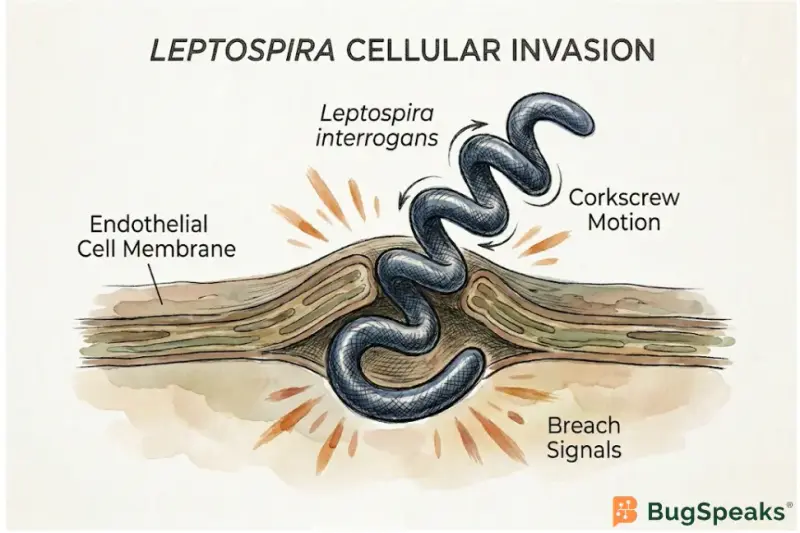
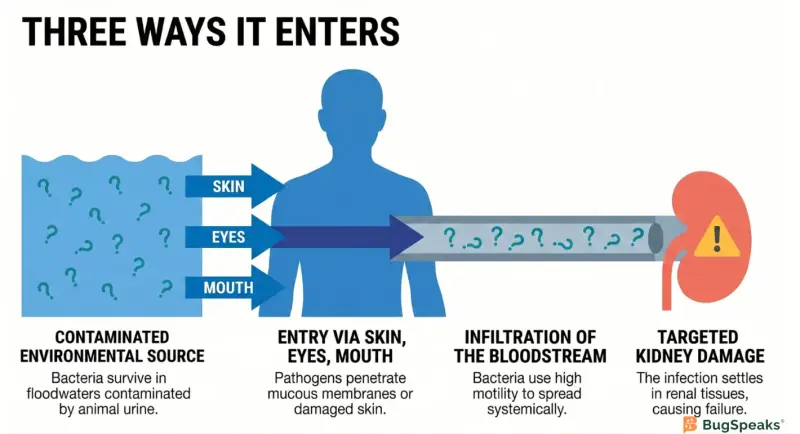
Pathogenesis begins when Leptospira gains entry through mucous membranes or damaged skin, using its high motility to "corkscrew" into the bloodstream. Once inside the vascular compartment, the bacteria act as markers of virulence by interacting directly with the endothelial lining of small blood vessels. This interaction causes systemic "vascular leaks," where the walls of the blood vessels become permeable, leading to internal bleeding and tissue damage. The bacteria eventually settle in the kidney tubules, where they can persist for months, effectively hijacking the host's renal infrastructure.
What are the primary routes of transmission for Leptospira?
Transmission is primarily zoonotic, meaning the bacteria jump from animals to humans through contact with infected urine or contaminated environments. Asymptomatic chronic carriers, particularly rodents, excrete the bacteria into the soil and water via their urine throughout their lives. Humans become "incidental hosts" when they come into contact with floodwaters, contaminated food, or moist soil after heavy rainfall or hurricanes. The bacteria can even survive for several weeks in stagnant water, waiting for a host to swim or wade by.
How does a Leptospira infection manifest in the host?
Signs and symptoms of leptospirosis typically occur in two distinct phases, starting with a sudden onset of flu-like symptoms. The first phase includes high fever, severe headache, muscle aches (especially in the calves), and "red eyes" (conjunctival injection). If not cleared, a second, more severe phase may follow, known as Weil's Syndrome, characterized by jaundice (yellowing of the eyes/skin), kidney failure, and liver damage. In extreme cases, pulmonary hemorrhage occurs, where the patient begins coughing up blood due to severe lung damage.
Table 2: Clinical Progression of Leptospirosis
What tools are used to confirm a Leptospira breach?
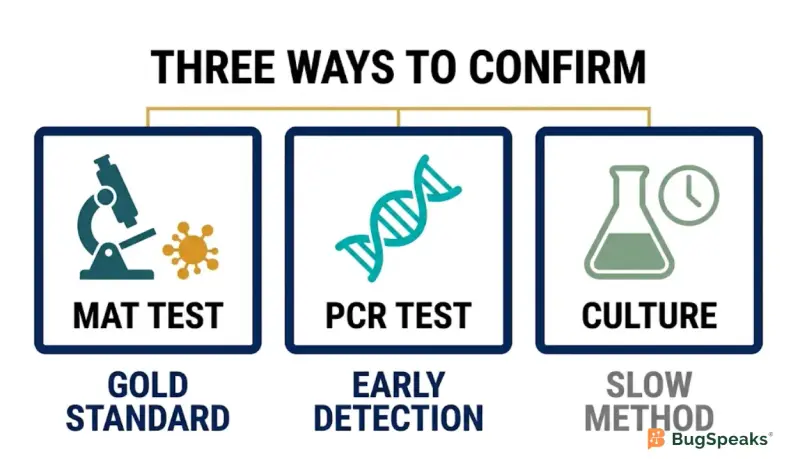
Diagnosis relies on a combination of molecular testing and specialized serological assays to detect the bacteria in the blood or urine. The "gold standard" for diagnosis is the Microscopic Agglutination Test (MAT), which uses live cultures to detect specific antibodies in the patient's serum. During the early phase of the infection, Polymerase Chain Reaction (PCR) is highly effective as it detects the DNA of the bacteria directly from blood or tissue samples. Because the organism is slow-growing, traditional bacterial culture can take anywhere from 12 to 26 weeks, making it less useful for immediate clinical decisions.
How is the biological infection treated?
Treatment involves the immediate administration of targeted antibiotics to kill the bacteria and prevent systemic organ failure. For mild cases, oral antibiotics like doxycycline are the standard of care, while more severe infections require intravenous (IV) penicillin or ceftriaxone. Early treatment is vital; starting antibiotics as soon as leptospirosis is suspected can significantly decrease the duration of the illness and prevent the transition into the deadly second phase. In severe cases, supportive care such as dialysis or mechanical ventilation may be necessary to manage kidney or lung failure.
What strategies can prevent a Leptospira intrusion?
Prevention focuses on breaking the link between animal reservoirs and human environments through hygiene and protective barriers. The best way to reduce risk is to avoid swimming or wading in water that might be contaminated with animal urine, especially after heavy rains or flooding. For those at high risk due to their occupation, such as veterinarians, farmers, or sewer workers, wearing protective gear like gloves, boots, and eye protection is mandatory. Additionally, managing rodent populations around homes and workplaces can drastically lower the microbial load in the environment.
Are there biological shields or vaccines available?
Vaccines are available for animals and, in specific high-risk regions, for human use to create a biological shield against infection. Vaccinating livestock and pets is a primary defense as it prevents these animals from becoming reservoir hosts and shedding the bacteria into the environment. In humans, region-specific vaccination strategies are employed in high-endemic areas, though a universal vaccine remains a major goal for global immunology. Current research is focused on multi-epitope vaccine approaches that could provide broad protection across the many different serovars of Leptospira.
How is Leptospira classified in the biological hierarchy?
Taxonomic classification places Leptospira within a unique lineage of spirochetes that evolved specific adaptations for life on both land and water. According to the 2026 classification system (Bacillati/Pseudomonadati), it is part of the kingdom Bacillati, which groups organisms with high environmental resistance.
Taxonomic Classification of Leptospira interrogans
Domain: Bacteria
Kingdom: Bacillati
Phylum: Actinomycetota
Class: Spirochaetia
Order: Leptospirales
Family: Leptospiraceae
Genus: Leptospira
Species:Leptospira interrogans
Subspecies/Serovars: Over 250 recognized (e.g., Icterohaemorrhagiae)
-Varsha V
Reference
Abdullah, M., Kadivella, M., Vyas, P., C P, J., Palanisamy, B., Azam, S., & Faisal, S. M. (2026). A multi-epitope approach for development of a universal vaccine against leptospirosis. Frontiers in immunology, 17, 1774717. https://doi.org/10.3389/fimmu.2026.1774717
Dias CS, Pinna MH.2025.Leptospira biofilms: implications for survival, transmission, and disease management. Appl Environ Microbiol91:e01914-24.https://doi.org/10.1128/aem.01914-24
Bilung, L. M., Tahar, A. S., Pui, C. F., Bakeri, M. K. S., Su'ut, L., Ngui, R., Kira, R., & Apun, K. (2026). Leptospira and Leptospirosis: A Review of Species Classifications, Genomes, Morphological Structures, Antimicrobial Resistances, Transmissions, and Clinical Manifestations. Current microbiology, 83(2), 122. https://doi.org/10.1007/s00284-026-04722-7
Anderson, P. N., Hahn, B. L., Thao, G., Johnson, M. S., Giraud-Gatineau, A., Gao, Y., Picardeau, M., Coburn, J., & Surdel, M. C. (2026). In vitro and in vivo endothelial interactions of Leptospira species are markers of virulence. PLoS neglected tropical diseases, 20(1), e0013939. https://doi.org/10.1371/journal.pntd.0013939
https://www.biorxiv.org/content/10.64898/2026.02.11.705417v1.full.pdf