Understanding the Microbiome's Role in Obesity: A Comprehensive Guide
How does the gut microbiome control calorie extraction from food?
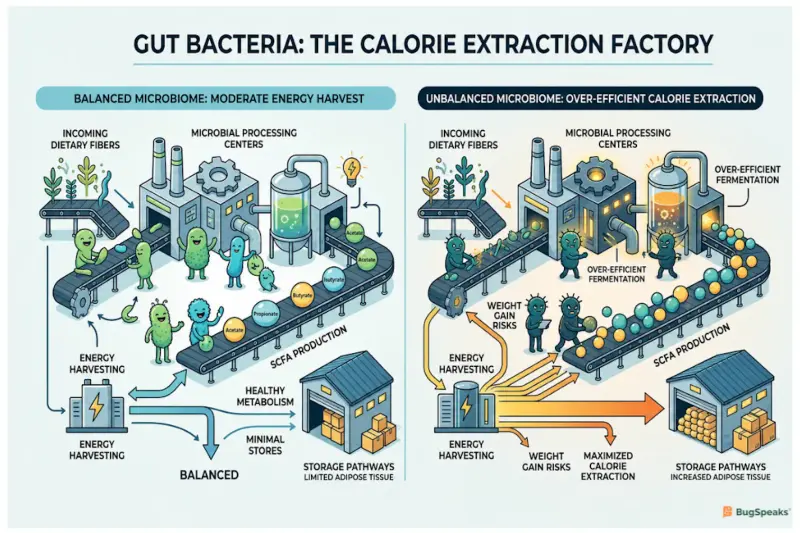
The gut microbiome controls calorie extraction by using specialized bacterial enzymes to break down tough, indigestible plant fibers into usable energy, directly determining how many calories your body actually absorbs from your daily mealsMasi et al. (2026). In our biological resource-harvesting ecosystem, the food you consume represents the incoming resources. Human digestion alone completely lacks the tools to break down these complex fibers, relying heavily on beneficial microbes acting as balanced resource processorsIqbal et al. (2025). When these microscopic processors are highly active, they dismantle tough plant fibers and extract a large amount of extra calories, showing why basic calorie counting is an incomplete science.
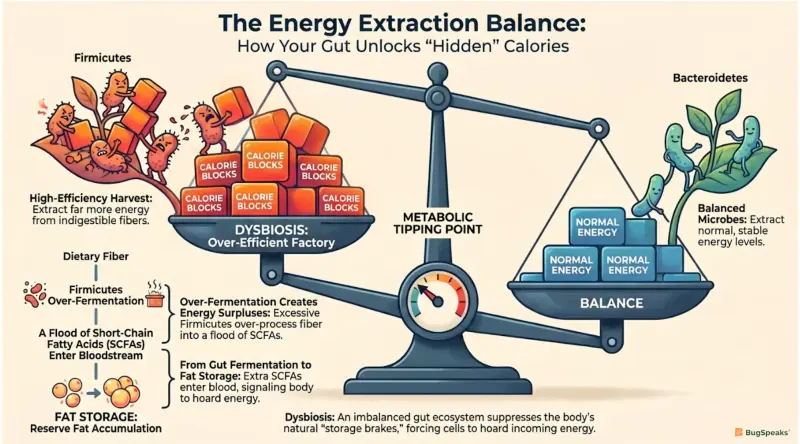
A major factor in this extraction process is the balance between the two dominant bacterial phyla, Firmicutes and Bacteroidetes. In many cases of obesity, researchers observe an altered harvesting pattern characterized by a higher Firmicutes-to-Bacteroidetes ratio (Baek et al., 2025). These specific microbes are exceptionally skilled at fermenting dietary fibers into energy-yielding molecules known as Short-Chain Fatty Acids (SCFAs)Iqbal et al. (2025). In a resource-harvesting ecosystem burdened with this altered population, the overall ecosystem output is aggressively maximized, creating a constant surplus of extra fuel that the human body rapidly converts into reserve accumulation, which we see as stored body fat.
This microbial efficiency explains why different people eating the same diet experience different levels of weight gain. The gut acts as a dynamic resource-harvesting ecosystem where the composition of microscopic processors dictates the final energy yield. When beneficial microbes are highly diverse, the incoming resources are processed steadily, safely supporting a stable ecosystem outputMasi et al. (2026). However, in states of dysbiosis, which is an imbalance in the gut community, altered harvesting patterns take over to excessively strip calories from food, continuously pushing extra energy into reserve accumulation. This means an imbalanced system acts like an over-efficient factory.
Why does microbial imbalance lead to increased fat storage?
Microbial imbalance leads to increased fat storage by directly suppressing the body's natural molecular brakes, which prompts fat cells to rapidly and continuously hoard incoming energy as lipid reservesIqbal et al. (2025). In our biological resource-harvesting ecosystem, specific host proteins act as precise regulatory switches to carefully control how much processed fuel becomes permanent reserve accumulation. One critical switch is Fasting-Induced Adipose Factor (FIAF), a protein that naturally circulates in the blood to actively inhibit massive fat storageIqbal et al. (2025). When the gut environment experiences severe dysbiosis, altered harvesting patterns suppress FIAF production, removing these essential brakes completely.
The dangerous suppression of FIAF immediately unleashes the aggressive activity of an enzyme called Lipoprotein Lipase (LPL), which acts as the primary cellular gatekeeper for systemic fat storage. Normally, healthy levels of FIAF limit the activity of LPL, carefully ensuring that the ecosystem output is burned for immediate metabolic energy rather than being mindlessly hoardedIqbal et al. (2025). However, when dysbiosis takes over the resource-harvesting ecosystem, the uninhibited LPL forcefully drives circulating fats directly into tissues, leading to rapid reserve accumulation and proving that an unhealthy gut actively programs the body to hoard fat. This represents a breakdown in the gatekeeping rules.
Beyond the actions of FIAF and LPL, the resource-harvesting ecosystem also heavily influences fat storage through the chemical modification of Bile Acids. Produced by the liver and modified by balanced resource processors, these acids activate specific metabolic receptors like the Farnesoid X Receptor (FXR) and the Takeda G protein-coupled Receptor 5 (TGR5)Belančić et al. (2026). Activated by a healthy microbiome, these receptors strongly limit new fat creation and increase metabolic burning. However, gut dysbiosis disrupts this crucial modification, leaving receptors inactive and promoting a sluggish ecosystem output that accelerates reserve accumulation. This slow burn means stored resources are rarely used.
How do bacterial toxins trigger metabolic inflammation and weight gain?
Bacterial toxins trigger metabolic inflammation and weight gain by leaking through a damaged intestinal wall into the bloodstream, provoking a chronic immune response that severely disrupts insulin signalingBelančić et al. (2026). Within our resource-harvesting ecosystem, a critical physical and chemical barrier normally separates the microbial processors perfectly from the host's body. When poor diets high in processed fats cause severe gut imbalance, this protective barrier degrades rapidly into a structural condition commonly known as Leaky GutBaek et al. (2025). This physical failure allows toxic bacterial wall fragments, known as Lipopolysaccharides (LPS), to escape the gut, crossing into the bloodstream where they do not belong.
Once LPS dangerously breaches the ecosystem borders, it acts as a highly inflammatory trigger, aggressively binding to Toll-Like Receptor 4 (TLR4) located on immune cells throughout the entire bodyIqbal et al. (2025). This specific binding initiates a biological state of Metabolic Endotoxemia, a low-grade, persistent inflammation that severely impairs the body's entire metabolic machineryBaek et al. (2025). The resulting inflammatory alarm signals severely disrupt how host cells respond to insulin, rapidly creating insulin resistance. Because the ecosystem output is heavily compromised, the body struggles to process resources, shunting sugars directly into reserve accumulation instead of immediate fuel, making it easy to store weight.
This relentless inflammatory cascade deeply affects the fat tissue itself, turning standard energy vaults into highly inflamed sites that perpetuate weight gain. Under the heavy influence of constant systemic LPS exposure, immune cells infiltrate the fat tissue and release further inflammatory chemicals that block normal fat burningBelančić et al. (2026). The altered harvesting patterns have now effectively weaponized the body's own fat stores, causing the entire metabolic system to malfunction. Restoring the physical integrity of the resource-harvesting ecosystem is the only way to stop this toxic, inflammatory weight gain, helping the processors function normally again. By protecting our microscopic helpers, we keep our storage vaults safe.
What role do microbial metabolites play in regulating appetite and energy?
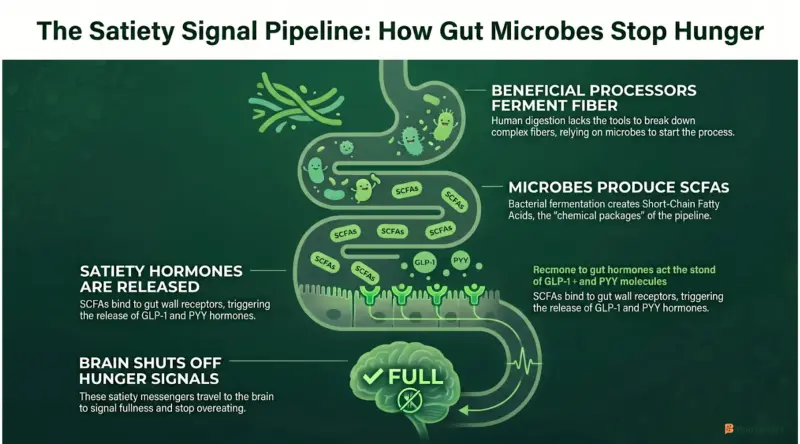
Microbial metabolites regulate appetite and energy by acting as sophisticated chemical messengers that travel directly from the gut to the brain, directly influencing feelings of fullness and your body's energy-burning rateMasi et al. (2026). When balanced resource processors successfully ferment complex incoming resources, they naturally produce beneficial byproducts like Short-Chain Fatty Acids (SCFAs). In a healthy resource-harvesting ecosystem, these SCFAs bind to specialized sensors on the intestinal wall, triggering the immediate release of satiety hormones like Glucagon-Like Peptide-1 (GLP-1)Baek et al. (2025). These satiety messengers tell the brain to halt resource collection, helping to stop overeating in your daily life.
Furthermore, specific SCFAs like butyrate and acetate actively modulate overall energy expenditure, essentially turning up the metabolic dial on your daily ecosystem output. They do this by traveling through the bloodstream to interact directly with brown adipose tissue and skeletal muscles, increasing the rate at which these cells burn fat for heatIqbal et al. (2025). However, when altered harvesting patterns dominate due to dysbiosis, the production of these specific satiety-inducing and energy-burning metabolites plummetsMasi et al. (2026). The brain stops receiving the biochemically active messages, driving a relentless urge to collect new resources and hoard excess body fat.
The gut microbiome also interacts closely with the Endocannabinoid System (ECS), which controls hunger and fat storage. In an unbalanced resource-harvesting ecosystem, harmful microbes chronically elevate specific endocannabinoids that overstimulate Cannabinoid Receptor Type 1 (CB1)Iqbal et al. (2025). Overactivating CB1 dramatically increases hunger, leading to hedonic eating behaviors, and drives the liver to construct new fat blocksGupta et al. (2020). This dangerous, systemic miscommunication within the extended reward network ensures that ecosystem output remains abnormally low while incoming resources are prioritized exclusively for reserve accumulation, trapping the human body in a greedy loop of constant, unhealthy cravings for highly processed foods.
How can precision nutrition and targeted therapies restore metabolic balance?
Precision nutrition and targeted therapies restore metabolic balance by deliberately seeding the gut with specific beneficial bacteria and providing the exact complex fibers needed to rebuild a robust, healthy ecosystemBaek et al. (2025). Repairing a severely broken resource-harvesting ecosystem requires much more than just eating fewer calories; it requires successfully introducing Prebiotics and Probiotics to permanently correct altered harvesting patterns. Prebiotics, like inulin, serve as highly specialized incoming resources that only balanced resource processors can useMasi et al. (2026). This selectively feeds beneficial bacterial workers, shifting the entire biological ecosystem away from fat-hoarding microbes and toward clean processors.
Alongside prebiotics, targeted probiotic strains act as elite biological reinforcements to the existing intestinal workforce. Next-generation probiotics like Akkermansia muciniphila and Faecalibacterium prausnitzii are gaining massive attention for their metabolic benefitsMasi et al. (2026). Akkermansia muciniphila resides deep in the gut mucosal lining and actively thickens the defensive barrier, preventing the toxic leakage of bacterial pieces that cause metabolic inflammationIqbal et al. (2025). By physically reinforcing the protective walls of our harvesting ecosystem, these microbes normalize insulin sensitivity, stop excessive reserve accumulation, and ensure that incoming resources are burned highly efficiently as active daily output for the body.
In cases of severe obesity and advanced dysbiosis, complete ecosystem resets are being actively explored, such as Fecal Microbiota Transplantation (FMT) and even surgical remodeling. FMT transfers a complete, balanced microbial community from a healthy, lean donor directly into the compromised patient, immediately replacing the dysfunctional processorsBelančić et al. (2026). Additionally, bariatric surgery fundamentally alters the gut environment, forcing a massive, dramatic restructuring of the entire resource-harvesting ecosystemMasi et al. (2026). This new environment rapidly increases populations of Akkermansia and intense SCFA producers, completely overturning the altered harvesting patterns that drove initial fat accumulation in our daily metabolic function.
-Varsha V
Visualize the process- https://youtu.be/Dn1n_AfYFWI
Reference
Masi, D., Watanabe, M., & Clément, K. (2026). Gut microbiome and obesity care: Bridging dietary, surgical, and pharmacological interventions. Cell reports. Medicine, 7(2), 102573. https://doi.org/10.1016/j.xcrm.2025.102573
A.Belančić, A.Fajkić, Y. Z.Sener, et al., “Gut Dysbiosis as a Shared Mechanism in Obesity and Hypertension: Exploring a Promising Therapeutic Avenue,” Endocrinology, Diabetes & Metabolism9, no. 3 (2026): e70159, https://doi.org/10.1002/edm2.70159.
Gupta, A., Osadchiy, V. & Mayer, E.A. Brain–gut–microbiome interactions in obesity and food addiction. Nat Rev Gastroenterol Hepatol17, 655–672 (2020). https://doi.org/10.1038/s41575-020-0341-5
Baek, K. R., Singh, S., Hwang, H. S., & Seo, S. O. (2025). Using Gut Microbiota Modulation as a Precision Strategy Against Obesity. International journal of molecular sciences, 26(13), 6282. https://doi.org/10.3390/ijms26136282
Iqbal, M., Yu, Q., Tang, J., & Xiang, J. (2025). Unraveling the gut microbiota's role in obesity: key metabolites, microbial species, and therapeutic insights. Journal of bacteriology, 207(5), e0047924. https://doi.org/10.1128/jb.00479-24