The Microbyte Series: Meet the Starch-Lover: Lactobacillus amylovorus
History
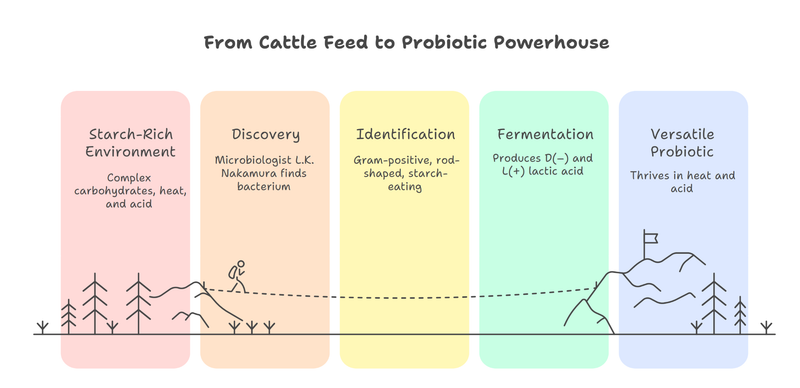
Not all probiotics are born in a yogurt cup; some emerge from much humbler beginnings. Lactobacillus amylovorus was first discovered in 1981 by microbiologist L.K. Nakamura, deep within fermenting cattle feed. This humble, starch-rich environment revealed a bacterium unlike its relatives: one that could devour complex carbohydrates and thrive in heat and acid. Its very name tells the story: “amylovorus” means “starch-eating.”
Under the microscope, it’s a Gram-positive, rod-shaped bacterium that loves acidity and warmth. While many Lactobacillus species ferment simple sugars, L. amylovorus stands out for its ability to tackle starch itself, producing both D(–) and L(+) lactic acid. It grows happily even at 45–48 °C and can survive at pH 3 traits that make it both tough and versatile.
For years, L. amylovorus was considered part of the Lactobacillus acidophilus group, a family of gut-friendly species adapted to animals. Later, genetic studies clarified its unique identity. Interestingly, a species once named Lactobacillus sobrius was later found to be genetically identical, merging back into L. amylovorus.
In 2020, when scientists reorganized over 200 Lactobacillus species into new genera, L. amylovorus held its ground in the core Lactobacillus genus. In 2024, researchers proposed new subspecies amylovorus and animalis, highlighting its evolutionary journey from soil and silage to the animal gut.
Where It Thrives: Between Silage and the Small Intestine
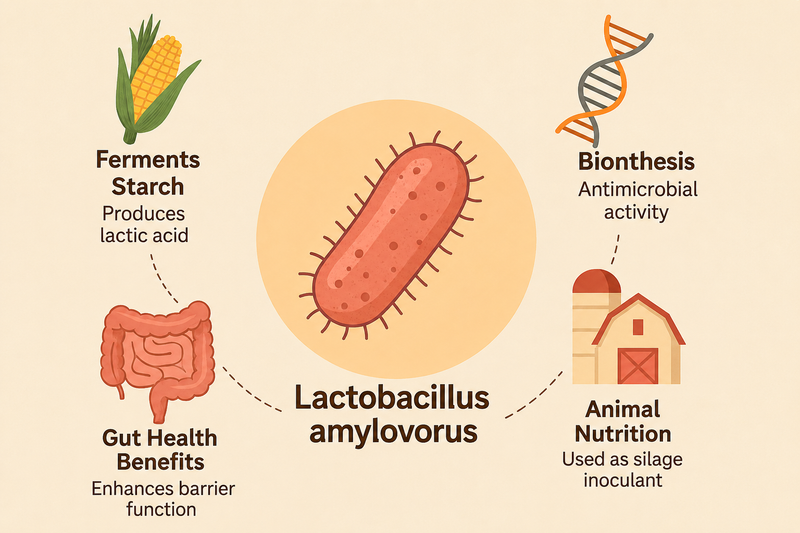
What’s fascinating about L. amylovorus is its dual life. In nature, it thrives in carbohydrate-rich fermentations, corn steep liquor, tomato pomace silage, and even mushroom compost. It’s the silent architect behind successful fermentations, lowering pH fast and preserving feed by producing lactic acid.
In animals, particularly pigs, it takes on a probiotic role. Studies show L. amylovorus dominates the ileum and colon of weaned piglets, helping them adapt after weaning. Its S-layer proteins, unique surface molecules that act like molecular Velcro, allow it to stick to intestinal cells, forming a stable presence that helps exclude harmful pathogens.
This dual nature, thriving in both the environment and the gut, makes L. amylovorus a rare “bridge species” between fermentation and physiology.
The Science of Survival: A Genetic Blueprint for Resilience
Genomics reveals how this bacterium survives where others fail. L. amylovorus carries genes that help it resist acid and bile: atpD, atpH, clpB, and grpE for acid stress; cbh for bile salt detoxification. These allow it to pass through the stomach and colonize the intestine successfully.
Unlike many lactic acid bacteria that rely on external nutrients, L. amylovorus can make its own vitamins. Genes such as ribB, ribD, ribE, and ribT enable the synthesis of riboflavin (Vitamin B2), while cobC supports parts of the B12 pathway. This independence means it doesn’t just survive; it potentially nourishes its host.
Its genetic toolkit also includes helveticin J, a bacteriocin that suppresses harmful microbes, and a CRISPR-Cas defense system that protects its DNA from invading viruses. Together, these features make it remarkably self-sufficient as a microbial survivalist with purpose.
What It Does for the Gut: Repair, Absorb, Defend
Animal studies show that L. amylovorus isn’t just a bystander in the gut; it's an active contributor to intestinal health. In piglets with growth challenges, supplementation improved gut structure, increasing villus height and strengthening intestinal tight junctions through upregulation of Claudin-1.
Functionally, it helps the gut digest lactose and boosts glucose uptake by increasing GLUT2 expression, essentially teaching the gut to absorb nutrients more efficiently. These effects translate into measurable outcomes: better growth, improved digestion, and stronger barrier protection.
Its S-layer proteins also help it compete for space, preventing pathogens like E. coli and Salmonella from attaching. At the immune level, L. amylovorus may help balance inflammation by decreasing pro-inflammatory cytokines (like TNF-α and IL-1β) and increasing anti-inflammatory signals (like IL-10). This fine-tuned immunomodulation shows why it’s a promising candidate for gut health support not only in animals but potentially in humans as well.
From Farm to Factory: Its Expanding Applications
In the agricultural world, L. amylovorus is a trusted ally. It’s used as a silage inoculant, a microbial starter that rapidly acidifies forage and locks in nutrients, creating stable, pathogen-free animal feed. Its ability to dominate in acidic, carbohydrate-rich environments makes it ideal for this role.
In biotechnology, it’s gaining recognition as a biofactory. Under optimized fermentation, strains like DCE 471 can produce large quantities of helveticin J, a natural antimicrobial peptide that could replace chemical preservatives in food. Its ability to synthesize B-vitamins also positions it for use in functional foods and supplements, potentially enriching human diets naturally.
Why It Matters: Beyond a Typical Probiotic
The story of Lactobacillus amylovorus reminds us that science often hides its best discoveries in unexpected places, in this case, a pile of fermenting corn waste. Over four decades of research have turned this once-obscure bacterium into a promising probiotic with dual power: improving animal health while supporting sustainable fermentation industries.
Its unique combination of acid and bile tolerance, vitamin biosynthesis, adhesion, and antimicrobial activity sets it apart from standard probiotics. It’s not just a microbe that survives the gut; it’s one that reshapes it, promoting resilience, nutrient efficiency, and microbial balance.
As research continues, the future may see L. amylovorus added to specialized probiotic formulations, next-generation feed additives, or even personalized gut-health therapies. From silage tanks to intestinal walls, this tiny “starch-eater” has proven that adaptability and intelligence aren’t limited to large organisms; they thrive at the microscopic scale too.
Taxonomic Classification
Domain: Bacteria
Kingdom: Bacillati
Phylum: Bacillota
Class: Bacilli
Order: Lactobacillales
Family: Lactobacillaceae
Genus: Lactobacillus
Species: Lactobacillus amylovorus
Microbe Profile
Shape: Rod-shaped
Gram nature: Gram-positive
Spore formation: No
Biofilm formation: Yes
Oxygen requirement: No oxygen requirement
Optimal temperature: 45–48 °C
Optimal pH: 3
Nutrient usage: Ferments simple sugars like glucose and lactose
Reference
Dewi, G., & Kollanoor Johny, A. (2022). Lactobacillus in food animal production—a forerunner for clean label prospects in animal-derived products. Frontiers in Sustainable Food Systems, 6, 831195.
Latif, A., Shehzad, A., Niazi, S., Zahid, A., Ashraf, W., Iqbal, M. W., Rehman, A., Riaz, T., Aadil, R. M., Khan, I. M., Özogul, F., Rocha, J. M., Esatbeyoglu, T., & Korma, S. A. (2023). Probiotics: mechanism of action, health benefits and their application in food industries. Frontiers in microbiology, 14, 1216674. https://doi.org/10.3389/fmicb.2023.1216674
Kant, R., Paulin, L., Alatalo, E., de Vos, W. M., & Palva, A. (2011). Genome sequence of Lactobacillus amylovorus GRL1118, isolated from pig ileum. Journal of bacteriology, 193(12), 3147–3148. https://doi.org/10.1128/JB.00423-11
Walter J. (2008). Ecological role of lactobacilli in the gastrointestinal tract: implications for fundamental and biomedical research. Applied and environmental microbiology, 74(16), 4985–4996. https://doi.org/10.1128/AEM.00753-08
Park, S., Kim, J. A., Jang, H. J., Kim, D. H., & Kim, Y. (2023). Complete genome sequence of functional probiotic candidate Lactobacillus amylovorus CACC736. Journal of animal science and technology, 65(2), 473–477. https://doi.org/10.5187/jast.2022.e85
Lee, Y. R., Bang, W. Y., Baek, K. R., Kim, G. H., Kang, M. J., Yang, J., & Seo, S. O. (2022). Safety Evaluation by Phenotypic and Genomic Characterization of Four Lactobacilli Strains with Probiotic Properties. Microorganisms, 10(11), 2218. https://doi.org/10.3390/microorganisms10112218
Wu, Y., Liu, X., Zou, Y., Zhang, X., Wang, Z., Hu, J., Han, D., Zhao, J., Dai, Z., & Wang, J. (2024). Lactobacillus amylovorus Promotes Lactose Utilization in Small Intestine and Enhances Intestinal Barrier Function in Intrauterine Growth Restricted Piglets. The Journal of nutrition, 154(2), 535–542. https://doi.org/10.1016/j.tjnut.2023.12.004
Evivie, S. E., Huo, G. C., Igene, J. O., & Bian, X. (2017). Some current applications, limitations and future perspectives of lactic acid bacteria as probiotics. Food & nutrition research, 61(1), 1318034. https://doi.org/10.1080/16546628.2017.1318034