How does long-read sequencing translate physical biology into digital data?
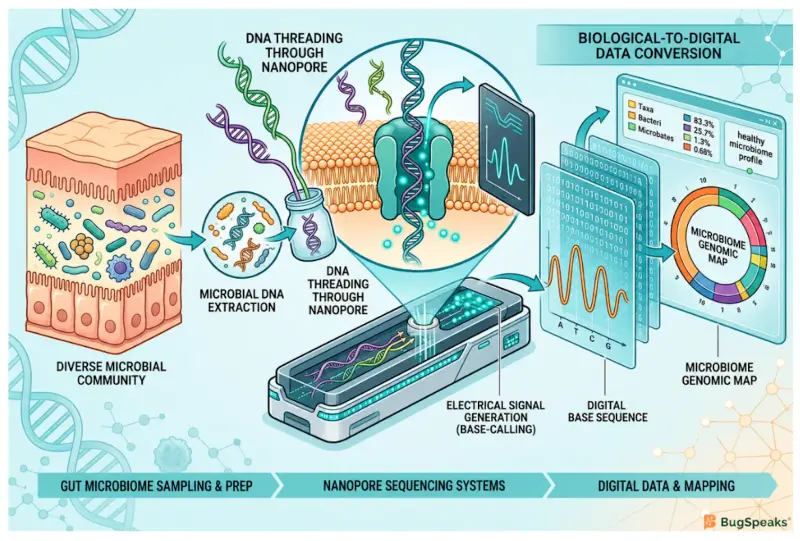
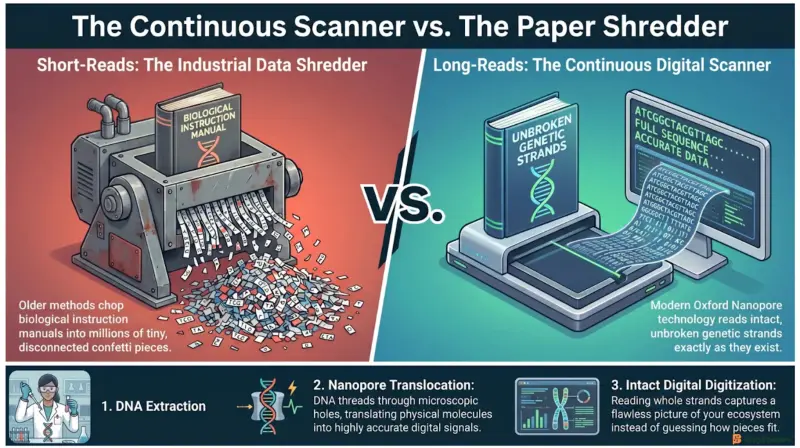
Long-read sequencing translates your biological sample into digital data by reading entire, unbroken strands of genetic material exactly as they exist in your gut. To deeply understand this process, imagine your biological sample arriving as a shipment of raw materials at a massive, high-tech Genomic Data Processing & Analysis Facility. For many years, scientists relied on an older sequencing method that acted exactly like a giant industrial paper shredder. This old method would take the complex, beautiful biological instruction manuals of your gut bacteria and aggressively chop them into millions of tiny, disconnected confetti pieces. Scientists would then use computers to try to tape these tiny fragments back together, essentially guessing how the original manual was supposed to look. This old approach caused massive blind spots, frequently scrambling the data and missing crucial details about the fragile, rare bacteria living deep inside you. When the data is scrambled, you remain completely unaware of the invisible microscopic imbalances that are actively causing your daily fatigue and poor digestion.
Our modern facility completely replaces that destructive process with an advanced technology called Whole Metagenome Shotgun Sequencing (mNGS), specifically using the Oxford Nanopore Technologies (ONT) platform. Instead of shredding the manual, this technology acts as a continuous, high-definition digital scanner. Inside the machine, intact, ultra-long molecules of Deoxyribonucleic Acid (DNA) are carefully threaded through a microscopic hole called a nanopore. As the long biological strand passes through this tiny physical scanner, the molecule's unique shape causes measurable disruptions in the electrical current.
This continuous physical scanning process instantly translates the biological molecule into a highly accurate digital electrical signal. Because the facility reads the entire, unbroken strand of genetic data at once, we capture a flawless, high-resolution picture of your internal ecosystem without ever having to guess how the pieces fit together. This guarantees that the facility can precisely map the specific bacterial strains that control your daily digestion, energy levels, and immune system. By capturing this pristine data, we transition your health from messy, physical guesswork to a secure, professional, and actionable digital portfolio.
What is the MetaRich pipeline and why does it act as a security checkpoint?
The MetaRich Pipeline is our proprietary digital operating system that strictly filters, cleans, and processes your incoming genetic data to ensure absolute medical accuracy. Once your physical sample has been successfully converted into a digital data stream, it must be carefully managed by the facility's master control architecture. You can think of the MetaRich pipeline as the highly intelligent, automated manager of the entire Genomic Data Processing & Analysis Facility. Its primary job is to ensure that only 100% accurate, trustworthy information makes it pass the loading dock and onto your final health report. Without a strict master operating system, biological data can easily become corrupted and useless.
In the world of microscopic biology, incoming data can sometimes become inherently noisy. When a sequencing machine is scanning trillions of tiny organisms at once, small digital glitches, microscopic cross-contamination, or technological background dust can sometimes trigger a false alarm. These glitches trick the computers into thinking a specific bacteria is present in your gut when it actually is not. If the MetaRich operating system allowed these "ghost signals" to pass through the facility unchecked, your final report would be filled with inaccurate information. You might be told you have a severe bacterial infection when you are perfectly healthy, leading to entirely incorrect dietary and lifestyle changes.
To completely prevent these false alarms, the MetaRich operating system enforces a strict security checkpoint known as the Limit of Detection (LoD). This checkpoint acts as an impenetrable digital firewall. The MetaRich system mandates a minimum of exactly 100 absolute reads, meaning the scanner must confidently detect the same biological signature at least 100 times before it officially confirms that the bacteria are truly living in your gut. This strict security rule mathematically corresponds to a 0.001% Relative Abundance threshold. By enforcing this heavy gate, the MetaRich pipeline physically blocks all background noise from entering the production floor, guaranteeing that every single organism we report is an active, living participant in your digestive system.
How does the Kraken 2 system quickly identify trillions of unknown gut microbes?
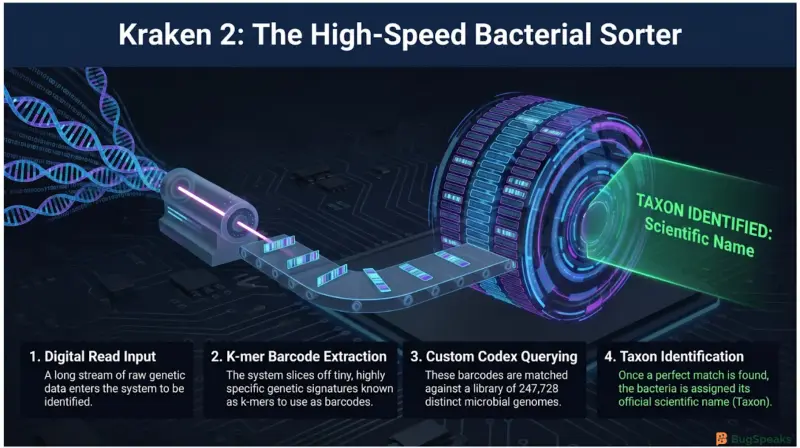
Kraken 2 is an ultra-fast computational sorting machine that identifies unknown bacteria by matching tiny pieces of their genetic code against a massive master reference library. Once your pristine, noise-free data successfully passes the MetaRich security checkpoints, it moves deep into the facility's sorting and identification department. Because a single human gut sample produces massive amounts of complex data representing thousands of different microscopic species, the facility requires a specialized, heavy-duty tool to categorize them instantly. This industrial sorting tool is known as Kraken 2.
Instead of drastically slowing down the facility by trying to read the entire massive genetic book of a bacteria all at once, the Kraken 2 sorting machine quickly extracts tiny, highly specific overlapping barcodes from the incoming data stream. In computational biology, these tiny signature barcodes are known as k-mers. By focusing strictly on these tiny, mathematically distinct k-mers, the Kraken 2 machine can process millions of genetic fragments at blinding speeds. It takes these extracted barcodes and throws them into a massive, spinning reference archive for immediate cross-referencing.
However, a sorting machine is only as smart as the dictionary it uses to translate the barcodes. Standard public databases often miss the rare, fragile bacteria that live deep within the human digestive tract, creating dangerous blind spots for patients. To permanently solve this, the Kraken 2 machine inside our facility is connected directly to a proprietary, custom-built library known as the Custom Codex. This massive digital archive contains exactly 2,47,728 distinct, highly curated microbial genomes. When the Kraken 2 sorting machine finds a perfect match between your tiny biological barcode and the massive Custom Codex, it instantly and permanently assigns the correct official Taxon, or biological name, to that bacteria. This ensures that even the most obscure, microscopic probiotics in your system are successfully identified.
How do the analytics engines turn bacterial names into dietary actions?
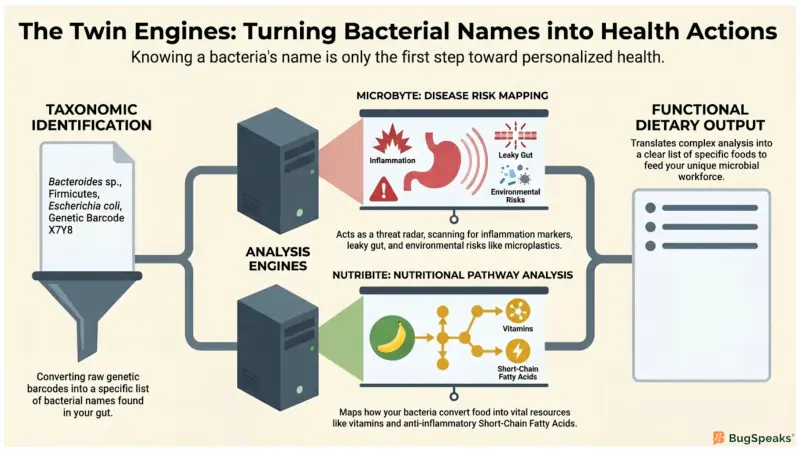
Our advanced analytics engines translate raw bacterial names into personalized dietary actions by analyzing exactly what those specific bacteria actively produce inside your body. Simply knowing the complicated scientific name of a bacteria is not enough to actually improve your health. The facility must figure out exactly what that bacteria is manufacturing on the factory floor, and how those products interact with your cells. To achieve this, the MetaRich operating system utilizes two highly advanced production analytics engines: MicroByte and NutriBite.
The MicroByte engine acts as the facility's disease and threat radar. It takes the long list of bacteria identified by the Kraken 2 sorting machine and maps them against known human health risks. For example, if MicroByte notices that you have a severe lack of the bacteria responsible for protecting your stomach lining, and a massive overgrowth of bad bacteria that cause swelling, it will immediately flag a high risk for systemic inflammation and leaky gut. It is so advanced that it even scans for modern environmental threats, such as biological markers indicating high microplastic exposure. If MicroByte sees a threat, it generates a direct warning so you can take preventative action before you ever feel sick.
Working right beside it is the NutriBite engine, which acts as the facility's nutritional pathways mapper. NutriBite analyzes your specific bacteria to see if they are successfully breaking down your food to manufacture vital resources. It looks specifically for the production of Short-Chain Fatty Acids (SCFAs), which are critical, soothing chemicals that lower internal inflammation and help your body absorb essential minerals like calcium. If NutriBite sees that your factory is not producing enough of these vital chemicals, it will directly recommend specific complex prebiotic foods designed to feed those exact struggling bacteria. To ensure these recommendations are always safe and accurate, both of these engines undergo a complete, rigorous knowledge update cycle every six months.
How does cohort comparison finalize your personalized wellness score?

Your personalized wellness score is finalized by mathematically comparing your unique microbial workforce against a massive database of thousands of perfectly healthy individuals to find your optimal balance. In the science of the microbiome, raw numbers mean very little on their own. To truly understand if your internal ecosystem is operating in a state of healthy balance, known as Eubiosis, or a state of toxic imbalance, known as Dysbiosis, we must contextualize your data. The final stage of the facility involves the reporting dashboards, mapping your specific bacterial levels onto a massive statistical spectrum based on healthy populations.
Instead of using rigid, robotic cutoffs that claim a certain bacteria is always universally "good" or always "bad," our comparison algorithms recognize that human biology is highly flexible. We project your unique factory blueprint against thousands of highly optimized, healthy factories. If your levels of beneficial bacteria fall directly within the safe, active zones of these healthy populations, you are marked in the optimal green zone. If your biological levels drift dangerously far away from the healthy standard, perhaps due to a poor diet or recent antibiotic use, the dashboard highlights these specific areas in warning orange or critical red. This spectrum ensures your goals are actually biologically attainable.
All of this comparative data is finally processed by the Advanced Interpretation Engine, which calculates your ultimate RychIndex Score. This single, easy-to-read number from 0 to 100 represents the total resilience, diversity, and efficiency of your entire biological space station. It actively rewards you for having a highly diverse workforce and penalizes your score if pathogens or inflammation markers are too high. While this score is an incredibly powerful wellness tool, it is computer-generated and non-diagnostic, meaning it should be used to empower your daily lifestyle choices and discussed with your medical practitioner. Securing this deep biological data is the first step in taking command of your health portfolio. With BugSpeaks personalized microbiome testing, you receive this fully decoded flight map, allowing you to bypass the guesswork and provide your unique microbial crew with the exact nutritional fuel they need to thrive.
-Abhishek Lakshmipathy
Visualize the process- https://youtu.be/wODxvqCNv8M