What happens to your gut during back-to-back wedding feasts?
During back-to-back wedding feasts, your digestive system experiences acute nutrient overload, leading to microbial shifts, compromised barrier function, and systemic inflammation.
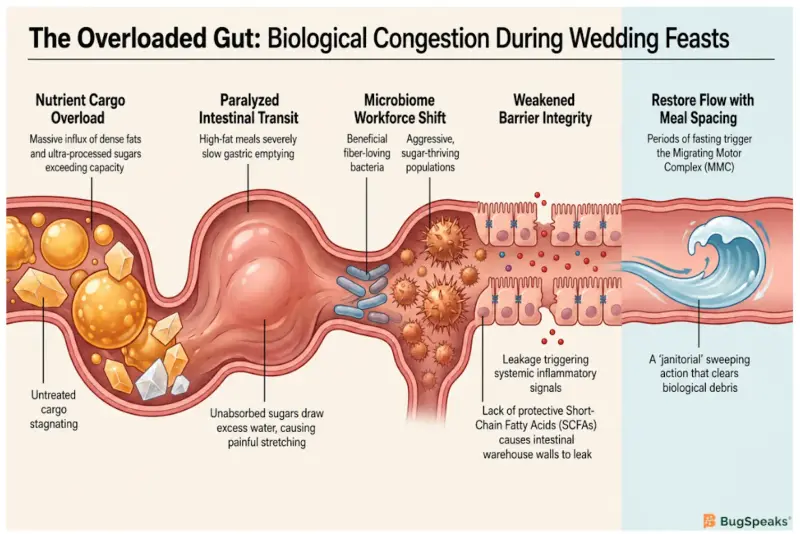
Your gastrointestinal tract functions as a highly coordinated sequence of organs designed to extract nutrients from the food you eat. Under normal conditions, this biological network processes incoming meals at a steady, manageable pace. However, wedding season eating typically involves consecutive, highly concentrated meals that are often rich in fats, sugars, and heavily refined ingredients. This creates an immediate and intense metabolic burden on your body. When you consume large volumes of heavy food day after day, the physical capacity of your stomach and intestines is pushed to its limits. The sheer volume of nutrients demands massive amounts of digestive fluids, while the high fat content severely slows down gastric emptying.
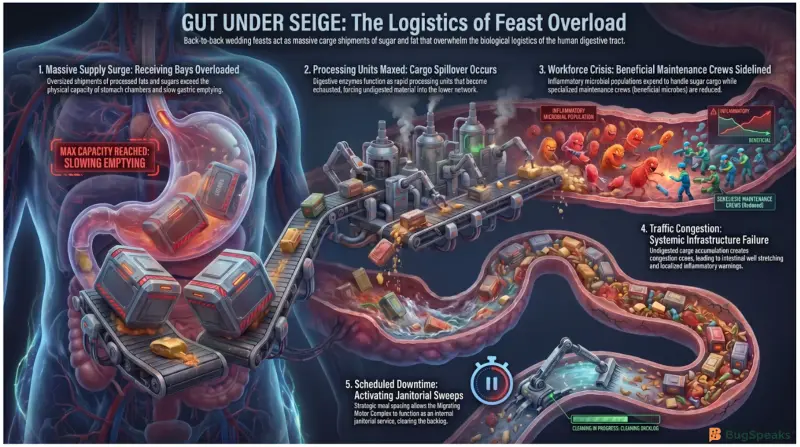
To understand this biologically, we can visualize your digestive system as a large-scale food distribution infrastructure. This infrastructure is perfectly designed to handle a steady, predictable flow of daily shipments. However, festival meals act as sudden supply surges. Instead of a balanced delivery of goods, massive crates of highly concentrated, difficult-to-process cargo are dumped into the receiving bays all at once. The infrastructure simply does not have the physical space or the transport capacity to move this much material smoothly through the system. As a result, the natural rhythm of your digestion is severely disrupted, causing the entire biological operation to strain under the pressure.
This strain is significantly worsened when the meals consist heavily of ultra-processed foods. These are industrially created formulations that lack structural integrity, contain artificial additives, and are stripped of natural nutrients. Frequent exposure to these foods is directly associated with a higher risk of adverse cardiometabolic outcomes and increased systemic inflammationLane et al. (2024). Because these foods bypass normal digestive pacing, they hit your system rapidly. In our environment, this means the sudden supply surges are composed of chemically modified cargo that the infrastructure was never designed to handle safely.
Furthermore, this rapid influx directly impacts your gut microbes. Trillions of bacteria live in your large intestine and play a crucial role in maintaining your health. These microbes act as the support logistics workforce for your distribution infrastructure. When they are bombarded with an endless surge of refined fats and sugars, the workforce becomes overwhelmed. The specialized workers who handle complex, healthy materials are sidelined, while the workers who thrive on simple sugars begin to over-multiply. This creates a severe imbalance in the workforce, causing structural stress along the distribution lines and leading to widespread inflammation throughout your body.
Why do consecutive heavy meals cause bloating and digestion slowdowns?
Consecutive heavy meals cause bloating and digestion slowdowns because the rapid influx of high-fat and high-sugar foods overwhelms digestive enzymes and severely slows down intestinal transit time.
When food enters your small intestine, your pancreas and gallbladder release specific enzymes and bile to break down carbohydrates, proteins, and fats into absorbable molecules. However, the human body can only produce a limited amount of these biological tools at any given moment. During a massive wedding feast, the volume of macronutrients far exceeds your immediate enzymatic capacity. Because the food cannot be fully broken down, a large portion of undigested material is forced to move prematurely into the large intestine. Once there, the resident bacteria rapidly ferment this undigested food, producing excessive amounts of gas. Simultaneously, the high concentration of unabsorbed sugars draws excess water into the intestines through osmosis, leading to uncomfortable stretching of the intestinal walls.
We can clearly see this mechanism by looking at our large-scale food distribution infrastructure. The enzymes in your gut function as the rapid processing units of the network. Their job is to quickly break down incoming cargo so it can be shipped out to the body. However, when the sudden supply surges arrive faster than these units can operate, untreated cargo spills over into the lower network. This massive accumulation creates severe traffic congestion zones. Biologically, you experience these congestion zones as painful bloating, excessive gas, and localized intestinal inflammation.
To make matters worse, these heavy festival meals typically lack dietary fiber. Fiber is essential because it is the primary food source for the specific bacteria that produce Short-Chain Fatty Acids (SCFAs), such as butyrate and acetate. These powerful molecules are responsible for providing energy to the cells lining your gut and keeping the intestinal barrier completely sealedSzrejder and Piwkowska (2025). Without enough fiber, SCFA production drops dramatically. In our distribution network, SCFAs act as the daily maintenance materials that keep the warehouse walls secure. When the support logistics workforce cannot produce these materials, the infrastructure begins to leak and deteriorate, making the traffic congestion zones even more damaging to the surrounding area.
How does feast-induced stress impact your gut bacteria?
Feast-induced stress alters the composition of your gut bacteria, reducing the diversity of beneficial microbes and increasing populations that thrive on simple sugars and fats.
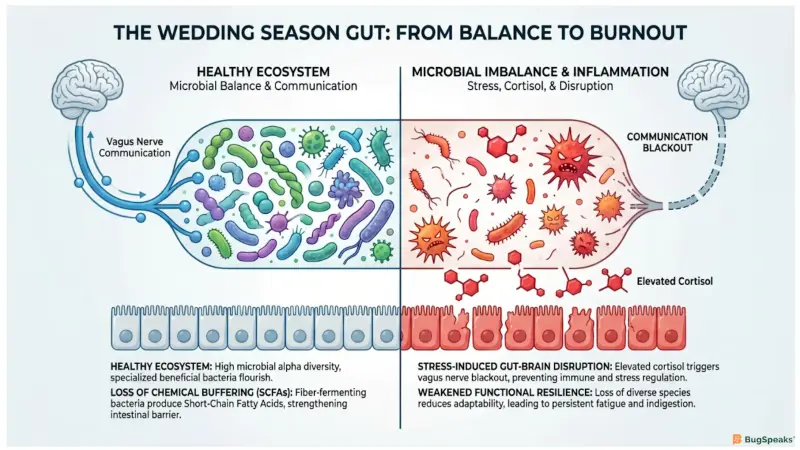
Wedding season is not just a dietary challenge; it is also a physical and psychological challenge. Late nights, alcohol consumption, travel, and constant socializing trigger your body's stress response, specifically activating the release of stress hormones like cortisol. This acute stress directly impacts the environment of your gut. Scientific research demonstrates that acute stress causes a measurable deviation from bodily homeostasis, and this stress reactivity is heavily modulated by your gut microbiome. Specifically, individuals with higher microbial alpha diversity, a measure of how many different beneficial species are present in the gut, show significant fluctuations in their cortisol levels and subjective stress when challengedKarner et al. (2026).
In the context of the large-scale food distribution infrastructure, acute stress acts like a severe communication breakdown across the entire facility. The support logistics workforce relies on highly diverse teams of specialized workers to handle different types of cargo efficiently. However, the combination of sudden supply surges and systemic stress causes the overall diversity of this workforce to drop. The specialized workers who maintain order begin to die off, leaving behind only the most aggressive teams that thrive on the chaotic influx of refined sugars.
When your gut loses this essential microbial diversity, it loses its functional resilience. A healthy, diverse microbiome normally produces specific anti-inflammatory signals that travel through the vagus nerve to calm the brain and regulate the immune system. Certain bacteria are inferred to possess the metabolic pathways necessary to produce propionate and butyrate, which are crucial for blunting the physiological damage of stressKarner et al. (2026). When back-to-back feasts destroy these specific bacterial populations, your body loses its chemical buffering system.
Consequently, the distribution network becomes highly fragile. Because the specialized members of the support logistics workforce are missing, the infrastructure cannot adapt to new incoming shipments. The communication blackout prevents the rapid processing units from coordinating with the lower network. This explains why, after several days of heavy eating and high stress, even a normal meal can suddenly cause extreme discomfort, indigestion, and fatigue. Your biological systems are simply too depleted of diverse bacteria to maintain normal operational standards.
How can fiber and water protect your gut during wedding season?
Fiber and water protect your gut during wedding season by maintaining healthy intestinal transit times and feeding the beneficial bacteria that produce protective short-chain fatty acids.
Dietary fiber is a unique type of carbohydrate that human digestive enzymes cannot break down. Because it resists digestion in the small intestine, it travels fully intact into the large intestine. Here, it absorbs water, adding bulk and softness to your stool, which stimulates the muscular contractions of the intestinal walls to push waste out of the body. Water works directly alongside fiber to ensure that the contents of the digestive tract remain hydrated and mobile. Together, they prevent the stagnation of food, which is the primary cause of bacterial overgrowth and toxin accumulation in the gut.
In our large-scale food distribution infrastructure, fiber and water act as essential flow stabilizers. They ensure that cargo moves smoothly and continuously along the conveyor belts, preventing bottlenecks. When you introduce flow stabilizers during a period of sudden supply surges, they force the untreated cargo to keep moving. This physical movement prevents the formation of massive traffic congestion zones, ensuring that the supply lines remain clear and the infrastructure does not back up into the upper receiving bays.
Biologically, fiber does much more than just move waste; it is the critical fuel for your microbiome. When gut bacteria ferment fiber, they generate SCFAs. These molecules actively lower the pH of the colon, creating a hostile environment for harmful pathogens while suppressing inflammatory pathways like Nuclear Factor-Kappa B (NF-κB)Szrejder and Piwkowska (2025). Additionally, incorporating traditional fermented foods can introduce beneficial Lactic Acid Bacteria (LAB) into your system. These specific bacteria have strong antimicrobial properties and can produce exopolysaccharides, which are natural compounds that further stabilize the physical texture of the gut environmentAtter et al. (2025).
By providing your logistics workforce with flow stabilizers, you empower them to do their jobs efficiently. The fiber feeds the specialized workers, allowing them to rapidly produce the necessary maintenance materials (SCFAs) to repair the warehouse walls. Meanwhile, the beneficial LAB acts as temporary reinforcements, helping the workforce break down complex cargo and neutralize any toxic spills that occurred during the feast overload.
What is the best strategy for spacing meals and recovering from feast overload?
The best strategy for recovering from feast overload is to space out meals and prioritize plant-based, minimally processed foods to restore microbial balance and allow digestive inflammation to subside.
Your digestive system requires periods of complete fasting to perform essential internal maintenance. When you stop eating for several hours, your body initiates a biological process called the migrating motor complex (MMC). This is a series of strong, sweeping muscular contractions that travel from the stomach down through the intestines. The MMC acts as an internal janitorial service, sweeping residual undigested food, cellular debris, and excess bacteria out of the upper gastrointestinal tract and into the colon. Continuous snacking or eating back-to-back heavy meals completely paralyzes this sweeping action, leading to bacterial overgrowth in the small intestine and persistent, lingering inflammation.
If we look at the large-scale food distribution infrastructure, the necessity of meal spacing becomes visually obvious. A massive distribution center cannot receive sudden supply surges 24 hours a day without eventually failing. The facility requires scheduled downtime to clean the floors, repair the conveyor belts, and reset the rapid processing units. If the shipments never stop arriving, the support logistics workforce never gets a single moment to clear the existing traffic congestion zones, resulting in a total operational breakdown.
To properly recover, you must strategically minimize your exposure to ultra-processed foods, which are strongly linked to the incidence of type 2 diabetes, obesity, and all-cause mortalityLane et al. (2024). By providing your gut with clear windows of rest, such as a 12 to 14-hour overnight fast and reintroducing nutrient-dense whole foods, the gut lining has the opportunity to repair itself. The inflammation in the tissue subsides, and the specific receptors on your cells (such as GPR43 and GPR109A) can once again properly receive the protective SCFA signals produced by your recovering microbiomeSzrejder and Piwkowska (2025).
By implementing structured meal spacing, you are essentially pausing the chaotic deliveries at the receiving bays. This vital pause gives the rapid processing units time to recharge and allows the support logistics workforce to finally clear out the backlogged cargo, ensuring your body is fully prepared and structurally sound for the next event of the season.
-Varsha V
Visualize the process- https://youtu.be/sOYtDgskcew
Reference
Karner, Thomas, Paul AG Forbes, David Berry, and Isabella C. Wagner. "Gut microbial diversity and inferred capacity to produce short-chain fatty acids are associated with acute stress reactivity in healthy adults." Neurobiology of Stress (2026): 100807.
https://www.sciencedirect.com/science/article/pii/S2352289526000287 Lane, M. M., Gamage, E., Du, S., Ashtree, D. N., McGuinness, A. J., Gauci, S., ... & Marx, W. (2024). Ultra-processed food exposure and adverse health outcomes: umbrella review of epidemiological meta-analyses. bmj, 384.
https://www.bmj.com/content/384/bmj-2023-077310 Atter, A., Diaz, M., Mayer, M. J., Tano-Debrah, K., Kunadu, A. P., Owusu-Kwarteng, J., Amoa-Awua, W., & Narbad, A. (2025). Technological and probiotic properties of lactic acid bacteria and yeasts isolated from Ghanaian spontaneously fermented pearl-millet porridge, Hausa koko. BMC microbiology, 26(1), 1. https://doi.org/10.1186/s12866-025-04537-9
Szrejder, M., & Piwkowska, A. (2025). Gut Microbiome-Derived Short-Chain Fatty Acids in Glomerular Protection and Modulation of Chronic Kidney Disease Progression. Nutrients, 17(17), 2904. https://doi.org/10.3390/nu17172904