Your Gut's Hidden Power: Making Its Own B-Vitamins
What defines the biochemical laboratory conditions of the human intestinal environment?
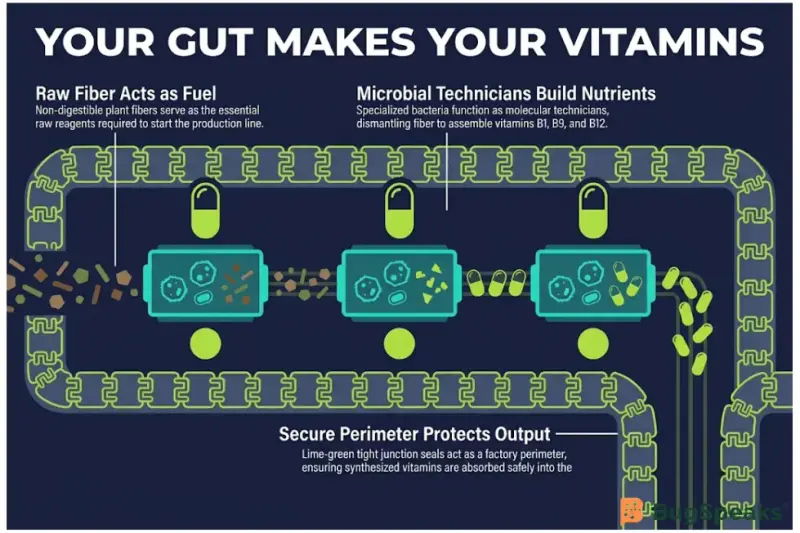
The human intestinal environment is defined by a highly regulated, compartmentalized sequence of spatial gradients encompassing strict pH controls, varying oxygen tensions, and precise transit times that collectively function as a high-precision reaction chamber for microbial organic synthesisSandhu & Radhakrishnan (2025). The upper gastrointestinal tract operates under extreme environmental stressors, maintaining a low pH to break down incoming materials, which permits only highly specialized, acid-resistant molecular technicians to survive. In stark contrast, the distal large intestine functions as the ultimate biological clean room, characterized by delayed transit times and an environment of strict anaerobiosis. This pristine, oxygen-depleted colonic sector hosts the highest density of specialized technicians on Earth, ensuring the laboratory remains at peak functional capacity.
How do specific microbial populations maintain these clean room conditions?
Specific microbial populations maintain these precise clean room conditions by organizing into a layered, functional division of labor that meticulously regulates the biochemical laboratory's internal stabilitySandhu & Radhakrishnan (2025). Luminal microbes reside freely within the central reaction chamber, functioning as the primary operators of nutrient fermentation and the enzymatic assembly of postbiotic metabolites. Concurrently, mucosal microbes adhere to the laboratory walls to act as the facility's security and maintenance team. By processing incoming chemical substrates into short-chain fatty acids (SCFAs), these obligate anaerobes sustain the strict homeostatic conditions required for complex, oxygen-sensitive organic syntheses, including the manufacturing of vital B-vitamins.
How do plant-based dietary substrates act as reagents for human microbial synthesis?
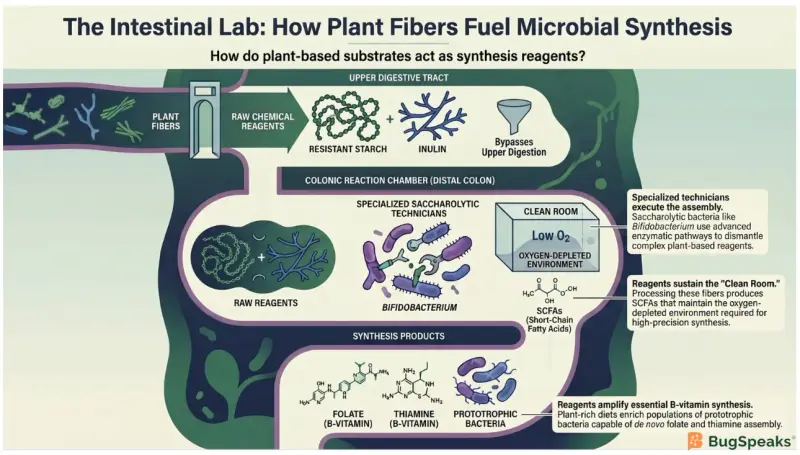
Plant-based dietary substrates act as essential chemical reagents for human microbial synthesis by providing complex, non-digestible polysaccharides that bypass early host digestion to fuel the colonic reaction chamberEgas-Montenegro et al. (2026). Certain complex carbohydrates, such as resistant starch, possess sturdy structures that survive the acidic transit through the upper facility. Upon arrival in the distal large intestine, these raw chemical reagents are systematically dismantled by highly specialized saccharolytic bacteria. These technicians function like biological processors, breaking down the tough plant fibers into smaller molecules and converting them into a diverse array of bioactive outputs.
Table 1: Laboratory Reagent Intake and Microbial Processing
In what ways do these plant-based reagents amplify the synthesis of essential B-vitamins?
Plant-based reagents amplify the synthesis of essential B-vitamins by actively enriching the populations of specialized prototrophic bacteria capable of executing de novo organic assemblyEgas-Montenegro et al. (2026). The introduction of fiber-rich plant substrates creates an optimal biochemical environment that significantly upregulates folate biosynthesis. Furthermore, plant-derived phytochemicals, particularly polyphenols and flavonoids, function as secondary regulatory reagents. They actively favor a healthy Firmicutes-to-Bacteroidetes ratio and inhibit the adhesion of opportunistic pathogens, ensuring that the synthesis workstations remain uncontaminated and highly efficient.
What are the precise enzymatic mechanisms driving the microbial Thiamine (B1) synthesis workstations?
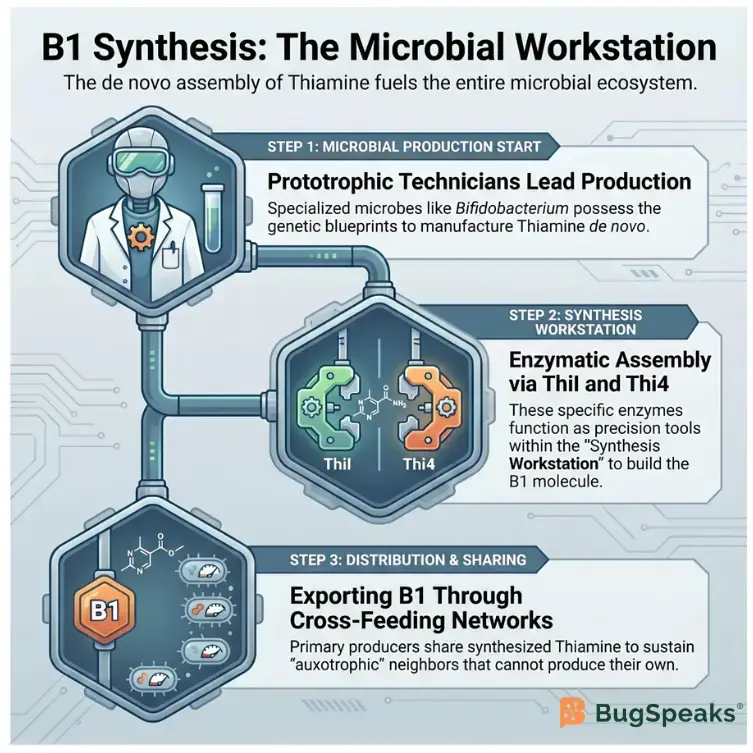
Microbial Thiamine (B1) synthesis workstations are driven by highly conserved, precise enzymatic mechanisms wherein prototrophic bacteria utilize specialized enzymatic tools, specifically Thi1 and Thi4 to construct the vitamin entirely de novoXia et al. (2025). This organic synthesis is predominantly executed by keystone technicians such as Bifidobacterium, which possess the genetic blueprints required to manufacture the active molecule. Crucially, these primary producers also export synthesized thiamine into the environment, engaging in cross-feeding networks to sustain auxotrophic bacteria that inherently lack these capabilities. This cooperative exchange ensures that even the less specialized residents can continue their roles in the laboratory facility.
How do obesity-related metabolic shifts reduce the production efficiency of Thiamine (B1)?
Obesity-related metabolic shifts reduce the production efficiency of Thiamine (B1) by depleting essential prototrophic technicians and forcing the workforce to rely on inefficient salvage pathwaysXia et al. (2025). In the absence of robust de novo synthesis, the altered community shifts its metabolic strategy toward the Salvage II Pathway, which is a scavenging protocol designed to collect fragmented thiamine parts simply to survive. This shift is heavily exploited by opportunistic pathogens, which overgrow and prioritize rapid, inefficient fermentation over meticulous vitamin synthesis. This thiamine deficiency dismantles the laboratory's bacterial cross-feeding networks and compromises the host's systemic balance.
Table 2: Comparison of Thiamine Production in Normal vs. Obese Lab Conditions
How do microbially synthesized Folate (B9) and Cobalamin (B12) maintain human epithelial integrity?
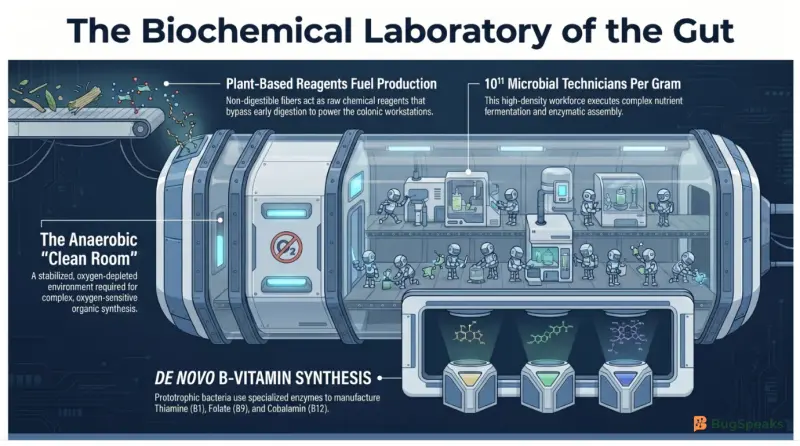
Microbially synthesized Folate (B9) and Cobalamin (B12) maintain human epithelial integrity by serving as mandatory cofactors within one-carbon metabolism, which regulates enterocyte differentiation and DNA repairHossain et al. (2026). When the laboratory fails to supply these critical outputs, the intestinal walls start to crumble. Deficiency in these vitamins triggers a significant hyperplastic response, an emergency biological attempt to expand the surface area for nutrient uptake. Simultaneously, the lack of B9 and B12 interrupts proper goblet cell function, leading to a reduction in the protective moisture layer and leaving the epithelium physically unprotected and exposed to inflammation.
In what ways do B-vitamin deficiencies disrupt systemic metabolic homeostasis?
Deficiencies in microbially-derived B-vitamins disrupt systemic metabolic homeostasis by destabilizing hepatic detoxification processes and driving the accumulation of toxic byproductsHossain et al. (2026). Without adequate B9 and B12 to sustain the synthesis of methyl donors, the capacity for waste disposal in the liver plummets. This forces the host to export elevated volumes of metabolic conjugates directly back into the colonic environment. Within the altered laboratory, specific technicians utilize beta-glucuronidase to cleave these conjugates, resulting in a toxic accumulation of free glucuronic acid. This biochemical failure forces a massive shift in the overall microbial metabolite profile, leaking hazardous chemicals into the body.
What structural disruptions does dysbiosis create to impede vitamin absorption?
Dysbiosis creates structural disruptions to vitamin absorption by degrading the moisture barrier and fracturing the epithelial tight junctionsSandhu & Radhakrishnan (2025). Dysbiosis acts as a strike within the facility, depleting mucin-regulating specialists like Akkermansia muciniphila. This establishes a state of elevated intestinal permeability, often referred to as a "Leaky Lab," where the walls are no longer solid but full of gaps. In this state, synthesized B-vitamins become trapped in an inflamed environment, prevented from safely traversing into the host's systemic circulation.
How do biological cascades disrupt human intestinal transport systems?
Biological cascades disrupt human intestinal transport systems by triggering metabolic endotoxemia and driving the production of inflammatory cytokinesSandhu & Radhakrishnan (2025). As clean room conditions deteriorate, opportunistic bacteria release massive quantities of lipopolysaccharides (LPS), which act like biohazard spills. This LPS load triggers the facility's alarm system, leading to the creation of a biological roadblock. In an attempt to contain the spill, the body shuts down its transport proteins, ensuring that any residual vitamins synthesized by the remaining workforce cannot be properly absorbed by the host.
How does the SLC Transport System act as the laboratory's exit units?
The SLC (Solute Carrier) Transport System acts as the primary exit units for synthesized vitamins by utilizing dedicated transport proteins to move finished products through the epithelial wallsSandhu & Radhakrishnan (2025). Even when technicians are at peak production, the host only benefits if these specialized SLC19A2 units are fully functional. During a security breach, high levels of the pro-inflammatory signal TNF-α act as a structural dismantling crew. This systematic removal ensures that no material can exit the reaction chamber, effectively trapping the laboratory's output and leaving the host in a state of nutrient starvation.
Table 3: SLC Transport Unit Specifications and Disruptions
How does the Microbial Tax Shield ensure the laboratory's oxygen-free status?
The production of Butyrate serves as a vital Microbial Tax Shield by fueling the host’s local oxygen-scrubbing equipmentEgas-Montenegro et al. (2026). This fatty acid stimulates a state of Physiological Hypoxia through the activation of the HIF-1α regulatory protein. By consuming all available oxygen at the laboratory's boundary, this "Tax Shield" prevents atmospheric contamination from leaking into the deep reaction chamber. When this payment system fails, the resulting oxygen leak poisons the environment for the anaerobic workforce, causing a total crash in the B-vitamin synthesis workstation.
How does Trace Mineral Logistics impact the production of Cobalamin (B12)?
Trace mineral logistics impact the production of Cobalamin (B12) by ensuring the delivery of Rare Parts, specifically Cobalt, which molecular technicians require to finalize synthesisHossain et al. (2026). Unlike other vitamins built from common reagents, B12 assembly relies on a procurement chain that must deliver cobalt atoms directly to synthesis workstations. If this chain is interrupted, the workstation enters a state of Stalled Assembly. Furthermore, the laboratory equipment requires lubricating co-factors, such as magnesium and zinc, to keep the enzymatic processes turning efficiently.
How does Quorum Sensing function as the laboratory's wireless communication network?
Quorum Sensing functions as the laboratory's wireless communication network by allowing molecular technicians to release and detect autoinducers to coordinate their production schedulesXia et al. (2025). This high-bandwidth system ensures that workstations only turn on when the workforce has reached a sufficient density. However, during states of dysbiosis, signal jamming occurs when pathogens release noise signals that mimic these messages to confuse the workforce. This chemical interference can lead to a premature shutdown of synthesis workstations, effectively paralyzing the laboratory's primary communication infrastructure.
Visualize the process- https://youtu.be/0U6_SoiS3qA
Reference
Xia Y, Lu L, Wang L, Qiu Y, Liu X and Ge W (2025) Multi-omics analyses reveal altered gut microbial thiamine production in obesity. Front. Microbiol. 16:1516393. doi: 10.3389/fmicb.2025.1516393
Egas-Montenegro E, Echeverria-Chilla J, García-Ulloa M, Aizaga-Benalcazar C and Ordoñez-Araque R (2026) The influence of a plant-based diet on the composition and functions of the human gut microbiota: a review. Front. Nutr. 13:1774375. doi: 10.3389/fnut.2026.1774375
Sandhu, A. H., & Radhakrishnan, A. (2025). Gut Biome-Mediated Barriers to Nutrient Absorption: Investigating the Impact of Dysbiosis. Microbiology Research, 16(11), 241. https://doi.org/10.3390/microbiolres16110241
Hossain, K. S., Rasouli, A., Amarasena, S., Kroezen, Z., Kurysko, N., Shanmuganathan, M., Brunton, J. A., Lamers, Y., Tahlan, K., Britz Mckibbin, P., & Mayengbam, S. (2026). Dietary Vitamin B-9 and B-12 Deficiencies Alter Gut Homeostasis in Sprague-Dawley Rats. The Journal of nutrition, 156(4), 101385. https://doi.org/10.1016/j.tjnut.2026.101385