# How to Support Your Gut Health: The Importance of Vitamin D
Author: Neha Rao
Author URL: https://www.bugspeaks.com/blog/author/neha-rao
Published: 2026-08-18
Category: Diet and Supplements
Category URL: https://www.bugspeaks.com/blog/category/diet-and-supplements
Meta Title: Vitamin D and Gut Health: Probiotic Support | BugSpeaks
Meta Description: Explore vitamin D and gut health, and learn how probiotics may support the gut barrier, microbiome balance, and metabolic health. Read the science today!
Tags: Gut Health, Vitamin D
Tag URLs: Gut Health (https://www.bugspeaks.com/blog/tag/gut-health), Vitamin D (https://www.bugspeaks.com/blog/tag/vitamin-d)
URL: https://www.bugspeaks.com/blog/vitamin-d-gut-health-probiotics
## Why does a high-end probiotic supplement fail to work if your body lacks enough sunshine vitamins?
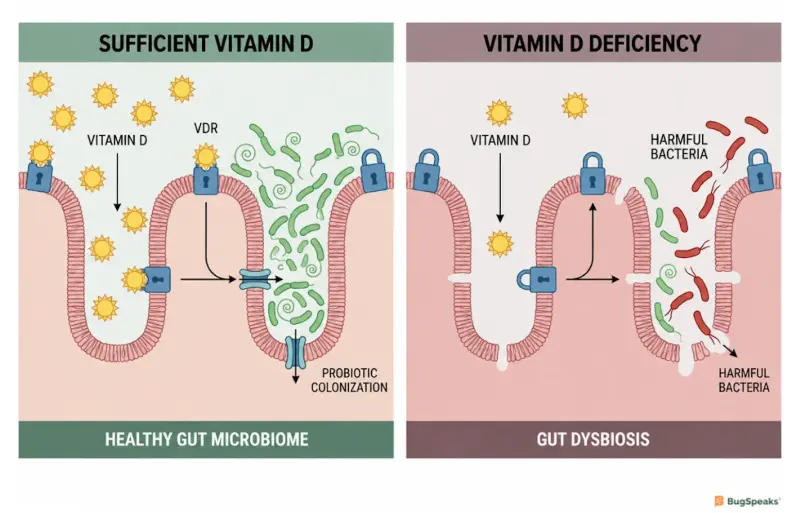
A high-end probiotic supplement cannot function properly without optimal vitamin D levels because friendly bacteria require vitamin D to activate the Vitamin D Receptors (VDR) on our gut lining and prepare the physical environment for colonization. In our gut, which serves as a massive shared workspace, these friendly bacteria act as microbial partners trying to set up helpful workshops. However, if the essential host nutrient, vitamin D, is missing from this shared workspace, the doors remain completely locked. The microbial partners of beneficial probiotic strains like Lactobacillus and Bifidobacterium cannot find a comfortable place to attach or work. They simply pass through without helping us, which makes even the most expensive supplements for our body [Barkhidarian (2021)](https://doi.org/10.3390/nu13093001).
Without this host nutrient, the collaborating populations of local bacteria inside the shared workspace begin to shift. Friendly microbial partners are forced out, leaving room for unfriendly microbes to take over and cause trouble. Our coordinating partner, which is the immune system, also gets confused and starts overreacting because the workspace is messy and uncontrolled. This coordination breakdown means that just eating more probiotics will not fix the issue at all. You must first ensure there is enough vitamin D to help the coordinating partner guide the new microbial partners safely into their assigned seats [Pagnini (2021)](https://doi.org/10.3389/fphar.2021.747856).
This essential connection between the host nutrient and microbial partners is what scientists call a synergistic relationship, meaning they work much better together than alone. When you have enough vitamin D, it acts like a friendly invitation that helps the coordinating partner maintain a peaceful environment for the new arrivals. This peace allows the incoming microbial partners to settle down, multiply, and start producing healthy substances for your body's wellness and overall digestive strength. If you ignore your vitamin D levels, your high-end probiotics will never have the chance to build a healthy gut community [Tabatabaeizadeh (2018)](https://doi.org/10.4103/jrms.JRMS_606_17).
**Shared Workspace**\- The physical environment inside our gut where microbes live and work together.
**Microbial Partners**\- Friendly probiotic bacteria that work with our body to keep us healthy.
**Host Nutrient**\- An essential vitamin or mineral (like vitamin D) that the body provides to support microbial survival.
**Collaborating Populations**\- Different groups of friendly and native bacteria living inside our digestive system.
**Coordinating Partner**\- The immune system, which monitors and manages the shared workspace to keep it safe.
**Immune System**\- Your body's active defense team and coordinating partner that keeps dangerous germs away while learning to peacefully welcome and protect friendly probiotic bacteria in our gut workspace.
## How does vitamin D help friendly bacteria settle into their new gut home?
Vitamin D helps friendly bacteria settle into their new gut home by activating a special receptor called the Vitamin D Receptor (VDR). This important receptor is found in large numbers on gut epithelial cells, which line the entire digestive tract. There are about one thousand times more in the gut than in the liver! When the host nutrient binds to this lock, it sends a strong signal to prepare the shared workspace to receive incoming friendly microbial partners safely and easily [Zeng (2020)](https://doi.org/10.1152/ajpgi.00286.2019).
This signaling process is critical because it teaches our mucosal immunity, the gut's local security team, how to stay calm and welcoming. Under normal conditions, the security team might view any new bacteria as a threat, but the unlocked receptor tells them to allow friendly microbial partners to build their homes. This careful control prevents a harmful, overactive response that could lead to painful, pathogenetic swelling, tissue damage, and chronic disease inside the digestive tract. By keeping the security team informed, the host nutrient ensures that the entire workspace remains in a healthy state of balance, known as homeostasis [Pagnini (2021)](https://doi.org/10.3389/fphar.2021.747856).
When this balance is well maintained, the friendly bacteria can easily attach to the gut lining and start their helpful work. They quickly form large families that protect us, while the unlocked receiving locks continue to send signals that keep the physical environment strong and healthy. Without enough vitamin D to turn these locks, the gut walls cannot prepare for these friendly populations at all. The security team stays on high alert, creating a hostile environment where beneficial microbes cannot survive for more than a few hours before being completely swept away from the body by the physical flow [Akimbekov (2020)](https://doi.org/10.1267/ahc.20011).
**Simulation Component**
**Biological Entity**
**Core Function inside Gut**
**Systemic Impact if Lacking**
Host Nutrient
Vitamin D3
Opens biological locks to welcome friendly microbes
Probiotics cannot colonize and are wasted
Receiving Lock
Vitamin D Receptor (VDR)
Sits on cells to receive vitamin D signals
Immune system becomes overactive
Security Guard
Mucosal Immunity
Keeps bad germs out while welcoming partners
Severe inflammation and gut lining damage
**Vitamin D Receptor (VDR)**\- A special molecular lock on our cells that only vitamin D can open to send healthy signals.
**Gut Epithelial Cells**\- The thin layer of cells that line our gut walls to act as a physical barrier.
**Mucosal Immunity**\- The gut's local immune system that protects the lining and manages the doors.
**Pathogenetic**\- Anything that is capable of causing diseases, harmful swelling, or tissue irritation.
**Homeostasis**\- A perfectly balanced state of health where all biological systems work smoothly together.
**Gut Lining**\- The thin, protective cell wall inside your digestive tract that acts as a secure border, letting healthy nutrients pass through while blocking harmful toxins from escaping into your bloodstream.
## **In** what ways do gut microbes and vitamin D work together to build a strong biological wall?
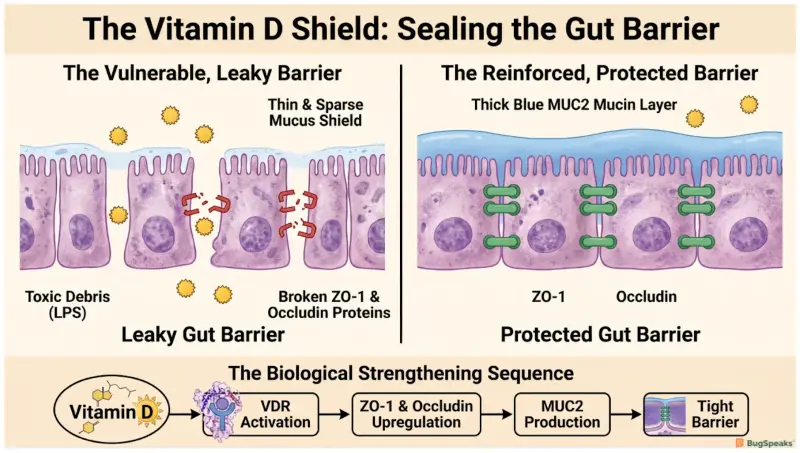
Gut microbes and vitamin D work together to build a strong biological wall by producing tight physical links and specialized protective fluids that keep harmful invaders from entering our bloodstream. The physical wall is held together by specialized microscopic links called tight junction proteins, which act like strong staples sealing the gaps between cells. To protect these cells, the body also produces protective fluids called mucins that form a thick shield over the lining. The host nutrient directly instructs our cells to build these staples and fluids, creating a secure, resilient, and balanced shared workspace for all of our friendly microbes [Zeng (2020)](https://doi.org/10.1152/ajpgi.00286.2019).
At the same time, specialized defense cells at the bottom of the gut walls, known as Paneth cells, produce powerful natural germ-fighters called antimicrobial peptides (AMPs). These germ-fighters, which include protective proteins called alpha-defensins, act like smart security fences in our gut. They are designed to selectively target and eliminate bad bacteria while leaving our friendly microbial partners completely unharmed. This cooperative defense system ensures that the shared workspace remains completely organized and allows the collaborating populations of friendly bacteria to live and work in perfect peace and harmony throughout the day without facing any biological stress [Zhan (2026)](https://doi.org/10.3390/microorganisms14030628).
This elegant partnership creates a double layer of defense that is necessary for our health. The physical staples keep the wall tight and impermeable, while the natural germ-fighters patrol the slippery surface to sweep away any dangerous intruders. If vitamin D levels drop, the physical staples begin to break down, the protective fluid layer thins, and the specialized defense cells stop making these germ-fighters. This leaves the shared workspace completely undefended, allowing bad microbes to damage the wall and cause serious, painful inflammatory issues and long-term biological damage throughout the entire body, which makes you feel tired [Tabatabaeizadeh (2018)](https://doi.org/10.4103/jrms.JRMS_606_17).
**Barrier Component**
**Biological Entity**
**Role in Wall Strength**
**Impact of Vitamin D Lack**
Microscopic Staples
Tight Junction Proteins (ZO-1, Occludin)
Lock cells together to prevent physical leaks
Staples break, creating a leaky gut wall
Slippery Shield
Mucins (MUC2)
Coats the cells so bad bacteria cannot stick
Shield becomes thin and easy to damage
Smart Security Fence
Alpha-Defensins (AMPs)
Kills bad invaders while protecting friendly partners
Defense cells stop producing these protective proteins
**Tight Junction Proteins**\- Microscopic staples that seal the spaces between our gut wall cells to keep them watertight.
**Mucins**\- A protective fluid layer that coats and protects the gut lining.
**Paneth Cells**\- Tiny defense factories at the bottom of the small intestine walls that make natural germ-fighters.
**Antimicrobial Peptides (AMPs)**\- Natural chemical weapons produced by our bodies to destroy harmful bacteria.
**Alpha-Defensins**\- Specific protective proteins produced by Paneth cells to keep bad microbes away.
**ZO-1, Occludin**\- Crucial tight junction proteins that behave like microscopic staples, pinning your gut cells tightly together so that no leaks or gaps can form in the wall.
## What is the biological pathway that allows gut bacteria to increase your active vitamin D levels?
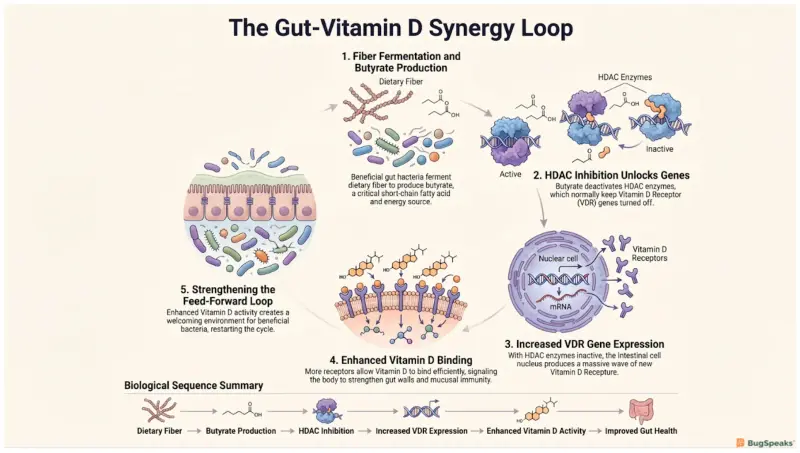
The biological pathway that allows gut bacteria to increase active [vitamin](https://www.bugspeaks.com/blog/vitaminb-guthealth-gutmicrobiome) D levels relies on the production of helpful chemical messengers called short-chain fatty acids (SCFAs) that multiply and unlock our vitamin receptors. These chemical messengers are produced when friendly microbial partners ferment the dietary fibers we eat. One of the most important of these messengers is a substance called butyrate, which acts as a powerful energy source for our gut lining cells. This energetic support helps the cells grow strong, divide quickly, and remain healthy so they can build more receiving locks for the vitamin to latch onto safely [Pagnini (2021)](https://doi.org/10.3389/fphar.2021.747856).
Furthermore, butyrate works by turning off certain blocking enzymes called histone deacetylases (HDACs), which normally keep our receptor genes turned off. By putting these blocking enzymes for a while, butyrate allows our cells to produce a massive wave of new receptors on the [gut wall.](https://www.bugspeaks.com/blog/postbiotics-guthealth-gutmicrobiome) This incredible process creates a feed-forward loop where the microbial partners make more locks, and those locks allow more vitamin D to bind. This mutual support system ensures that both partners can work together at maximum efficiency to keep us healthy. [Akimbekov (2020)](https://doi.org/10.1267/ahc.20011).
Additionally, some specific friendly bacteria can directly help raise the storage form of vitamin D, known as 25-hydroxyvitamin D3 \[25(OH)D3\], in our blood. This storage form of the vitamin has a long half-life of three weeks, acting as a stable reservoir of energy. When certain probiotics are active in the gut, they improve the gut's acidity and aid the direct absorption of fat-soluble nutrients, boosting our overall vitamin levels. This is why having healthy bacteria is just as important as getting regular sunlight exposure for maintaining optimal levels of this sun-derived regulatory hormone to ensure our complete system stays strong [Barkhidarian (2021)](https://doi.org/10.3390/nu13093001).
**Short-Chain Fatty Acids (SCFAs)**\- Healthy chemical messengers made when friendly gut bacteria digest fiber.
**Butyrate**\- A special SCFA that acts as fuel for gut cells and helps activate the VDR.
**Histone Deacetylases (HDACs)**\- Blocking enzymes that turn off healthy genes; disabling them allows VDR production.
**25-hydroxyvitamin D3 \[25(OH)D3\]**\- The storage form of vitamin D measured in blood tests that represents your vitamin reserves.
**Feed-Forward Loop**\- A biological process where a beneficial reaction helps create more of the components needed to repeat itself.
## How does the lack of vitamin D disrupt metabolic signaling and lead to high blood sugar?
The lack of vitamin D disrupts metabolic signaling and leads to high blood sugar by causing the protective gut wall to leak, which allows toxic bacterial debris to enter our bloodstream and cause body-wide irritation. This toxic debris is made of a bacterial outer shell material called lipopolysaccharide (LPS). When our physical wall breaks down due to low levels of the host nutrient, this toxic debris easily slips through the gaps. It enters our blood circulation and acts like a false alarm that confuses our coordinating partner, the local immune system, causing widespread biological confusion and triggering false defense alarms [Zhan (2026)](https://doi.org/10.3390/microorganisms14030628).
Once in the blood, the toxic debris binds to immune sensors called Toll-like receptor 4 (TLR4) on the surface of our defense cells. This binding triggers a state of constant, quiet irritation known as systemic low-grade inflammation throughout the body. This quiet irritation behaves like static noise on a radio, jamming the important communications between our organs and cells. As a result, the body's cells can no longer hear the signal to absorb sugar from our food, leading to a major communication breakdown where energy cannot be managed properly, causing high blood sugar levels and making our cells feel very weak [Zeng (2020)](https://doi.org/10.1152/ajpgi.00286.2019).
This cellular communication breakdown, where cells stop listening to insulin's knocks, is known as insulin resistance \[IR\], which prevents our body from managing blood sugar properly. When this condition lasts for a long time, the pancreas becomes exhausted, and sugar levels remain high, leading to Type 2 Diabetes Mellitus \[T2DM\]. This shows that metabolic health does not just depend on avoiding sugar, but also on keeping the gut wall strong. By maintaining enough vitamin D, you support the physical barrier, prevent toxic leaks, and allow your body's sugar-absorbing signals to work perfectly, naturally, efficiently, and without any cellular blockages, signaling issues, or metabolic breakdowns [Zhan (2026)](https://doi.org/10.3390/microorganisms14030628).
**Lipopolysaccharide (LPS)**\- Toxic fragments from the outer walls of bad bacteria that cause inflammation when they leak into the blood.
**Toll-like Receptor 4 (TLR4)**\- Sensory antennas on immune cells that detect leaked bacterial toxins.
**Systemic Low-Grade Inflammation**\- A state of mild, continuous immune alarm that travels through the blood and irritates tissues.
**Insulin Resistance \[IR\]**\- A condition where cells stop listening to insulin's message to absorb sugar from the blood.
**Type 2 Diabetes Mellitus \[T2DM\]**\- A metabolic condition marked by high blood sugar due to a persistent signaling breakdown.
Visualize the process- [https://youtu.be/edNO\_sOeGRs](https://youtu.be/edNO_sOeGRs)
### Reference
Tabatabaeizadeh, S. A., Tafazoli, N., Ferns, G. A., Avan, A., & Ghayour-Mobarhan, M. (2018). Vitamin D, the gut microbiome and inflammatory bowel disease. _Journal of research in medical sciences : the official journal of Isfahan University of Medical Sciences_, _23_, 75\. [https://doi.org/10.4103/jrms.JRMS\_606\_17](https://doi.org/10.4103/jrms.JRMS_606_17)
Akimbekov, N. S., Digel, I., Sherelkhan, D. K., Lutfor, A. B., & Razzaque, M. S. (2020). Vitamin D and the Host-Gut Microbiome: A Brief Overview. _Acta histochemica et cytochemica_, _53_(3), 33–42. [https://doi.org/10.1267/ahc.20011](https://doi.org/10.1267/ahc.20011)
Pagnini, C., Di Paolo, M. C., Graziani, M. G., & Delle Fave, G. (2021). Probiotics and Vitamin D/Vitamin D Receptor Pathway Interaction: Potential Therapeutic Implications in Inflammatory Bowel Disease. _Frontiers in pharmacology_, _12_, 747856\. [https://doi.org/10.3389/fphar.2021.747856](https://doi.org/10.3389/fphar.2021.747856)
Zhan, Y., Liu, J., Di, Q., & Na, L. (2026). Role of Gut Microbiota in Bridging Vitamin D Deficiency and Type 2 Diabetes Mellitus Pathogenesis. Microorganisms, 14(3), 628. [https://doi.org/10.3390/microorganisms14030628](https://doi.org/10.3390/microorganisms14030628)
Zeng, Y., Luo, M., Pan, L., Chen, Y., Guo, S., Luo, D., Zhu, L., Liu, Y., Pan, L., Xu, S., Zhang, R., Zhang, C., Wu, P., Ge, L., Noureddin, M., Pandol, S. J., & Han, Y. P. (2020). Vitamin D signaling maintains intestinal innate immunity and gut microbiota: potential intervention for metabolic syndrome and NAFLD. _American journal of physiology. Gastrointestinal and liver physiology_, _318_(3), G542–G553. [https://doi.org/10.1152/ajpgi.00286.2019](https://doi.org/10.1152/ajpgi.00286.2019)
Barkhidarian, B., Roldos, L., Iskandar, M. M., Saedisomeolia, A., & Kubow, S. (2021). Probiotic Supplementation and Micronutrient Status in Healthy Subjects: A Systematic Review of Clinical Trials. _Nutrients_, _13_(9), 3001. [https://doi.org/10.3390/nu13093001](https://doi.org/10.3390/nu13093001)
## FAQs
Q: Why can't I just take more high-end probiotics if I have a gut issue?
A: Even the most expensive, high-dose probiotics cannot survive or build healthy populations in your gut if your vitamin D levels are low. Without vitamin D to unlock the VDR on your gut cells, your local immune cells stay on high alert and treat your probiotics as foreign invaders. The gut workspace remains unprepared, meaning the friendly bacteria will simply pass through your body without setting up their helpful workshops.
Q: How does vitamin D prevent "leaky gut" in simple terms?
A: Vitamin D acts like a construction manager that commands your cells to build and repair the gut wall. It tells cells to produce tight junction proteins, which act like tiny metal staples holding the cells tightly together so no gaps form. It also helps your cells secrete mucins (a slippery protective fluid) and tells Paneth cells to produce alpha-defensins (microscopic security guards) that keep bad bacteria away from the wall.
Q: What is the "feed-forward loop" between probiotics and vitamin D?
A: This is a beautiful team effort: when friendly bacteria ferment dietary fibers, they produce a healthy acid called butyrate. Butyrate puts blocking enzymes (HDACs) to sleep, which allows your body to build a massive number of new VDR locks on the gut lining. Having more locks allows more vitamin D to bind, which in turn strengthens the gut wall and helps even more friendly bacteria grow, creating a continuous loop of health.
Q: How does a leaky gut wall lead to high blood sugar and diabetes?
A: When your gut wall is weak and leaky, toxic fragments of bad bacteria (LPS) slip through the gaps and enter your bloodstream. Your immune cells spot these toxins using sensors (TLR4) and sound a continuous false alarm. This alarm creates systemic low-grade inflammation, which acts like loud radio static inside your body. Because of this static, your cells become "deaf" to insulin's message to absorb sugar from your blood, causing sugar to pile up and lead to diabetes.
Q: Is getting sunlight enough, or do I also need a healthy microbiome to maintain vitamin D?
A: You need both! While sunlight helps your skin synthesize vitamin D, your gut microbiome plays a critical role in helping your body absorb and utilize that vitamin. Healthy gut bacteria produce short-chain fatty acids like butyrate that increase the number of vitamin locks (VDR) on your gut wall. Without these bacteria-produced locks, your body cannot efficiently receive and use the vitamin D you make from sunshine or supplements.
---
This blog is powered by Superblog. Visit https://superblog.ai to know more.
---