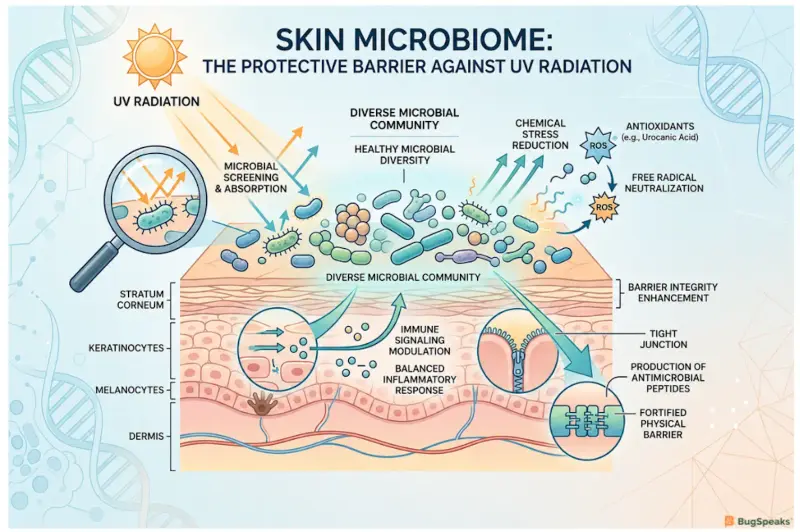
How does the skin microbiome act as an atmospheric shield against UV radiation?
The Skin Microbiome acts as an atmospheric shield by breaking down harmful chemicals created during sun exposure and helping regulate the body’s immune defenses against Ultraviolet Radiation (UVR). The skin itself works like a planetary surface shield, forming the body’s first protective boundary. Living across this surface is a dense community of bacteria, fungi, and other microbes that help stabilize the environment when sunlight strikes the skin.
When Ultraviolet Radiation (UVR) reaches the skin, it triggers chemical reactions in the outer layers. One important reaction involves a molecule called urocanic acid, which normally helps maintain moisture in the skin. UV exposure changes this molecule into cis-Urocanic Acid (cis-UCA), a form that temporarily suppresses local immune activity. In small amounts, this helps prevent excessive inflammation. But when too much accumulates, the skin becomes more vulnerable to infections, irritation, and cellular stress [Patra et al. (2025)].
This is where beneficial skin bacteria become essential. Certain microbes, especially Staphylococcus epidermidis, contain an enzyme called urocanase. These bacteria consume excess cis-Urocanic Acid (cis-UCA) and break it down for energy. By reducing the buildup of this immunosuppressive molecule, the microbiome helps keep the skin’s defense systems active during sun exposure [Patra et al. (2025)].
Rather than acting as passive organisms, these microbes function as active environmental regulators. They continuously monitor chemical changes on the skin’s surface and help restore balance after UV stress. This allows the skin to tolerate normal sunlight exposure while limiting unnecessary immune suppression and tissue damage.
What happens to the skin's defense systems when exposed to solar radiation?
When exposed to solar radiation, the skin strengthens its defense systems because surface bacteria begin producing protective signaling molecules that reinforce the skin barrier. Instead of simply surviving UV stress, many skin microbes actively change their metabolism to help the body adapt to the environment [Mercer et al. (2026)].
A major part of this response involves the amino acid Tryptophan, which is naturally present on the skin. Bacteria such as Staphylococcus hominis and Micrococcus luteus convert Tryptophan into indole-based metabolites. These microbial compounds interact with a cellular sensor called the Aryl Hydrocarbon Receptor (AhR) inside human skin cells. Once activated, AhR turns on protective repair pathways that reduce oxidative stress and improve the skin’s ability to tolerate UV exposure [Mercer et al. (2026)].
One of the most important outcomes of AhR activation is stronger barrier integrity. Scientists measure this using Transepithelial Electrical Resistance (TEER), which reflects how tightly skin cells are connected. Moderate UV exposure encourages beneficial microbes to produce metabolites that increase TEER, making the skin barrier less permeable and more resistant to moisture loss and irritation [Mercer et al. (2026)].
This process shows that the skin microbiome does more than protect against harmful bacteria. It also helps coordinate how the skin physically adapts to environmental stress. Under balanced conditions, sunlight and microbial activity work together to maintain a stable and resilient skin barrier.
How does ultraviolet light on the skin affect the gut microbiome?
Ultraviolet light on the skin affects the gut microbiome by triggering biological signals that travel through the bloodstream and influence intestinal immunity, microbial balance, and inflammation. This communication network is known as the Gut-Skin Axis (GSA), a system that links the body’s external and internal microbial environments [Jimenez-Sanchez et al. (2025)].
One of the most important messengers in this system is Vitamin D. When Ultraviolet Radiation (UVR) reaches the skin, it helps convert precursor molecules into active Vitamin D. This hormone then circulates throughout the body and binds to receptors inside the gastrointestinal tract. In the gut, Vitamin D helps tighten the intestinal barrier, regulate immune activity, and support the growth of beneficial microbes [Jimenez-Sanchez et al. (2025)].
Low sunlight exposure can disrupt this process. Without sufficient Vitamin D production, intestinal inflammation may increase and protective microbial populations may weaken. Researchers have linked reduced sunlight exposure with higher rates of inflammatory bowel conditions and broader immune imbalance [Jimenez-Sanchez et al. (2025)].
The communication between skin and gut also involves microbial metabolites. During UV exposure, skin bacteria produce compounds that activate the Aryl Hydrocarbon Receptor (AhR). Some of these molecules enter circulation and reach the intestinal lining, where they help regulate barrier repair and immune signaling. This means that healthy skin microbial activity can influence intestinal resilience far beyond the skin itself.
Together, these pathways show that moderate sunlight exposure affects the body as an integrated biological network. The skin collects environmental signals, while the gut responds through coordinated immune and microbial adjustments.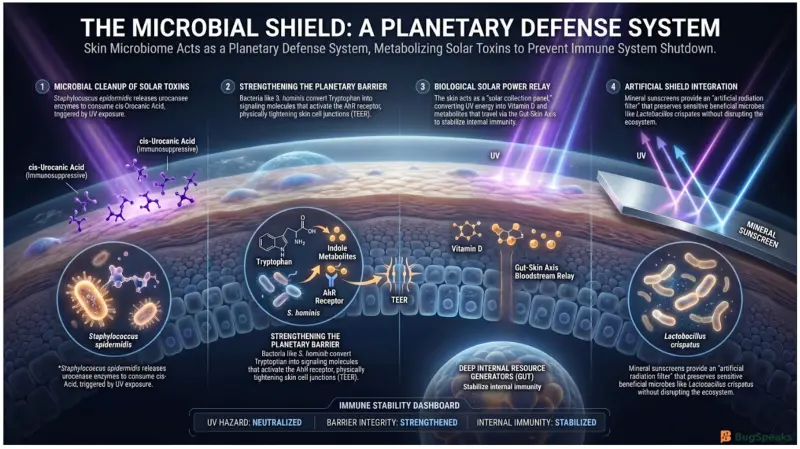
How do gut microbes regulate skin resilience and repair?
Gut microbes regulate skin resilience by converting dietary fiber into anti-inflammatory compounds that travel through the bloodstream and support skin repair. In this system, the gut microbiome functions as an internal resource network that supplies the skin with molecules needed for recovery, barrier maintenance, and immune balance [Singla et al. (2025)].
The most important of these molecules are Short-Chain Fatty Acids (SCFAs). When beneficial gut bacteria ferment plant fibers, they produce compounds such as butyrate and propionate. These metabolites enter circulation and eventually reach the skin, where they help regulate inflammation and strengthen cellular repair systems [Jimenez-Sanchez et al. (2025)].
Inside the skin, Short-Chain Fatty Acids (SCFAs) improve barrier function by supporting skin cell metabolism and encouraging healthy structural development. This reduces moisture loss and helps the skin recover more efficiently from environmental stress, including UV-related oxidative damage. A healthy gut microbiome therefore contributes directly to stronger skin resilience.
Problems emerge when the gut ecosystem becomes unbalanced, a condition called Dysbiosis. During dysbiosis, harmful bacteria can overpower beneficial species, weakening the intestinal barrier and allowing inflammatory bacterial byproducts to leak into the bloodstream. Once these molecules reach the skin, they increase irritation and immune dysfunction [Singla et al. (2025)].
Researchers have linked this process to inflammatory skin conditions such as Atopic Dermatitis (AD) and psoriasis. Without steady production of beneficial microbial metabolites, the skin barrier becomes less stable and more vulnerable to dryness, inflammation, and UV stress.
How do sunscreens interact with our protective microbial shield?
Sunscreens interact safely with the skin microbiome by reducing harmful UV exposure without disrupting the beneficial microbes that maintain skin stability. Modern sunscreen formulations function as external radiation filters that work alongside the skin’s natural microbial defenses rather than replacing them [Smith et al. (2025)].
Research shows that properly formulated Mineral Sunscreens do not significantly alter the diversity or survival of beneficial skin bacteria. Ingredients such as zinc oxide and titanium dioxide remain primarily on the skin surface, where they reflect or scatter UV radiation instead of interfering with microbial metabolism [Smith et al. (2025)].
Studies monitoring the skin microbiome after sunscreen application found that core bacterial populations remained stable over time. Protective microbes continued performing their normal functions even while UV exposure was reduced. This suggests that sunscreen can strengthen environmental protection without damaging the natural microbial ecosystem of the skin.
Some evidence also suggests that sunscreen may help preserve sensitive beneficial species during heavy UV exposure. For example, SPF protection can help maintain populations of Lactobacillus crispatus, a bacterium associated with healthy skin balance. At the same time, controlled UV filtering may reduce populations of inflammation-associated bacteria such as Cutibacterium acnes [Schuetz et al. (2024)].
This creates a balanced system where sunscreen and the microbiome work together. The sunscreen limits excessive UV damage, while beneficial microbes continue regulating immunity, barrier repair, and chemical stability across the skin surface.
Visualize the process- https://youtu.be/G0bKC6q7G-k
Reference
Patra, V., Trajanoski, S., Joshi, A., Lenief, V., Goyet, C., Cornu, A., Golob-Schwarzl, N., Somlapura, M., Mosnier, A., Zarfl, M., Eichmann, T., Köefeler, H., Norval, M., Nicolas, J. F., Wolf, P., & Vocanson, M. (2025). Urocanase-Positive Skin-Resident Bacteria Metabolize cis-Urocanic Acid and in Turn Reduce the Immunosuppressive Properties of UVR. The Journal of investigative dermatology, 145(11), 2839–2853.e6. https://doi.org/10.1016/j.jid.2025.03.035
Mercer, S. D., Elias, A., Taylor, G., Briggs, G. S., Bell, M., McBain, A. J., & O'Neill, C. A. (2026). Ultraviolet radiation reshapes the metabolome of skin commensal bacteria, influencing AhR signaling and barrier function. Applied and environmental microbiology, 92(4), e0238525. https://doi.org/10.1128/aem.02385-25
Schuetz, R., Claypool, J., Sfriso, R., & Vollhardt, J. H. (2024). Sunscreens can preserve human skin microbiome upon erythemal UV exposure. International journal of cosmetic science, 46(1), 71–84. https://doi.org/10.1111/ics.12910
Jimenez-Sanchez, M., Celiberto, L. S., Yang, H., Sham, H. P., & Vallance, B. A. (2025). The gut-skin axis: a bi-directional, microbiota-driven relationship with therapeutic potential. Gut microbes, 17(1), 2473524. https://doi.org/10.1080/19490976.2025.2473524
Smith, M. L., Rillaer, T. V., Willmott, T., Lebeer, S., Souza, A., O'Neill, C. A., & McBain, A. J. (2026). The human skin microbiome remains unchanged after 24 h of sunscreen application. Applied and environmental microbiology, 92(1), e0147625. https://doi.org/10.1128/aem.01476-25
Singla, N., Singla, K., Attauabi, M., & Aggarwal, D. (2025). Gut-skin axis: Emerging insights for gastroenterologists-a narrative review. World journal of gastrointestinal pathophysiology, 16(3), 108952. https://doi.org/10.4291/wjgp.v16.i3.108952