Exploring the Thyroid-Gut Connection: What You Need to Know
How does a healthy gut act as a smart information filter?
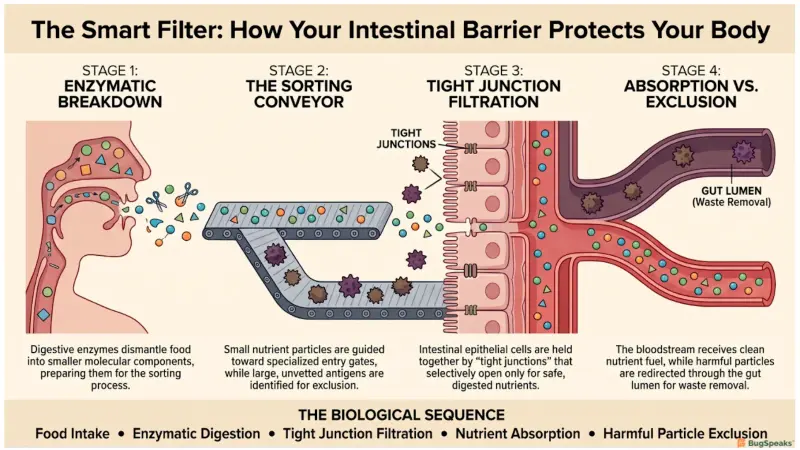
A healthy gut acts as a smart information filter by screening everything we eat and sending clear, safe signals to our immune system. Inside your gut, this biological information filter works like a secure post office, carefully checking every incoming letter. It decides which nutrients are safe to let into your blood and which foreign objects should be kept out. The bacteria in your gut, called the microbiome, help sort through this daily information and keep the system running (Cayres et al. (2021). By delivering organized messages to your body's defenders, this smart filter ensures that downstream organs, like your thyroid gland, can do their jobs without any unexpected interruptionsBargiel et al. (2021).
Your body relies on this clever sorting system because your environment is constantly sending mixed messages that need careful translation. The special lining of your intestines is made of tiny cells packed tightly together to form the perfect information filterBargiel et al. (2021). This barrier allows tiny digested food particles to pass through while blocking large, unapproved debris that might confuse it. Specialized defenders, known as the immune system, sit right behind this filter to read the molecular codes of everything that comes near. When the filter is working perfectly, the immune system stays calm, happy, and fully informed about the outside worldCayres et al. (2021).
This peaceful communication is essential because the thyroid gland uses these clean signals to control how fast your body burns energy. Think of your thyroid as a tiny metabolic engine that needs a quiet environment to keep your temperature and mood balanced. If the gut filter sends too many messages, the immune system gets distracted and starts making noise. These alarms travel through your blood and can easily disrupt the delicate work of your thyroid glandBargiel et al. (2021). That is why keeping the gut filter strong is the secret first step to having steady energy every single day.
What happens when our gut filter gets damaged and starts to leak?
When our gut filter gets damaged and starts to leak, unapproved debris slips directly into the blood and triggers chronic inflammation. In a healthy body, the microscopic cells of the filter are held together by snug, smart gates called tight junctionsBargiel et al. (2021). However, certain environmental inputs or eating bad foods can cause the body to release too much of a protein called zonulinCayres et al. (2021). This protein acts like a key that forces the tight junctions to stay wide open for too long. When these protective gates are open, the filter's mesh breaks down and allows raw, unrefined parts of food to cross over.
This state of a broken barrier is scientifically known as increased intestinal permeability, which means the protective mesh has become leakyCayres et al. (2021). Instead of carefully screening and sorting incoming letters, the damaged post office now has tears in its sorting conveyor belt. Undigested food, metabolic waste, and microscopic invaders, known as antigens, can now sneak through these gapsBargiel et al. (2021). These antigens are supposed to stay inside the gut to be safely processed or thrown away as waste. But once they leak past the broken filter, they enter the blood where they immediately encounter our body's highly sensitive immune security guards.
When these security guards meet the invading antigens, they experience a massive shock and instantly go on high alert. Since these foreign particles were never screened by the information filter, the body treats them as dangerous, hostile invaders. This constant state of red alert creates a slow burn of irritation throughout your entire body, known as chronic inflammation. This persistent inflammation is like a smoky fire that travels through the blood and damages healthy tissues along the wayHu et al. (2023). This toxic smoke spreads everywhere and can severely impact the quiet, delicate operations of your thyroid hormone factory in the neck.
How does a broken gut filter confuse our immune system?
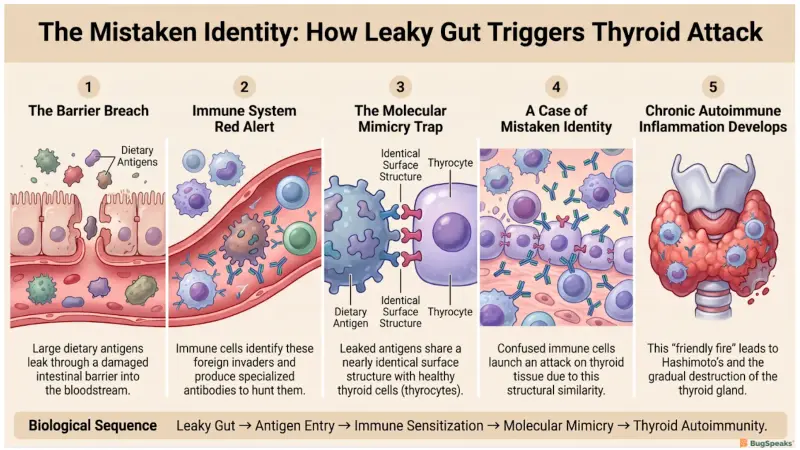
A broken gut filter confuses our immune system by letting foreign pieces look exactly like our own healthy body parts. When raw food parts and bacteria leak into the bloodstream, your body's defensive guards must quickly figure out who they are. Unfortunately, some of these leaked invaders have a chemical shape that looks almost identical to your own healthy cells. This confusing situation is called molecular mimicry Bargiel et al. (2021). Because the disguise is so good, your security guards accidentally memorize the wrong target and get highly confused about who is friendly.
This deep confusion triggers a serious autoimmune condition called Hashimoto's thyroiditis, where the body mistakenly attacks its own thyroid glandCayres et al. (2021). To fight the disguised invaders, the confused immune guards create special heat-seeking proteins called autoantibodies to hunt them down. These autoantibodies travel through the blood and begin searching for anything that matches the chemical pattern of the leaked antigensBargiel et al. (2021). Unfortunately, the healthy cells inside your thyroid, called thyrocytes, happen to share that same chemical pattern on their outer walls. As a direct result, these heat-seeking proteins lock onto the vulnerable thyrocytes and begin destroying your body's healthy thyroid tissue.
Over time, this friendly fire wears down the thyroid gland until it can no longer produce enough energy-boosting hormones. The ongoing assault by autoantibodies causes gradual damage to the thyrocytes, leading to chronic swelling and permanent scarringCayres et al. (2021). Instead of a highly efficient hormone factory, the thyroid becomes a slow and sluggish organ under constant siege. This explains why many people with a leaky gut suffer from fatigue that does not go away with normal sleep. Their confused immune guards are trapped in an endless loop of fighting a misdirected immune attack that started with a simple tear in the gut.
How do gut bacteria produce healthy messages to fix our filter?
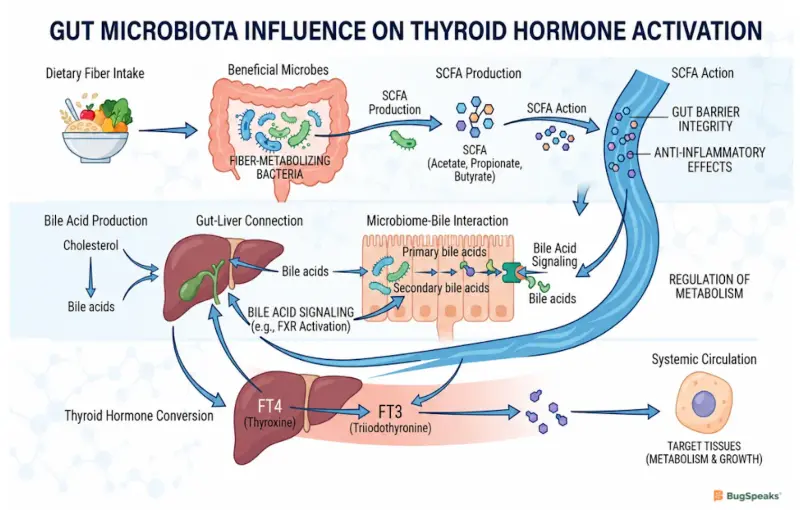
Gut bacteria produce healthy messages to fix our filter by digesting plant fibers into special healing chemicals. When you eat healthy vegetables, fruits, and seeds, friendly bacteria like Bifidobacterium feast on these indigestible plant fibersCayres et al. (2021). This active digestion process creates amazing chemical messengers known as short-chain fatty acids Bargiel et al. (2021). These tiny molecules work very quickly to glue the cells of your gut lining back together, repairing any microscopic leaks. By feeding helpful bacteria like Bifidobacterium with colorful fiber, you give your body the exact raw tools it needs to patch up the damaged information filter.
These short-chain fatty acids also work together with thyroid hormones to tell your gut cells to grow strong and healthyBargiel et al. (2021). At the same time, your liver releases specialized cholesterol-based fluids called bile acids to help you digest fats in your daily food. Your friendly gut microbiome converts these raw fluids into secondary bile acids, which act as powerful systemic endocrine messengersBargiel et al. (2021). These special secondary fluids travel to your body tissues and activate a very important helper enzyme called deiodinaseCayres et al. (2021). This crucial enzyme is the master switch that converts inactive thyroid hormones into the active form that your body's cells actually use.
When your gut microbiome is balanced and healthy, this team of chemical messengers runs smoothly and efficiently. The deiodinase enzyme has plenty of support to turn slow hormones into active energy, keeping your metabolic engine working perfectly Bargiel et al. (2021). But if you do not have enough Bifidobacterium to ferment plant fiber, the production of these healing messages drops dangerously lowCayres et al. (2021). Without enough short-chain fatty acids and secondary bile acids, the gut filter remains torn, and cellular hormone conversion slows down. This double blow leaves your body starved of energy, showing how the gut directly controls your daily physical vitality and strength.
How does high body inflammation cause thyroid fatigue?
High body inflammation causes thyroid fatigue by blocking our cells from converting thyroid hormones into their active, energy-giving form. Scientists can measure this internal smoky fire using a special blood test score called the Systemic Immune-Inflammation IndexHu et al. (2023). This score counts your platelets, neutrophils, and lymphocytes to see how balanced your immune defenses are in the body. When your gut filter is leaky and allows antigens to pass through, your immune cells stay irritated and release chemical cytokines. This constant defense activity raises your systemic inflammation index score, showing that your immune system is extremely overworked and highly stressed.
A high inflammation score has a massive negative impact on how your body handles its daily thyroid hormones. Normally, your thyroid gland produces a special storage hormone called free thyroxine that travels through your bloodstream. To give you steady metabolic energy, your body's cells must quickly convert this storage hormone into the active hormone called free triiodothyronine. But when your body's overall inflammation index score is high, this crucial hormone conversion process gets completely blockedHu et al. (2023). The thyroid keeps making plenty of thyroglobulin, which is the raw protein storage block, but your cells cannot successfully activate the final active energy hormones.
This conversion blockade is why you can feel completely exhausted even if your thyroid gland structure seems normal. Large-scale medical studies show that as the inflammation index score goes up, active free triiodothyronine levels drop dramaticallyHu et al. (2023). You have plenty of storage hormone, free thyroxine, but your cells cannot use it because of the smoky systemic inflammation. This is just like having a giant warehouse full of raw food but no stove to cook. By healing your gut filter and putting out the inflammatory fire, you can restore hormone balance and finally feel energized again.
Visualize the process- https://youtu.be/c_-Gbxg807o
Reference
Cayres LCF, de Salis LVV, Rodrigues GSP, Lengert AVH, Biondi APC, Sargentini LDB, Brisotti JL, Gomes E, de Oliveira GLV. Detection of Alterations in the Gut Microbiota and Intestinal Permeability in Patients With Hashimoto Thyroiditis. Front Immunol. 2021 Mar 5;12:579140. doi: 10.3389/fimmu.2021.579140. PMID: 33746942; PMCID: PMC7973118.
Bargiel P, Szczuko M, Stachowska L, Prowans P, Czapla N, Markowska M, Petriczko J, Kledzik J, Jędrzejczyk-Kledzik A, Palma J, Zabielska P, Maciejewska-Markiewicz D. Microbiome Metabolites and Thyroid Dysfunction. J Clin Med. 2021 Aug 16;10(16):3609. doi: 10.3390/jcm10163609. PMID: 34441905; PMCID: PMC8397005.
Hu XY, Liang YC, Zhang HH, Li HL, Liu DL. Association between the Systemic Immune-Inflammation Index and Thyroid Function in U.S. Adults. Mediators Inflamm. 2023 Nov 16;2023:5831858. doi: 10.1155/2023/5831858. PMID: 38022688; PMCID: PMC10667040.