Understanding the Impact of Synthetic Clothes on Your Skin and Gut Health
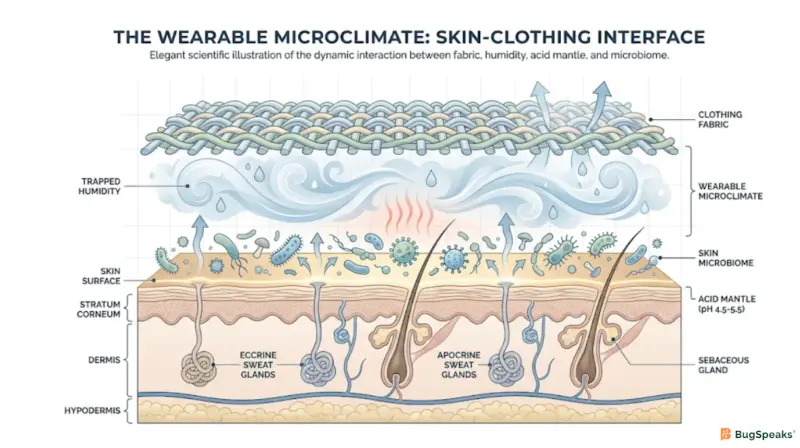
How does your clothing choice create a wearable microclimate for skin bacteria?
Your clothing choice creates a wearable microclimate on your body by acting as an environmental boundary that traps your natural heat and moisture. When you put on a shirt, you are not just wearing fabric; you are establishing a miniature climate system that your skin microbes experience every secondBroadhead et al. (2021). This wearable environment covers a massive surface area of about twenty-five square meters, including all your tiny sweat glands and hair folliclesSingla et al. (2025). Within this space, the skin surface produces moisture and salt, creating unique local conditions that decide exactly which types of microscopic organisms can live and thrive on your delicate body.
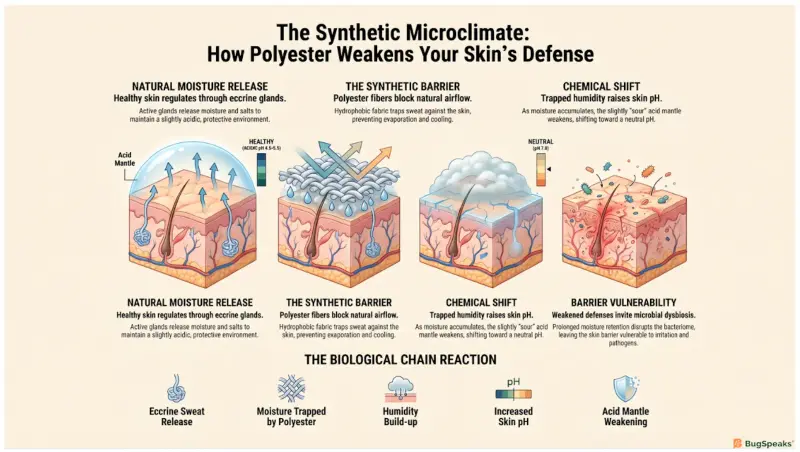
This delicate balance of microscopic life is protected by a thin, slightly acidic layer on your outer skin called the acid mantleBroadhead et al. (2021). The acid mantle usually has a healthy pH level of about five or even lower, which acts like an invisible shield against unwanted invaders. Under these conditions, your skin's friendly bacteria thrive and work hard to block harmful germs from moving in. However, when we wear fabrics that do not let the skin breathe, we trap excess moisture, which can raise the skin's pH toward a neutral level and weaken our body's natural defense shield.
Trapping too much moisture also changes the balance of your bacteriome, which is the massive community of bacteria living on your skinSingla et al. (2025). Along with bacteria, your skin is home to a fungal community called the mycobiome, which also reacts strongly to these rapid humidity shiftsOliveira and Tavaria (2023). When the microclimate gets too hot and wet, certain bacteria and fungi grow too fast and crowd out the helpful ones. This crowding causes dysbiosis; this can make your skin itchy, red, or irritated, showing how deeply your wardrobe choices affect your tiny bacterial residents.
Why do synthetic fabrics promote unpleasant odors compared to natural ones?
Natural fibers let air and water pass through easily, while synthetic fibers trap sweat and feed odor-causing bacteria. When you wear synthetic fibers like polyester, they act as a tight moisture regulator that keeps sweat trapped against your skinBroadhead et al. (2021). Natural fibers like cotton and wool, however, act as a breathable regulator, letting fresh air cool your body and sweeping away excess dampnessOliveira and Tavaria (2023). This difference is huge because sweaty, non-breathable environments selectively encourage the growth of specific bacteria that feed on human sweat. These wet conditions are perfect for growing bacteria that create strong, unpleasant body odors.
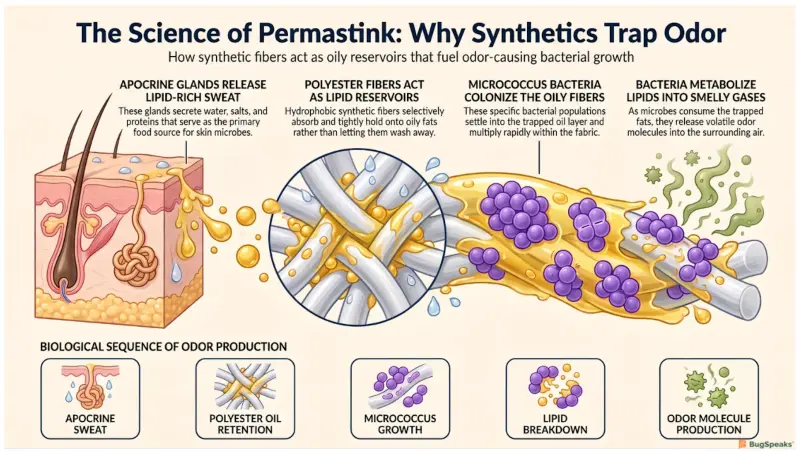
These sweaty microclimates act as nourishment zones for the resident populations of microbes that live on your skinOliveira and Tavaria (2023). When you sweat, your skin glands release water, salts, and proteinsBroadhead et al. (2021). While sweat itself is completely odorless, certain skin microbes break down these rich mixtures to grow. As they consume these compounds, they break them down into smelly gas molecules. In synthetic fabrics, hydrophobic polyester fibers selectively absorb these oily fats and hold onto them tightlyBroadhead et al. (2021). This selective absorption creates a concentrated buffet that fuels rapid microbial activity, generating much stronger and more noticeable body odors than natural fibers do.
Synthetic clothing can develop a permanent, stubborn odor problem known as permastinkBroadhead et al. (2021). Because polyester fibers love oily compounds, they suck up apocrine sweat fats and hold onto them like a magnet. When you wash your synthetic clothes at low temperatures with gentle detergents, these oily fats do not wash awayBroadhead et al. (2021). They stay stuck inside the fibers, building up after every wear. Microbes like Micrococcus species settle into this oily fiber layer and multiply quickly. When you put the garment on, your body warmth boosts the activity of these bacteria, prompting them to rapidly digest the leftover skin oils and produce a sudden, noticeable odor.
How do harsh synthetic dyes act as environmental modifiers on your skin?
Harsh synthetic dyes act as environmental modifiers, releasing toxic chemicals directly onto your skin as you sweat. Many modern clothes are treated with cheap, synthetic disperse dyes, which do not stick well to the fibersBroadhead et al. (2021). When you move and sweat, these unbound dye molecules migrate from the fabric into your warm skin moistureCortes (2026). These migrating chemicals act as environmental modifiers, altering the natural chemistry of your skin's habitatBroadhead et al. (2021). This toxic chemical runoff can cause a painful skin condition called contact dermatitis, which is an itchy, red rash triggered by direct contact with irritating materialsBroadhead et al. (2021).
At a microscopic level, these migrating dye chemicals cause severe cellular damage called cytotoxicityMachado et al. (2025). When cells experience cytotoxicity, they can no longer grow properly, leading to cell injury and death. Researchers testing these dyes on human skin cells discovered that common textile colors like Disperse Blue 124 are highly toxicCortes (2026). This toxic reaction damages your body's outer cells, making it much harder for your skin to heal from minor cuts and scrapes. These unseen cellular dangers is absolutely crucial for understanding how cheap fast-fashion synthetic dyes can harm your long-term skin health.
These harsh chemical colorants specifically target the keratinocytes, which are the main barrier cells making up eighty percent of your outer skinOliveira and Tavaria (2023). Keratinocytes are responsible for building a strong skin barrier that keeps moisture in and harmful germs out. When exposed to disperse dyes, these cells get highly stressed and release warning signals called cytokinesCortes (2026). These chemical alarms trigger a wave of local inflammation, causing your skin to become red, swollen, and irritated. This chronic irritation weakens your outer protective barrier, leaving your body much more vulnerable to microscopic invaders and persistent skin issues.
Can the chemical modifiers on your clothes reach and disrupt your gut microbiome?
Migrating chemical modifiers can travel through your skin barrier, enter your bloodstream, and ultimately disrupt your gut microbiome. This systemic connection is made possible by the gut-skin axis, which is a highly active, two-way communication highway between your digestive tract and your skinSingla et al. (2025). Because of this connection, what happens inside your stomach can directly shape how healthy and comfortable your skin feels on the outside. When you wear synthetic clothes treated with toxic finishes, your skin absorbs these small chemical molecules over timeMachado et al. (2025). Once absorbed, these compounds enter your blood vessels, allowing them to travel throughout your body and directly contact your delicate gut microbes.
Once inside your body, these absorbed chemicals can damage your gut lining, leading to a condition called intestinal permeability, or leaky gutSingla et al. (2025). Intestinal permeability means that the tight seals between your gut cells get weak and form tiny gaps. Normally, these seals act like strict border guards, letting nutrients pass into your blood while keeping harmful toxins out. However, toxic textile chemicals can weaken this barrier, letting undigested food and chemicals leak out of your digestive system. This leakage triggers your immune system to launch an inflammatory response, which can cause chronic inflammation throughout your entire body.
This constant state of systemic inflammation can trigger chronic skin conditions like atopic dermatitis, showing how deeply your gut and skin are linkedSingla et al. (2025). Atopic dermatitis is an itchy, inflammatory skin condition that is closely tied to an overactive immune system. When your gut lining leaks, your body gets flooded with inflammatory signals that weaken both your gut and skin barriers. This systemic loop means that treating your skin problems often requires looking after your digestive health too. By choosing clothing that is free of toxic chemicals, you protect both your skin microbes and your internal digestive ecosystem.
How can we optimize our wearable environment for a balanced microbiome?
You can optimize your wearable environment by choosing natural fibers and clothes with bioactive finishes that naturally support skin microbes. One of the best ways to improve your skin microclimate is by using fabrics treated with chitosan, a natural sugar extracted from recycled crab shellsBroadhead et al. (2021). Chitosan has natural, gentle antibacterial properties that prevent smelly bacteria from growing without harming your friendly skin microbesOliveira and Tavaria (2023). Unlike harsh synthetic biocides, this natural polymer works selectively, keeping your skin's microscopic community balanced. Using these smart, eco-friendly materials helps you maintain a clean and odor-free microclimate while actively protecting your body's outer ecosystem.
These smart, bioactive fabrics help control the growth of harmful pathogens, which are dangerous germs that can cause skin infectionsOliveira and Tavaria (2023). On healthy skin, friendly resident bacteria act like a protective shield, competing with pathogens for space and nutrientsBroadhead et al. (2021). However, synthetic fabrics and harsh dyes can kill your friendly microbes, leaving open territory for dangerous pathogens to colonize. Bioactive textiles, like those functionalized with zinc oxide or chitosan, specifically target and suppress these invadersOliveira and Tavaria (2023). This targeted defense keeps your skin microclimate safe and healthy, showing how modern clothing science can actively protect your body's microbial boundaries.
By choosing organic cotton, linen, or bamboo, you establish a stable, breathable microclimate that keeps your skin dry and comfortableBroadhead et al. (2021). These natural fibers act as breathable regulators, allowing heat and humidity to escape easily rather than trapping them against your body. This dry environment naturally limits the growth of odor-causing microbes while keeping your skin pH slightly acidic and healthy. Additionally, avoiding clothes with harsh dyes protects your skin cells from cytotoxicity and limits systemic inflammation. Taking care of your wearable microclimate is a simple, powerful way to support your microbiome and enjoy healthier, happier skin every day.
Visualize the process- https://youtu.be/2Awq4euvuPM
Reference
de Oliveira, C. S. F., & Tavaria, F. K. (2023). The impact of bioactive textiles on human skin microbiota. European Journal of Pharmaceutics and Biopharmaceutics, 188, 66-77.
Broadhead R, Craeye L, Callewaert C. The Future of Functional Clothing for an Improved Skin and Textile Microbiome Relationship. Microorganisms. 2021 May 31;9(6):1192. doi: 10.3390/microorganisms9061192. PMID: 34073029; PMCID: PMC8226598.
Cortes LM. Immune and epithelial responses to textile dyes: the role of chemical structure in toxicity. Front Allergy. 2026 Jan 9;6:1636419. doi: 10.3389/falgy.2025.1636419. PMID: 41584311; PMCID: PMC12827529.
Singla N, Singla K, Attauabi M, Aggarwal D. Gut-skin axis: Emerging insights for gastroenterologists-a narrative review. World J Gastrointest Pathophysiol. 2025 Sep 22;16(3):108952. doi: 10.4291/wjgp.v16.i3.108952. PMID: 41024986; PMCID: PMC12476645.
Suellen Ferro de Oliveira C, Kekhasharú Tavaria F. The impact of bioactive textiles on human skin microbiota. Eur J Pharm Biopharm. 2023 Jul;188:66-77. doi: 10.1016/j.ejpb.2023.05.004. Epub 2023 May 12. PMID: 37182552.
Machado, V., Marinho, A., Vieira de Castro, P., & Silva, T. (2025). From Fabric to Finish: The Cytotoxic Impact of Textile Chemicals on Humans Health. Textiles, 5(2), 16. https://doi.org/10.3390/textiles5020016